Senior Engineering Interview Handbook / Chapter 120
Complete Project-Deep-Dive Mock
A complete project-deep-dive mock transcript, interviewer branch guide, and evidence-repair method for turning prepared material into a defensible conversation.
Preparing audio…
Audio edition
Complete Project-Deep-Dive Mock
Page tools
The first clean answer is not the test
A prepared project story often sounds strongest in its first two minutes. The problem is well framed, the architecture is legible, and the result arrives on time. Then the interviewer asks who designed the data model. Or why the team did not choose the cheaper migration. Or which result was measured rather than inferred. The story begins to separate into facts the candidate knows, claims the candidate borrowed from the team, and transitions the candidate memorized.
That separation is what a complete mock should expose.
The preceding chapters gave you the raw material: a project dossier, an architecture narrative, a decision log, an ownership map, evidence, a failure, a follow-up tree, and safe substitutes for private detail. The mock does not reward you for reciting all of it. It lets another person enter at any point and inspect whether the pieces agree.
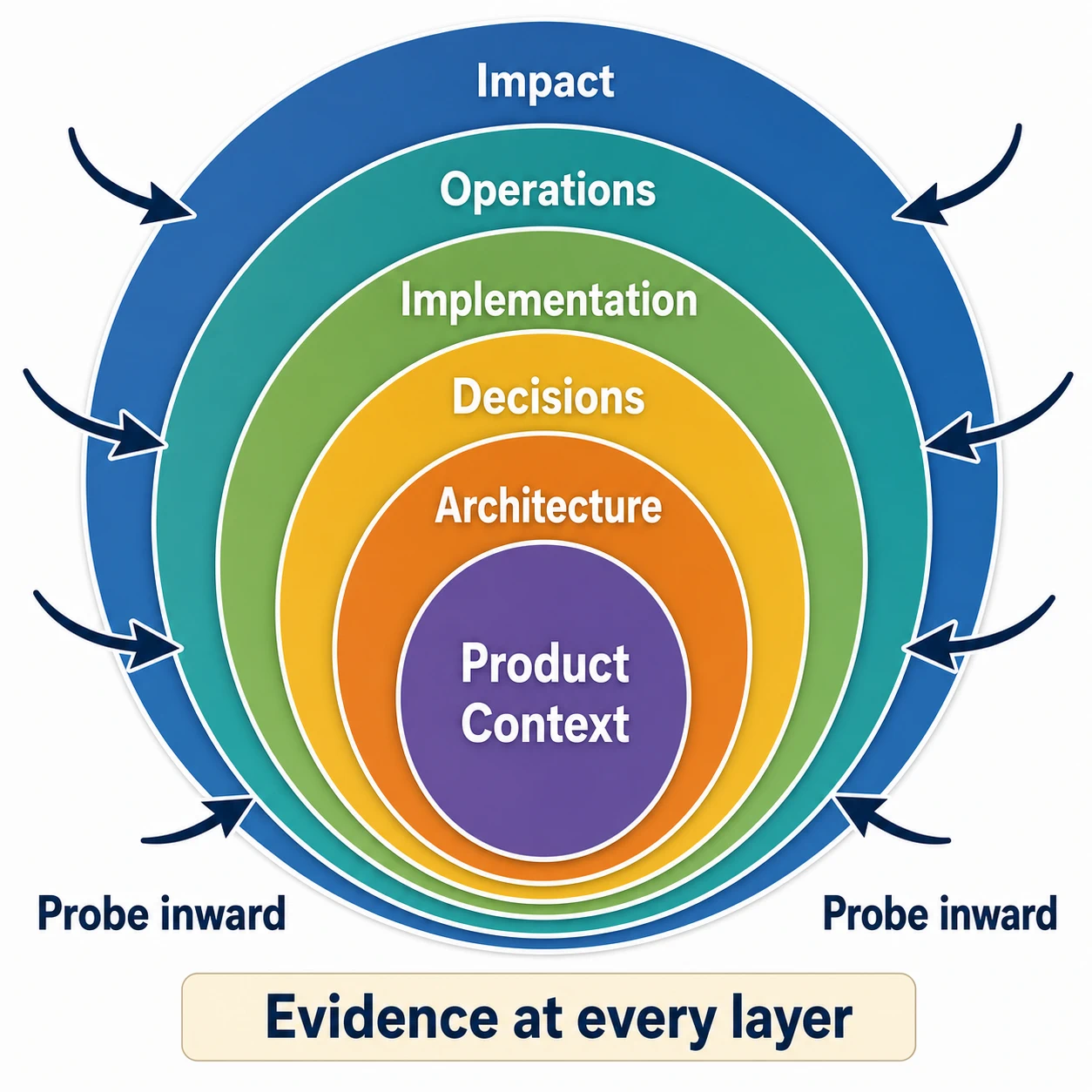
Run the mock before you study the example
Allow thirty-five minutes. One person interviews; one answers. Record the run if both people are comfortable doing so, but do not pause to take elaborate notes. The interviewer needs only the prompt and the branch guide later in this chapter.
The candidate may bring a single page containing the project spine, several real decisions and rejected alternatives, the available evidence and its limits, one consequential miss, and the details that must remain private. Do not bring a script. A script trains you to rescue a sequence of sentences; the mock is meant to discover whether you can rescue the reasoning.
Begin here:
Walk me through a project in which you had meaningful senior-engineering
ownership. Give me the problem, your role, the architecture, the important
decisions, the outcome, and what you would change. I will interrupt and follow
the parts I want to inspect.
The interviewer should make the first interruption within three minutes. Ask for a boundary, an alternative, a piece of evidence, or an ownership detail—not another invitation to continue the prepared overview. If the candidate gives a vague answer, stay on it for one more question. A polite tour of every topic can miss the exact place where the account fails.
A complete mock: the reconciliation migration
The following project is modeled and sanitized. It is useful because the architecture, audit requirements, rollout, and team boundaries constrain one another. Read it for the movement of the questioning, not for sentences to reuse.
Interviewer: Tell me about the project.

Candidate: I led a reconciliation migration for a regulated financial
workflow. Partner events became auditable checkpoints, but retries, late
adjustments, and partner-specific behavior were producing exceptions that
often needed engineering investigation. We moved idempotency to the ingestion
boundary and rolled the change out by partner group. The migration made the
review path safer and reduced routine escalations to engineering.

Interviewer: Stop there. You said you led it. What exactly was yours?

Candidate: That was too broad. I proposed the event-boundary design, wrote the
idempotency contract, led its design review, and defined rollout gates with
finance operations. Two teammates owned most ledger-persistence and adapter
implementation. I reviewed those areas where they touched the contract or
rollout safety, but I did not build them end to end.
The interruption has already improved the account. “Led” concealed several kinds of contribution; the repair names direct ownership, collaboration, and a limit. A mock interviewer should notice broad verbs early, because later answers often inherit the same inflated boundary.
Interviewer: Why put idempotency at ingestion? Cleaning up duplicates later
sounds cheaper.

Candidate: It was cheaper initially, and it reused review logic we already
had. The cost was that ordinary partner retries would still enter downstream
exception queues before cleanup, so finance and engineering would remain the
control for something the system could identify earlier. Boundary idempotency
required more migration work and a more careful identity model. We accepted
that cost because it removed duplicate work before it acquired audit meaning,
then used shadow comparison and a reversible partner-group ramp to manage the
migration risk.

Interviewer: You are making the rejected option sound obviously wrong. Why
did reasonable people prefer it?

Candidate: Because the existing path was understood in production. It kept
the new adapter work narrow and avoided a backfill change. My first proposal
understated those advantages. The decision turned on recurring operator load
and audit clarity, not on cleanup being careless engineering.
The second question matters. Naming an alternative is easy; granting it its real advantages is harder. A candidate who owned the decision should remember why the room did not agree immediately and what finally outweighed the safer or cheaper path.
Interviewer: Show me the data model.

Candidate: I should not share the internal schema, but I can describe the
invariant. Partner-event identity and audit-checkpoint identity had to be
separate. A retry mapped to the same event identity. A legitimate late
adjustment created a new checkpoint related to the earlier one. If we used one
identity for both, deduplication could erase a change that finance needed to
explain.

Interviewer: Where was that invariant enforced?

Candidate: The boundary assigned or resolved event identity before downstream
processing. The audit path then created checkpoints according to event
meaning. Adapter tests covered known partner behavior; replay and shadow
comparison checked that the old and new paths classified historical cases the
same way where they were supposed to.
The candidate declines an artifact but leaves the interviewer with a sharper technical surface: two identities, their lifecycle, an enforcement boundary, and several kinds of validation. Confidentiality has not ended the discussion.
Interviewer: What failed first?

Candidate: A partner group sent late adjustments near a financial deadline
more often than our sample suggested. The code followed our contract, but the
operating model surfaced the adjustment label too late for finance review. I
led the exception-model review, so treating that case as rare and deferrable
was my miss. We paused the next ramp, made adjustment handling explicit,
changed the operator labels, and added finance validation to readiness.

Interviewer: Is that a software failure or a process failure?

Candidate: Both descriptions are incomplete. The system preserved the event,
so it was not data loss. But a technically retained event was not enough if the
operator could not classify it in time. We had designed the data behavior and
the operating behavior as though they could be validated separately. After
that group, the rollout gate required both.
A polished lesson would be weaker here. The follow-up forces the candidate to say precisely what remained correct, what failed in practice, and how the definition of readiness changed.
Interviewer: Which teammate would disagree with your account?

Candidate: The engineer who owned ledger persistence would say I still make
the boundary decision sound cheaper than it was. They had to absorb backfill
and storage changes that my first plan treated as implementation detail. The
boundary remained the right choice, but the estimate was not fair to their
part of it. In later reviews I asked each affected owner to price the cost of
my preferred option, not only criticize the alternatives.

Interviewer: Did that disagreement change the design?

Candidate: It changed the migration more than the steady-state boundary. We
reduced the first partner group, separated one backfill step, and made rollback
possible before the old review path was removed. So I would not claim the
original proposal simply won. The implemented plan carried their objection.
This branch tests more than modesty. Real collaboration leaves marks on the artifact. If disagreement never changed scope, sequencing, safeguards, or the candidate’s own rule, the answer may be giving ceremonial credit rather than describing influence.
Interviewer: You said the migration reduced escalations. By how much?

Candidate: I cannot share the private volume. More importantly, “reduced
escalations” was broader than our evidence. What we measured was that common
reconciliation questions for the migrated groups no longer required
engineering log pulls, and ordinary retry cases stopped entering the same
exception categories. I cannot attribute a change in the whole finance close
to this project because other process changes happened at the same time.

Interviewer: Then what outcome can you defend?

Candidate: The system absorbed more routine classification work and gave
operators a clearer reason for the exceptions that remained. That is narrower
than my opening claim, but it is the claim the evidence supports.
The opening has now been corrected twice: “led” became a contribution boundary, and “reduced escalations” became an observable operational result. That is not a failed mock. Discovering an attractive claim that cannot survive its own evidence is one of the best outcomes practice can produce.
Interviewer: Give me the customer name and the exact daily volume. I need to
know whether the scale was meaningful.

Candidate: I should not share either. The useful scale fact is that dependable
manual review could not remain the control, while partner behavior varied
enough that one cutover would have been irresponsible. Those conditions drove
the automated boundary and the partner-group rollout.

Interviewer: What would you cut if you had half the time?

Candidate: I would keep the identity contract, shadow comparison, finance
readiness check, and reversible ramp. I would defer dashboard polish and some
long-tail adapter cleanup. Correctness, operational interpretation, evidence,
and rollback were the controls; convenience was not the first release gate.

Interviewer: And at ten times the load?

Candidate: I would re-evaluate identity generation, replay throughput,
monitoring cardinality, and ownership of the exception queue. I think the
boundary still holds, but at that load the recovery path and operator system
become architecture rather than rollout detail.
The last questions remove the historical sequence. The candidate must decide which constraints survive a changed world, which controls are essential, and which conclusions need new evidence.
Give the interviewer branches, not a questionnaire
The interviewer should listen for a claim and probe inward from it. These branches are enough for a full run:
- From the opening, ask why this project required senior judgment rather than competent execution. Then ask what part of the answer belongs to someone else.
- From an architecture choice, ask for the invariant, the most credible alternative, its advantage, the chosen path’s cost, and what evidence would have reversed the decision.
- From a production claim, ask what failed first, how the team detected it, what rollback or containment existed, and how production evidence changed the design or operating model.
- From an impact claim, ask what was measured, what was merely observed, what else changed at the same time, and what the candidate cannot fairly claim.
- From a collaboration claim, ask who disagreed, what they were right about, and where their objection appears in the implemented plan.
- From a sensitive detail, request the exact name, number, schema, or security mechanism. A good answer sets the boundary once and preserves the technical shape.
- At the end, change one constraint: halve the time, multiply the load, remove a team, tighten the reliability target, or forbid the original technology. Ask what remains and what must be reconsidered.
Do not use every branch. Follow the two places where the account becomes most fragile. Aggression here means sustained skepticism about the evidence, not rudeness, interruption for its own sake, or an attempt to trick the candidate with trivia.
The debrief must change the evidence
Immediately after the run, find three moments: the first answer that drifted, the claim that became narrower under questioning, and the probe that the candidate could not answer without improvising. For each, write four lines:
Claim I made:
Probe that exposed it:
Evidence or boundary I was missing:
Artifact I will repair:
In the reconciliation mock, one repair would read:
Claim I made: The migration reduced routine escalations.
Probe that exposed it: Which escalations, and by how much?
Evidence or boundary I was missing: We measured log-pull avoidance and
exception categories for migrated groups, not every escalation or the whole
finance close.
Artifact I will repair: Narrow the project-spine outcome and add the attribution
caveat to the evidence sheet.
Repair the source artifact, not just the spoken answer. An attribution failure belongs in the ownership map. A weak alternative belongs in the decision log. An unsupported result belongs in the evidence sheet. A disclosure freeze belongs in the sanitization layer. If the same branch fails twice, stop running complete mocks until the underlying material changes.
Three serious runs are usually more revealing than many smooth repetitions. Use the first to discover where the account breaks, the second to concentrate on the two weakest branches, and the third to restore natural interruption and constraint changes. The goal is not identical wording. It is stable reasoning with increasingly precise claims.
Leave this part with a project that can be entered anywhere
The project is ready for a real deep dive when an interviewer can interrupt the opening, move from product consequence to data invariant, from architecture to operator behavior, or from impact to attribution, and still find one coherent account. You can name what you owned without erasing the team, make the rejected path sound reasonable, let a miss remain a miss, narrow a claim without defensiveness, and protect private facts without retreating into vagueness.
That is also the bridge to behavioral and leadership interviews. The next part widens the evidence base beyond one project, but it keeps the same discipline: stakes, decisions, contribution, proof, limits, and changed behavior must agree when the prepared sequence disappears.