Senior Engineering Interview Handbook / Chapter 3
Choose Your Preparation Path
A route-selection chapter that turns the baseline diagnostic into a practical preparation path with a core spine, role-specific branches, and readiness gates.
Preparing audio…
Audio edition
Choose Your Preparation Path
Page tools
What this process controls
The baseline diagnostic tells you where the risk is. It does not tell you how much time you have, which companies are already moving, what your life can realistically support this month, or which target roles deserve extra depth. Chapter 3 turns the diagnostic into a route.
The common mistake is to choose a plan from anxiety. Algorithms feel scary, so the candidate grinds algorithms. System design feels broad, so the candidate watches design videos. Behavioral rounds feel familiar, so the candidate ignores them. None of that is planning. It is mood management.
A senior preparation path should look like engineering planning: constraints, scope, sequence, trade-offs, and gates. The right path is not the longest path. It is the path that closes the highest hiring risks before the interview loop samples them.
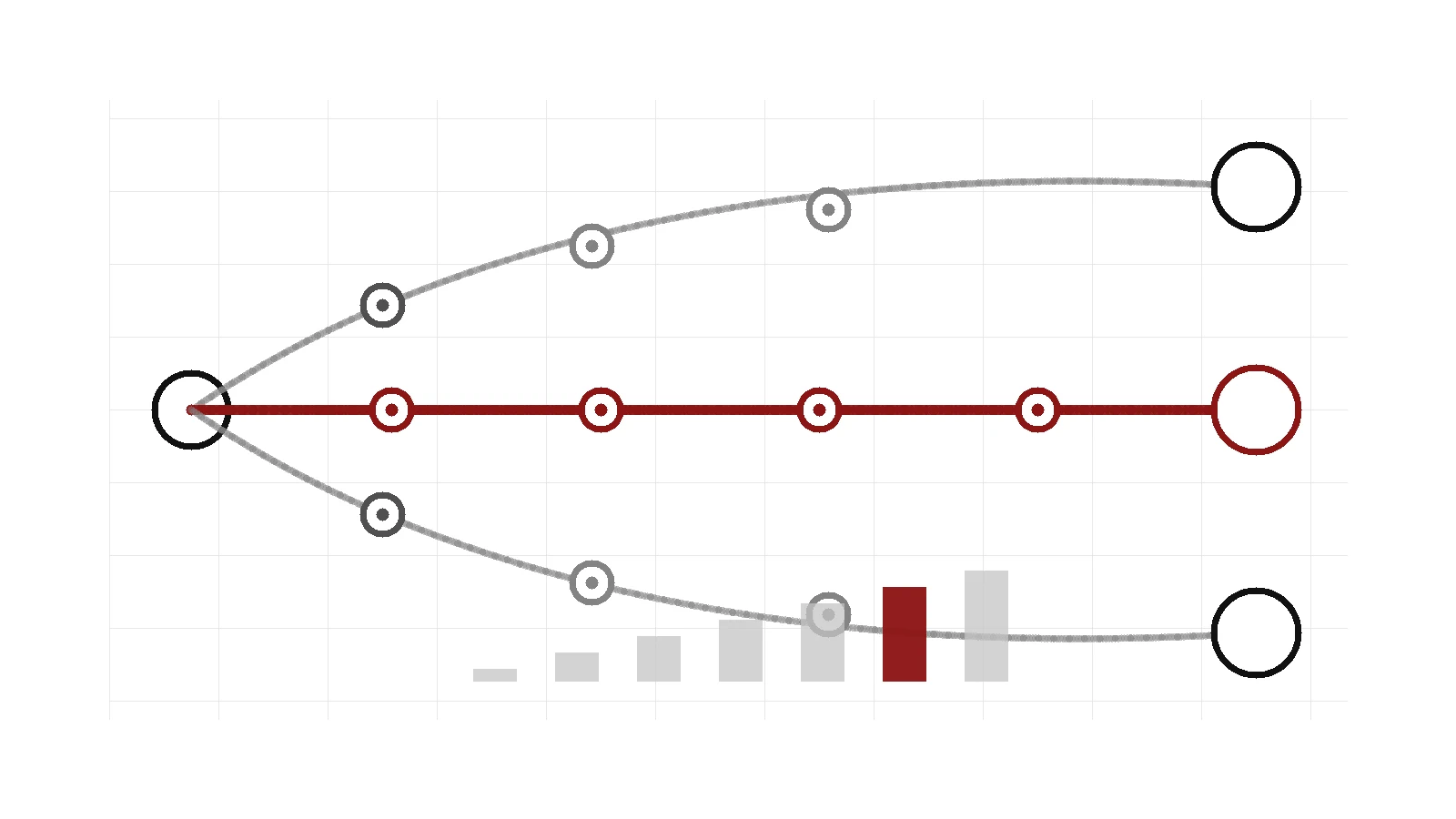
Inputs, outputs, and constraints
A useful route begins with five inputs:
- your interview timeline;
- your weekly practice capacity;
- your baseline diagnostic;
- your target role and likely loop;
- your current opportunity cost for delaying, narrowing, or taking interviews.
The output should be a plan you can actually run. It should say what you will practice, what you will postpone, when you will mock, and what evidence will let you proceed.
The constraint is not only time. Energy matters. Family responsibilities matter. Current work matters. A plan that assumes heroic late-night effort for six weeks is usually fake. Senior interviews evaluate judgment and communication; exhaustion damages both.
Good route selection should leave you with a small number of protected workstreams, not a giant study queue.
Workflow and cadence
Use four words: route, spine, branch, gate.
| Element | Meaning |
|---|---|
| Route | The time horizon you actually have: 14 days, 30 days, 8 weeks, or 12+ weeks. |
| Spine | The shared senior signals almost every candidate must show: coding workflow, design trade-offs, production judgment, project depth, behavioral leadership, communication. |
| Branch | Role-specific depth: frontend performance, SRE incidents, data pipelines, ML systems, security, platform reliability, mobile release constraints. |
| Gate | Observable evidence that says whether to schedule, delay, narrow, or keep practicing. |
The sequence is simple:
- Pick the route from the calendar.
- Protect the spine from your baseline diagnostic.
- Add branches only where target roles require them.
- Schedule mocks early enough that they can change the plan.
- Re-score the weakest lanes.
- Decide whether to proceed, delay, or narrow the target list.
The cadence should tighten as interviews approach. Early practice can be exploratory. Late practice must become timed, scored, and specific.
The four routes
The 14-day emergency route is for an interview loop that is already moving. It is not a complete education. It is risk reduction. You protect coding execution, one design skeleton, two project stories, behavioral leadership basics, and day-of execution. You add a specialty branch only if the job description clearly demands it. The goal is to avoid preventable failure, not to become broadly ready for every senior role.
The 30-day focused route is for candidates who have some recent fluency and a month before serious screens. It restores execution and closes yellow lanes. You can run weekly mocks, repair one or two weak signals, and add one primary branch. This route works well when the diagnostic has no catastrophic red lane but shows uneven interview performance.
The 8-week standard route is the best default for a deliberate campaign. It gives enough time to build balanced readiness across coding, design, production judgment, project depth, behavioral leadership, and communication. You can run repeated mocks, re-score, and correct behavior instead of merely consuming content.
The 12-week deep route is for larger changes: returning after a long interviewing gap, changing domains, targeting a much higher bar, or rebuilding weak foundations. It allows specialty depth and full-loop simulations. It should not become an excuse to avoid real calibration. Even a deep route needs early mocks.
Each route cuts something. The emergency route cuts breadth. The focused route cuts low-probability branches. The standard route cuts perfection. The deep route cuts impatience.
Decision points and trade-offs
A route should change at least four decisions.
First, what will you protect? These are the workstreams that stay on the calendar even when the week gets busy. For most senior candidates, protected work includes coding maintenance, design practice, project-story rehearsal, and mock review.
Second, what will you cut? If everything is mandatory, nothing is planned. A backend platform candidate may cut deep frontend state-management prep. A frontend product candidate may cut distributed consensus unless the role clearly requires it. A candidate with only two weeks may cut most specialty reading and protect mocks instead.
Third, when will you mock? Mock interviews are not graduation ceremonies. They are measurement tools. If the first mock happens at the end, it cannot improve the route. Put at least one mock early enough to expose the wrong plan.
Fourth, what gate will control real interviews? A gate should be observable:
- coding prompts completed with planned tests and complexity explanation;
- system designs that include failure, observability, data ownership, and trade-offs without heavy prompting;
- project stories that fit the clock and survive probes;
- behavioral answers that show agency without blame;
- communication that lets an interviewer score the work without dragging it out of you.
Do not treat finishing a reading list as readiness. The interview does not score the reading list.
Worked scenario: Mateo chooses the focused route
Mateo is targeting senior full-stack roles at product companies. He has 30 days before likely technical screens and can practice about eight hours per week.
His baseline says coding implementation is serviceable, project depth is plausible, and behavioral examples are available. The risks are algorithmic reasoning, system design, production judgment, and communication. In the design sample, he drew a reasonable architecture but did not surface failure modes or observability until prompted. In the replay, he noticed long monologues with few summaries.
A poor plan would be easy to justify: solve 100 algorithm problems, watch several design videos, and hope the rest works out. That plan would feel productive, but it would not address the senior-level risk. Mateo is not mainly failing because he lacks topics. He is failing because his interview sample hides production judgment and makes the interviewer work too hard to follow him.
So he chooses the 30-day focused route.
In week one, he restores the operating loop: timed coding with tests, one design outline, and one recorded project story. In week two, he runs production-aware design drills and reviews transcripts for rambling. In week three, he patches algorithm weak spots and rehearses leadership stories. In week four, he runs mocks and re-scores.
His cut list is explicit. He will not study deep distributed consensus unless a target company clearly requires it. He will not spend evenings passively watching design talks. He will not postpone mocks until he feels ready.
His gate is also explicit:
- coding stays at 3 or better in two timed prompts;
- one system-design mock reaches 3 without prompting for failure and observability;
- communication improves to concise summaries every few minutes;
- project stories fit the clock and leave room for probes.
If he misses the design and communication gates, he can keep recruiter conversations moving, but he should avoid stacking multiple full loops in the same week. That is not fear. It is sequencing.
Failure modes
Route selection fails when the plan becomes a disguise for avoidance.
Watch for these patterns:
- choosing the longest route because it postpones judgment;
- choosing the emergency route because of impatience rather than an actual interview date;
- building the plan around videos and reading instead of artifacts and mocks;
- treating all senior roles as if they test the same skills;
- spending all preparation time on coding because it has the clearest scoreboard;
- skipping behavioral preparation because real stories exist somewhere in memory;
- adding too many specialty branches and starving the core spine;
- scheduling mocks so late that they can only confirm weakness;
- declaring readiness because the plan was completed rather than because evidence improved.
The route is not a promise that every topic will be covered. It is a controlled bet on the signals most likely to decide the loop.
Practice: choose the route
Use the baseline from Chapter 2 and write a one-page route brief.
- Name the target role and likely loop.
- Name the calendar constraint and weekly practice capacity.
- Choose the route: 14 days, 30 days, 8 weeks, or 12+ weeks.
- List the protected spine workstreams.
- Add at most two role-specific branches.
- Write the cut list.
- Schedule the first mock before the halfway point.
- Define the readiness gate in observable terms.
The most important line is the cut list. It forces the plan to become real.
Readiness gate and checklist
Before you schedule or stack full loops, check the route against these questions:
| Question | Good answer |
|---|---|
| Does the route match the real calendar? | The plan fits actual hours and energy, not imagined discipline. |
| Does it target the diagnostic risk? | Red and yellow lanes receive protected practice time. |
| Does it protect the senior spine? | Coding, design, production judgment, project depth, behavioral leadership, and communication are represented where relevant. |
| Are branches role-driven? | Specialty work follows target roles, not curiosity. |
| Are mocks early enough? | At least one mock can still change the plan. |
| Are gates observable? | Readiness depends on artifacts, scores, and repeated behavior, not confidence. |
If the answers are weak, narrow the plan. A smaller executable route beats a comprehensive route that lives only on paper.
Field reference
Field reference
Route selection
- Pick the route from the constraint: 14 days, 30 days, 8 weeks, or 12+ weeks.
- Protect the spine: coding workflow, design trade-offs, production judgment, project depth, behavioral leadership, communication.
- Add branches only when target roles require them.
- Cut low-probability work explicitly.
- Schedule mocks early enough to change the plan.
- Use gates based on visible evidence, not confidence.
- Re-score weak lanes weekly.
- The right path closes hiring risk; it does not maximize content consumed.
Where the book goes next
You now have the opening operating system:
- Chapter 1 explains why interviews sample evidence.
- Chapter 2 shows how to diagnose which evidence is visible.
- Chapter 3 turns that diagnosis into a preparation route.
The next part of the book explains the senior bar itself. Before you can prepare well, you need to understand what companies mean when they say “senior,” how that differs from mid-level, staff, tech lead, and manager expectations, and how interviewers turn behavior into level judgments.