Senior Engineering Interview Handbook / Chapter 9
Why Experienced Engineers Fail
A senior-interview failure taxonomy for experienced engineers, with concrete corrections for clarifying before solving, exposing judgment, right-sizing scope, proving ownership, validating decisions, and recovering after hints.
Preparing audio…
Audio edition
Why Experienced Engineers Fail
Page tools
Why failure diagnosis changes preparation
Experienced engineers do not usually fail senior interviews because they have never solved hard problems. They fail when real capability does not translate into visible evidence under interview constraints.
That distinction matters. In real work, you have history, trust, documents, code review, production context, team memory, and time to revise. In an interview, you have a prompt, a clock, a stranger, and a scoring process. The interview cannot see the engineer you are in the abstract. It can only see what you make observable.
The senior failure pattern is therefore not “experienced people are bad at interviews.” It is more precise:
The candidate has senior raw material, but the round receives weak senior signal.
That can happen in coding, system design, project depth, behavioral conversations, or hiring-manager calibration. It can happen to people who are excellent at their jobs. It can also be fixed, because most of these failures are not knowledge gaps. They are evidence-production gaps.
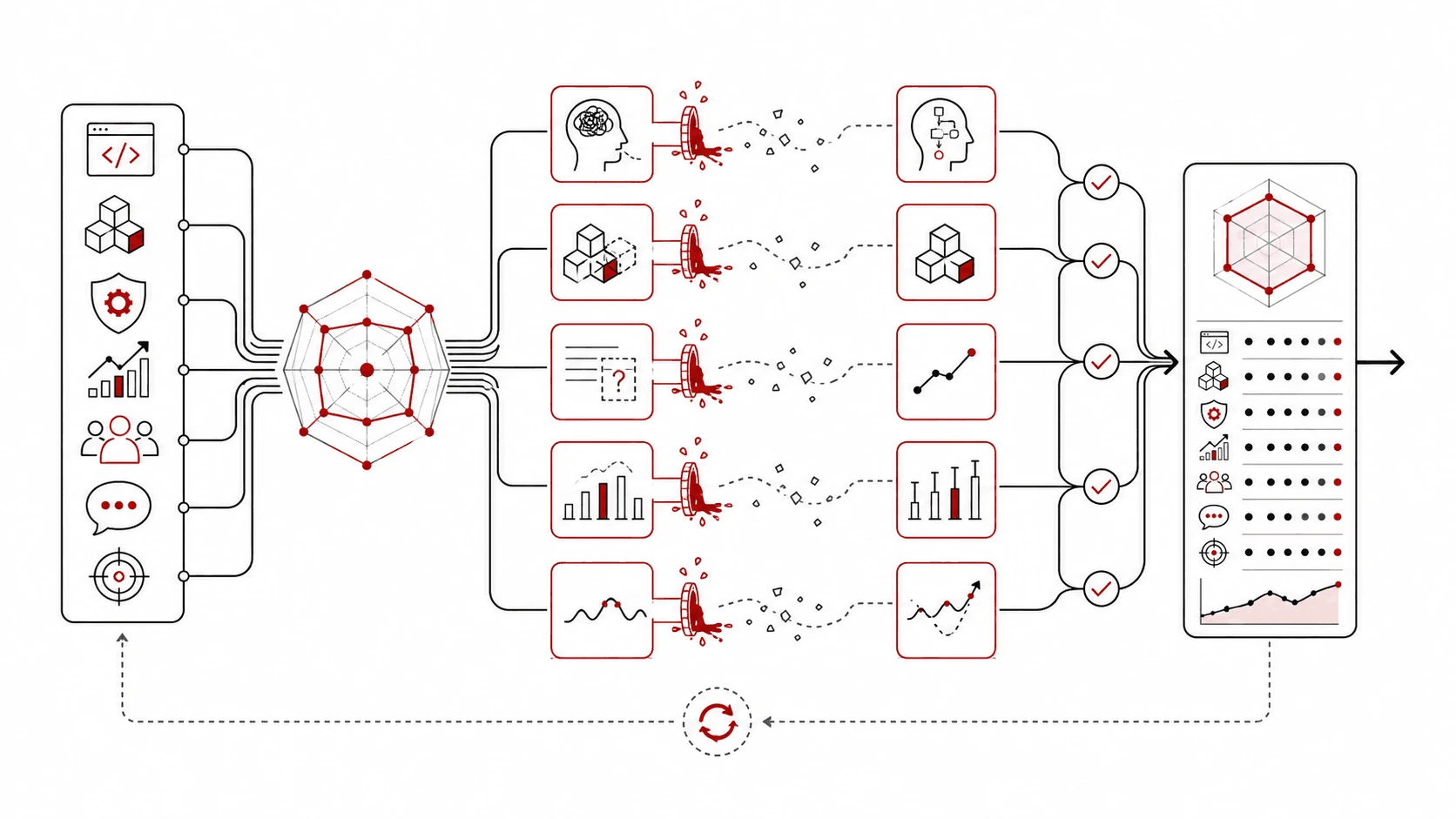
The six-signal-leak model
Use this chapter as a diagnostic lens, not as a list of personal flaws. A failure mode is a place where signal leaks out before it reaches the scorecard.
| Signal leak | What it looks like | What it hides |
|---|---|---|
| Framing leak | You start solving before clarifying the problem. | Judgment about goals, constraints, users, and unacceptable failure. |
| Visibility leak | You reach conclusions without exposing the reasoning path. | Decision quality, communication, and trade-off awareness. |
| Scope leak | You overbuild, underbuild, or replay a memorized architecture. | Ability to size a solution to the actual problem. |
| Validation leak | You treat tests, failure modes, rollout, or observability as optional extras. | Correctness discipline and production ownership. |
| Ownership leak | You describe team outcomes with vague “we” and broad impact claims. | Personal agency, influence, and level evidence. |
| Recovery leak | You freeze, argue, spiral, or abandon structure after a hint. | Adaptability under feedback and senior composure. |
This taxonomy is deliberately small. Most long lists of senior-candidate mistakes collapse into one of these six leaks. “Solving before clarifying” is a framing leak. “Talking continuously without steering” is a visibility leak. “Kafka by reflex” is a scope leak. “No edge cases” is a validation leak. “The team shipped a big thing” with no personal attribution is an ownership leak. “The hint means I failed” is a recovery leak.
Once you can name the leak, preparation becomes much less vague. You are no longer trying to “be better at interviews.” You are practicing a specific conversion:
- Turn ambiguity into a frame.
- Turn private reasoning into inspectable decisions.
- Turn experience into right-sized judgment.
- Turn correctness claims into validation.
- Turn team history into precise ownership.
- Turn challenge into revised forward motion.
How the leaks appear across rounds
The six leaks do not belong to one round. The same habit can look like premature implementation in coding, premature architecture in system design, vague attribution in a project deep dive, or defensiveness in a behavioral round. Diagnose the leak beneath the symptom.
Framing leaks: solving the wrong problem quickly
Experienced engineers are good at pattern recognition. That strength becomes a liability when a prompt resembles something familiar and you begin implementing or architecting before you know what problem the interviewer means.
In real work, surrounding context often narrows the problem for you. You know the product, the customers, the deployment model, the data shape, the company risk tolerance, and the constraints that matter. In an interview, those constraints are missing on purpose. Senior signal begins when you notice that absence and create a frame.
Useful framing questions are not a ritual. They change the design:
- Who is the user or operator?
- What outcome matters most?
- What volume, latency, correctness, privacy, or availability constraint would change the solution?
- What can be approximate, delayed, manual, or out of scope?
- What failure would be unacceptable?
- Which decision is reversible and which decision is expensive to undo?
Weak framing sounds like speed:
“This is a standard scheduler problem. I will use a queue, workers, and a database.”
Senior framing sounds like constraint discovery:
“Before choosing the scheduler, I want to know whether this is user-created reminders where minute-level delay is fine, or transactional delivery where missed or duplicate sends are serious. I will assume moderate-volume reminders unless you want the stricter version.”
The second answer is not slower in the way that matters. It prevents the candidate from spending twenty minutes optimizing for the wrong system.
Visibility leaks: making the interviewer infer judgment
Many experienced engineers make decisions silently because the reasoning has become automatic. They see a trade-off and choose a reasonable path, but the interviewer only hears the final answer. That creates a weak written record: “Candidate chose Postgres,” “Candidate used a cache,” “Candidate wrote a helper.”
Those notes do not prove seniority. They describe outputs without reasoning.
The fix is not to narrate every thought. Continuous narration can be as hard to score as silence. The fix is to expose the decisions that matter:
- “I am choosing the relational model because cancellation and audit history matter more than write throughput at this scale.”
- “I am not adding a cache yet because stale eligibility would be worse than the current latency.”
- “I will test the empty input, duplicate key, and overflow cases because those are the paths most likely to break this implementation.”
- “I am going to defer multi-region replication until we know the recovery-time objective.”
Make the interviewer see your judgment without forcing them to assemble it from fragments. A good rule is to speak when you cross a decision boundary: assumption, rejected alternative, trade-off, risk, validation, or revision.
Scope leaks: confusing complexity with seniority
Overengineering is one of the most common experienced-candidate failures because it is emotionally understandable. You want to show that you know distributed systems, operations, scaling, queues, caches, streams, workflows, and migration plans. So you reach for the largest version of the answer.
That can backfire. Seniority is not the number of components in the diagram. Seniority is the fit between constraints and design.
For a future-email scheduling system, an overbuilt first move might include an event stream, Redis, a fleet of scheduler services, a workflow engine, a delivery service, a provider abstraction, a dead-letter queue, a dashboard, and a shard plan. Some of those components may eventually be justified. The problem is that the candidate has not earned them yet.
A better answer starts with a baseline:
“For moderate scale, I would store scheduled messages in a relational table with status, due time, recipient preferences, idempotency key, and attempt state. Workers claim due rows in batches using leases, send through the provider, and record terminal or retryable outcomes. If due backlog, precision, or provider isolation becomes the bottleneck, that is when I would introduce a queue or partitioned scheduler.”
This answer proves more than component familiarity. It shows baseline design, operational state, idempotency, evolution threshold, and scope control.
Memorized architecture is the sibling of overengineering. A memorized design may be reasonable for the common version of a prompt and wrong for the version in front of you. The interviewer is not checking whether you can recite the industry-standard diagram. They are checking whether you can adapt it.
Validation leaks: treating correctness as a finishing touch
Senior interviewers notice when validation appears only at the end, if time remains. In production, correctness is not a flourish. It is part of the design.
Validation shows up differently by round:
| Round | Validation evidence |
|---|---|
| Coding | Edge cases, invariants, complexity, readable tests, and correction of bugs found during walkthrough. |
| Practical engineering | Error handling, input validation, maintainability, regression tests, and debuggability. |
| System design | Failure modes, rollout, observability, data integrity, security, cost, and operational ownership. |
| Project deep dive | Metrics with baselines, launch checks, incidents, rollback criteria, and what changed after learning. |
| Behavioral | Reflection that leads to different future behavior, not just a polished story. |
The common failure is saying, “We can add monitoring,” “We would test it,” or “We can scale it horizontally” without naming what you would observe, test, scale, or protect.
Stronger validation is specific:
“The two failure modes I care about are duplicate sends and stuck scheduled messages. I would track due backlog age, send attempts by provider, terminal failures, duplicate-suppression hits, and cancellation-after-claim cases. During rollout I would start with internal traffic and compare scheduled due time to actual send time.”
That is production judgment in a form an interviewer can score.
Ownership leaks: hiding the person inside the team
Senior engineering is collaborative, so “we” is often accurate. But a senior interview also has to answer a personal level question: what did you own, decide, influence, and change?
Weak ownership is vague:
“We migrated billing and improved reliability.”
That may describe important work, but it does not tell the interviewer whether you led the technical plan, implemented a slice, reviewed someone else’s design, coordinated rollout, wrote tests, handled incidents, or simply participated.
Strong ownership separates the layers:
“The team migrated billing in three phases. I owned the compatibility plan and dual-write validation, partnered with finance on reconciliation thresholds, and reviewed the rollback criteria. The data platform team owned the warehouse changes.”
This does two useful things at once. It claims real agency, and it avoids taking credit for work you did not own. Both increase credibility.
Impact needs the same precision. “Improved performance” is weaker than “reduced p95 dashboard load time from about 900 ms to about 280 ms for the main account view after moving the read path off a cross-service fan-out.” The exact metric only helps when it has context: baseline, scope, change, and consequence.
Blame is another ownership leak. Senior candidates can describe bad context without making other people the whole explanation. “Product changed the requirements” is usually less useful than “I did not establish a decision owner for scope trade-offs before implementation, so the requirement change arrived after the design was already too rigid.”
The second sentence does not pretend the environment was easy. It shows agency inside the environment.
Recovery leaks: losing structure after new information
Hints, corrections, and challenges are not automatically evidence of failure. Interviewers often use them to see whether you can incorporate new information. The recovery moment is part of the signal.
Weak recovery has several forms:
- arguing with the premise;
- apologizing repeatedly;
- continuing down a path that has been invalidated;
- abandoning all structure and starting over chaotically;
- treating a hint as proof that the round is lost.
Senior recovery is calm and mechanical:
- Pause.
- Restate the new information.
- Name what it invalidates.
- Revise the plan.
- Preserve time for validation.
Useful language is simple:
- “That constraint changes the write path. I need idempotency before retries are safe.”
- “I optimized for throughput, but the real bottleneck is tail latency. Let me revise the design around isolation.”
- “I can simplify this. The queue is not justified for the scale we assumed.”
- “I found a bug in my loop condition. I will fix that and rerun the edge cases.”
Do not overperform contrition. The interviewer does not need a speech about how disappointed you are. They need to see whether you can update your model and keep moving.
Examples: the same ability, different signal
Prompt:
“Design a system that lets users schedule email notifications for future delivery.”
An experienced engineer with real backend depth might answer poorly:
“I have built something like this. I would use an API service, Kafka, scheduler workers, Redis for near-term jobs, Postgres for persistence, an email provider abstraction, retries, and a dashboard.”
The components are plausible. The signal is weak. The answer leaks framing because it does not ask what “schedule” means. It leaks scope because it adds machinery before constraints require it. It leaks validation because retries and dashboards are named without duplicate suppression, cancellation, provider failure, or delivery metrics.
The same engineer can produce stronger evidence with a different opening:
“I want to split the problem into product semantics and delivery mechanics. Are these user-created reminders where a few minutes of delay is acceptable, or transactional messages where duplicates and missed sends are high severity? I will assume user reminders at moderate scale. If you want transactional delivery, I would tighten idempotency, audit, and alerting.”
Then the design can stay deliberately small:
- create, update, cancel, and inspect scheduled notifications;
- persistent records with due time, status, recipient, preference snapshot or preference check, idempotency key, attempt count, and provider response;
- workers that claim due records with leases so two workers do not send the same message;
- retry policy with terminal failure states and provider-specific backoff;
- cancellation handling for records that are due or already claimed;
- metrics for due backlog age, send latency, retry exhaustion, provider failures, and duplicate suppression;
- an evolution path to partitioned schedulers or queues if backlog, precision, or isolation demands it.
Notice what changed. The answer did not become more theatrical. It became more scoreable. The interviewer can now write evidence for problem framing, architectural judgment, production judgment, trade-offs, and communication.
A project-depth recovery example
Interviewer: “Tell me about a project that did not go well.”
Candidate: “We had a checkout performance project where the first release reduced median latency but increased p99 latency during payment-provider slowdowns. My part was the backend aggregation layer. I made a batching decision that helped normal traffic but amplified tail latency when one provider degraded.”
This opening works because it names the failure, the metric, the candidate’s part, and the flawed decision. It does not hide behind “the team had challenges.”
Interviewer: “What did you miss?”
Candidate: “I optimized for average request count and did not model the slowest dependency as the controlling factor. We had p95 dashboards, but not a p99 alert tied to checkout completion. In hindsight, the design review should have included dependency isolation and timeout behavior as launch requirements.”
The candidate has not become smaller by admitting the miss. The answer is stronger because the lesson is specific.
Interviewer: “How did you respond?”
Candidate: “We split provider calls so one slow provider could not hold the whole aggregation response, added per-provider timeout budgets, and returned partial payment options when the business rules allowed it. I added a load test scenario with provider latency injection. The durable change was adding dependency-specific failure tests to the checkout release checklist.”
This is recovery evidence: mitigation, validation, and a change in team practice.
Interviewer: “Was there disagreement?”
Candidate: “Yes. Product was worried that partial options would confuse users. That concern was valid. We agreed to show the most reliable options first, suppress unstable options only under provider degradation, and log suppression events for follow-up. It was not the most complete experience, but it protected checkout completion during incidents.”
The answer shows product judgment without blame. That is the difference between recounting a hard project and proving senior reflection.
Reader decisions: turn the taxonomy into preparation
The failure taxonomy is useful only if it changes how you practice. After each mock round or written answer, diagnose the leak before adding more study hours.
| If the feedback says… | Diagnose first | Practice this |
|---|---|---|
| “Jumped into solving too quickly.” | Framing leak. | Spend the first two minutes naming users, goals, constraints, assumptions, and unacceptable failure. |
| “Hard to follow.” | Visibility leak. | Speak only at decision boundaries: assumption, choice, trade-off, risk, validation, revision. |
| “Overcomplicated.” | Scope leak. | Start with the simplest design that works, then state thresholds for more machinery. |
| “Missed edge cases.” | Validation leak. | Attach tests, failure modes, observability, or rollout checks to the core answer, not the afterthought. |
| “Unclear what they owned.” | Ownership leak. | Split each story into team outcome, my direct ownership, my influence, and others’ ownership. |
| “Did not recover well.” | Recovery leak. | Rehearse accepting a hint, restating the changed constraint, revising the plan, and continuing. |
This is also how the earlier senior-bar concepts become practical. Level tells you the altitude expected. The seven signals tell you what evidence must appear. The loop tells you where each signal is sampled. Scoring tells you that evidence must be observable and defensible. Failure diagnosis tells you where your evidence is leaking before it reaches the debrief.
Practice drills
Leak replay
25 minBaseline before machinery
20 minAttribution split
20 minRecovery interruption
15 minDiagnostic self-check
Score each dimension from 0 to 4 after two practice rounds. Use evidence from the recording or transcript, not your intention.
| Dimension | 0 | 2 | 4 |
|---|---|---|---|
| Framing | Starts with implementation or components. | Asks a few questions but does not let answers shape the plan. | Defines users, goals, constraints, assumptions, and unacceptable failure before committing. |
| Visibility | Gives conclusions and waits for probing. | Explains some decisions after prompting. | Makes important assumptions, alternatives, trade-offs, risks, and revisions visible at the right moment. |
| Scope control | Adds complexity reflexively or undershoots obvious constraints. | Chooses plausible machinery with uneven justification. | Starts with a fit-for-purpose baseline and names evolution thresholds. |
| Validation | Treats tests or production concerns as optional. | Mentions validation generically. | Validates the risks that matter: edge cases, failure paths, observability, rollout, data integrity, or reflection. |
| Ownership | Uses vague “we” or over-claims. | Gives some personal contribution. | Separates team outcome, direct ownership, influence, and other owners precisely. |
| Recovery | Freezes, argues, apologizes repeatedly, or loses the thread. | Accepts hints but becomes scattered. | Uses new information to revise calmly and continue with structure. |
Readiness gate: if any dimension scores below 3 twice, do not respond by adding broad study material. Build a drill for that specific leak. A senior loop can tolerate a normal mistake. It is much less forgiving when the same leak appears across rounds.
One-page field reference
Field reference
Experienced engineer failure diagnostic
- Failure is often signal loss, not lack of ability.
- Clarify the problem before solving it.
- Speak at decision boundaries: assumption, alternative, trade-off, risk, validation, revision.
- Start with the simplest design that satisfies the stated constraints.
- Add complexity only when a named constraint requires it.
- Make correctness visible through tests, edge cases, failure modes, rollout, observability, and data integrity.
- Use “we” for team outcomes and “I” for your decisions, artifacts, influence, and learning.
- Describe impact with baseline, change, scope, and consequence.
- Treat hints as new information, not as a verdict.
- Recover by restating the constraint, revising the plan, and continuing.
- After each practice round, ask: where did senior signal leak?
That diagnostic completes the senior-bar foundation. The next part uses it to choose roles deliberately, so preparation starts from the work and loop you are actually trying to win.