Senior Engineering Interview Handbook / Chapter 24
Recovering When Stuck
A senior-interview chapter on getting unstuck without panic in coding, system design, debugging, project, and behavioral rounds.
Preparing audio…
Audio edition
Recovering When Stuck
Page tools
Find the edge you cannot cross
You are tracing a sliding window through abba. The first a and b are
easy. At the second b, you know the left edge must move, but the update rule
has gone missing. Continuing to type would conceal the problem inside new
code. Going silent would make the interviewer find it for you.
So make the stall smaller:
“The sliding-window approach still fits. I am stuck on one rule: where the left edge moves when the repeated character may already be outside the current window. I am going to trace
abbabefore I change the code.”
This is recovery. You have not solved the problem, but you have turned “I am stuck” into a precise question with an observable next move. The useful interview signal is not uninterrupted fluency. It is whether you can restore structure without asking someone else to take over.
Trace the failure, not the whole solution
Return to abba. Let left mark the beginning of the current window, and
record the most recent index of each character.
After reading a at index 0 and b at index 1, the current window is ab.
The next character, b at index 2, repeats inside that window. Moving left
to one position after the previous b makes left = 2; the valid window is
now the single character b.
The final a creates the revealing case. Its previous occurrence is at index
0, already outside the current window. Setting left to 1 would move the
boundary backward and reintroduce a duplicate b. The boundary therefore
needs a one-way rule:
left = max(left, lastSeen[character] + 1)
Now the last window is ba, and left has never moved backward. The
invariant is stronger than “the window has no duplicate characters.” The left
edge is also monotonic. That second fact is what makes the update safe when a
character was seen long ago.
The case earned its place because it resisted the first plausible update. Random examples merely consume time; a good recovery case separates two rules that could both have sounded right.
The ladder is not a speech
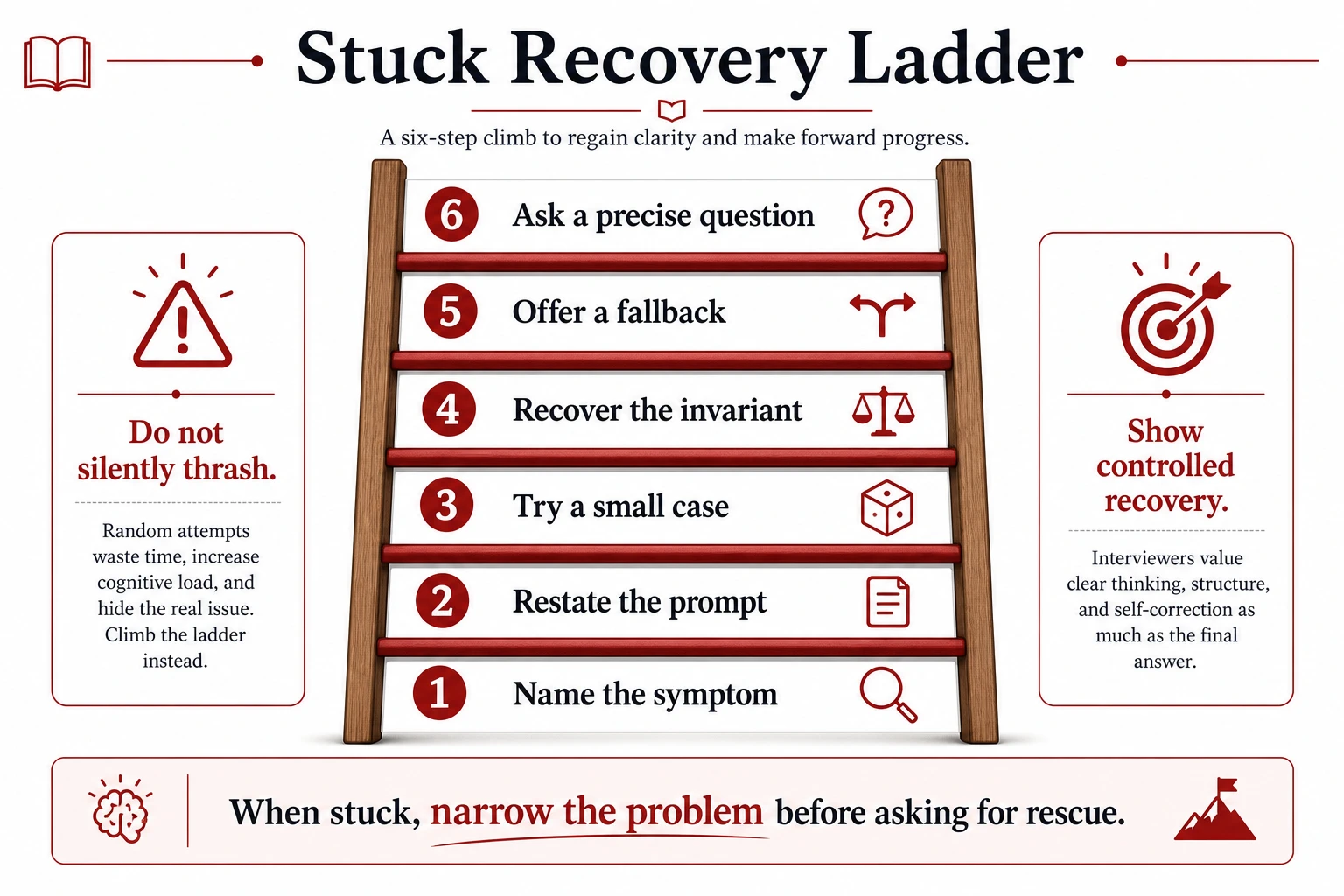
When a round starts to dissolve into guessing, six moves are available. They often occur in this order, but you rarely need to perform all six.
First, locate the blockage. “I am stuck on the deletion case, not the trie structure” preserves the work that still holds. A stall feels global from the inside; naming its boundary prevents an unnecessary restart.
Then restore the target. This is more exact than repeating the prompt. “We need all matching intervals, sorted by start time” identifies the contract that the next step must satisfy. In a project discussion, the equivalent may be: “The question is about how I handled disagreement, so the decision process matters more than the final architecture.”
Next, make the uncertainty visible. In code, use the smallest input that can break the disputed rule: touching intervals when equality matters, duplicates when identity and value may diverge, or out-of-order events when ordering has been assumed. In debugging, choose the cheapest check that distinguishes two hypotheses. In design, follow one failed dependency through the request path and durable state.
From that evidence, recover the rule you must preserve. It may be a loop invariant, a requirement boundary, an ownership claim, or the fact that would falsify a debugging hypothesis. State it before changing the artifact. The rule tells you both what to repair and what not to discard.
If the rule still does not emerge, establish a correct baseline. A sort and scan, a two-pass implementation, one service with one database, or a narrow story with clear ownership gives the round somewhere sound to stand. A baseline is not an apology for missing the elegant answer. It protects correctness and makes the remaining trade-off explicit:
“I do not yet see a clean one-pass solution. I can implement the correct
O(n log n)sort-and-scan version, test it, and then use the input bound to decide whether optimization is necessary.”
Only then ask for the missing information, if information is actually what you lack. “What am I missing?” transfers the search. “Should touching endpoints merge in this prompt?” resolves one assumption and leaves the work with you.
Different rounds offer different footholds
The same recovery movement operates on different artifacts.
In system design, several plausible architectures can create a false sense of stuckness. Return to the dominant requirement and choose the boundary it controls: “Delivery may be eventual, but operators must be able to inspect failure, so provider retries should leave the user request path.” The next move is now a failure trace, not another box on the diagram.
In practical coding, protect the simple path and isolate the troublesome edge case. A helper or a better representation is useful only if it makes the rule visible. Refactoring while the rule remains unknown simply moves the confusion.
In debugging, resist the urge to list hypotheses indefinitely. Name the two most plausible explanations and the observation that would make one of them false. The cheapest discriminating check is your small case.
In a project deep dive, a question may cross your ownership boundary. Say which decision you owned, which team owned the neighboring system, and how you influenced or coordinated the shared outcome. Inventing proximity is not recovery.
In a behavioral round, the artifact is the example itself. If your story cannot show the conflict or judgment in the prompt, name the mismatch and switch early. Ten seconds spent choosing a better story costs less than two minutes of setup for the wrong one.
Use help without surrendering the problem
An interviewer may offer a hint while you are tracing a case. Treat it as new evidence, but finish the reasoning yourself.
Suppose you are choosing between synchronous notification calls and an asynchronous queue. The interviewer asks what happens if a provider accepts a request but the worker times out and retries. A useful response is:
“That exposes the boundary I had not resolved. Our worker should persist an attempt and reuse one idempotency key for the logical delivery. Whether that also prevents a duplicate at the provider depends on the provider’s contract. Does this provider honor idempotency keys across retries?”
The question is bounded because you have already owned the internal design and identified the uncertainty at the external boundary. If the answer is no, you can describe the remaining ambiguity honestly rather than promising exactly-once delivery that the system cannot enforce.
Chapter 23 dealt with integrating hints and corrections after they arrive. Here the prior work is diagnosis: reducing a broad stall until a case, invariant, baseline, or bounded question can move the answer again.
Do not make the stall expensive
Being stuck costs time. These reactions add a second, avoidable cost:
- editing code while you cannot state the rule the edit should preserve;
- redrawing a design without naming the requirement that changed;
- discarding sound work because one layer failed;
- rejecting a correct baseline because it is not impressive;
- apologizing until the interviewer has to manage your confidence;
- pretending to understand a hint and building on a false premise;
- saying “I was going to get there” instead of repairing the artifact.
Visible recovery is concrete. Add the test. Move the boundary. Narrow the hypothesis. Correct the ownership claim. Then say what changed and resume.
Rehearse recovery, not panic
Choose one coding prompt you know well and one design, debugging, or behavioral prompt. For each, decide in advance where you will stop. Give yourself ninety seconds to name the blocked edge, restore the objective, and produce a discriminating case or correct baseline. Ask a question only if the remaining uncertainty belongs to the prompt rather than to your own reasoning.
Review the attempt without assigning yourself a score:
- Did you make the blocked point narrower than the whole problem?
- Did the example or check distinguish competing rules?
- Could you state what remained true before changing anything?
- If you asked for help, did the answer unlock one assumption rather than supply the next step?
- Did you resume with a changed rule, test, design choice, hypothesis, or example?
If the recovery produced no new evidence, sharpen the case. If it produced evidence but you did not use it, practice the transition from observation to the next visible change.
Field reference
Recovery ladder
- Locate the blocked edge; preserve the work that still holds.
- Restore the objective and the constraint controlling the next move.
- Choose a case, failure trace, or check that can disprove an assumption.
- State the invariant, decision rule, hypothesis separator, or story focus.
- Offer a correct baseline before chasing elegance.
- Ask one bounded question only when the missing fact belongs to the prompt.
- Apply new evidence to the code, diagram, test, plan, or example.
- Resume by naming what changed.
Recovery is complete when the round has something more reliable than it had before the stall. You do not need to look untroubled. You need to find the next true thing and make it useful.