Senior Engineering Interview Handbook / Chapter 19
The Six-Phase Response Loop
A senior-engineer interview operating method for turning ambiguous prompts into structured answers: clarify the objective, model the problem, plan the approach, execute visibly, validate the result, and reflect on trade-offs.
Preparing audio…
Audio edition
The Six-Phase Response Loop
Page tools
What the operating loop controls when the prompt arrives
The application campaign ends when the interviewer gives you a problem. The calendar, company brief, and rehearsals have done what they can. You now have a partial prompt, a clock, and another person trying to understand how you work.
Consider a broad system-design prompt:
“Design a feature-flag service for web, mobile, and backend services.”
It is tempting to answer with components: API, database, cache, queue, SDK. That may produce a plausible diagram, but it hides the decisions that should shape the diagram. Are flags for experiments or emergency shutdowns? Must evaluation happen without a network call? How stale may a flag be? What happens when distribution fails?
The operating model
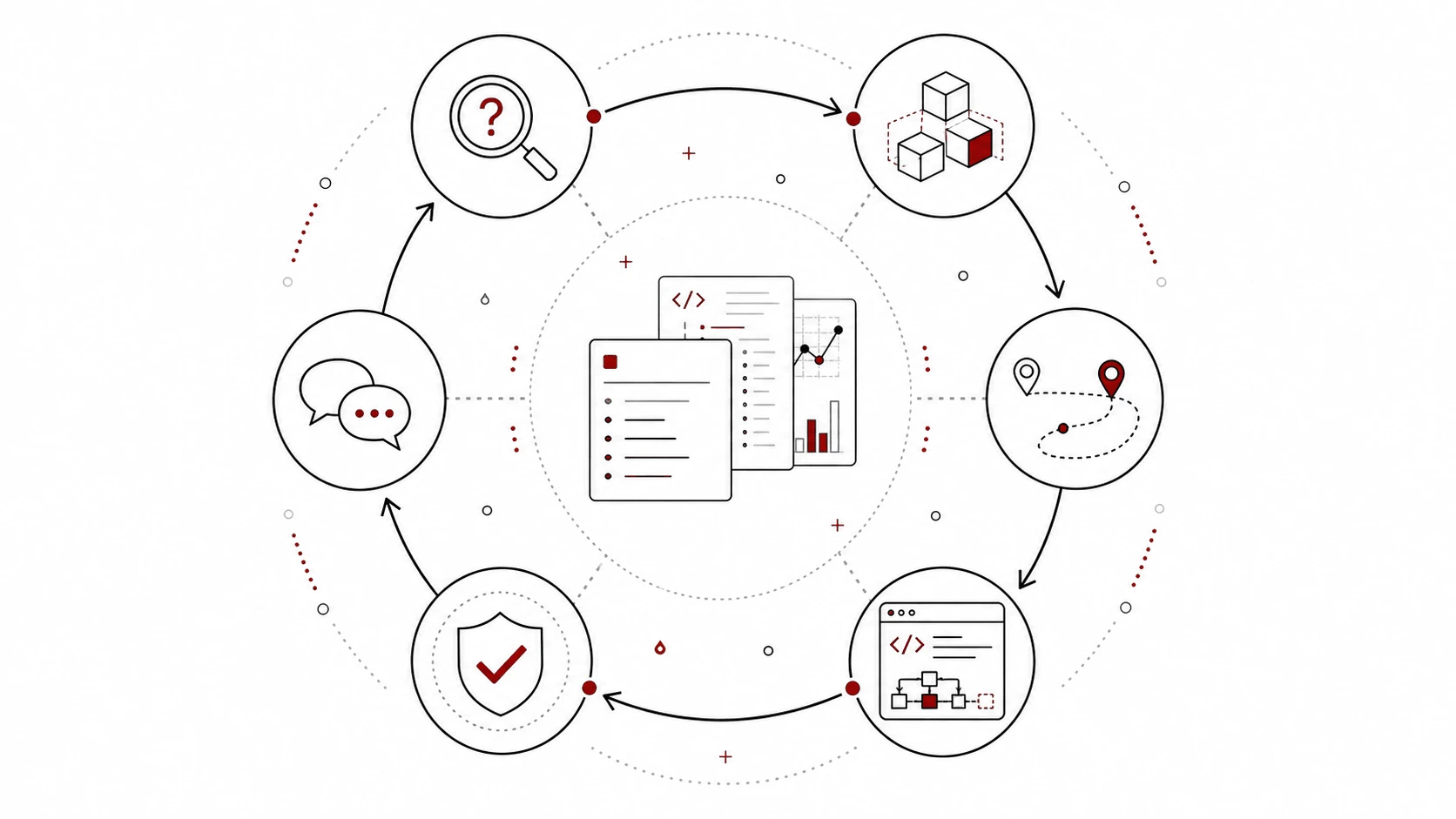
A senior answer turns that uncertainty into visible progress. The six-phase response loop gives the work a reliable movement:
- Clarify the uncertainties that can change the answer.
- Model the structure that makes the problem tractable.
- Plan a route through the work and its riskiest point.
- Execute in increments another person can inspect.
- Validate the important cases, paths, and failures.
- Reflect on consequences, limits, and alternatives.
The phases are not lines to recite. They are places to put your attention. A good answer may move through them almost invisibly.
Senior-level performance is controlled adaptation
The loop does not make an answer senior. Its value is that it leaves room for judgment to become visible. The candidate chooses which ambiguity deserves time, which model explains the work, how much structure the artifact needs, and which failure is serious enough to test. When evidence changes, the candidate revises the answer without losing ownership of it.
Rehearsal can make those moves easier, but polish is not the objective. A perfectly smooth answer that protects its first assumption is less convincing than one that notices a contradiction, explains what it changes, and recovers.
Worked example: an annotated interaction
The feature-flag prompt is still too broad to design honestly. The interaction begins before any diagram appears. The candidate starts with the uncertainty that separates two different products:
“Are flags mainly for controlled rollout and kill switches, or do we also need long-running experimentation?”
The interviewer makes rollout and kill switches essential; experimentation can wait. One question has established the priority. The candidate states two ordinary assumptions—reads dominate writes, and evaluation sits on latency-sensitive paths—then names the model:
“I will separate a control plane, where operators create and change flags, from an evaluation path used by applications. The control plane needs auditability and safe writes. The evaluation path needs low latency and a useful answer even when distribution is impaired.”
This is clarify becoming model. The model is more valuable than a list of components because it exposes the main tension: centrally governed state must be evaluated quickly in many processes, some of which may be offline or running an old mobile release.
Plan where the design can be redirected
Before drawing, the candidate makes a compact commitment:
“I will define the flag and targeting model, sketch the write and distribution path, then walk evaluation and an emergency disable. After that I will examine stale configuration, audit history, and mobile-version behavior.”
The plan tells the interviewer both the order and the intended proof. If the interviewer cares more about multi-tenant authorization or experimentation, this is a cheap moment to redirect. A ten-minute architecture monologue would be expensive to unwind.
Planning should therefore be brief but falsifiable. “I will discuss scale and reliability” is not much of a plan. “I will follow a flag change from operator write to SDK evaluation, then break the distribution path” creates a path the interviewer can inspect.
Execute the smallest design that honors the model
The candidate defines a flag with an identifier, environment, default value, enabled state, typed variants, targeting rules, and version. An authenticated admin API writes flag changes to a durable store and appends an audit event. A publisher turns each committed version into a configuration snapshot for regional distribution nodes. Server and web SDKs keep a local snapshot and evaluate in process; mobile clients receive only rules and values they are allowed to possess.
The first design is deliberately plain. It does not acquire a streaming platform, a global database, or a separate service for every noun merely because those components might appear in a mature implementation. Complexity arrives when a requirement earns it.
The candidate keeps the work inspectable by pausing at boundaries:
“At this point the control plane owns flag state and history. Distribution moves immutable versions. SDKs evaluate a last-known-good snapshot. I have not yet provided an emergency guarantee; I want to test that path next.”
That sentence does more than narrate the diagram. It states what is true, what is missing, and where the reasoning will go.
Validate a path that can fail
Suppose payment errors rise after a rollout and an operator disables the flag. The write must commit, record who changed what, publish a new version, reach distribution nodes, and replace SDK snapshots. Services that cannot reach distribution continue with their last-known-good version.
The walkthrough reveals a real limit: the kill switch is not instantaneous. Its safety depends on a stated propagation objective, SDK refresh behavior, and visibility into clients that remain stale. Mobile makes the limit sharper; an offline client may not receive a change at all, so a remotely evaluated server decision or a conservative local default may be necessary for truly dangerous behavior.
Validation has changed the design discussion. It is no longer enough to say that configuration is “eventually consistent.” The answer must say how delay is observed, what applications do during delay, and whether the emergency requirement can tolerate it.
Reflect by naming the consequence
A strong reflection does not apologize for everything the design omitted. It identifies the decision the current design made:
“Local evaluation keeps request latency independent of the control plane and lets services survive a distribution outage. The cost is bounded staleness and a harder emergency-disable guarantee. If disabling a flag must take effect within a few seconds, I would require measurable propagation, aggressive refresh, and perhaps a separate override path for the small set of safety-critical flags. That path would add operational complexity and would need its own failure tests.”
The answer is now defensible. It began with an incomplete prompt, produced an artifact, tested its most consequential path, and made the remaining trade-off explicit.
Failure modes: treating the loop as a conveyor belt
Interviews change while you are answering. A new constraint, a failed test, or a useful hint should send you back to the earliest phase that is now wrong.
If you assumed coding input was sorted and learn that it is not, clarify the contract, replace the model that depended on ordering, and update the plan. Patching the existing loop while pretending the assumption still holds only makes the answer harder to trust.
If a system-design walkthrough exposes an unsubscribe race, the prompt may be clear and the model sound; execution or validation needs revision. If a behavioral story contains no decision you personally influenced, the problem is earlier: choose a better model for the evidence and plan the story again.
This recovery rule is more useful than protecting the appearance of fluency:
Hints fit the same pattern. Treat a hint as new evidence, not as an interruption to a prepared performance. Restate what it changes and make the smallest necessary revision. The interviewer can then see both the correction and your control of it.
Weak, usable, and senior response quality
A weak answer either charges ahead or waits for the interviewer to supply the structure. It may still produce code or a diagram, but the path from prompt to artifact is difficult to inspect and validation arrives only when requested.
A usable answer asks relevant questions, proposes an approach, and checks the obvious cases. It can complete the round, though it may need steering when a constraint changes or the first plan fails.
A senior answer is not necessarily longer or more polished. Its assumptions are consequential and explicit; its model makes the artifact easier to reason about; its validation attacks the risky path; and its reflection explains the cost of the chosen direction. Most important, it can absorb correction without turning adaptation into defensiveness.
The artifact changes; the movement survives
The loop should not make different rounds sound alike. Each round produces a different artifact, so each phase receives a different amount of time.
In a coding round, clarification establishes the input contract. The model is usually an invariant, recurrence, graph state, or relationship between data structures. The plan is a few sentences; execution produces code in testable increments. Validation uses examples that could disprove correctness before complexity and alternatives become reflection.
For merging intervals, for example, adjacency rules affect clarification; sorted order creates the model; the active merged interval is the invariant; nested and disjoint inputs validate it; and streaming input exposes the limit of the sorting approach. The loop prevents typing from outrunning the reason the algorithm works.
In debugging, clarification establishes symptom, time, and blast radius. The model is the expected path plus a small set of competing hypotheses. The plan pairs each hypothesis with evidence and a mitigation threshold. Execution narrows rather than guesses. Validation distinguishes cause from coincidence and confirms recovery; reflection improves the system that allowed the failure to escape.
In a behavioral round, clarification is often a single story-selection question. The model is a spine of stakes, decision, action, evidence, result, and reflection. Execution is the story itself, with enough technical and human detail to make the decision credible. Validation comes from outcomes rather than adjectives. Reflection names what the experience changed without rewriting the story as a flawless victory.
System design usually spends longer in clarify and model. Coding gives more of the clock to execute and validate. Debugging may loop repeatedly between model, execution, and validation. Behavioral answers compress all six phases into a few minutes. The shared discipline is not timing or vocabulary; it is that the answer remains open to evidence.
Practice transitions, then self-check
Practicing six labels at once can make an answer stiff. Instead, rehearse the transitions where control is commonly lost.
One prompt, three passes
25 minWhen reviewing a practice answer, ask:
- Did each question change the answer, or merely delay it?
- Could another engineer state the model I was using?
- Did the plan reveal an order and a risky point?
- Was there an artifact to inspect rather than a stream of commentary?
- Did validation try to disprove the answer?
- Did reflection sharpen the decision rather than weaken it?
Choose one weak transition for the next repetition. The loop becomes natural when recovery is familiar, not when every phase has a memorized speech.
Field reference
Field reference
Six-phase response loop
- Clarify: Which uncertain answer could change the solution?
- Model: What invariant, state, path, boundary, hypothesis, or story spine makes the work tractable?
- Plan: What will I do first, where is the risk, and how will I check it?
- Execute: What inspectable artifact am I producing now?
- Validate: Which case, path, constraint, or failure could prove me wrong?
- Reflect: What consequence, limit, alternative, or next step completes the judgment?
When the answer breaks, return to the earliest phase that no longer holds. State the correction and continue.
The loop begins with a deceptively difficult decision: which ambiguity is worth spending the interviewer’s time on? The next chapter develops that clarifying judgment without turning it into a checklist of ceremonial questions.