Senior Engineering Interview Handbook / Chapter 23
Handling Hints, Corrections, and Disagreement
A senior-interview chapter on recognizing hints, responding to corrections, changing direction, disagreeing professionally, and recovering without pretending the mistake did not happen.
Preparing audio…
Audio edition
Handling Hints, Corrections, and Disagreement
Page tools
The question after your answer
You have drawn a notification service that calls its email, SMS, and push providers from the request path. The interviewer studies the diagram and asks:
“What happens when the SMS provider is down?”
The architecture is no longer the only thing being examined. The next few seconds will show whether you can recognize a hint, accept a correction, or hold a technical disagreement without making the interviewer take ownership of the answer.
Three reflexes waste the moment. “We can retry” answers without following the failure. “That is what I meant” conceals the change. “Fine, I will use a queue” surrenders the reasoning. A useful response does something harder: it makes the interruption specific, revises the model, and leaves a visible repair.
Find out what kind of interruption occurred
Hints, corrections, and disagreements can arrive in the same mild tone. They do different work.
A hint points toward a case you have not examined: duplicate events, empty input, a regional failure, or a retry whose owner is missing from the diagram. Turn it into a test. “What about duplicate events?” should lead to a concrete trace through the consumer and its side effects, not a quick assurance that duplicates are handled.
A correction establishes that something in the answer is wrong. Perhaps the prompt asks for all matching intervals and the code returns the first, or the project story credits you with a decision made by another team. The record now needs repair.
A disagreement concerns a choice that may still be valid. The interviewer may prefer synchronous delivery, a relational model, or a different consistency boundary. Before defending the choice, discover which requirement their alternative serves.
When the intent is unclear, ask about the technical branch rather than the interviewer’s hidden motive:
“Are you pointing out that duplicates break my current write path, or asking whether the product should allow repeated delivery?”
That question verifies the feedback without asking the interviewer to solve the problem. It also prevents a challenge to one trade-off from becoming an unnecessary rewrite of the whole answer.
Let the failure travel through the design
Return to the unavailable SMS provider. A weak answer adds a retry arrow and moves on. The arrow hides every consequential question: whether the user waits, where retry state lives, which process resumes it, and what prevents a second attempt from producing a second message.
A stronger response begins by naming the exposed assumption:
“I put provider availability on the user request path. Unless immediate delivery confirmation is required, that is the wrong boundary.”
Now revise the design. The API persists the notification request and returns an accepted status. Provider-specific jobs are enqueued from durable state. Workers record attempts and delivery status so retries survive process failure and operators can inspect them. Each logical delivery carries an idempotency key; whether that prevents a duplicate at the provider also depends on the provider’s contract, so do not promise more than the boundary can guarantee.
The hint has altered latency, failure ownership, state, observability, and the duplicate-delivery story. That is what it means to integrate feedback. Saying “good point” would have changed none of them.
Make disagreement conditional
The interviewer may now push back:
“Synchronous fan-out is much simpler. Why not keep it?”
“Queues are better” is not a defense; it is a preference wearing technical clothes. Start with what the alternative gets right, then locate the decision boundary:
“It is simpler, and I would use it if the request must confirm delivery before returning. If fast acknowledgement and eventual delivery are the product requirements, synchronous fan-out couples user latency and availability to every provider. Under those requirements I would keep the durable asynchronous path.”
Suppose the interviewer confirms that one regulatory message must be delivered before the operation succeeds. That is not defeat. It is a new requirement:
“Then I will keep that required channel on the confirmation path. I would leave optional channels asynchronous so one slow provider cannot block the entire operation.”
The answer changes because the requirement changed, not because authority won. Professional disagreement works the same way in code review and design work: state the benefit, expose the cost, tie the choice to an explicit priority, and name the evidence that would change your mind.
A correction must leave a mark
Some interruptions are less ambiguous. If your code returns the first matching interval and the prompt asks for all matches, acknowledge the miss without either denial or self-punishment:
“You’re right. I optimized for early return and missed the output contract. The scan is still valid, but the result must become an accumulator. I will change it and add a case with two matches.”
The response preserves what remains true, repairs what is false, and names the test that will demonstrate the change. After the edit, state any consequence: the scan remains linear in the input, while the returned output now requires space proportional to the number of matches.
Size the repair to the error. Correct a mistaken term in one sentence. A missed requirement needs an approach change and a test. A broken invariant deserves a pause before more code is written. A misplaced architectural responsibility requires a redrawn boundary and a new failure trace. An overstated project claim requires an exact account of ownership:
“Let me correct that. I owned the migration plan and rollout guardrails. The platform team chose the storage engine; I validated its fit for our traffic and led the cutover.”
Pretending the earlier claim never happened makes the repair less credible. Long apologies are not better; they turn the conversation away from the work. Name the mistake, change the artifact or claim, establish the consequence, and resume.
Preserve the parts that still hold
Feedback often damages only one layer of an answer. The interval scan can survive while its result handling changes. The notification API can survive while provider calls move behind durable jobs. A project story can survive while its ownership boundary becomes more precise.
Before restarting, ask what the interruption actually invalidated. Preserve the unaffected invariant, interface, flow, or evidence. This is not attachment to the first answer; it is controlled change. Throwing away correct work after every challenge hides your judgment just as surely as refusing to change it.
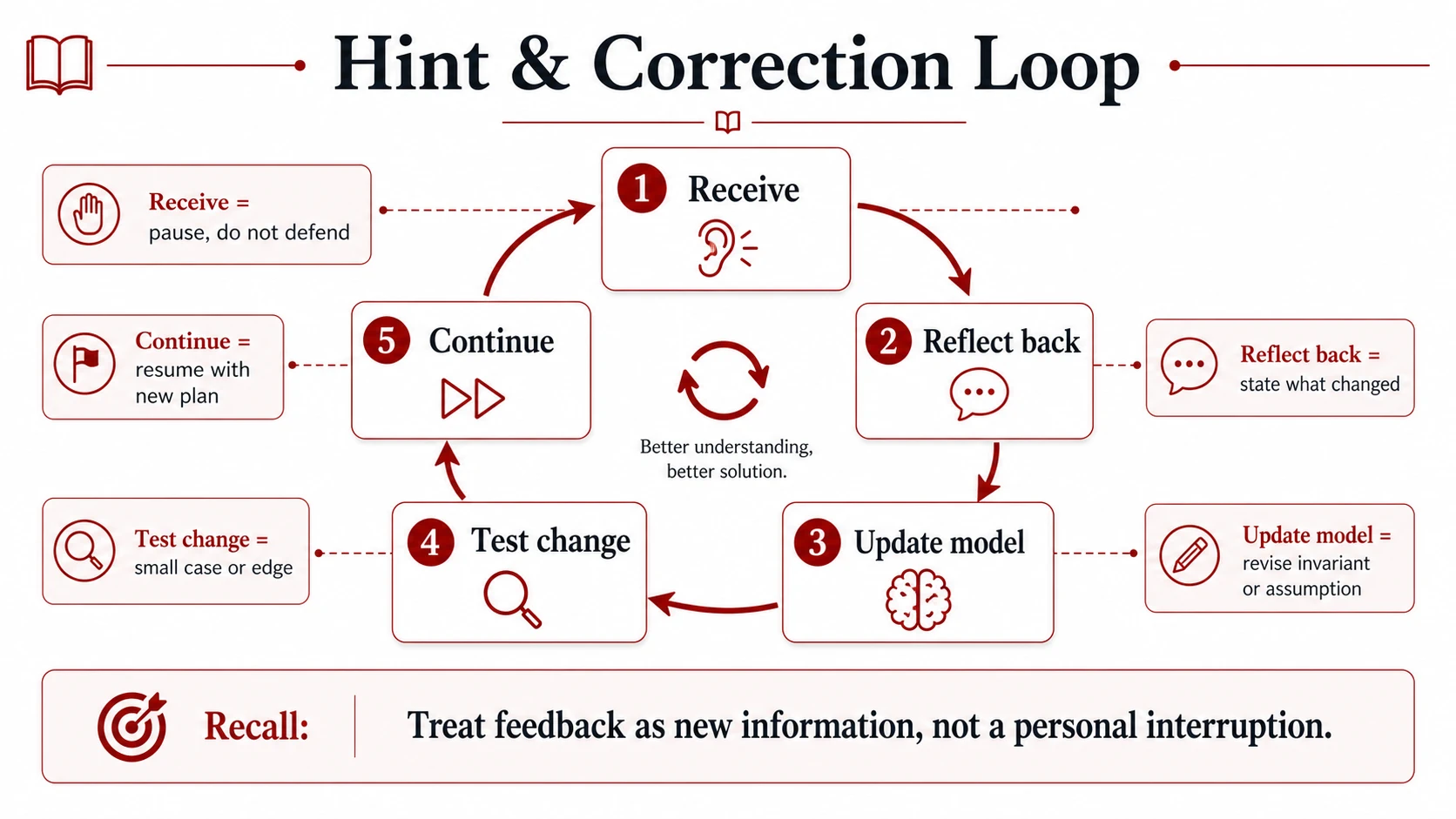
The useful sequence is compact:
- Reflect the new fact or concern in concrete terms.
- Identify the assumption, requirement, invariant, or trade-off it affects.
- Change the code, diagram, test, or claim where the damage appears.
- Explain the consequence and continue from the repaired state.
Rehearse the interruption
Take one coding answer, one design, and one project story you already know. Introduce a correction halfway through each: change an output requirement, remove a dependency, or narrow your real ownership. Give yourself ninety seconds to identify what broke, preserve what did not, and make the repair visible.
Then practice disagreement separately. Choose two plausible designs and name the priority that favors each. Do not argue for either until you can finish this sentence: “If the requirement is ___, I would change my choice because ___.” The exercise is complete when a new requirement can change the answer without erasing the reasoning that produced the first one.
Field reference
Handling hints, corrections, and disagreement
- Turn an indirect hint into a boundary case or failure trace.
- If intent is unclear, ask which technical branch the interviewer means.
- State the assumption, requirement, invariant, or ownership claim that changed.
- Repair the visible artifact; social agreement is not a technical update.
- Preserve the parts of the answer that remain valid.
- Disagree from explicit requirements, not loyalty to a preferred design.
- Name what would change your mind.
- Acknowledge errors without denying them or making the interviewer manage an apology.
An interruption is not outside the round. It is the point where a prepared answer meets evidence it did not control. The aim is neither compliance nor victory. It is to keep ownership while making the answer more accurate than it was a moment ago.