Senior Engineering Interview Handbook / Chapter 17
Company Research and Interview Intelligence
A repeatable senior-engineer research method for turning public company information, recruiter details, role context, interviewer backgrounds, permitted tools, and logistics into focused interview preparation.
Preparing audio…
Audio edition
Company Research and Interview Intelligence
Page tools
What the brief must accomplish
Omar has 45 minutes before a recruiter screen for a senior backend role at a B2B product used by finance teams. He can spend that time collecting company facts, or he can make four decisions:
- which of his projects best matches the work;
- which technical pressures deserve practice;
- which questions would change his view of the role;
- which tools, policies, and logistics need confirmation.
Only the second activity is interview preparation.
Company research tends to expand because there is always another product page, press release, profile, or engineering post to read. The useful output is much smaller: a one-page intelligence brief that can be reviewed in five minutes. It connects what is public to what you will do, while keeping uncertainty visible.
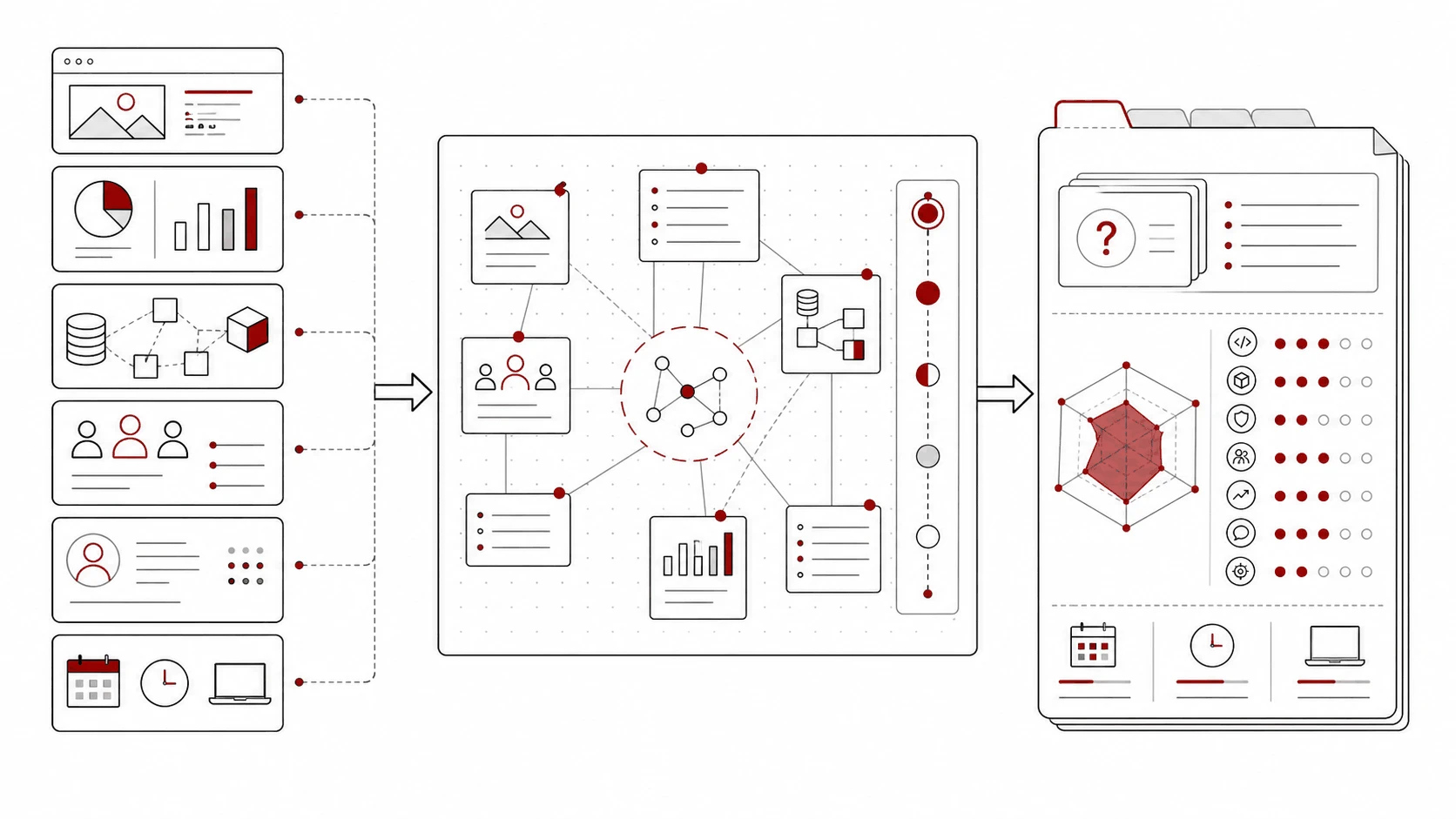
How the brief changes interview behavior
Omar begins his brief with a working thesis:
This looks like a hands-on senior backend role where workflow correctness, enterprise reliability, and platform modernization matter. My strongest evidence is a workflow-engine migration, integration reliability work, and production ownership for a customer-facing service. I need to learn whether the immediate pressure is customer scale, modernization, or reliability.
The thesis is not a speech to memorize. It is a selection rule. It tells Omar which sources matter, which experience to rehearse, and where his confidence should stop.
The evidence model: fact, inference, and question
Public material rarely explains a team’s current architecture or private roadmap. Treating it as if it does is the quickest way to make research sound like bluffing. Give every consequential note one of three labels:
- Fact: publicly stated, recruiter-confirmed, or directly observed.
- Inference: a reasonable conclusion from facts, still uncertain.
- Question: something a recruiter, hiring manager, or interviewer can clarify.
Omar’s first three notes read:
Fact: Public product documentation describes approvals, audit trails, integrations, and reporting for finance teams.
Inference: Failed or delayed workflows may create customer-support, audit, and trust problems.
Question: Which workflow is most important to this team, and what happens when it fails?
That sequence does more than protect accuracy. It moves the conversation from website language to engineering consequences without claiming access Omar does not have. In an interview he can say, “The public docs led me to this hypothesis; where is it accurate, and where would you correct it?”
Start with the product, not the stack
The product tells you which failures have weight. Identify who uses it, who pays, which workflow they are trying to complete, and what a slow, incorrect, unavailable, insecure, or confusing result would cost them. Then ask what the business model adds to that pressure.
A scheduling product may have to reconcile time zones, permissions, external calendar APIs, notifications, billing, and enterprise administration. A marketplace may carry matching, search, payment, fraud, disputes, and operational tooling in the same customer journey. A developer product makes API evolution, documentation, compatibility, and migration part of the product itself. Subscription software often adds tenancy, permissions, integrations, billing, and customer escalation. None of these shapes reveals an interview prompt. Each supplies more intelligent constraints and questions.
For Omar, “finance workflow software” is still too broad. The useful product note names approvals and integrations, then asks whether correctness, availability, reporting freshness, or modernization is placing the team under the greatest pressure. His research now has somewhere to go.
Read the technical footprint for constraints
A technology name is rarely useful by itself. “They use Kubernetes” does not tell you what the team owns, where the difficult boundary lies, or what to practice. Public APIs, SDKs, migration guides, status pages, incident reports, trust material, engineering talks, open-source repositories, release notes, and neighboring job descriptions can reveal more.
Read those sources with a narrow question: what constraint might this expose?
Public webhooks suggest delivery guarantees, retries, observability, and partner support. SDKs and versioned APIs raise compatibility and customer migration. Data-residency language raises tenant boundaries, regional controls, and operational complexity. Incident reports may reveal how a company communicates failure, but an old incident should become a question, not a theory about the present system.
Omar finds public API and webhook documentation. Related job descriptions mention permissions and data residency. He adds:
Facts: The product exposes APIs and webhooks. Related roles mention permissions and data residency.
Inference: Integration reliability, tenant boundaries, and auditability may matter to this team.
Questions: Which integration failures are most visible to customers? How does the team manage retries and customer recovery? Are regional or permission requirements driving current architecture work?
Public technical material ages. Record the date and source in deeper notes, and soften the claim when the evidence is old or copied across job listings. The one-page brief needs the conclusion and its uncertainty, not a bibliography of everything you opened.
Find out why the role exists now
The best public research cannot answer the most valuable hiring question:
What changed that made this hire important now?
A new product team, a backfill, a migration, rapid customer growth, and a reliability problem can all produce the same job title. They call for different evidence. Ask what problem is waiting for the person who joins, what strong work would look like after six months, and whether the need is service ownership, feature delivery, migration leadership, platform adoption, or broader technical direction.
Current product launches, pricing changes, leadership interviews, trust updates, and hiring patterns may suggest a priority. Use recent, authoritative, dated material to form a precise question:
I saw the recent public launch around enterprise administration, and the role description mentions permissions and auditability. Is this team involved in that work, or is the immediate need elsewhere?
An old or indirect source deserves more distance: “Public material suggests enterprise workflows have been important, but I do not know how current that is.” Curiosity is credible. Private-roadmap certainty based on public marketing is not.
When Omar learns that the role is new headcount for a modernization effort, he changes the top line of his brief. The migration project moves ahead of his general service-ownership story. Research has now altered preparation rather than merely increasing knowledge.
Research operating culture through work
Values pages are weak evidence unless operating details support them. Look for how engineers write decisions, review designs, own production, learn from incidents, collaborate with product and support, work across time zones, and move shared platforms into use.
Then choose evidence with the same operating shape. Design documents and architecture review call for a story about written trade-offs. On-call and incident material call for production ownership and responsible escalation. Platform language calls for adoption, migration, standards, and influence without formal authority. A trust-sensitive domain calls for auditability, privacy, review, and conservative rollout. Remote work calls for evidence of clear asynchronous coordination, not a recital of the company’s values.
Omar finds engineering posts that describe design review and incident learning. He prepares one example in which a written decision changed a migration, and one in which an incident led to a durable operating change. He still asks how those practices work on this team; a public post is context, not proof of a uniform culture.
Let the brief choose practice
Product and role signals should narrow practice without turning into prompt prediction. Commerce may justify revisiting idempotency, reconciliation, payment retries, and ledger-like records. Collaboration products may bring fanout, presence, permissions, search, and abuse controls into view. Developer platforms may make API evolution, webhooks, observability, migration, and multi-tenant control planes useful territory. Data products may emphasize ingestion, freshness, backfills, lineage, and access control.
The transferable practice is not a memorized company design. It is reasoning about the relevant constraints: scale, correctness, latency, reliability, privacy, cost, operability, compliance, supportability, and migration. If the actual prompt is unrelated, that practice still strengthens judgment.
Omar chooses approval workflows and webhook delivery as practice domains. For each, he writes two assumptions he would clarify rather than baking guesses into a solution. He also rehearses the migration project, the incident-learning story, and a cross-functional example involving support and product. One page has now selected technical, project, and behavioral preparation.
Use interviewer context without trespassing
For a scheduled interviewer, public professional context can help you prepare one question about the work and avoid entering an obvious domain cold. Title, team, professional writing, and public technical talks are enough.
Do not collect private details, scrape non-public material, manufacture familiarity, or tailor an answer to manipulate one person’s known interests. A staff engineer who once spoke about search may still be running a general design round. A manager may probe technical judgment. Background is context, not a script.
If Omar sees that an interviewer works on developer platform, a proportionate question is:
How does the team decide when to build a shared platform capability rather than leave autonomy with product teams? In my last role, that boundary was where much of the migration risk appeared.
The question connects professional context to Omar’s own experience. It does not announce how thoroughly he researched the interviewer.
Put tools and logistics on the same page
The recruiter screen established the process. The company brief keeps its unresolved details visible before each round: video link, time zone, shared editor or local IDE, language options, documentation and personal-note policy, AI-tool policy, screen sharing, round length, breaks, project-deep-dive format, accessibility process, and a backup contact.
Ask plainly when a policy is unclear:
Could you confirm the coding environment, whether documentation and personal notes are allowed, and whether AI tools are prohibited?
Policies differ and change. Do not rely on what another company allowed or on an old candidate report. Until the company confirms a tool policy, behave conservatively. Logistics should support the interview, not become its most memorable event.
Brief structure and selection rules
Omar’s one-page brief now contains eight compact sections:
- Role thesis: the likely role shape, two or three evidence anchors, and the main uncertainty.
- Product and users: critical workflows, customer type, and failure consequences.
- Business and priorities: business pressure, dated public signals, and the questions they raise.
- Technical footprint: public interfaces and constraints, with stale evidence marked.
- Operating culture: observable practices and the stories they make worth preparing.
- Role history: why the hire exists, what waits for the new person, and what success would mean.
- Round map: stages, interviewer roles, practice focus, tools, policy, and logistics.
- Open questions: only uncertainties that could change preparation or the decision to continue.
Each section is a few lines, not a second dossier. Deeper notes can retain links and dates. The interview-facing page exists to recover focus quickly.
Annotated example: the brief in conversation
Before the hiring-manager call, Omar can now say:
The product appears to sit where workflow correctness and customer trust matter. The role description and public docs suggest modernization and enterprise reliability, but I am treating that as a hypothesis. My migration and integration work looks relevant. Which part of the platform is under the most pressure now?
He is specific, honest about the boundary of his knowledge, and ready to revise the brief when the answer arrives.
Common defects: when research goes wrong
Volume is the common failure. It appears as copied company language, stack scavenging, stale posts treated as current truth, questions already answered by the role description, or facts that never alter preparation. It can also appear as overfitting to one incident, one interviewer profile, or one imagined system-design prompt.
After each consequential note, ask: what will I do differently? A useful answer names a project, practice domain, behavioral story, question, decision, or logistical check. If the note changes none of those, move it to background or delete it.
The same test exposes missing research. If you cannot explain why the role exists, have not asked what success means, or are assuming the tool policy, the brief still has work to do.
Review workflow: build and critique one brief
Build a company intelligence brief
45 minDo a boundary pass before using the brief. Remove private or overly personal information, certainty about private systems or strategy, and interviewer research that would create false familiarity.
Self-review before a serious loop
Read the page once, without opening the source links:
- Can I state the role thesis and its main uncertainty in under a minute?
- Do I understand the users, critical workflow, and consequences of failure?
- Are facts visibly separate from inferences and questions?
- Does every technical clue lead to a constraint or a question rather than a stack recital?
- Have I asked why the role exists and what six-month success means?
- Did culture research select evidence, or only give me slogans to repeat?
- Did the brief change my project, design, and behavioral preparation?
- Is interviewer research limited to relevant public professional context?
- Are tools, AI policy, timing, breaks, accessibility needs, and backup plans confirmed or explicitly open?
- Can I review the whole brief in five minutes?
If role history remains unknown, keep the question prominent. If facts and inferences blur together, repair the labels before the next conversation. If the page does not change preparation, it is still a scrapbook.
Field reference
Field reference
Company intelligence brief
- Lead with a role thesis: likely work, strongest evidence, main uncertainty.
- Product: users, payer, critical workflow, failure consequences.
- Business: model, current pressure, dated public priorities.
- Technical: public interfaces, constraints, ownership clues, stale evidence.
- Culture: observable practices and the stories they make worth preparing.
- Role history: new headcount or backfill, immediate problem, six-month success.
- Round map: stages, interviewer roles, practice domains, tools, policy, logistics.
- Open questions: only answers that could change preparation or a decision.
- Label important notes as fact, inference, or question.
- Use only public professional interviewer context; avoid false familiarity.
- Delete any research that changes no example, practice prompt, question, or logistical check.