Senior Engineering Interview Handbook / Chapter 8
How Interviewers Score Candidates
Learn how interviewers turn observed behavior into defensible evidence, how debriefs resolve conflicting signals, and how to produce senior judgment that survives the scoring process.
Preparing audio…
Audio edition
How Interviewers Score Candidates
Page tools
Why scoring changes preparation
Interview scoring is not a secret conversion chart from answers to points. At its best, it is a way to preserve evidence from a short conversation so people who were not in the room can make a defensible decision about role, level, and risk.
That distinction matters. Candidates often prepare as if the goal is to impress the interviewer in real time. Real-time rapport helps, but it is not enough. After the round, the interviewer may need to write feedback, choose a rating, compare notes with other interviewers, and explain why the evidence supports a senior hire, a lower level, or a rejection. A charming answer that leaves no recordable decision is fragile. A concise answer with clear assumptions, trade-offs, artifacts, and outcomes travels farther.
Companies differ. Some use detailed scorecards. Some use lightweight written feedback. Some have formal hiring committees; others rely on a hiring manager and debrief. Some separate level calibration from hire/no-hire; others combine them. You do not need to know every internal mechanism. You do need to understand the common pattern:
- An interviewer observes behavior.
- The interviewer records evidence.
- The evidence is compared with expectations for a competency, role, or level.
- The loop resolves agreement, disagreement, gaps, and risk.
Your job is not to game that system. Your job is to make your real senior judgment observable enough that it can survive being written down.
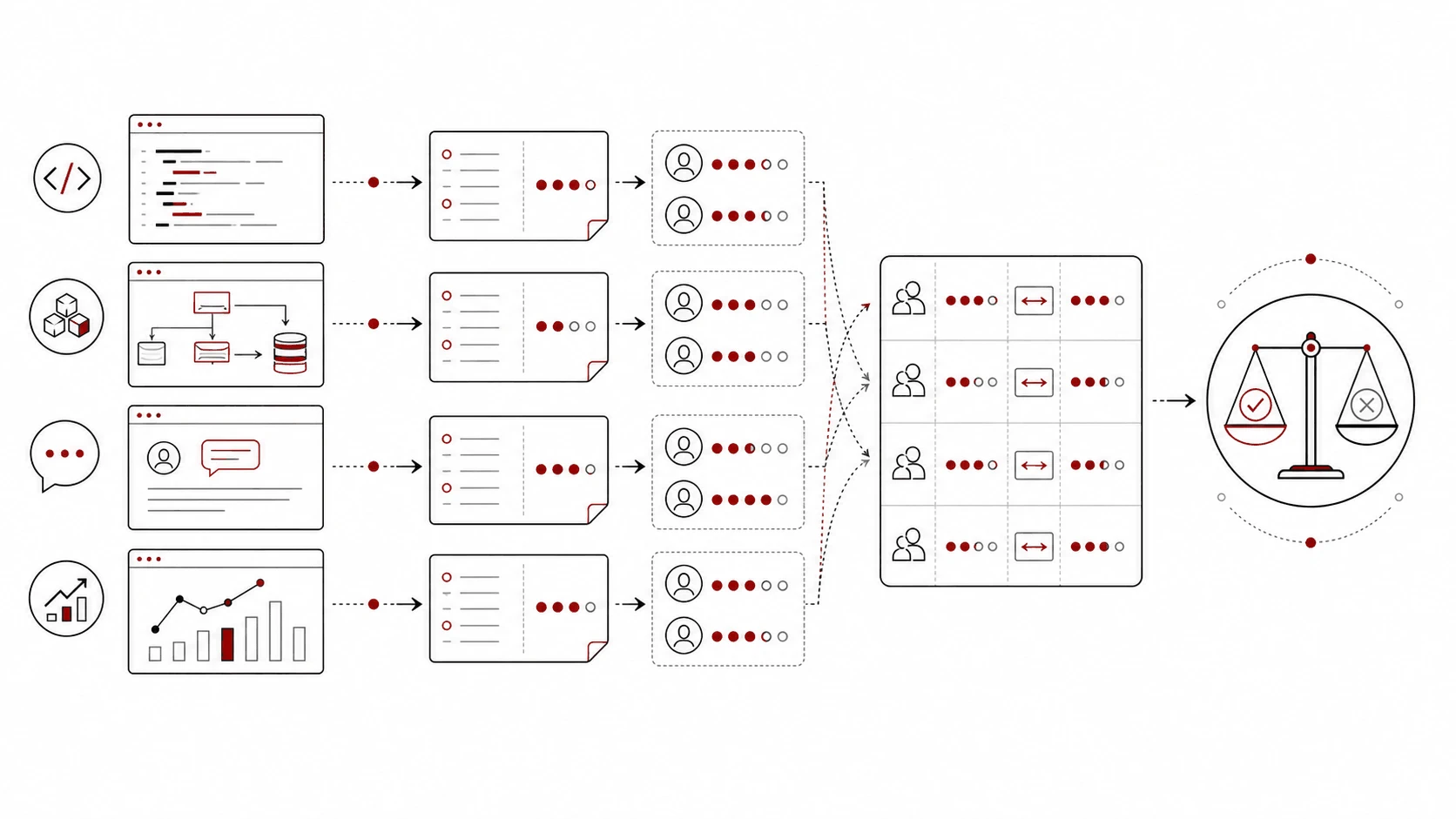
The evidence preservation model
A scorecard is a translation device. It turns a messy interaction into a small set of claims the hiring team can compare. For senior engineering roles, those claims often concern the signals introduced earlier in this part of the book: problem framing, coding fluency, architectural judgment, production judgment, delivery and product judgment, leadership and influence, and communication and reflection.
The scorecard is not the work itself. It is a compressed account of the work shown in the interview.
Weak evidence sounds like this:
Candidate had good senior energy and talked about scaling.
Stronger evidence sounds like this:
Candidate clarified write latency, read freshness, and blast-radius requirements before choosing a design. They separated control-plane updates from runtime reads, chose local evaluation with bounded staleness, and named audit logging and rollback behavior as launch requirements.
The second version gives a hiring team something to inspect. It has observed behavior, a decision, a trade-off, and a level-relevant reason. It does not require the reader to trust the interviewer’s vibe.
Think of every round as producing an evidence packet:
| Evidence layer | What it contains | Senior version |
|---|---|---|
| Observation | What you did or said in the room. | “Clarified consistency before choosing storage.” |
| Artifact | The code, design, story, test, plan, or explanation you produced. | “Designed idempotent retries with terminal failure states.” |
| Reasoning | Why you chose one path over another. | “Rejected synchronous fanout because one slow provider would dominate checkout latency.” |
| Level signal | Why the evidence belongs at the target level. | “Connected design, rollout, observability, and customer impact without heavy prompting.” |
If one layer is missing, the evidence weakens. Correct code without tests leaves correctness discipline unclear. A project story without personal attribution leaves ownership unclear. A design with components but no requirements leaves judgment unclear. A behavioral story with lessons but no consequence leaves reflection unclear.
Rubrics and anchors are not arithmetic
Competency rubrics describe what the company wants interviewers to look for. Anchored ratings attach meaning to a judgment. The exact labels vary, but a simplified scale might distinguish “no hire,” “lean hire,” “hire,” and “strong hire.” The useful part is not the label. The useful part is the anchor behind it.
A “hire” rating usually means the interviewer can defend the claim that the candidate met the bar for the owned signal. A “strong hire” usually means the evidence was unusually clear, deep, or level-raising for the role. A “lean hire” often means the evidence was positive but carried reservations. A “no hire” may reflect a serious gap, a floor failure, or simply insufficient evidence for the expected level.
Do not treat these ratings as points that add up mechanically. Senior hiring decisions are rarely clean averages. A severe coding correctness problem may matter more than several pleasant conversations. Weak production judgment may dominate a backend infrastructure loop. A system design miss may be less damaging for a role that does not require much architecture, but the same miss may be decisive for a platform role. A vague project deep dive may create more doubt when the resume claims large ownership.
Rubrics create discipline, not certainty. Interviewers still have to interpret context:
- Was the missing signal core to the role?
- Did another round collect credible adjacent evidence?
- Was the weakness a small gap, a coachable format issue, or a level risk?
- Did the candidate recover when challenged?
- Is the evidence current, personally attributable, and relevant to the work?
This is why generic scorecard language is dangerous. Saying “I care about scalability” does not prove architectural judgment. Saying “I mentor people” does not prove influence. Saying “we owned reliability” does not prove production ownership. Anchored ratings need behavior that can be matched to the bar.
How scoring appears across rounds
Many interview processes ask interviewers to submit feedback before a debrief discussion. Not every company does this formally, but the principle is common: collect independent signal before the room converges on a story.
That changes how you should prepare. Each round must stand on its own. You cannot assume the system design interviewer will repair a weak coding signal, or that the hiring manager will explain your project attribution to the behavioral interviewer. You also cannot assume a later interviewer knows what you already proved.
This does not mean you should repeat the same monologue in every round. It means you should make the owned signal of each round clean.
In coding, that means constraints, implementation, tests, complexity, and recovery are visible.
In system design, that means requirements, data model, APIs, failure modes, observability, cost, security, and evolution are tied to product constraints rather than scattered as buzzwords.
In a project deep dive, that means the interviewer can separate team outcome from your direct decisions, influence, trade-offs, and reflection.
In behavioral or leadership rounds, that means the story includes conflict, stakes, agency, consequence, and changed behavior.
The audience is not only the person nodding on the video call. The audience is also the feedback they will write after the call.
Debriefs resolve risk, not just preference
A debrief is where the loop turns separate observations into a hiring recommendation. The conversation may be formal or informal. It may involve only interviewers and a hiring manager, or it may feed a committee packet. The mechanics vary, but the debrief usually has to answer a small set of questions:
- What evidence did each round produce?
- Which strengths repeated across independent interviewers?
- Which concerns repeated?
- Which concerns are isolated, role-relevant, or severe?
- Does the evidence support the target level?
- Would the team need unusual support structures for this hire to succeed?
- Is more signal needed, or is the decision clear enough?
Specific evidence is powerful in debriefs because it reduces interpretation load. “They handled failure well” is weaker than “when the interviewer added duplicate delivery, the candidate introduced idempotency keys, explained retry exhaustion, and added an alert for stuck terminal states.” The second statement lets other people judge the claim.
Vague positives are surprisingly weak. Interviewers may like a candidate and still be unable to advocate strongly because the notes do not contain senior-level evidence. Vague negatives are also dangerous, which is why good debriefs press for examples. “They seemed junior” should become “they needed repeated prompting to identify the primary failure mode” or be discounted.
For candidates, the implication is practical: leave behind quotable decisions. Make the trade-off explicit. Name the failure mode. State the metric. Separate your work from the team’s work. Explain what changed after the incident, launch, migration, or disagreement.
Leveling is a separate question
Senior candidates are often evaluated on two related questions:
- Should this person be hired?
- At what level would this person be set up to succeed?
Those questions can diverge. A company may believe a candidate is strong but not yet at the advertised level. It may believe a candidate has senior depth in one domain and mid-level evidence in another. It may down-level, reject, add a round, or move the candidate to a different role.
Leveling evidence is broader than task success. It includes:
- ambiguity handled without constant direction;
- scope of systems, teams, users, or business impact;
- quality of judgment under trade-offs;
- production ownership and risk management;
- influence across people who do not report to the candidate;
- ability to make others more effective;
- reflection after failure or surprise;
- current hands-on credibility where the role requires it.
This is where many experienced engineers lose signal. They describe big projects as if proximity to scale proves level. It does not. Leveling discussions need agency and judgment.
Compare:
We migrated the payments platform to a new provider.
With:
The team migrated payments to a new provider. I owned the idempotency model, the dual-write validation plan, and the rollback criteria. The finance systems lead owned reconciliation reporting, and the client team owned checkout UI changes. My main trade-off was accepting a longer shadow period so we could compare authorization outcomes before moving traffic.
The second answer is not louder. It is more scorable. It shows scope, attribution, collaboration, risk management, and decision quality.
Contradictory signals are normal
Senior loops often produce mixed evidence. That does not mean the process is broken. Different rounds sample different surfaces, and senior engineering itself is uneven across domains.
Common contradictions include:
- strong project depth but rusty live coding;
- strong coding but shallow system design;
- persuasive architecture but weak operational detail;
- clear leadership stories but vague personal technical contribution;
- polished communication but poor recovery after hints;
- impressive scale but unclear relevance to the target role.
Debriefs usually ask three questions about a contradiction.
First: is the weak signal core to the role? Weak frontend depth may be acceptable for some backend infrastructure roles. Weak debugging is harder to ignore for a production-heavy backend role.
Second: is the weak signal severe? A candidate who misses a minor edge case and recovers is different from a candidate who cannot reason about correctness. A candidate who forgets one operational metric is different from a candidate who treats production as someone else’s problem.
Third: is there credible adjacent evidence? If coding was uneven but a practical coding or code review round showed maintainable changes, that may reduce concern. If a project story claims production ownership but the system design round ignores failure modes, the contradiction gets worse.
You cannot control the debrief. You can control whether your evidence makes contradictions easier or harder to resolve. When you know your likely weak signal, prepare adjacent evidence honestly. Do not excuse it. Bound it, practice it, and make the rest of the loop clean.
Examples and counterexamples: one answer, different feedback
Prompt:
“Tell me about a technically difficult project you led.”
Candidate A:
“We had a major reliability project for our notification system. It was high scale and very cross-functional. We redesigned the architecture, added queues and retries, improved monitoring, and got the system to a much better place. I worked with product and infra, mentored junior engineers, and made sure everything shipped.”
This may be true, but it is difficult to score. The interviewer can infer seniority, but the evidence is soft. What did the candidate decide? What was broken? What alternatives were considered? Which part did they personally own? What changed? What did they learn?
Possible feedback:
Candidate described a large notification reliability project and seemed involved across teams, but ownership and technical decision-making were hard to isolate. Impact and production details were high level. Some senior scope, but evidence was not specific enough to calibrate confidently.
Candidate B:
“Our notification service was causing customer-visible delays during partner API slowdowns. The team goal was to keep normal sends fast while making degraded providers visible and recoverable. I owned the worker redesign and retry policy. I chose per-provider queues instead of one shared queue because one slow provider was head-of-line blocking others. The trade-off was more operational surface area, so we added queue-depth alerts, retry-exhaustion dashboards, and a terminal failure workflow for support. Product owned customer messaging, and infra helped with capacity. After rollout, provider incidents no longer delayed unrelated notification types. The main lesson was that retries are not a reliability strategy unless they have isolation, idempotency, and a visible failure state.”
This answer gives the interviewer material for multiple rubrics. It shows problem framing, architecture, production judgment, cross-functional work, personal attribution, impact, and reflection.
Possible feedback:
Candidate gave a clear notification reliability example with personal ownership of worker design and retry policy. They identified head-of-line blocking, chose per-provider queues, named the operational trade-off, added observability and terminal failure handling, and distinguished their work from product and infra responsibilities. Strong senior evidence in production judgment, attribution, and technical trade-off communication.
The difference is not polish. The difference is preservation. Candidate B’s answer can be carried into a debrief without requiring the interviewer to reconstruct the senior signal from memory.
Implications for scoring-aware preparation
Scoring awareness should make you clearer, not more robotic. The best answers still sound like real engineering judgment. They do not announce every competency by name. They expose the decisions a senior engineer would actually make.
Use this preparation method for each major round:
- Identify the signal the round is likely to own.
- Write the evidence an interviewer could honestly record if you performed well.
- Practice producing that evidence under the round’s constraints.
- Remove vague claims that require trust rather than observation.
- Add the missing layer: assumption, artifact, reasoning, level signal, or reflection.
For a coding round, a feedback-friendly target might be:
Candidate clarified input constraints, chose a simple hash-map approach, implemented cleanly, tested duplicates and empty input, explained O(n) time and O(n) space, and recovered from an off-by-one bug by tracing a failing case.
For a system design round:
Candidate clarified product semantics and consistency requirements before choosing architecture, explained the data model and read/write paths, compared two scaling options, and covered failure handling, observability, security, and rollout risk.
For a project deep dive:
Candidate explained context, personal ownership, alternatives rejected, rollout plan, production consequences, impact, and what they would change now.
For a behavioral round:
Candidate described a real conflict, named their own agency, represented the other side fairly, explained the decision process, and showed a durable change in future behavior.
These are not scripts. They are rehearsal targets. In the actual interview, speak naturally and adapt to the prompt. The point is to make sure the evidence exists.
Practice drills
Feedback rewrite
20 minAnchor test
15 minContradiction plan
20 minDiagnostic self-check
Score each dimension from 0 to 4 before a serious loop.
| Dimension | 0 | 2 | 4 |
|---|---|---|---|
| Observability | Important reasoning stays private. | Some decisions are visible after prompting. | Assumptions, decisions, tests, trade-offs, and recovery are visible without overexplaining. |
| Specificity | Uses broad claims and vague outcomes. | Gives examples with partial detail. | Gives context, action, artifact, metric or consequence, and reflection. |
| Attribution | Team and personal work are blurred. | Separates some personal work from team work. | Names what you owned, influenced, reviewed, delegated, and learned. |
| Level signal | Could describe a capable mid-level engineer. | Shows some senior scope. | Shows ambiguity, scope, production ownership, influence, and durable impact. |
| Debrief durability | Feedback would rely on impressions. | Feedback would include some concrete examples. | Feedback could defend the rating with specific behavior and quotes. |
| Contradiction handling | Weak signals are ignored or excused. | Weak signals are acknowledged vaguely. | Weak signals are practiced, bounded, and supported by adjacent evidence. |
Readiness gate: any 0 or 1 should change your preparation plan. At senior level, one unscorable core signal can outweigh several pleasant positives.
One-page field reference
Field reference
Scoring-aware interview checklist
- Interviewers can only score evidence they observe or can credibly record.
- A strong evidence packet contains observation, artifact, reasoning, and level signal.
- Rubrics and anchored ratings guide judgment; they are not simple point totals.
- Each round needs to stand on its own because feedback may be written independently.
- Debriefs compare strengths, concerns, contradictions, role risk, and level evidence.
- Leveling depends on ambiguity, scope, judgment, production ownership, influence, impact, and current hands-on credibility.
- Specific decisions travel farther than broad claims.
- Precise attribution is more credible than claiming the whole team outcome.
- Contradictory signals are judged by role relevance, severity, and adjacent evidence.
- Do not perform for the scorecard. Make real senior judgment visible.
Scoring awareness should not make you scripted. It should help you see where strong experience fails to become scoreable evidence, which is the failure pattern the next chapter diagnoses.