Senior Engineering Interview Handbook / Chapter 7
Anatomy of a Modern Interview Loop
Learn how modern senior software engineering interview loops sample evidence across stages, why process variation matters, and how to prepare without overfitting to one company's format.
Preparing audio…
Audio edition
Anatomy of a Modern Interview Loop
Page tools
Why loop anatomy changes preparation
A senior interview loop is not a string of unrelated meetings. It is an evidence architecture: a company chooses several formats, gives each format partial ownership of the senior bar, then asks whether the resulting pattern is strong enough to justify the hire and level.
That distinction matters because the surface process varies constantly. One company sends an online assessment before any human conversation. Another starts with a hiring manager. A startup may combine project depth, system design, and product judgment in one founder call. A large organization may split coding, design, behavioral, and calibration into separate rounds. The names change faster than the underlying work.
The durable question is:
Which senior signals is this stage designed to sample, and what evidence will travel into the final decision?
If you can answer that question, the loop becomes legible. You stop treating every calendar invite as a new exam and start seeing the whole process as a sequence of samples: some technical, some managerial, some collaborative, some confirmatory.
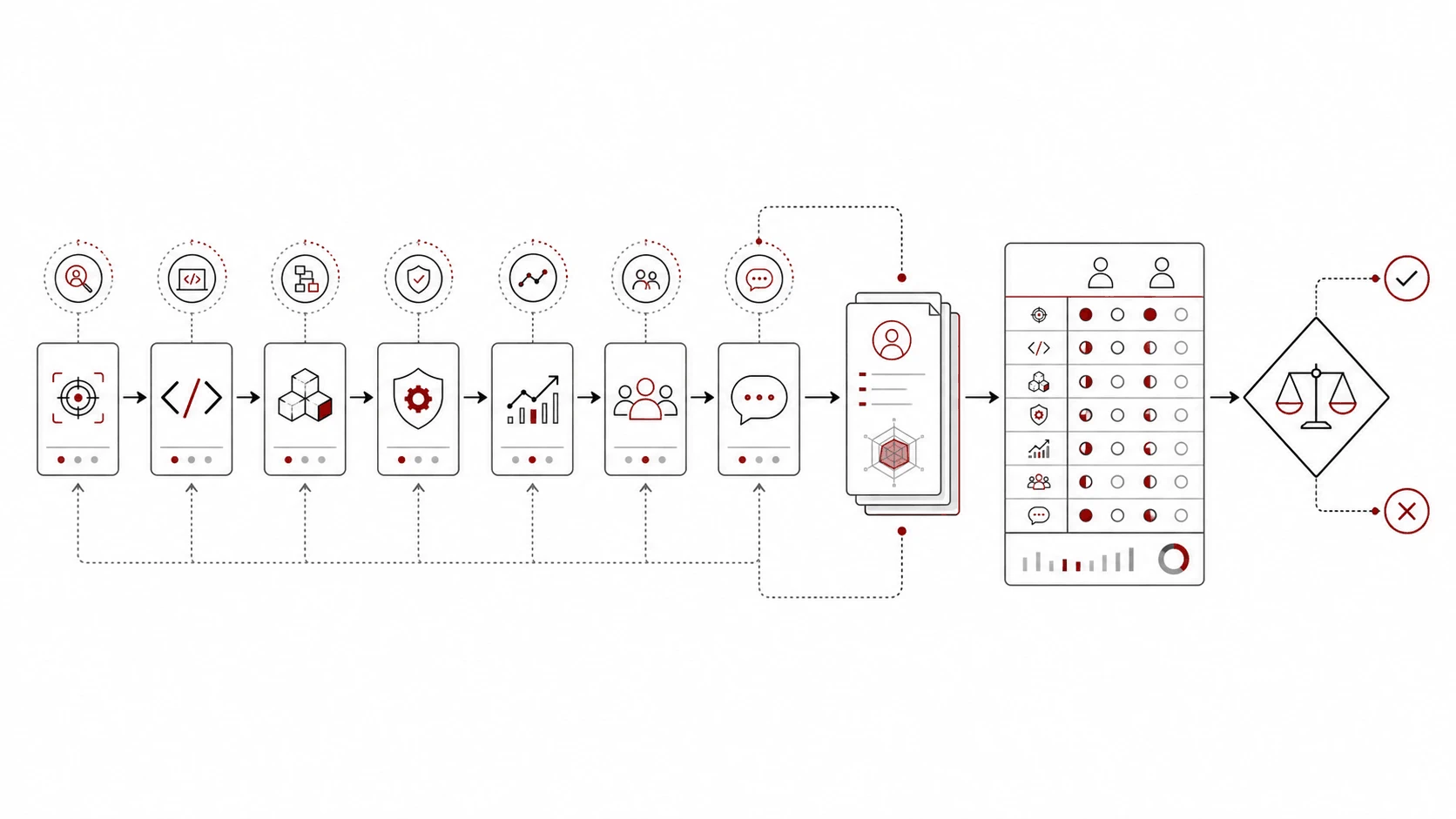
The gate-sample-reconcile model
Most loops have three jobs, even when the company does not name them this way.
| Job | What the process is doing | What you should make clear |
|---|---|---|
| Gate | Decide whether a full loop is worth scheduling. | Role fit, level plausibility, logistics, motivation, and baseline technical match. |
| Sample | Collect independent evidence through coding, design, project, practical, and behavioral formats. | The primary senior signal for each round, plus enough adjacent signal to make the result credible. |
| Reconcile | Compare notes, resolve contradictions, calibrate level, and decide whether the risk is acceptable. | Consistent evidence that can survive written feedback and secondhand discussion. |
The gate is not “easy.” A recruiter screen or hiring-manager conversation can shape leveling, route you to the wrong loop, or expose a mismatch before you have shown technical strength. The sample stage is not “the real interview” in isolation. A brilliant design round may not rescue a coding floor failure for a hands-on role, and a strong coding round may not prove senior scope. The reconcile stage happens mostly without you, but your preparation determines what evidence is available in the room.
This model also explains why senior preparation cannot be a pile of isolated drills. You need coding readiness, design fluency, project depth, leadership stories, and role calibration because the loop is trying to reduce uncertainty from several directions.
How the loop appears across rounds
The easiest way to read a loop is to ask what uncertainty each stage is supposed to reduce. The same stage can carry different weight in different organizations, but the usual ownership looks like this.
| Stage | Main uncertainty it reduces | Evidence that tends to matter |
|---|---|---|
| Recruiter screen | Is there a plausible match worth pursuing? | Clear target role, search status, timeline, logistics, compensation boundaries, and process questions. |
| Hiring-manager conversation | Does the role fit your scope, motivation, and likely contribution? | Problem-area ownership, current hands-on judgment, team fit, seniority calibration, and honest constraints. |
| Online assessment | Is there enough baseline implementation fluency to continue? | Correctness, edge cases, time management, and careful reading under constraint. |
| Coding screen | Can you turn a problem into working code while making reasoning visible? | Clarification, approach selection, readable implementation, tests, complexity, and recovery from bugs. |
| Practical coding | Can you work inside an existing codebase? | Local comprehension, small coherent changes, tests, API judgment, maintainability, and restraint. |
| Debugging or code review | Can you reason from symptoms, diffs, tests, and production risk? | Isolation, hypothesis discipline, correctness concerns, deploy safety, observability, and review quality. |
| Low-level design | Can you design program boundaries before code becomes accidental architecture? | Interfaces, state transitions, data model, invariants, extensibility, and testability. |
| System design | Can you shape an ambiguous system and defend trade-offs? | Requirements, workload, APIs, data flow, failure modes, reliability, security, cost, and evolution. |
| Project deep dive | Does your actual work show senior-level scope? | Context, personal decisions, trade-offs, rollout, impact, influence, and reflection. |
| Behavioral or values interview | How do you operate with people, ambiguity, conflict, and learning? | Specific stories, agency, judgment, ownership, repair, and non-defensive reflection. |
| Product or cross-functional interview | Can you connect engineering work to customer and business reality? | Prioritization, partner constraints, risk communication, measurement, and scope negotiation. |
| Executive, founder, or bar-raiser-style conversation | Is there company-level, level, or calibration risk? | Crisp narrative, judgment under ambiguity, motivation, strategic context, and consistency with earlier evidence. |
| References and background checks | Do external accounts match the pattern you presented? | Confirmed scope, collaboration, reliability, integrity, dates, titles, and contribution. |
Do not memorize this table as a universal process map. Use it as a translation layer. When a recruiter says “technical screen,” ask whether it is algorithmic coding, practical coding, debugging, design, or something else. When a hiring manager says “values,” ask yourself which leadership and collaboration signals the company is likely to overweight.
Process variation is signal variation
Process variation is not cosmetic. A loop’s shape tells you what the company is anxious about.
If a company includes a practical coding round, it may care about codebase fluency, maintainability, or day-one contribution more than pure algorithm speed. If it includes a debugging exercise, production judgment may be central to the role. If it adds a product or cross-functional conversation, seniority may involve negotiation with design, data, support, security, customers, or operations. If it uses a bar-raiser-style interviewer or hiring committee, the company may be trying to calibrate across teams rather than letting one manager’s enthusiasm decide.
Several patterns are common:
| Loop pattern | What may be overweighted | Preparation implication |
|---|---|---|
| Large-company standardized loop | Consistency across candidates, level calibration, independent signal ownership. | Prepare clean evidence for each round; do not rely on one interviewer to carry your case. |
| Startup or founder-led loop | Role ambiguity, pace, ownership, judgment, product instinct, and trust. | Be ready to discuss trade-offs, priorities, and messy constraints without losing technical specificity. |
| Infrastructure, platform, or SRE-heavy loop | Production judgment, reliability, debugging, migration risk, and operational ownership. | Practice incident reasoning, code review, failure modes, rollout plans, and reliability-oriented design. |
| Product engineering loop | Delivery judgment, customer impact, practical coding, collaboration, and maintainable execution. | Connect technical choices to user outcomes, release shape, and cross-functional constraints. |
| Specialist loop | Depth in a domain such as security, data, ML, mobile, embedded, or front end. | Keep the shared senior bar visible while preparing domain-specific examples and failure modes. |
| Remote-heavy loop | Written communication, async clarity, tool fluency, and self-management. | Confirm formats early and practice concise written or screen-shared explanations. |
These are clues, not guarantees. Treat them as hypotheses to verify through recruiter and hiring-manager questions.
How to read a loop brief
When you receive a process description, turn it into a working map before you start scheduling every evening around generic practice.
Ask five practical questions:
- What stages are expected, and in what order?
- Which rounds are live, take-home, async, or conversational?
- What tools, languages, or environments are used?
- Which rounds are calibrated to senior level rather than general engineering ability?
- Is there a project deep dive, and should it focus on one project or compare several?
Then build a loop map with four columns:
| Round | Likely owned signal | Evidence to prepare | Main risk |
|---|---|---|---|
| Hiring manager | Role fit, scope, motivation | Senior narrative, target role, two ownership examples | Sounding unfocused or misleveled. |
| Coding | Coding fluency and problem framing | Timed implementation practice, test cases, complexity language | Silent coding or incomplete correctness. |
| Practical debugging | Production judgment and codebase fluency | Debugging drills, review checklist, deploy-safety vocabulary | Rewriting too much or guessing from symptoms. |
| System design | Architecture and production judgment | Requirements-first design practice, failure and cost checkpoints | Drawing memorized components. |
| Project deep dive | Scope, attribution, impact, reflection | One deep project dossier with decisions and metrics | Hiding personal contribution inside “we.” |
| Values | Leadership and collaboration | Story bank for conflict, mentoring, ambiguity, and failure | Generic virtues without concrete behavior. |
The map does not make the loop predictable. It makes your preparation intentional.
Examples: a loop map in practice
Nadia is targeting a Senior Infrastructure Engineer role at a scale-up. The recruiter says the process is:
- Recruiter screen.
- Hiring-manager conversation.
- Live coding screen.
- Debugging and code review.
- System design.
- Project deep dive.
- Values interview.
Without a loop map, Nadia might spend most of her preparation time on algorithm drills and a few generic system design prompts. That would keep one muscle warm while neglecting the evidence this loop is clearly asking for: production debugging, reliability design, and infrastructure ownership.
Her revised map looks different:
| Stage | What Nadia infers | What she prepares |
|---|---|---|
| Recruiter screen | The company needs quick role and level plausibility. | A 90-second narrative, compensation boundaries, timeline, and process questions. |
| Hiring manager | The manager will probe current scope and team fit. | Two infrastructure ownership stories, one about reliability and one about migration work. |
| Live coding | Hands-on fluency still matters. | Timed practice in her interview language with explicit tests and edge cases. |
| Debugging and code review | The role likely involves production ownership. | Incident-style debugging, pull-request review practice, and deploy-safety trade-offs. |
| System design | Architecture must include reliability, not just scale. | 45-minute design mocks with failure, observability, rollback, and cost checkpoints. |
| Project deep dive | The company wants proof of senior scope from real work. | A service migration dossier with context, decisions, rollout, metrics, and reflection. |
| Values interview | The company will test collaboration under ambiguity. | Stories about conflict, mentoring, cross-team alignment, and a changed opinion. |
Nadia also plans story reuse. The same service migration appears briefly in the hiring-manager conversation as evidence of scope, deeply in the project round as the central technical narrative, and only selectively in the values round if the interviewer asks about conflict or influence. She does not repeat a memorized monologue. She varies the altitude while preserving the facts.
That is senior loop management: not gaming the process, but making sure each stage receives evidence in the form it can actually use.
Implications for loop decisions
Several loop mistakes come from misunderstanding stage ownership.
Treating the recruiter screen as administration. A recruiter may not score your architecture, but they can influence level target, team routing, process clarity, and whether accommodations or scheduling constraints are handled cleanly. A vague or inflated narrative can create problems before technical rounds begin.
Treating every technical stage as a coding test. Practical coding, debugging, low-level design, and system design sample different work. The same person can be strong in algorithms and weak in codebase judgment, or strong in architecture and weak in implementation detail. Name the format before choosing practice.
Confusing story repetition with consistency. Consistency means your resume, recruiter narrative, project stories, and references support the same senior case. It does not mean giving the same answer at the same length in every conversation.
Ignoring the weakly named rounds. “Values,” “culture,” “cross-functional,” “leadership,” and “bar raiser” can sound soft. For senior roles, they often carry hard questions about ambiguity, conflict, influence, operating norms, and level risk.
Overfitting to one company’s loop. It is useful to know the expected process. It is dangerous to let one format define your whole preparation. A senior engineer who can only perform in one interview shape has not prepared the underlying signals.
Managing contradiction across the loop
Senior loops often produce mixed evidence. One interviewer sees strong architecture. Another worries about coding speed. A hiring manager likes your ownership story. A practical round exposes rust in tests. The final decision depends on whether the pattern looks like manageable unevenness or role risk.
You cannot erase a weak round after it happens. You can avoid making the pattern worse.
If coding went poorly, do not turn the next system design round into an apology tour. Produce clean design evidence and, if an appropriate moment arises, show disciplined implementation thinking through API contracts, edge cases, or testing strategy. If a project deep dive felt too high level, use later behavioral or manager conversations to make personal decisions and concrete trade-offs sharper. If you stumbled under challenge, make later recovery visible by summarizing, checking assumptions, and responding directly.
The principle is simple: later rounds should strengthen their own primary signal first. Adjacent repair is useful only when it fits the round.
Preparation artifacts that travel
The best loop preparation creates artifacts you can reuse at different altitudes.
| Artifact | Where it helps | What it prevents |
|---|---|---|
| Senior narrative | Recruiter, hiring manager, executive, founder, references. | Drift about level, motivation, or target role. |
| Project dossier | Hiring manager, project deep dive, behavioral, system design. | Vague attribution and forgotten trade-offs. |
| Decision log | Project deep dive, design, cross-functional, behavioral. | Presenting outcomes without judgment. |
| Coding warm-up set | Online assessment, coding screen, practical coding. | Rust in basic correctness, tests, and language fluency. |
| Review/debug checklist | Practical coding, code review, production conversations. | Overlooking maintainability, deploy safety, and failure modes. |
| Story bank | Behavioral, values, manager, bar-raiser-style conversations. | Generic leadership claims without evidence. |
| Reference alignment notes | References and background checks. | Surprises about dates, scope, titles, or contribution. |
These artifacts are not scripts. They are memory structures. They help you keep the same truth available in the right resolution.
Practice drills
Loop translation
25 minStage-family sorting
20 minStory altitude map
30 minContradiction plan
20 minDiagnostic self-check
Score your loop readiness from 1 to 5.
| Dimension | 1 - Weak | 3 - Competent | 5 - Senior-ready |
|---|---|---|---|
| Process clarity | Does not know the expected stages. | Knows the main stages. | Knows stages, order, format, tools, timing, and likely signal ownership. |
| Signal ownership | Treats rounds as interchangeable. | Maps obvious technical rounds. | Can state what uncertainty each stage reduces and what evidence it needs. |
| Process variation | Prepares for a generic loop. | Adjusts for known round types. | Reads the loop shape as a clue about role risk and company priorities. |
| Evidence artifacts | Relies on improvisation. | Has examples for major rounds. | Has reusable artifacts for coding, design, projects, leadership, role fit, and references. |
| Consistency | Stories, resume, and claims drift. | Mostly consistent across conversations. | Uses the same truthful evidence at different altitudes without contradiction. |
| Recovery | A weak round derails later performance. | Can continue after mistakes. | Strengthens later primary signals and repairs adjacent concerns without defensiveness. |
| Reverse evaluation | Asks generic questions only. | Learns basic team context. | Uses the loop to assess scope, engineering culture, manager quality, and role risk. |
Interpretation:
- 7-17: You are likely to be surprised by the loop.
- 18-27: You can proceed, but need sharper signal mapping and artifacts.
- 28-35: You are prepared to manage the loop as a senior candidate.
One-page field reference
Field reference
Modern loop anatomy
- Treat the loop as an evidence architecture: gate, sample, reconcile.
- Ask what stages are included, which are live or async, what tools are used, and what each round emphasizes.
- Translate every stage into likely owned signal, prepared evidence, and main risk.
- Keep coding readiness current even when your strongest evidence is architecture or leadership.
- Treat practical coding, debugging, and code review as evidence of production and maintainability judgment.
- Prepare one deep project dossier, several focused leadership stories, and a concise senior narrative.
- Reuse evidence at different altitudes; do not repeat the same monologue.
- Read process variation as a clue about company priorities, then verify your inference.
- After a weak round, strengthen the next round’s primary signal before trying to repair adjacent concerns.
- Choose references who can validate senior ownership, collaboration, judgment, and integrity.
Once you can read the loop, preparation becomes less reactive. The next question is how the evidence from those stages turns into ratings, debriefs, and level decisions.