Senior Engineering Interview Handbook / Chapter 21
Thinking Aloud Without Narrating Noise
A senior-interview communication chapter on exposing the reasoning that matters: assumptions, models, invariants, risks, validation checks, trade-offs, and course corrections.
Preparing audio…
Audio edition
Thinking Aloud Without Narrating Noise
Page tools
What this method controls while an answer is unfinished
You are halfway through a coding problem. The interviewer can see a loop taking shape, but not why it should work. You notice that an update belongs after the shrink step rather than before it. There are three ways to proceed.
You can repair the code in silence. The artifact may improve, but the interviewer has to guess whether you found the underlying mistake or moved a line until the example passed.
You can broadcast the whole disturbance: “Wait, this looks wrong. Maybe I need another variable. No, perhaps the loop condition—let me try this.” Now the interviewer hears activity without gaining a model of the problem.
Or you can expose the turn:
“I am updating the answer before restoring the invariant. I will move that update after the shrink step, then replay the duplicate case.”
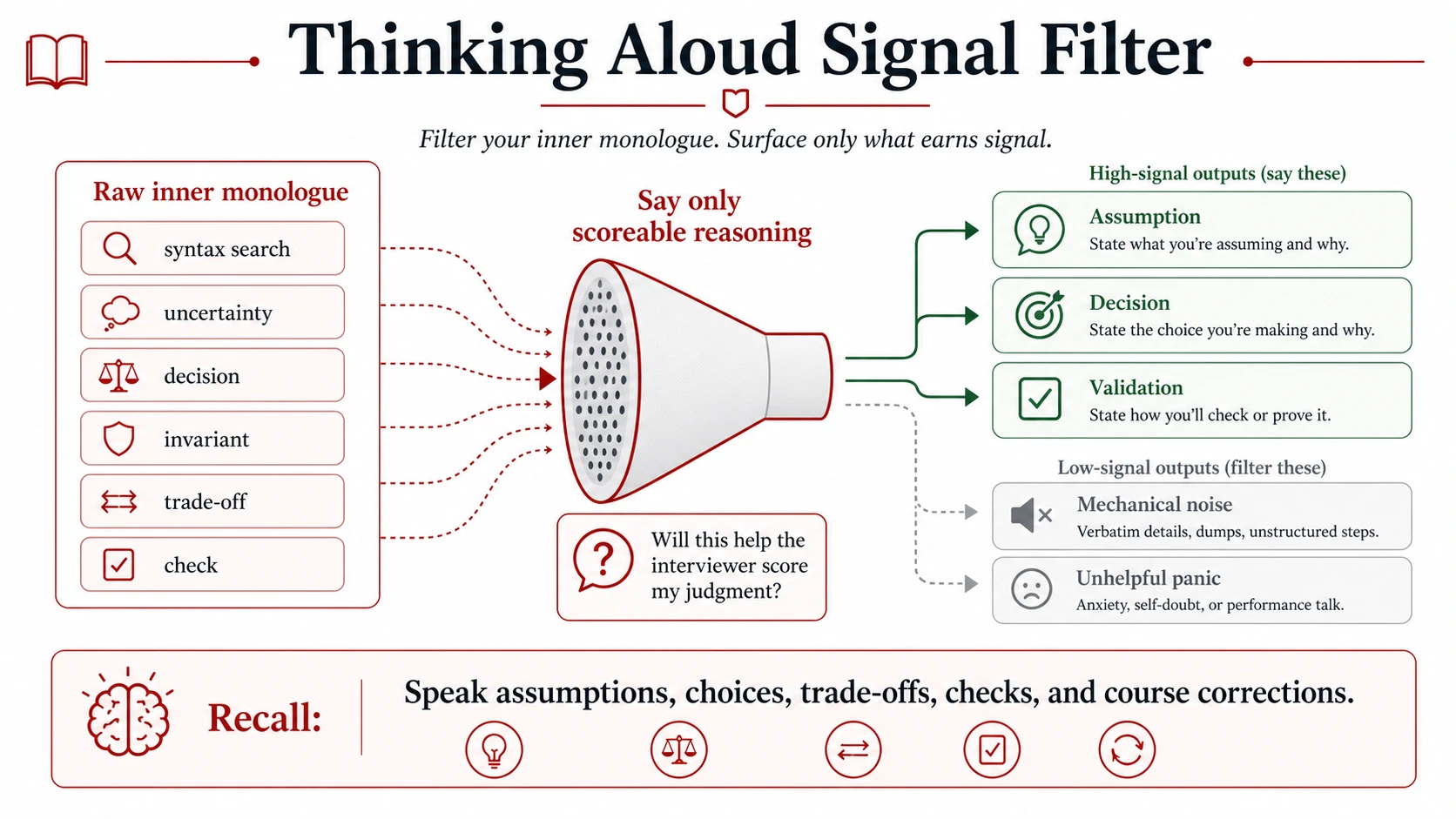
That sentence reveals what failed, what will change, and how you will check the repair. Thinking aloud is not a continuous account of thinking. It is the selective act of making consequential reasoning observable.
Worked example: follow one answer through its boundaries
Consider the prompt:
“Given a list of intervals, merge all overlapping intervals.”
Before reading on, take a moment to form an approach. What would an interviewer need to hear in order to understand why your approach is correct? They do not need your preferred variable names. They do need the boundary condition that could change the result.
A useful opening is short:
“I want to confirm whether touching intervals such as
[1,3]and[3,5]count as overlapping. Then I will sort by start time and scan once.”
The clarification matters because it changes the merge condition. The plan matters because it gives the next several minutes a shape. Neither requires a speech.
Once endpoint behavior is settled, the answer needs a model:
“After sorting, I only need to compare the next interval with the current merged range. Everything already appended to the result ends before that range and cannot overlap anything later.”
This is the hidden correctness argument. Saying “I will sort and loop” names operations; stating what remains true after each iteration explains why those operations solve the problem.
Then the candidate can become quiet. Creating the result list, naming the current interval, and writing an ordinary loop do not need commentary. A brief checkpoint is enough when the phase changes:
“The main scan is in place. I am going to test separation, containment, and touching endpoints before discussing complexity.”
Suppose the containment case exposes a bug: the code replaces the current end
with the next end, so [1,10] followed by [2,4] shrinks the merged range.
Useful narration identifies the violated rule:
“The merged end must never move backward. I should take the maximum of the two ends. I will rerun containment, then a chain such as
[1,3],[2,6],[6,8].”
The interviewer has now observed the whole reasoning path: requirement, model, invariant, quiet execution, discovered counterexample, correction, and validation. They did not have to listen to every keystroke to see it.
The operating model: speak where the work changes state
The interval example suggests a practical rhythm. Speak at boundaries:
- when an assumption becomes part of the problem;
- when you choose a model or plan;
- when you reach a risky or irreversible decision;
- when you move from building to checking;
- when evidence invalidates the current route;
- when you narrow scope or compare trade-offs.
These moments orient the interviewer because the answer is changing state. Between them, use silence for routine work.
This rhythm applies outside coding. In a system design round, “I am adding a queue” is a component announcement. The consequential reasoning is why the boundary exists:
“Notification delivery should not hold open the user write, so I will commit the intent synchronously and move provider fan-out to an asynchronous path. That creates duplicate-delivery risk, so the worker needs an idempotency key.”
In debugging, avoid reading the dashboard aloud. Mark the change in the investigation:
“Errors are confined to one region and began immediately after the deploy. I will mitigate that region first, then compare the new binary and configuration with a healthy region.”
In a project deep dive, the interviewer does not need a tour of every component. Give them the decision that organizes the story:
“The difficult part was not moving the data. It was running old and new ownership models together without losing writes, so I will focus on the cutover protocol and rollback boundary.”
In a behavioral answer, name the example and its relevance, then tell it:
“I will use a production incident where restoring service and preserving evidence pulled in opposite directions. My role was the mitigation decision and the cross-team handoff.”
Different rounds produce different artifacts, but the narration serves the same purpose: it lets another person locate the judgment inside unfinished work.
What senior-level performance sounds like
Senior-level narration is selective without being cryptic. The interviewer can locate the model, the difficult decision, and the check, but routine execution does not become a running commentary. Polish is incidental. What matters is that the answer remains legible while it is incomplete, including when the candidate pauses, changes direction, or needs help.
Failure modes: silence, apology, and unbounded uncertainty
Silence can carry a label
Hard reasoning sometimes needs quiet. Do not fill it merely to prove that work is happening. If the pause will be noticeable, tell the interviewer what you are trying to resolve:
“I need a moment to check whether that invariant survives duplicate input.”
Then pause. When you return, report the result rather than replaying the private search:
“It does not. I need to deduplicate first or make the state transition idempotent; I am choosing the latter because duplicates can also arrive during retry.”
For a longer pause, bound the decision:
“I am comparing heap and sort-and-scan. The deciding question is whether the input must be processed online. If it can be batched, I will take the simpler sort-and-scan route.”
This gives the interviewer a clean place to redirect you. It also prevents a common failure: explaining easy mechanics while disappearing during the reasoning that actually determines the answer.
Uncertainty needs shape, not apology
Uncertainty is ordinary in senior work. An interview becomes harder to follow when every uncertain thought is given equal weight:
“Maybe a heap? I am not sure. Quickselect might be better. I think I remember the partition code.”
Instead, name the live alternatives, their consequence, and the next move:
“A heap is straightforward for top-k and easy to validate. Quickselect gives better expected time if we only need the final set, but its implementation is riskier under this clock. I will use the heap and discuss quickselect as the optimization.”
You have not pretended certainty. You have made a bounded decision.
Syntax uncertainty deserves even less ceremony. If it blocks progress, state the operation you need and keep moving:
“I do not remember the exact ordered-map call. I need the first entry at or after this start time, so I will write that intent and return to the API name.”
Repeated apologies make normal thinking sound like failure. After a real mistake, acknowledge it once and expose the repair. The correction is useful evidence; self-punishment is not.
When the interviewer enters the conversation
Thinking aloud is still a conversation. Stop when the interviewer speaks. A hint, question, or objection may reveal that your model is missing a constraint. Treat the new information as part of the work:
Interviewer: “What if events arrive out of order?”
Candidate: “Then my assumption that I can finalize each window as time advances is too strong. I need either bounded lateness with a watermark or a correction path for closed windows. Let me revise the state model before I continue.”
The response does not defend the discarded approach or pretend the hint was already included. It says what changed and returns to the answer.
Sometimes the interviewer asks for more detail while you are deliberately keeping routine work quiet. Give it. Selective narration is not a rule for withholding information; it is a way to keep the conversation centered on what the other person needs to understand.
Response quality: weak, mid-level, and senior
A weak response hides the difficult reasoning or replaces it with raw monologue. A mid-level response exposes a plan but still narrates easy work, lets alternatives pile up, or announces checks only after prompting. A senior response makes the few consequential turns visible and gives the interviewer room to participate. The progression is not toward more speech. It is toward better selection.
Practice and self-check through subtraction
Record the first ten minutes of a coding, design, or debugging prompt. On the first playback, transcribe only what you said. For each sentence, ask:
- Did it expose an assumption, model, decision, risk, check, or correction?
- Did it orient the listener to meaningful progress?
- Was it mechanical narration or unstructured worry?
- Did I go quiet at the exact moment the difficult reasoning happened?
Do the same ten minutes again. This time, remove mechanical narration and add one sentence at each missing boundary. Do not aim to speak less in the abstract. Aim to make the consequential turns easier to follow.
On a later pass, practice a labeled pause. Say what you need to determine, take twenty quiet seconds, and return with the result in one sentence. This is often harder—and more useful—than filling the time.
A field reference for the next rehearsal
Field reference
Thinking aloud without noise
- Name the model before the details.
- Speak when an assumption, decision, risk, check, or correction changes the work.
- State what remains true, not merely which operation comes next.
- Keep routine typing and syntax search quiet unless they block progress.
- Label a noticeable pause, then return with its result.
- Give uncertainty boundaries: alternatives, consequence, chosen path.
- When evidence or a hint changes the model, say what changed and revise it.
The interviewer does not need access to your inner monologue. They need enough of the structure to understand an answer while it is still becoming one. Once that structure is visible, the next constraint is time: deciding which parts of the answer must be completed before the round ends.