Senior Engineering Interview Handbook / Chapter 18
Run the Application as a Campaign
A practical senior-engineer chapter on referrals, recruiter relationships, application tracking, batching interviews, sequencing target companies, limiting simultaneous loops, and preserving preparation time through the offer stage.
Preparing audio…
Audio edition
Run the Application as a Campaign
Page tools
What the campaign’s process controls protect
By Tuesday afternoon, Elena has a good problem. A referral has produced a hiring-manager call at a company she cares about. Two recruiters want to book technical screens. A fourth company has moved an onsite forward by a week. Each invitation is reasonable by itself. Together, they would consume the evenings she needs to rehearse her design-system migration, restore coding fluency, and prepare for the onsite.
The easy response is to accept every slot while it is available. It also puts her most important interview at the end of a tired week.
A search becomes a campaign when the candidate chooses where the next scarce hour goes. Applications matter, but so do attention, preparation, calendar space, relationship capital, and the ability to learn from one interview before entering the next. The objective is not maximum activity. It is a small set of credible opportunities moving at a pace that preserves the quality of the interview.
Inputs, outputs, and constraints of the tracker
An application is a submission. An active loop is a continuing decision: one company and role, the evidence that makes it plausible, its current stage, the next action, the preparation it needs, and the date on which waiting becomes a problem.
That is the useful unit in a tracker. Elena’s entry for the referral looks like this:
Northstar / Senior Frontend Platform Engineer
Priority: high
Why this role: design-system migration, developer tooling, cross-team adoption
Stage: hiring-manager call on Thursday
Next action: confirm team scope and first-six-month problem by Wednesday
Preparation: 60-minute migration-story rehearsal; questions from company brief
Constraints: remote; compensation range unconfirmed
Risk: role may be feature leadership rather than platform ownership
Decision window: technical round likely next week
The form can be a spreadsheet, database, or notes file. It should show, without searching the inbox:
- the company, role, priority, and source of the opportunity;
- the recruiter, coordinator, referrer, or hiring-manager contact;
- the current stage, next action, owner, and date;
- known constraints such as location, authorization, compensation, timing, travel, and working model;
- the round sequence, permitted tools, and preparation focus;
- the main risk, eventual outcome, and lesson.
If an entry has no next action, it is either waiting on a named person until a named date or it is no longer active. This one rule keeps the tracker from becoming a museum of old applications.
Priority determines how much attention a role may spend
Not every plausible role deserves the same campaign. Before adding volume, sort opportunities by fit and opportunity cost.
A high-priority role has convincing alignment with your evidence, attractive work, and acceptable known constraints. It earns company research, a tailored resume pass, a referral attempt when appropriate, careful scheduling, and protected preparation. A solid role worth serious exploration gets moderate tailoring; preparation deepens if the recruiter or hiring-manager conversation improves the evidence of fit. A calibration role is close enough to teach you something but is not where you intend to spend the most attention. An excluded role fails a material constraint or has too little connection to the work you want.
This is not a prestige ranking. A famous company can be a calibration target when the role is wrong. A small company can be the highest priority when the scope, manager, domain, and constraints match.
For every high-priority role, write one sentence that connects the work to your evidence:
I am pursuing this role because it needs a hands-on platform engineer who can
move a shared frontend system into use across product teams; my strongest
evidence is leading a design-system migration and the adoption work around it.
If you cannot write the sentence, you may have an interesting lead, but you do not yet have a reason to spend priority-level attention.
Sequence for learning before stakes rise
Recruiter delays, paused headcount, surprise referrals, and offer deadlines make a perfectly ordered search impossible. Deliberate sequencing still prevents the costliest mistakes.
- Begin with one or two credible warm-up processes. They should resemble the work you want closely enough that the feedback transfers. Use them to find rust in your materials, stories, tools, and live reasoning.
- Build the core pipeline with solid-fit roles. Correct obvious conversion or preparation problems while the cost of learning is still moderate.
- Bring the highest-priority companies forward once your performance is stable. Do not wait for an imaginary state of perfect readiness; wait only long enough to remove the failures you can already see.
- As serious processes reach their final stages, try to keep their decision windows close enough for comparison. Communicate real deadlines early and never invent an offer or competing process.
Warm-up does not mean interviewing for work you would never accept. An irrelevant loop consumes time without producing useful learning and treats the other side carelessly. The role should remain a genuine possibility.
Referrals are for routing, not borrowed proof
A referral can put a relevant application in front of the right person with a small amount of borrowed credibility. It cannot supply role fit or interview evidence. Use it where better routing would justify the social cost, usually for priority roles.
Make the request easy to assess and easy to decline:
Hi Maya — I am applying for the Senior Frontend Platform role on the Design
Systems team. My recent work leading a shared-component migration and adoption
across product teams looks relevant. Would you be comfortable referring me or
pointing me to the right recruiter? No pressure if you do not know my work well
enough; I can send a two-line summary and resume.
Send the exact role, a short and accurate account of the fit, and a clear ask. Do not ask a weak contact to imply knowledge they do not have, ask for confidential interview material, or make the referrer invent your positioning. Let them know, briefly, if the referral leads to a meaningful result.
Recruiter conversations establish the operating boundaries
Recruiter calls are where uncertainty about level, scope, location, authorization, compensation, timing, process, and tools can become explicit. Treat those details as campaign inputs, not as awkward questions to postpone until an onsite.
After a material call, a short confirmation can expose a misunderstanding while it is still cheap:
Thanks for the conversation. My understanding is that this is a hands-on
senior platform role focused on design-system adoption, remote work from my
location is supported, and the next stages are coding, system design, and a
project deep dive. I still need to confirm the compensation range and whether
the coding round uses a shared editor or local IDE.
When a proposed slot would leave a serious round underprepared, ask for a different one directly:
I can make tomorrow work for a short recruiter call. For the technical screen,
could we use Thursday or Friday? That gives me time to prepare the environment
and give the round proper focus.
The request may not always be granted. Making it is still better than silently funding the schedule with sleep or hoping preparation will appear after the calendar fills.
Failure modes: too many interviews in progress
Active technical loops consume much more attention than open applications. Each one creates company research, rehearsal, logistics, context switching, the interview itself, and a post-round review. Capacity therefore depends on the candidate’s job, caregiving, health, time zones, and current fluency—not on how many invitations arrive.
For many people working full-time, two or three active technical loops is a useful starting limit, with no more than one onsite or final loop in a week when scheduling allows. This is a planning assumption, not a standard to meet. Use a lower limit if preparation is already disappearing. A candidate between roles with a stable practice routine may be able to carry more.
Reserve preparation before accepting the slot. A recruiter screen may need a role thesis, constraints, and process questions. A coding round may need language and editor warm-up. System design needs work on relevant constraints and failure modes. A project deep dive needs an architecture sketch, evidence, mistakes, and cross-team decisions. A final loop needs coherent stories, reverse-interview questions, logistics, and rest.
The campaign is overloaded when you confuse round formats, cannot state why an active role fits, give generic answers across companies, drop practice blocks, or replace project rehearsal with last-minute rereading. Pause outbound applications, delay a lower-priority round, or decline a poor-fit process before those symptoms reach the interview that matters most.
Worked scenario: campaign decisions and trade-offs
Elena’s four opportunities cannot all receive equal treatment. Her tracker makes the trade-offs visible.
The referral role is high priority and has a hiring-manager call on Thursday. She keeps the call, finishes the company brief, and rehearses the migration story once. A solid second company offers technical slots on Wednesday and the following Monday; she chooses Monday. A calibration company wants a Friday technical screen, but its mandatory office schedule conflicts with her stated constraints, so she declines rather than keeping it as practice. The onsite that moved forward would collide with an on-call handoff and leave no design preparation, so she asks to keep the original date.
Those choices leave two active technical loops and one recruiter-stage conversation. She pauses new applications for the week. The campaign has not stalled; it has made room for performance.
After the hiring-manager call, Elena learns that the priority role owns product features more than the shared platform. She updates the role thesis instead of defending her first interpretation. The opportunity remains attractive, but its priority falls. That released attention can go to the onsite or to a new target with stronger platform scope.
This is what campaign control looks like in practice: priority changes when the evidence changes, and the calendar changes with it.
Diagnose the funnel upstream
The funnel shows where opportunities stop moving, but the place where a rejection arrives is not necessarily where the problem began.
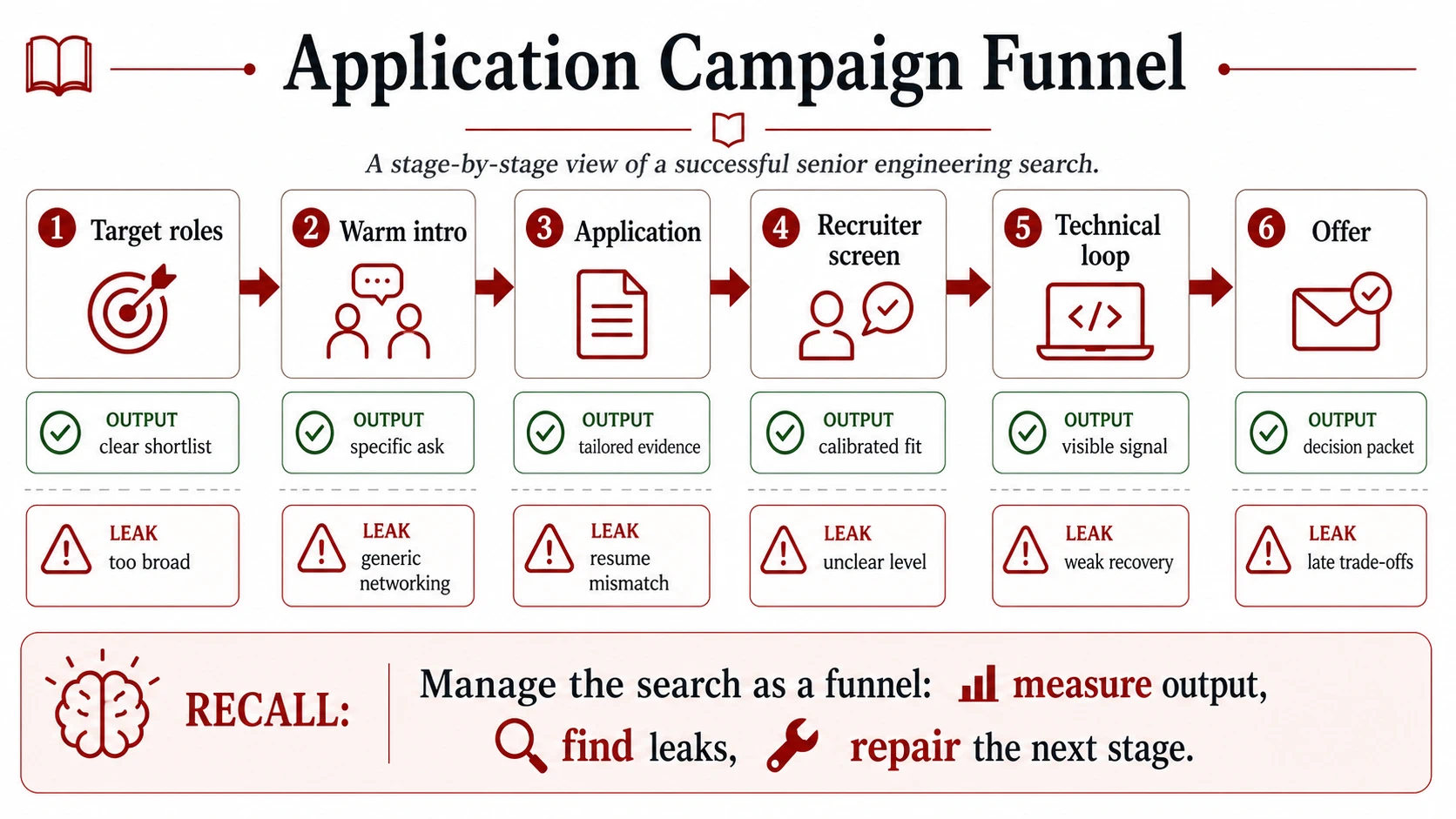
Few recruiter screens from many applications usually call for a closer look at target choice, resume relevance, or routing. Recruiter conversations that rarely advance may expose a level, location, compensation, or role-thesis mismatch. Repeated technical-screen exits point toward fluency, model choice, communication, tool comfort, or scheduling without enough preparation. Final loops without offers deserve comparison across project depth, behavioral evidence, system-design judgment, fatigue, and role fit. Weak or surprising offers may begin with target selection or constraints left unresolved much earlier.
Do not change application volume, resume, target category, referral strategy, and practice routine in the same week unless circumstances force you to. Pick the most plausible leak, make one meaningful correction, and watch the next set of outcomes. Small samples are noisy; the tracker should improve judgment, not manufacture certainty.
A weekly campaign cadence
A light operating rhythm keeps the inbox from deciding the search. At the start of the week, choose the applications, follow-ups, preparation blocks, and interviews that fit actual capacity. Triage messages daily so scheduling does not become a crisis. Before each round, review the role thesis, company brief, format, and specific risk. Afterward, record what happened while memory is fresh.
At the end of the week, ask three questions:
- Which active loops deserve preparation next week?
- Where did opportunities stop moving, and what evidence supports that diagnosis?
- What should be accelerated, delayed, paused, or declined so the strongest opportunities remain well prepared?
The answers should alter next week’s calendar. Otherwise the review is only a status report.
Practice: build your campaign on one page
Campaign control pass
45 minBefore increasing application volume, read the page once. Can you explain why each high-priority role fits? Are material constraints known early enough? Does every live loop have a next action or a waiting date? Are your most demanding rounds preceded by real preparation blocks? Are priority interviews sequenced after useful live practice? If any answer is no, more applications will amplify the problem rather than solve it.
Field reference
Field reference
Application campaign
- Manage active loops, not submission count.
- Give every priority role a one-sentence connection to your evidence.
- Sequence credible warm-up, core, priority, and late-stage processes.
- Use specific, low-pressure referral requests where routing matters.
- Clarify scope, level, compensation, location, process, timing, and tools early.
- Track the next action, preparation need, risk, and decision window.
- Limit technical loops to the number your preparation time can support.
- Diagnose funnel leaks upstream and change one major variable at a time.
- Communicate real deadlines; never manufacture leverage.
- Protect the calendar on which interview performance depends.
The campaign ends at the door of the live interview. Once the prompt arrives, the scarce resource is no longer calendar space but control of your reasoning. The next chapter develops the operating loop for that moment.