Senior Engineering Interview Handbook / Chapter 104
Root-Cause Analysis and Learning Reviews
A production-engineering chapter that carries the payment-routing incident into a learning review, from evidence and causal reconstruction through accountability, corrective action, and verification.
Preparing audio…
Audio edition
Root-Cause Analysis and Learning Reviews
Page tools
The easy story arrives first
The payment incident from the previous chapter has ended. Provider B is still disabled, authorization success is healthy, the 642 ambiguous requests have been reconciled, and duplicate checks are clean. The incident record now contains two findings that appear to settle the matter: provider B changed its timeout behavior during a regional degradation, and the checkout release classified one ambiguous response as safe to retry.
An easy review would choose one of those findings as the root cause. Blame the provider, and the problem sits outside the company. Blame the release, and one code fix appears to close the incident. Neither account explains why an ordinary dependency failure could reach customers, why the response was ambiguous, or which defenses kept the incident from becoming a financial integrity failure.
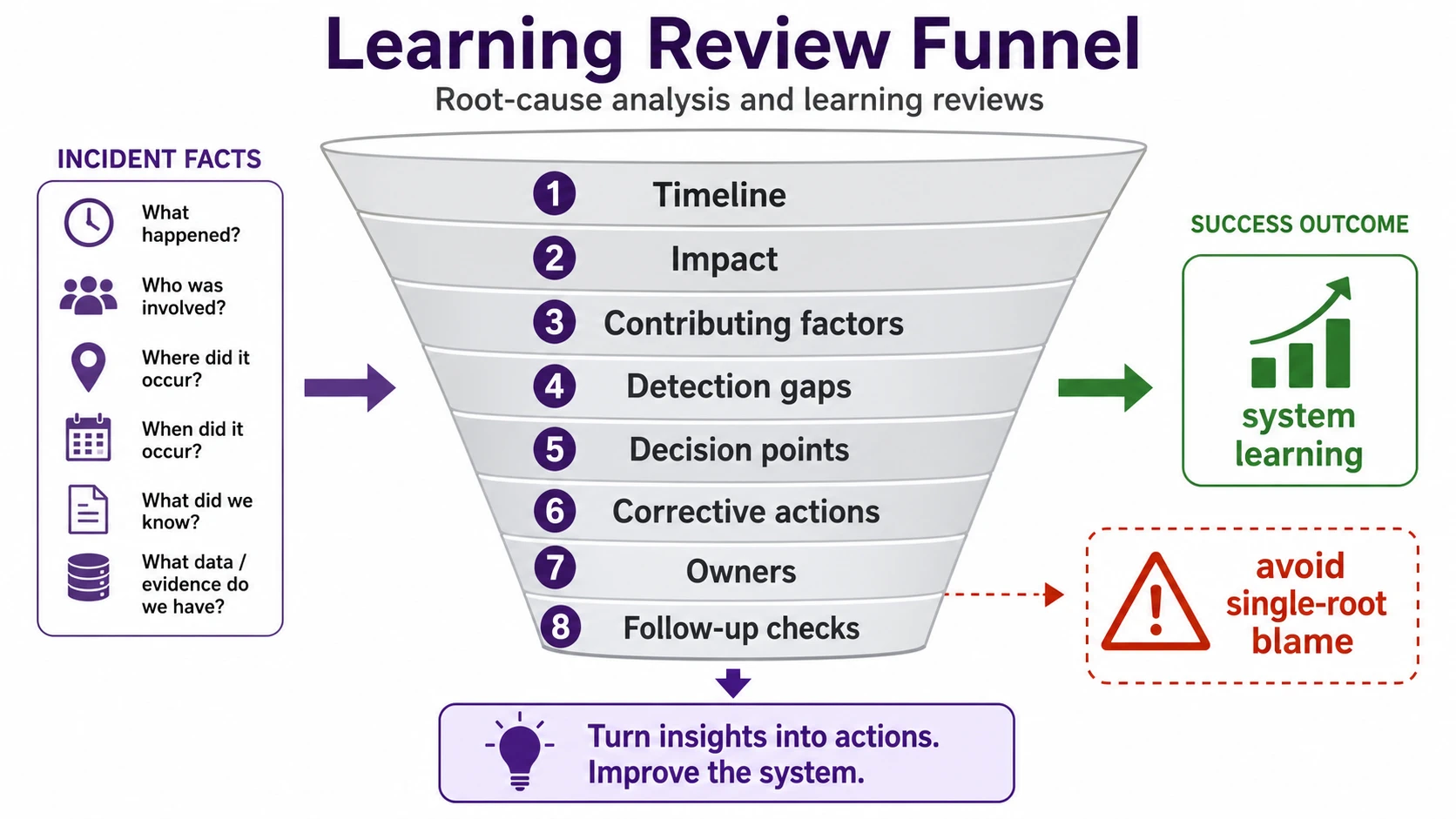
A learning review must resist the first complete-sounding story. Its work is to reconstruct how the system produced the outcome, including the technical mechanism, the conditions that enlarged or contained it, and the decisions that made sense while evidence was incomplete. Only then can the team choose changes that alter the next incident rather than merely rename this one.
Begin with the record, not the meeting
The learning review starts before people gather. A facilitator assembles the alert history, deploy and flag changes, provider responses, representative traces, support reports, the decision log, mitigation results, reconciliation output, and the recovery checks. The packet preserves what responders knew at each decision point; it does not silently replace that knowledge with facts discovered later.
For the payment incident, the shortest useful timeline is already revealing:
- at 13:35, the checkout release began serving 20 percent of US traffic;
- at 14:03, the routing flag sent part of that cohort to provider B;
- at 14:05, US card-authorization failures rose from 0.2 percent to 8 percent;
- at 14:13, the team stopped new provider-B traffic and paused automatic retries of ambiguous results;
- at 14:20, new authorization success returned to baseline, while 642 requests still required reconciliation;
- at 14:37, the team connected provider timeouts with the release’s retry classification;
- at 15:05, the queue was empty, payment and order state reconciled, duplicate checks remained clean, and the incident moved to watch.
The timeline contains different kinds of statements. The timestamps and measurements are facts. “Provider B caused the incident” is an interpretation. “A canary would have prevented it” is a hypothesis about a defense. Keeping those categories visible prevents the loudest early theory from hardening into the official history.
Impact deserves the same discipline. Customers experienced failed card authorizations and uncertain payment outcomes; support contacts increased; the team had to shift traffic and reconcile requests. The duplicate risk was serious, but the checks were clean. A review that says customers were charged twice would exaggerate the incident. A review that records only elevated error rates would erase the customer journey and the trust risk that shaped the response.
Follow cause through the system
“Root cause” is useful only when it encourages depth. In a production system, the more productive question is usually: which conditions made this failure possible, harmful, long-lived, or hard to understand?
The payment event has several causal layers.
The trigger was the provider’s regional degradation and changed timeout behavior. It exposed a weakness, but a dependency timeout is not by itself an explanation for how customer state was handled.
The proximate mechanism was the checkout release’s treatment of an ambiguous response. A transport timeout proved that no answer arrived; it did not prove that the provider had rejected the authorization. Classifying that state as an ordinary retryable failure created the risk of repeating a financial side effect.
The contributing conditions are the controls and assumptions around that mechanism. Did the provider contract describe timeout-after-acceptance? Did tests replay that behavior? Which outcome metric governed the routing change? Could an unknown result exist as an explicit state, or did the model force it into success or failure? Was the reconciliation path a designed control or an improvised rescue? Each answer needs evidence from contracts, tests, release configuration, code, and the incident record.
A systemic finding requires evidence beyond this one defect. Suppose the review finds that several customer-visible operations treat a missing response as a failed operation, and that release review has no standard for ambiguous side effects. The durable problem is then larger than one conditional: the platform lacks an explicit contract for uncertainty at side-effecting boundaries. If the pattern appears nowhere else, the review should not inflate a local bug into a cultural diagnosis.
This layering does not absolve the engineer who wrote or approved the retry classification. It makes the accountability useful. The review can name the decision, inspect the evidence available in code review, and ask why the unsafe classification looked valid. “The engineer forgot idempotency” ends inquiry at the person closest to the code. “The provider contract, state model, and replay tests did not represent ambiguous success” identifies work the organization can actually perform.
Preserve what worked
Failure analysis easily becomes a catalogue of absence. That produces a distorted system model. Several defenses in this incident changed the outcome: the alert preserved provider and region slices; the routing flag allowed a bounded traffic shift; the team paused retries rather than guessing; traces and provider references supported reconciliation; and recovery criteria kept the incident open after the headline rate turned green.
Those controls are not side notes. They show where to strengthen the system without replacing working machinery. The team might generalize the explicit reconciliation state, retain the provider-sliced alert, and make the route disablement easier to discover. A review that records only defects may remove or bypass the very controls that limited harm.
This is also why the counterfactual question must be precise. “What would have prevented the incident?” invites an imaginary perfect system. Better questions are smaller:
- Which control would have prevented an unknown authorization from being retried automatically?
- Which release signal would have stopped provider-B exposure earlier?
- Which artifact let responders classify the 642 uncertain requests safely?
- If that artifact had been absent, what recovery work would have remained?
The answers reveal prevention, containment, detection, and recovery as different engineering jobs.
Make the room safe enough for inconvenient facts
People conceal information when the review feels like a trial. They also learn to speak in evasions when “blameless” is used to forbid criticism. A useful facilitator protects neither comfort nor accusation; the facilitator protects the quality of the account.
Start with the shared purpose and the verified timeline. Ask participants what they believed, what signal supported that belief, which options they saw, and which constraints shaped the choice. The phrase “reasonable with the information available” is a question to investigate, not a verdict granted in advance.
If someone bypassed a release gate, say so. Record who owned the decision and what the gate was meant to prevent. Then examine whether bypass authority was clear, whether the risk was visible, what pressure existed, and why the system accepted the change. Deliberate misconduct and repeated disregard may require a separate management process. Turning the learning review itself into that process makes everyone else’s evidence less trustworthy.
Review depth should follow consequence and uncertainty. A narrow internal-tool failure with an obvious repair may need an asynchronous note. Customer harm, data integrity risk, a repeated failure, a long recovery, or disputed cross-team ownership warrants facilitated reconstruction and formal follow-through. Security, legal, privacy, or contractual concerns may also restrict distribution; they do not remove the need for an evidence-based technical account.
Choose actions that change behavior
The meeting has not succeeded when it has filled an action tracker. It has succeeded when it has chosen a small set of changes with a credible path to lower probability, smaller blast radius, earlier detection, safer recovery, or better understanding.
For the payment incident, “fix retries,” “add monitoring,” and “be careful with provider changes” are labels, not actions. The causal account supports sharper work:
- The payment-platform owner introduces an explicit
unknownauthorization outcome. Automatic retry cannot consume that state; reconciliation or a provider query must resolve it first. - The checkout owner adds contract tests for timeout-before-acceptance and timeout-after-acceptance. The latter test must show that one customer action produces at most one effective authorization, even when the transport attempt is repeated.
- The release owner gates routing expansion on provider-sliced authorization success and growth of the ambiguous-outcome queue, with a tested action that stops further exposure.
- The service owner keeps provider B disabled until the contract, state model, and tests are reviewed, then exercises the reconciliation path during a controlled rollout.
Each item still needs a named person, priority, due date, and verification evidence in the real review record. The list is deliberately short. A proposal to redesign every payment integration may be worthwhile, but it belongs in a separate design decision with its own scope and trade-offs. Hiding a quarter of architecture work inside a post-incident task is not follow-through.
The action set should also match the causal claim. If the review says the health model concealed regional failure, another global dashboard is not a repair. If a backfill preserved row counts while corrupting account meaning, a faster progress counter is not a repair. The proposed control must interrupt the path the review says produced harm.
Completion is evidence, not a merged pull request
An action closes when its intended effect has been demonstrated. For the new
authorization state, the team can inject an accepted request followed by a
lost response and observe that the system records unknown, suppresses an
automatic retry, reconciles the provider result, and leaves one consistent
customer outcome. For the rollout gate, the team can introduce a small rate of
ambiguous responses and show that exposure stops before the queue or customer
failure rate crosses its bound.
Those checks may reveal that an action was well implemented but weakly chosen. Perhaps the provider cannot answer reconciliation queries quickly enough, or the gate reacts after most of a small cohort has already been exposed. The follow-up should revise the control, not defend the completed ticket.
Over time, the organization can ask a harder question: when the same class of uncertainty appeared again, was it detected earlier, contained to fewer customers, recovered with less manual work, or understood with better evidence? That is the point at which a learning review becomes part of the system rather than a document about its past.
Show the reasoning in a senior interview
In a production or behavioral interview, a learning-review story is strongest when it remains causal. State the customer impact, then distinguish the event that exposed the failure from the mechanism that produced harm. Explain two or three contributing conditions, including what worked. End with the actions chosen and the evidence that later tested them.
A compact version might sound like this:
The provider degradation triggered the incident, but the dangerous mechanism
was our treatment of a missing response as a failed authorization. The review
found that our state model and contract tests had no representation for
ambiguous success. Provider-sliced alerts and a reconciliation queue limited
the harm. We added an explicit unknown state, replay tests, and a rollout gate,
then fault-injected timeout-after-acceptance to verify that one customer action
could not silently become two authorizations.
That account owns the defect without turning one person into the explanation. It also avoids the opposite failure: using “systemic” language so broadly that nobody can tell what changed.
To practice, change one fact. Imagine that the timeout behavior was fully documented, but the team knowingly accepted the risk to meet a deadline. The technical mechanism stays the same; the questions about authority, incentives, and accountability change. Rebuild the causal account and the action set. A memorized postmortem template will not survive the variation, but a disciplined separation of evidence, mechanism, conditions, and verification will.
The next chapter moves from learning about a failed change to planning a risky one. The connection is direct: migrations are safest when the intermediate states, evidence, and recovery paths are designed before production has to teach them through an incident.