Senior Engineering Interview Handbook / Chapter 20
Asking High-Value Clarifying Questions
A practical senior-interview chapter on asking high-value clarifying questions in coding, system design, debugging, project, and behavioral rounds while avoiding question lists that stall progress.
Preparing audio…
Audio edition
Asking High-Value Clarifying Questions
Page tools
What the questioning method controls
Suppose the prompt is:
“Design a system for sending appointment reminders.”
You could ask how many users it has, which database to use, whether it should scale, whether security matters, and whether caching is required. The words sound technical. The answers may still leave you unable to say what the system is for.
Try a harder exercise before reading on: choose one first question. It must separate two meaningfully different designs.
The difficulty is not finding missing information. Almost every prompt is missing dozens of facts. The difficulty is finding the uncertainty whose answer changes the work. Clarification consumes the same scarce interview time as modeling, coding, drawing, and validation. A question should earn that time.
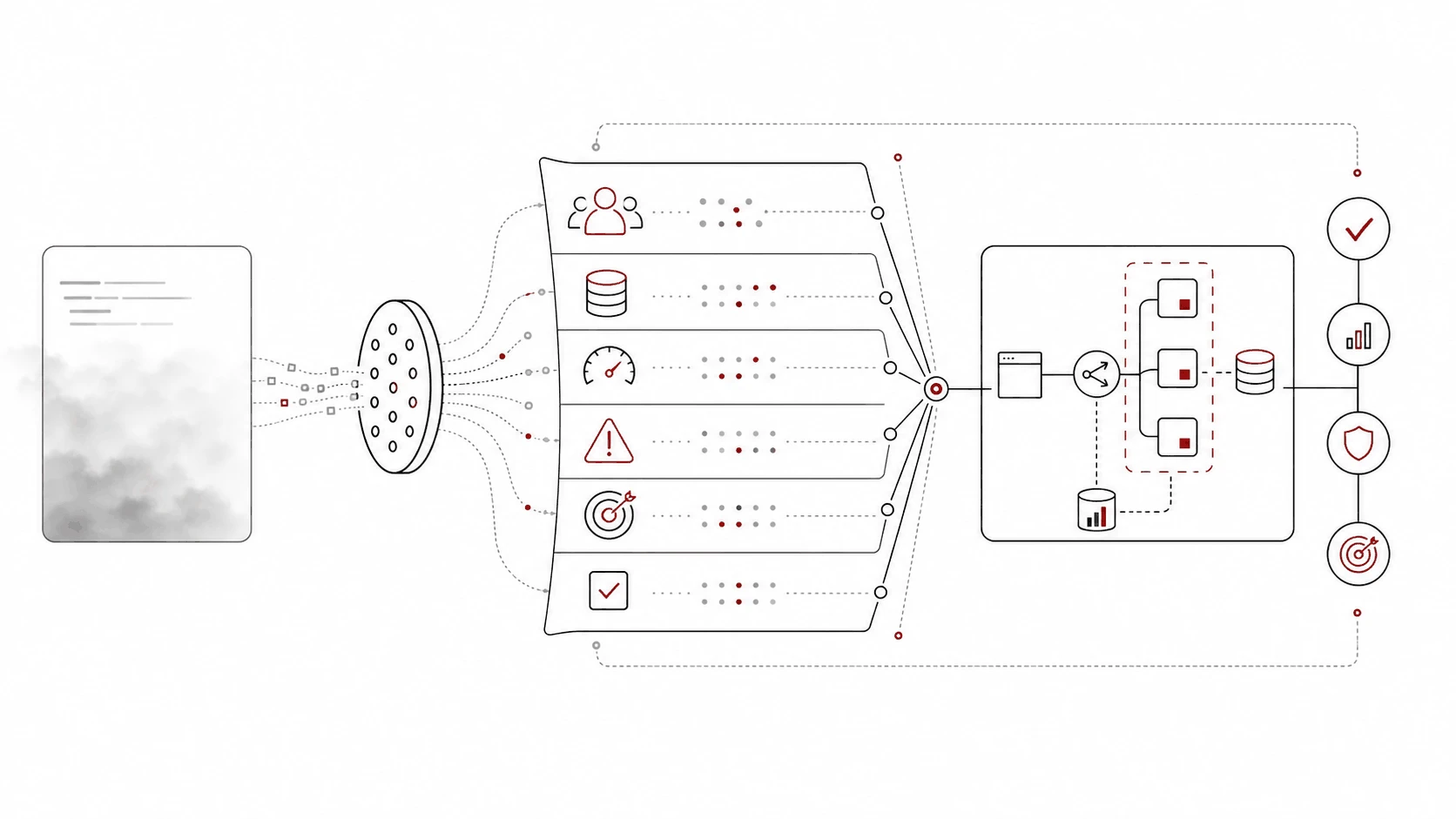
The operating model: find the fork in the answer
A useful first question for the reminder prompt is:
“Where do appointments come from: are users scheduling them here, or does an existing appointment system own them?”
If this service creates appointments, it owns scheduling rules and appointment state. If another system owns them, the design instead needs to consume changes, preserve source identity, and cope with cancellations or reschedules arriving late. The question exposes a fork in the architecture.
That fork gives you a private test for any clarifying question:
The test is counterfactual. Imagine both plausible answers and name what you would do differently. “What is the scale?” is weak when it is a ceremonial request for a number. “Is the hard part sustained write volume, bursty fan-out, large payloads, or geographic latency?” is useful because each answer pressures a different part of the design.
You need not explain every counterfactual aloud. Often the contrast can be heard in the question itself:
“Can values be negative? If they can, the sliding-window approach I have in mind will not be valid.”
“Do reads need to observe the latest write, or can they be briefly stale? That determines whether I can use asynchronous replication on this path.”
The candidate still owns the solution. Asking “Which database should I use?” hands an implementation decision to the interviewer. Asking about the required consistency exposes the constraint that should govern that decision.
Worked example: an interaction becomes a design
Return to appointment reminders. Watch how a short exchange turns a broad noun into a workable system.
Clarifying without stalling
Candidate: “Where do appointments come from: are users scheduling them here, or does an existing appointment system own them?”
Interviewer: “A clinic’s appointment system owns them.”
Candidate: “Then I will treat appointment state there as authoritative and keep reminder intent and delivery state here. Which channels are required for the first version?”
Interviewer: “Email and SMS.”
Candidate: “For failure behavior, is a late reminder still useful, or must it expire once the appointment begins?”
Interviewer: “It must expire. Duplicate reminders are also worse than a small timing delay.”
Candidate: “That puts the main correctness pressure on reschedules, expiration, and idempotent delivery. I will assume one region and ordinary clinic-scale volume for the first design. I will start with the state model, then trace a rescheduled appointment through both providers.”
Each answer changes the design. An external source of truth requires an ingestion boundary and reconciliation. Two channels introduce preferences, provider-specific attempts, and delivery results. Expiration and duplicate intolerance make blindly retrying unsafe. The final assumptions are explicit, cheap to correct, and do not conceal the central risk.
Notice the exit. The candidate does not continue through a prepared inventory of data retention, global traffic, analytics, accessibility, and administrator roles. Those may matter later. Enough is known to build a model and test the risky path.
Senior-level performance: ask, assume, begin
Good clarification has a short movement:
- Name the uncertainty that can redirect the answer.
- Ask a question that distinguishes plausible cases.
- Use the answer immediately.
- State minor assumptions and begin.
The third move is the one candidates often miss. If you ask whether touching intervals count as overlapping, the merge condition and tests must reflect the answer. If you ask whether a notification may be late, the queue policy, expiration checks, and walkthrough must reflect it. An unused answer makes the question look like ritual.
Assumptions are not an inferior form of clarification. They are how you keep ownership of ordinary uncertainty. A good assumption is plausible, visible, cheap to reverse, and outside the main trade-off:
“I will assume authentication already exists and focus on authorization for this workflow.”
“I will design the first version for one region and identify what breaks if we later require multi-region operation.”
Do not hide a trust or correctness decision inside an assumption. Data loss, payment duplication, exposure of sensitive records, or an emergency action that may arrive late usually deserves a question because the wrong answer changes the safety of the system.
Stop clarifying when you can choose a model, name the first plan, and identify what “correct enough” means. The objective is shared direction, not complete requirements discovery.
Which uncertainty deserves the next question?
When several gaps compete for attention, begin high in the causal chain. Components and edge cases depend on behavior; behavior depends on who is using the system and what they are trying to accomplish.
First establish the required behavior and its boundary. Who initiates the workflow, who is affected, and what is explicitly out of scope? A reminder service for patients differs from an internal task queue for clinic staff even if both send messages.
Then locate the data that makes the behavior true. What is authoritative? Can records arrive late, repeat, change, or be corrected? In coding, this becomes the input and output contract: ordering, duplicates, mutability, precision, and tie-breaking. In a project discussion, it becomes the evidence needed to support a claim rather than merely describe activity.
Ask about scale only at the dimension that could defeat the simple approach. Peak fan-out, tenant skew, object size, geographic distance, and sustained writes are not interchangeable. If no plausible scale answer changes the first design, state a baseline and continue.
Finally, look for the failure or success condition that changes the posture of the answer. Must a failed action block, retry, degrade, or expire? Who notices and repairs it? What outcome would make the first version successful? These questions often reveal queues, idempotency, audit history, operator tooling, or validation work that a happy-path prompt keeps hidden.
This is a reasoning order, not a checklist. One answer may settle several questions at once. The appointment exchange established source ownership, channel scope, failure behavior, and the first validation path in three turns.
The method changes shape by round
In coding, clarification protects the correctness contract. Ask about a fact that could invalidate the algorithm or change its boundary conditions:
“Should adjacent intervals such as
[1, 3]and[3, 5]merge, or only intervals with strict overlap?”
Input size matters when it separates a simple quadratic baseline from a needed subquadratic approach. Duplicates, negative values, ordering, overflow, and deterministic output matter when they change the invariant or tests. Whether you should use a hash map is usually yours to decide.
In system design, clarify product pressure before naming components. The critical user path, source of truth, consistency need, failure response, and operator role justify the cache, queue, reconciliation job, or audit log. A component list asked as questions is still a component list.
In debugging, blast radius comes before root-cause theory. Establish the exact symptom, when it began, who or what is affected, and whether customer impact requires mitigation now. “Do errors cluster by region, tenant, endpoint, or provider?” divides the search space. “Could it be the database?” merely adds a hypothesis without evidence.
Project and behavioral rounds need lighter clarification. The useful question selects evidence:
“Would you like me to focus on the migration decision, the rollout, or the cross-team conflict it created?”
“Would a peer disagreement or a delivery-pressure example be more useful?”
Ask once, choose the strongest relevant slice, and answer. Repeated negotiation of a behavioral prompt can sound like reluctance to own a story.
Response quality: weak, mid-level, and senior
A weak response guesses at hidden requirements or waits for the interviewer to frame the work. A mid-level response asks relevant questions but may collect answers without ranking them, then begins with the same plan it would have used before asking. A senior response is visible in the handoff: the answer changes, minor uncertainty becomes explicit assumptions, and the work starts with a clear target. The difference is not polish or question count. It is whether the clarification produced a better decision.
Failure modes: when clarification becomes avoidance
The most common failure is a memorized survey. It treats every prompt as if it must answer the same sequence about users, scale, security, reliability, and success. The categories are sensible; asking all of them without ranking is not. Replace the survey with a hypothesis about what could change the answer.
Another failure is disguised permission-seeking: “Should I use a queue?” “Should I optimize this?” “What would you like me to do?” Requirements belong to the shared conversation; engineering choices remain yours. Ask for the latency, delivery, or scope constraint, then make the choice and explain it.
Some candidates keep questioning because the interviewer continues answering. An interview is cooperative, so this can feel productive long after the answer has a target. Give the clarifying phase an exit sentence:
“Given those constraints, I will assume one region and start with the core workflow. I will return to geographic distribution if the failure analysis makes it necessary.”
That sentence marks progress without pretending uncertainty has disappeared.
Practice the fork, not the questionnaire
Three-question cap
20 minThe cap is practice pressure, not a rule for real interviews. It forces each question to compete for time and reveals whether you can move from an answer to a decision.
Self-check and field reference
Field reference
High-value clarification
- Find the uncertainty whose plausible answers lead to different work.
- Ask for a requirement or constraint; do not ask the interviewer to make your implementation choice.
- Name the consequence when it is not obvious.
- Use the answer in the model, plan, artifact, or validation.
- Turn minor, reversible gaps into explicit assumptions.
- Stop when you can choose a model, begin a plan, and define success.
Private test: Would a different answer change what I do next?
Clarification makes the target trustworthy. The next task is to keep the reasoning visible while you pursue it—without making the interviewer listen to every thought that does not affect the work.