Senior Engineering Interview Handbook / Chapter 110
Responsible Engineering
A production-engineering foundation chapter that develops security, privacy, accessibility, safety, abuse prevention, auditability, release control, and escalation through an enterprise bulk-action case.
Preparing audio…
Audio edition
Responsible Engineering
Page tools
The feature works. Should it launch?
An enterprise customer wants its administrators to disable hundreds of user accounts at once. The request is tied to a renewal. Engineering can meet the date by putting the existing single-account endpoint in a loop and adding a confirmation dialog.
That implementation can be correct and still be irresponsible.
A mistaken upload could lock an entire office out of its tools. A compromised administrator could remove access before defenders react. A role check that is valid at preview time might be stale by execution time. The uploaded file could leave employee identifiers in logs and support systems. A mouse-only preview could prevent an administrator from noticing that the wrong people were selected. If the operation succeeds for 497 accounts and fails for three, neither “complete” nor “failed” tells support what happened.
These are not objections from outside engineering. They are properties of the system the team is about to release.
The useful question is therefore not whether the feature is ethical in the abstract. It is: what must the system do differently because this action can harm people or betray their trust?
Begin at the trust boundary
The new capability allows one person to change many other people’s access. That is the trust boundary. Naming it immediately gives the design something more exact than a list of virtues.
Security asks whether the actor has authority for this tenant, this operation, and every target. Privacy asks which identifiers the batch consumes, where they appear, and how long they remain. Accessibility asks whether an administrator using a keyboard or assistive technology can inspect the selection, understand conflicts, and recover from errors. Safety asks how a mistake is contained and reversed. Abuse prevention treats a compromised or malicious administrator as a plausible actor rather than an exotic edge case. Auditability asks what a customer, investigator, or support engineer will need to reconstruct later.
Those concerns share a center: a high-impact action needs a bounded path from intent to effect. The design should make the affected set visible before execution, enforce authority at the moment of change, tolerate retries without repeating harm, preserve enough evidence to explain the result, and offer a credible way back.
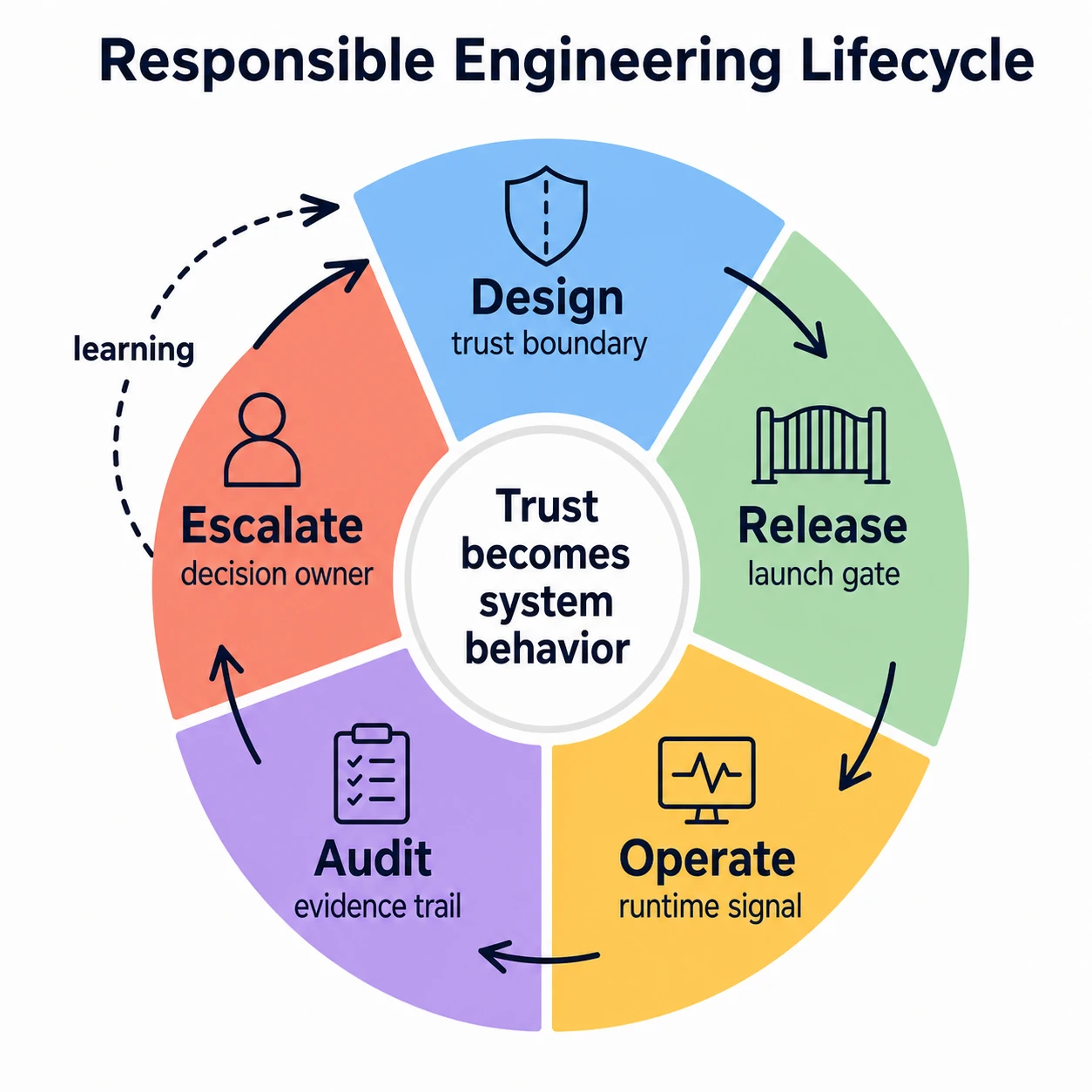
The wheel is a sequence, not a compliance worksheet. Design establishes what the feature may do. Release tests the team’s claims about it. Production reveals behavior the design did not predict. Audit makes that behavior investigable. Escalation resolves the risks that code alone cannot decide. What the team learns goes back into the design.
Trace one batch from intent to effect
Suppose an administrator uploads a list of employee identifiers. Before any account changes, the service creates a batch with a stable identifier, records the actor and tenant, and resolves each identifier within that tenant. It then produces a preview: eligible accounts, unknown identifiers, already-disabled accounts, policy conflicts, and the consequences of proceeding.
The preview is not merely a nicer confirmation dialog. It is the first safety boundary. It lets the administrator detect a wrong file or unexpected scope while the action is still reversible at zero cost. The critical information must be available through semantic structure, keyboard navigation, meaningful focus order, and text—not color or pointer interaction alone. Accessibility here improves the control itself: a review that some administrators cannot reliably perform is a weaker review for everyone.
Confirmation creates a batch command, not hundreds of unrelated button
clicks. The command carries the tenant, actor, authority used, stated reason,
policy version, and an idempotency key. Each target has its own state, such as
pending, disabled, rejected, or recovery-failed. The service checks
authorization again during execution and records the result for each target.
If the client times out and retries, the stable command returns the existing
batch rather than starting another one.
Idempotency does not make every outcome safe. A target may be disabled after the preview but before the response. The actor’s role may be revoked midway through a large batch. Disabling an account may invalidate sessions in one system while leaving long-lived credentials active in another. The state model must admit partial and uncertain outcomes, and the runbook must say whether to continue, stop, or recover when authority changes or a dependency fails.
This is where responsibility stops resembling a promise and begins resembling architecture.
Leave evidence without building a second hazard
Support needs to answer four questions: who initiated the batch, under what authority, which accounts changed, and what recovery is possible. Security may also need the source, timing, policy version, approvals, and correlation data for an investigation. The customer may need an export of its own administrative history.
It does not follow that the service should retain the uploaded file, request body, and full before-and-after account record forever. That would turn an investigation aid into a concentrated privacy and security risk.
Keep evidence for a stated purpose. For this feature, that may mean the batch identifier; actor, tenant, reason, and authority; a protected reference to each target; per-target result; timestamps; policy version; approval where required; and recovery status. Limit who can read it, redact it from ordinary application logs, define retention by the real support and governance need, and make access to the evidence itself visible.
The choice is not “logging or privacy.” It is an evidence design problem. Too little leaves harmful actions unaccountable. Too much creates a new way to expose the people the feature is meant to administer.
A release is a claim about recovery
The first release should be conditional on what the team can prove. Tenant and role boundaries need tests at preview and execution. Retry tests need to show that one command cannot fan out twice. The preview and result need an accessibility review on the actual critical path. Support needs a view that shows batch and recovery state without exposing unrelated employee data. Alerts and a kill switch need an owner. Most importantly, the team must rehearse a mistaken batch far enough to know what “undo” really means across sessions, tokens, downstream systems, and customer communication.
If recovery is incomplete, the choice is not limited to “ship” or “block.” The team can begin with an assisted workflow, a small set of trained administrators, a lower batch limit, manual approval above a threshold, or a tenant allowlist. Those are product constraints enforced by the system, not reassuring notes in a launch document.
A precise recommendation might sound like this:
We can learn from the renewal customer's workflow without enabling an
irreversible bulk action for every tenant. I recommend an assisted pilot with a
100-account limit, a second approval above 25 accounts, per-target audit state,
and a tested re-enable path. We can widen the release after the pilot proves
authorization, support visibility, and recovery under a partial failure.
The narrower launch preserves the customer goal while refusing to make the largest claim before the evidence exists.
Production introduces actors the happy path omitted
After launch, cooperative administrators are no longer the whole threat model. A phished account may attempt several large batches at an unusual hour. An insider may target one department. A well-intentioned administrator may upload the current employee list when the form expects the people to disable. A script may retry on every timeout.
The earliest useful signals follow from those behaviors: unusual batch size or velocity, repeated denied targets, high-impact actions from a new device or network, sudden concentration on one organizational group, recovery attempts, and growth in support contacts after a batch. These signals are reasons for review, not automatic proof of abuse. A blunt detector can itself cause harm if it silently blocks legitimate offboarding or exposes employee relationships to too many operators.
Operations therefore needs graduated responses. A suspicious batch might require another approval, pause before execution, or page a security owner. A known compromise may justify disabling the feature for one tenant. A partial dependency failure may stop new targets while preserving exact state for those already changed. Support should be able to explain and escalate an outcome, but not impersonate the administrator or acquire broader access than the original problem requires.
The production loop also finds exclusions the launch review missed. Repeated abandonment at the preview, keyboard traps, ambiguous errors, or support calls from administrators using assistive technology are operational evidence, not polish for a later redesign.
When the renewal date wins the argument
Now assume the assisted pilot works, but the re-enable path still fails for some downstream applications. Sales wants broad availability before the quarter ends. Product argues that the issue is rare. Engineering cannot resolve the remaining risk by repeating that safety matters.
Escalation should make the decision smaller and clearer:
Risk: a mistaken batch can leave some users disabled in downstream systems
after the primary account has been restored.

Affected people: employees selected by an administrator, including people
outside the intended offboarding group.

Current evidence: the pilot recovered the primary account correctly, but two
downstream integrations required manual repair.

Mitigation: keep the allowlist, cap batch size, require a second approver, and
staff a documented manual recovery path while the integrations are repaired.

Decision: the product and security owners must choose whether that residual
risk is acceptable for the named tenants before broad enablement.

Revisit: widen only after a recovery rehearsal succeeds across every supported
integration.
This record does not transfer an engineer’s judgment to a manager. It exposes the user impact, evidence, mitigation, and remaining uncertainty so the person with authority makes the actual choice. It also prevents the post-incident fiction that everyone understood the same risk.
Some decisions require qualified security, privacy, accessibility, legal, compliance, or domain owners. Involving them is not abdication: engineers still have to discover the risk and make the system legible enough to review. Nor should an engineer invent regulatory certainty. Requirements vary by jurisdiction, industry, contract, policy, and time. State the engineering facts you can defend—data collected, access granted, action taken, evidence retained, people affected—and ask the accountable expert to decide the domain-specific obligation.
Use the model on a system you know
Choose one consequential action: support impersonation, a public sharing link, an automated enforcement decision, a money movement, an identity change, or a model-assisted recommendation. Do not begin by filling six risk categories. Trace one real attempt from intent to effect.
Ask where authority is checked, what data crosses the boundary, what a person can inspect before the action, what happens on a retry, how a mistake is reversed, and what evidence remains. Then change the conditions:
- The actor’s permission changes during execution.
- The operation succeeds halfway and the client times out.
- A hostile actor discovers how to profit from the feature.
- A user cannot complete the critical review with a keyboard or assistive technology.
- Support must explain one disputed outcome without seeing unrelated data.
- A delivery deadline arrives before recovery is reliable.
For each change, revise the system or the launch—not the statement that the team should be careful. End by naming the residual risk, the smallest release you can defend, and the owner qualified to accept what remains.
In a system-design conversation, draw permission and data boundaries over the architecture and follow the action through state and failure. In a production conversation, explain detection, intervention, recovery, and support. In a project deep dive, show the exact design or rollout change a trust concern caused. In a leadership conversation, make the escalation evidence specific enough that another person could disagree with you honestly.
Responsible engineering is not a speech delivered after the architecture is finished. It is the work of deciding what a useful system may do, what it must refuse, what it must reveal, and how the organization will act when trust and delivery pull in different directions.