Senior Engineering Interview Handbook / Chapter 6
The Seven-Signal Model
Learn how the seven senior-interview signals interact, how different rounds sample them, and how to make evidence visible without treating the interview as a trivia contest.
Preparing audio…
Audio edition
The Seven-Signal Model
Page tools
Why the signal pattern changes preparation
A senior interview does not measure seniority directly. It samples behavior under constraints, then asks whether the pattern is trustworthy enough for senior scope. That is why the same person can look strong in one round and risky in another: the loop is not a single exam. It is a collection of partial observations.
The seven-signal model gives those observations a shared language:
| Signal | What must become visible |
|---|---|
| Problem framing | You can turn an ambiguous prompt into goals, constraints, assumptions, non-goals, and a plan. |
| Coding fluency | You can produce correct, readable, testable code under time pressure without hiding your reasoning. |
| Architectural judgment | You can choose system boundaries, data flows, APIs, and trade-offs that fit the problem. |
| Production judgment | You can reason about failure, observability, security, privacy, data correctness, operations, and cost. |
| Delivery and product judgment | You can connect engineering choices to users, milestones, risk, adoption, and business value. |
| Leadership and influence | You can improve outcomes beyond your own tasks through decisions, alignment, mentorship, standards, and durable artifacts. |
| Communication and reflection | You can make your thinking scoreable, respond to challenge, and learn from what happened. |
These are not seven personality traits. They are evidence categories. The useful question is not “Do I have this signal?” It is “What would an interviewer be able to write down that proves it?”
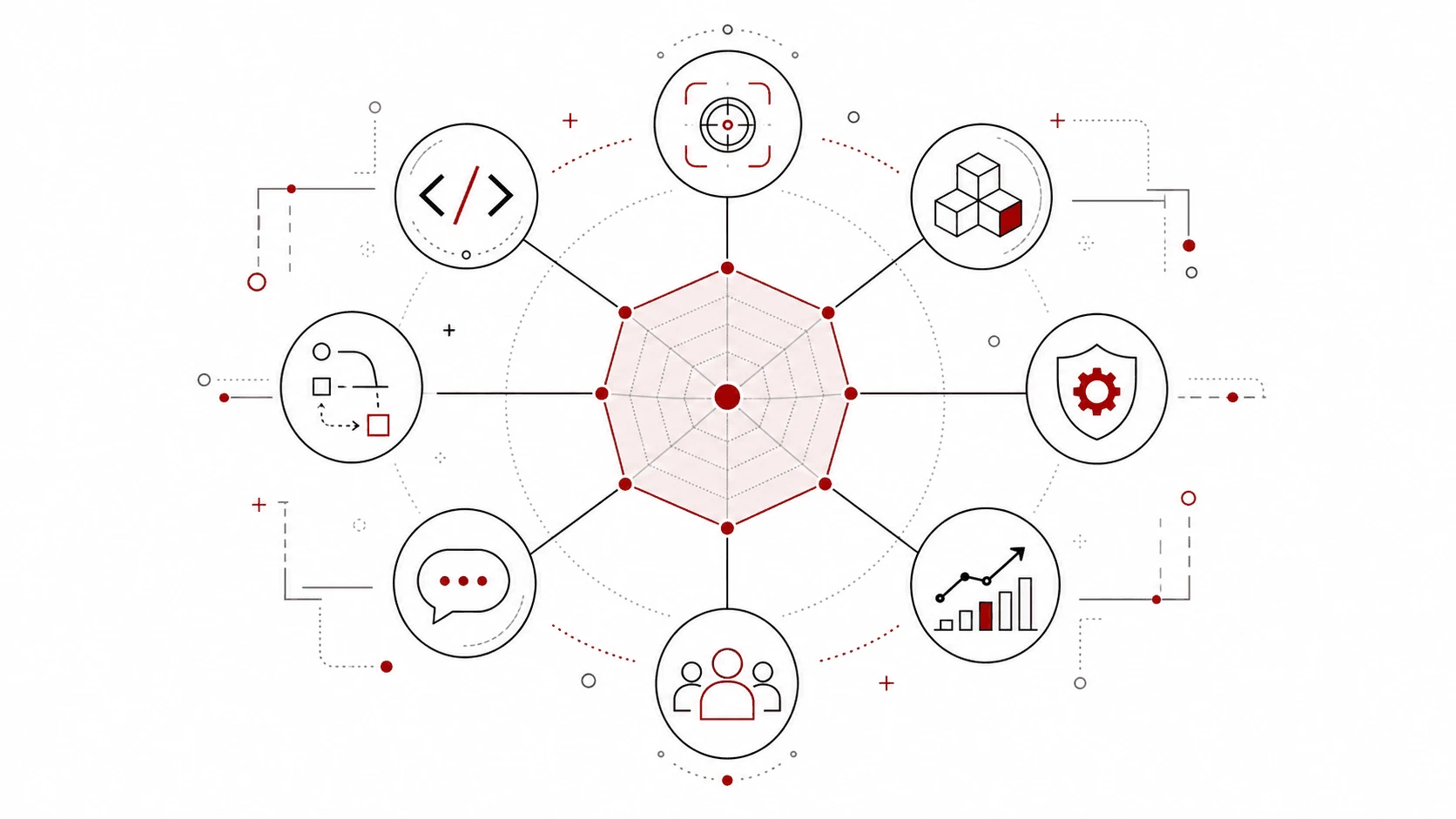
The model: seven distinct signals
The signals often appear together, but each one answers a different trust question.
Problem framing asks whether you solve the right problem. Coding fluency asks whether you can translate an approach into working software. Architectural judgment asks whether your design choices fit the system’s shape and constraints. Production judgment asks whether your solution can survive real use. Delivery and product judgment asks whether you can sequence work toward a valuable outcome. Leadership and influence ask whether your judgment improves the surrounding team or system. Communication and reflection ask whether others can understand, challenge, and trust your reasoning.
Confusing the signals causes common preparation mistakes:
- Treating architecture as a component list instead of a trade-off discipline.
- Treating production judgment as a monitoring checklist instead of ownership of failure and recovery.
- Treating leadership as status or charisma instead of specific technical influence.
- Treating communication as constant narration instead of timely exposure of decisions, assumptions, corrections, and learning.
- Treating product judgment as enthusiasm for the company instead of disciplined prioritization under constraints.
The distinction matters because each major interview format emphasizes a different mix. Coding work still requires framing and communication. System design still requires delivery and production judgment. Project and behavioral stories still require technical specificity. The model keeps those expectations connected without flattening every round into the same answer.
Signals interact; they do not add up cleanly
Strong senior evidence has shape. It is not seven separate checkmarks.
Framing gates everything downstream
If you frame the wrong problem, later skill can make the wrong answer look polished. A coding solution may be optimal for constraints the prompt did not have. A system design may be scalable for a workload no one asked for. A project story may sound impressive while avoiding the actual business risk.
Good framing is not a long interrogation. It is a short conversion from ambiguity to a working contract: “I am assuming X, optimizing for Y, excluding Z for now, and I will revisit this if the constraint changes.”
Architecture and production judgment travel together
Architecture explains how the system is organized. Production judgment explains what happens when reality pushes back. At senior level, a design that cannot describe retries, data loss, observability, deploy safety, abuse, or rollback is unfinished. The reverse is also true: production concerns with no design structure become a pile of defensive features.
The strongest answers connect the two: “This boundary lets us retry generation without duplicating delivery,” or “This queue gives us back pressure, but it also creates delayed visibility for support, so we need job status.”
Delivery judgment constrains technical elegance
Senior engineers are not rewarded for the most elaborate correct design. They are rewarded for choosing a path that can be delivered responsibly. That may mean starting with one region, one customer segment, one provider, one migration slice, or one explicit non-goal.
Delivery judgment does not cheapen technical quality. It protects it by sequencing risk.
Leadership becomes credible through artifacts
Influence is easiest to trust when it leaves evidence behind: a design review decision, migration plan, runbook, test harness, API contract, onboarding guide, incident review, standard, dashboard, or rollback checklist. “I aligned the team” is weak until the listener can see what changed and how people used it.
Communication is the visibility layer
Communication and reflection are floor signals because every other signal depends on them. You can have sound reasoning and still receive little credit if the interviewer cannot see the decision. You can also talk constantly and produce poor signal if your words do not expose assumptions, trade-offs, corrections, or outcomes.
The goal is not to narrate every thought. The goal is to surface the decision points that make the work trustworthy.
How signals appear across rounds
Every round has a primary signal, several secondary signals, and a few floor expectations.
| Layer | Meaning | Example |
|---|---|---|
| Primary signal | The main evidence the round is designed to collect. | Coding fluency in a live coding screen. |
| Secondary signal | Adjacent evidence that strengthens or weakens the primary result. | Problem framing, testing, and communication in that same coding screen. |
| Floor signal | Behavior expected almost everywhere. | Clear structure, honest uncertainty, direct answers, recovery from feedback. |
This model prevents two opposite errors. The first is under-signaling: doing good work silently and assuming the interviewer will infer the rest. The second is signal dumping: forcing production, leadership, product, and architecture commentary into a moment that needs five minutes of clean code.
Use the round’s primary signal to choose the center of gravity:
| Round | Primary signal | Natural secondary signals |
|---|---|---|
| Recruiter or hiring-manager conversation | Communication, reflection, delivery and product judgment | Level calibration, leadership, role fit |
| Online assessment or coding screen | Coding fluency | Problem framing, testing, communication |
| Practical coding, debugging, or code review | Coding fluency, production judgment | Architecture, delivery risk, communication |
| Low-level design | Architectural judgment, coding fluency | Problem framing, production constraints |
| System design | Problem framing, architectural judgment, production judgment | Delivery, product judgment, communication |
| Project deep dive | Architecture, production, leadership, delivery | Personal attribution, reflection, communication |
| Behavioral or values interview | Leadership and influence, communication and reflection | Delivery judgment, conflict handling, ownership |
| Product or cross-functional interview | Delivery and product judgment | Problem framing, influence, communication |
The next useful move is simple: prepare by signal, then perform by round.
Examples: a signal-oriented walkthrough
Prompt: “Design a service that lets users schedule recurring reports and receive them by email.”
A shallow answer can still sound technical: API, database, scheduler, queue, workers, email provider. Those nouns are plausible, but nouns alone do not prove senior judgment. The stronger answer makes decisions visible as it moves.
| Moment | Candidate behavior | Signals made visible |
|---|---|---|
| Establish the work | “Are these internal reports or customer-facing reports? Is delivery exact-time or best-effort? Do users need audit history?” | Problem framing, delivery judgment |
| State assumptions | “I will assume customer-facing daily or weekly reports, delivery within 15 minutes, and a support need to see status.” | Problem framing, product judgment |
| Choose the shape | “A report-definition service stores schedules; a scheduler expands due jobs; workers generate reports; delivery records email status separately.” | Architectural judgment |
| Defend a trade-off | “I prefer an explicit job table plus queue over cron-only execution because retries, auditability, and support visibility matter here.” | Architecture, production judgment |
| Handle failure | “Generation and email send need separate idempotency keys so a retry does not regenerate expensive data or send duplicate messages.” | Production judgment |
| Sequence release | “The first release supports daily reports, one provider, and UTC scheduling. Time zones, pauses, and provider failover come after the core path is observable.” | Delivery and product judgment |
| Show ownership boundaries | “Analytics owns report definitions; platform owns scheduler reliability; support needs delivery-state language; product decides which delivery guarantees are promised.” | Leadership and influence |
| Keep the conversation scoreable | “I have covered requirements, baseline architecture, and failure. I can go deeper on the data model, scheduler semantics, or scale next.” | Communication and reflection |
Notice what the answer avoids. It does not recite every possible production concern. It does not turn into a product strategy speech. It does not claim team leadership without a decision or artifact. It makes a small number of senior decisions visible at the moment they matter.
The evidence ledger
Use an evidence ledger when preparing stories, mocks, and post-round notes. It is not a script. It is a way to detect invisible strengths and repeated gaps.
| Signal | Evidence sentence to prepare or review |
|---|---|
| Problem framing | “The ambiguous part was…, so I defined success as…” |
| Coding fluency | “The implementation risk was…, so I kept the code/test shape…” |
| Architectural judgment | “The main design choice was A versus B, and I chose… because…” |
| Production judgment | “The failure mode I protected against was…, using…” |
| Delivery and product judgment | “The sequencing decision was…, because the user/business risk was…” |
| Leadership and influence | “The people or system I influenced were…, through…” |
| Communication and reflection | “The thing I changed after evidence or feedback was…” |
After a mock interview, fill the ledger with what was actually observable, not what you meant to show. If the production row says “I thought about retries but never said them,” the signal was absent. If the leadership row says “we delivered the migration” with no personal decision, attribution is weak. If the architecture row says “used Kafka” but no trade-off, the answer may have named technology without proving judgment.
The ledger also keeps preparation honest. A real senior project usually has more than one signal, but not every project proves every signal equally. One story may be excellent for production risk and migration leadership. Another may be better for product judgment. Another may be a clean coding or low-level design example. Build a portfolio of evidence rather than stretching one story until it becomes unbelievable.
Implications and failure modes
Signal substitution
Signal substitution happens when you answer with the signal you prefer instead of the signal being sampled. Examples:
- using architecture vocabulary when the coding round needs working code;
- using process language when the interviewer asks for a technical decision;
- using impact metrics when the interviewer asks how the system handled failure;
- using confidence when the interviewer asks for a trade-off.
Substitution often comes from strength, not weakness. Experienced engineers lean on their best-developed signal. Senior readiness requires range.
Signal hiding
Signal hiding happens when the work was good but the evidence stays implicit. You choose the right algorithm but never explain the constraint that made it right. You operated the migration carefully but tell the story as a timeline. You mentored someone effectively but never describe the review pattern or artifact that changed their work.
The fix is one sentence at the decision point, not a longer answer everywhere.
Signal collision
Signals can interfere with each other. A candidate trying to show leadership may overtalk and weaken communication. A candidate trying to show production judgment may bloat a design. A candidate trying to show coding fluency may rush past framing and build the wrong thing.
When signals collide, return to the round’s center of gravity. In coding, make code correct and inspectable first. In system design, make the problem and trade-offs legible. In behavioral rounds, make the story specific enough that leadership is not just a claim.
Signal imbalance
One excellent signal rarely compensates for repeated weakness elsewhere. Strong architecture with poor communication can leave interviewers unable to defend the hire. Fast code with no testing can look brittle. Strong leadership stories with no current technical detail can raise doubts about hands-on fit.
You do not need perfect symmetry. You do need enough balance that the final loop pattern says “senior engineer” rather than “specialist with a serious blind spot.”
Practice drills
Signal ledger pass
25 minPrimary-signal restraint
15 minHidden-signal audit
20 minSignal collision repair
20 minDiagnostic self-check
Score the evidence an interviewer could actually observe, not your private confidence.
| Signal | Weak evidence | Senior-ready evidence |
|---|---|---|
| Problem framing | Starts solving before success, constraints, and assumptions are clear. | Defines the working contract and adjusts it when new information appears. |
| Coding fluency | Knows an approach but produces fragile, opaque, or untested code. | Writes readable code, tests meaningful cases, explains complexity, and debugs from state. |
| Architectural judgment | Lists components or patterns without rationale. | Chooses boundaries and trade-offs from requirements, workload, ownership, and evolution. |
| Production judgment | Mentions logs, alerts, or retries as an afterthought. | Reasons concretely about failure, data correctness, deploy safety, abuse, observability, and cost. |
| Delivery and product judgment | Optimizes technical purity without user, milestone, or adoption context. | Sequences work so value, risk, learning, and reversibility are explicit. |
| Leadership and influence | Claims leadership through meetings, title, or vague team outcomes. | Names decisions, artifacts, standards, mentoring patterns, and influence without inflating authority. |
| Communication and reflection | Monologues, hides uncertainty, or becomes defensive under challenge. | Structures the answer, exposes decision points, responds directly, and updates from evidence. |
Interpretation:
- A repeated weak row is a preparation priority even if another row is strong.
- Communication and reflection are never optional; they make the other signals scoreable.
- The target role changes weighting. A backend infrastructure role may weight production more heavily than product judgment; a product-platform role may require both.
- The strongest preparation question is: “Which signal would a skeptical interviewer still not be able to see?”
One-page field reference
Field reference
Seven-signal model
- Senior interviews sample behavior; they do not read your intent.
- Problem framing: define success, assumptions, constraints, non-goals, and plan.
- Coding fluency: produce correct, readable, tested code and explain the important choices.
- Architectural judgment: choose system boundaries and trade-offs that fit the problem.
- Production judgment: reason about failure, operations, security, correctness, and cost.
- Delivery and product judgment: sequence work around user value, risk, adoption, and reversibility.
- Leadership and influence: show decisions, artifacts, mentoring, standards, and alignment that changed outcomes.
- Communication and reflection: make decisions visible, respond to challenge, and state what changed after learning.
- Prepare by signal; perform by round.
- After every mock, fill the ledger with what was observable, not what you intended.
The signal model explains what the loop is trying to observe. The next chapter shows how those observations are distributed across an actual interview process.
Related links
- Chapter 1: The Interview Is a Sampled Performance
- Chapter 2: The Baseline Diagnostic
- Chapter 4: What Senior Software Engineer Actually Means
- Chapter 5: Mid-Level, Senior, Staff, Tech Lead, and Engineering Manager
- Chapter 7: Anatomy of a Modern Interview Loop
- Chapter 8: How Interviewers Score Candidates
- The seven senior signals