Senior Engineering Interview Handbook / Chapter 118
The Follow-Up Tree
Build and rehearse a deliberately uneven follow-up tree that supports precise answers when a project deep dive leaves its prepared sequence.
Preparing audio…
Audio edition
The Follow-Up Tree
Page tools
The interviewer chooses a branch
Your project overview has done its job. The interviewer understands the problem, your role, the central decision, and the result. Then they stop following your sequence.
“Why was idempotency at the boundary?”
You answer, and the next question moves to data ownership. A minute later they ask who could pause the rollout. Then they return to the failed assumption you mentioned in passing. This is where a polished story can become surprisingly fragile: the project is still yours, but the order no longer is.
A follow-up tree prepares for that change of control. It maps the overview to the places a careful interviewer can inspect, then attaches evidence and deeper questions to the branches that matter most. It is private preparation, not a script to recite or a document to show.
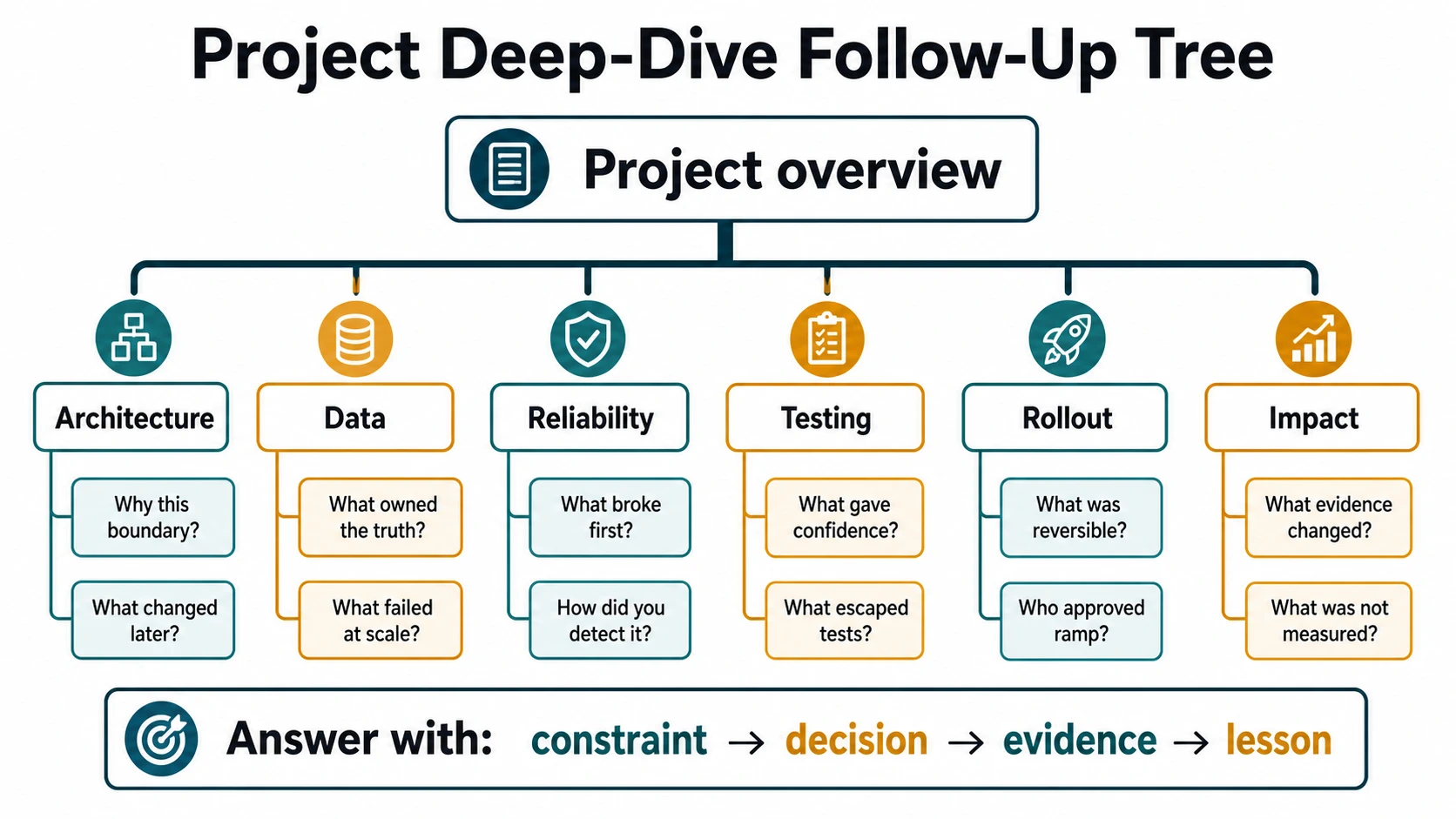
Draw the trunk from work you have already done
Do not invent a new project summary for this artifact. Take the trunk from your project dossier:
- the problem and its users;
- your role;
- the constraint that shaped the work;
- the central decision;
- the result and its limits;
- the lesson you now carry.
For the reconciliation migration used throughout this part, the trunk might sound like this:
I worked on a reconciliation migration for a regulated financial workflow.
I owned the exception model and the readiness review, while a platform team
owned shared ingestion changes. Partner retries and late adjustments had
different operational consequences, so we put idempotency at the ingestion
boundary and made ledger checkpoints the auditable state. We rolled out by
partner group. Ordinary review moved into a finance-facing workflow, although
we could not isolate every outcome from partner volume and seasonality. The
first ramp also changed how I judge rare but deadline-sensitive cases.
Almost every phrase offers a legitimate descent. “Ingestion boundary” opens architecture and data. “Auditable state” opens correctness and compliance. “By partner group” opens rollout and organizational authority. The attribution sentence opens personal contribution. The caveat opens impact evidence. The last sentence opens failure, testing, and changed judgment.
That is enough trunk. If the overview tries to contain the answers to all of those questions, it stops being an overview.
Let this project determine the branches
The outline of the artifact is not a checklist of topics. Begin with what the project makes doubtful.
For this migration, architecture, data, reliability, rollout, impact, and ownership deserve substantial branches. Testing and organizational alignment matter because they explain why the first readiness model failed and how the new gate worked. Security and privacy need a prepared boundary because the domain is regulated. Scaling may remain thin if scale was neither the binding constraint nor a claim in the overview.
Other projects will have a different silhouette. A multi-tenant storage system may need deep scaling, cost, isolation, and migration branches. A developer-tooling project may need adoption, compatibility, build performance, and influence without authority. Preparing every familiar category to the same depth makes the important decisions harder to retrieve.
Still, look once for omissions. Architecture, data, scaling, reliability, testing, security, rollout, organizational alignment, prioritization, impact, and personal contribution are useful prompts because interviewers often use them to test a project from different directions. Add a branch when the project supports it or when its absence would make a reasonable claim hard to trust. Leave it shallow when honest evidence runs out.
Build one branch until it can bear weight
Start with the branch most likely to expose a weak claim. In the reconciliation story, reliability is a good choice because the overview mentions a changed view of rare cases.
A working note for that branch could be as small as:
RELIABILITY

Likely entry: What failed during rollout?
First descent: Why did your test and readiness plan miss it?
Hard descent: What evidence says the repair worked?
Decision pressure: rare across a month, urgent near financial close
My boundary: owned exception-model review; did not own every partner behavior
Evidence: ramp pause, revised readiness gate, later partner-group reviews
Limit: no claim that every exception disappeared
Changed rule: judge frequency and operational urgency separately
The note is useful because each line has a job. The entry question gets you into the branch. The descents prevent a first-level answer from masquerading as depth. The ownership boundary stops “we” from absorbing the whole team. The evidence limit keeps the repair claim honest. The changed rule connects the project to future judgment.
Now answer only the first question:
During the first partner-group ramp, a late-adjustment category reached finance
operations near close. We had tested the frequent duplicate and replay paths,
but our readiness model treated rarity as low importance. I owned the
exception-model review and should have brought finance operations into that
review earlier. We paused the ramp, added a distinct adjustment path, and made
finance validation a readiness gate for later groups.
Then stop. If the interviewer wants the test gap, evidence of improvement, or ownership split, the branch has somewhere to go. Volunteering all three would turn preparation back into a monologue.
Make neighboring branches disagree usefully
A weak tree repeats the same answer under several labels. A stronger tree lets adjacent branches inspect different consequences of the same decision.
If the interviewer asks why idempotency sits at ingestion, the architecture answer concerns the placement of the correctness boundary and the rejected alternative of downstream cleanup. If they ask what owns truth, the data answer concerns raw partner events, ledger checkpoints, and their different lifecycles. If they ask what gave the team confidence, the testing answer distinguishes retry fixtures from the finance semantics those fixtures missed.
These answers share facts without becoming duplicates. Each begins from the constraint relevant to the question, names the decision or trade-off, supplies an evidence anchor, and leaves a bounded lesson. Use that sequence as a retrieval path, not as wording to memorize.
Evidence anchors should also be things that could have existed during the work: a design review, rejected alternative, load test, incident record, dashboard, launch gate, decision log, customer-research finding, or clear operational observation. “The architecture was scalable” is a description. “The capacity model forced us to partition by tenant before the second region” is an inspectable claim. If you no longer have access to an internal artifact, you can still describe its function and the decision it supported without pretending you can show it.
Prepare pressure, not hostility
Friendly prompts establish the surface. Senior follow-ups usually test what would make that surface unreliable:
- Alternative: Why not choose the simpler or more familiar approach?
- Failure: What broke, escaped, or changed after launch?
- Evidence: How do you know the result came from this work?
- Ownership: What did you decide, and where did someone else decide?
- Priority: What did you defer, and what condition would have reversed it?
- Boundary: What can you not safely share or claim?
- Transfer: When would the lesson from this project be wrong?
Write only the pressure questions that fit the branch. A rollout branch needs authority, reversibility, and pause criteria more than a generic request to “go deeper.” A scaling branch needs a bottleneck, workload assumption, and failure threshold. An alignment branch needs visible disagreement, decision rights, and acceptance criteria—not merely a stakeholder count.
The best hard question is the one that could change your answer. If no evidence could make you qualify the result and no constraint could make you prefer the rejected alternative, the branch is probably rehearsed advocacy rather than engineering judgment.
Rehearse sideways
Read the branch names aloud, shuffle them, and have a peer choose one without warning. They should be able to move from testing to personal contribution to impact, then descend twice into any one of them. Your answers should remain parts of the same project without depending on the original narrative order.
Listen for three failures during rehearsal. If every answer begins with the project background, shorten the trunk you carry into each branch. If a small question produces five minutes of material, decide what the first answer may omit. If you stall after the first “why,” the branch needs another evidence anchor or a more honest limit.
Also listen for invented certainty. A branch should be cut rather than filled with a guessed metric, borrowed team achievement, or technical detail you did not own. Range is useful only while it remains defensible.
Add the confidentiality layer before the mock
The tree exposes details quickly, so mark each branch for private names, exact figures, internal architecture, customer information, security posture, and personnel history. Prepare the safe form of the answer while you still have time to think.
Do not erase the engineering to make it safe. “A confidential system had scale challenges” leaves nothing to inspect. “A regulated reconciliation workflow had partner retries and auditable checkpoints with different lifecycles” preserves the decision pressure without naming a customer, service, table, or exact volume.
The next chapter develops this work into a complete sanitization layer. For now, mark any branch you cannot discuss safely. You may need a translated answer, a narrower claim, or a different project.
Build the artifact
Use one sheet, document, or mind map for one project.
- Write the six-line trunk from the dossier.
- Underline the nouns and claims that invite inspection.
- Name the branches created by those openings.
- Deepen the branches where judgment, risk, impact, or ownership could be doubted.
- Give each deep branch an ordinary question, two harder descents, an evidence anchor, an ownership boundary, and a claim limit.
- Add any missing branch the project genuinely needs; remove any branch you can defend only by guessing or exposing private detail.
- Rehearse in random order. Answer the selected branch and pause.
The tree is ready when a second question makes the answer more precise rather than forcing you back to the beginning. It will not make the conversation predictable. It will make your evidence reachable when the conversation is not.