Senior Engineering Interview Handbook / Chapter 43
Sorting, Searching, and Intervals
A reasoning-first guide to binary search, search on an answer, interval and event ordering, custom comparators, sweep lines, and selection algorithms.
Preparing audio…
Audio edition
Sorting, Searching, and Intervals
Page tools
What can you stop reconsidering?
Suppose a sorted array is [2, 2, 4, 7, 7] and the target is 5. There is no
matching element, yet there is a precise answer worth finding: index 3, the
place where 5 could be inserted without breaking the order.
Viewed as comparisons with the target, the array has this shape:
value >= 5:  false  false  false  true  true
index:          0      1      2      3     4
                                  ^
                              first true
That change from false to true is the useful object. A correct search does not merely visit promising midpoints. Each comparison proves that a whole region can no longer contain the boundary.
Sorting, interval scans, sweep lines, and selection algorithms make the same kind of bargain. They spend work to create an order, then use that order to make decisions irreversible. The decisive question is therefore not “Which template fits?” It is “After this step, what will I never need to reconsider?”
A search is its invariant
For a lower bound, the job is to return the first index whose value is at least
the target. The answer may be len(nums) when every value is smaller.
def lower_bound(nums, target):
    lo = 0
    hi = len(nums)

    while lo < hi:
        mid = lo + (hi - lo) // 2
        if nums[mid] >= target:
            hi = mid
        else:
            lo = mid + 1

    return lo
Before every iteration:
- every index before
lois known to contain a value smaller thantarget; - every in-array index at or after
hiis known to contain a value at leasttarget; - the first qualifying index remains somewhere in
[lo, hi].
If nums[mid] >= target, mid may be the first true position, so the search
keeps it by setting hi = mid. Otherwise mid is disproved and joins the
false region through lo = mid + 1. When the two boundaries meet, the unknown
region is empty.
Change the predicate to nums[mid] > target and the same loop finds the upper
bound. The pair composes into a range without two bespoke searches:
first = lower_bound(nums, target)
after = upper_bound(nums, target)
count = after - first
If the caller needs a found-or-missing answer, check first < len(nums) and
nums[first] == target. A bound returns a position, not a promise that the
target exists.
Closed binary search is also valid, but it has a different contract. With
lo = 0, hi = n - 1, and while lo <= hi, the unknown region is inclusive.
After proving nums[mid] > target, the update must be hi = mid - 1 because
mid has already been eliminated. Most binary-search bugs are not failures to
remember syntax. They are collisions between two different meanings of the
endpoints.
A rotated sorted array makes that discipline visible. The whole range is not ordered, but with distinct values at least one side of a midpoint is. The algorithm may discard that side only after determining whether its ordered range can contain the target. Duplicates weaken the observation: when the left, middle, and right values are equal, neither side may reveal useful order, and worst-case progress can become linear.
Search an answer you never sorted
Now consider a nonempty sequence of positive package weights that must be shipped in order within at least one day. The packages are not the search space. Capacity is.
For any proposed capacity, a linear scan can answer a yes-or-no question: does
that capacity finish within the deadline? If capacity C works, every larger
capacity works as well. The possible answers therefore have the same
false-then-true shape as the sorted-array predicate.
def minimum_ship_capacity(weights, days):
    lo = max(weights)
    hi = sum(weights)

    def feasible(capacity):
        used_days = 1
        load = 0

        for weight in weights:
            if load + weight > capacity:
                used_days += 1
                load = 0
            load += weight

        return used_days <= days

    while lo < hi:
        mid = lo + (hi - lo) // 2
        if feasible(mid):
            hi = mid
        else:
            lo = mid + 1

    return lo
The initial bounds carry part of the proof. A capacity below the heaviest package is impossible. The sum of all weights is sufficient for one day. The greedy feasibility scan fills a day until the next package does not fit; starting a new day earlier could not reduce the number of days because order is fixed.
The running time is O(n log R), where R is the inclusive capacity range.
That expression is meaningful only after monotonicity has been established.
Before searching a speed, distance, load, time, or threshold, try to construct
a counterexample in which a larger answer becomes infeasible again. If one
exists, binary search on the answer has no boundary to find.
Sort until the future cannot revise the past
Sorting earns its cost when it turns a global problem into a finalizing scan. Interval merging is the cleanest example, provided the endpoint convention is settled first.
Closed intervals [start, end] include both endpoints, so [1, 2] overlaps
[2, 3]. Half-open intervals [start, end) do not overlap at that boundary.
Neither convention is universally correct. Calendar bookings, integer ranges,
and occupied byte offsets may require different contracts.
For closed intervals, sort by start and then end:
def merge_closed(intervals):
    merged = []

    for start, end in sorted(intervals):
        if not merged or start > merged[-1][1]:
            merged.append([start, end])
        else:
            merged[-1][1] = max(merged[-1][1], end)

    return merged
At every step, merged exactly covers the intervals already seen, and its
last range is the only one the next interval could extend. Nondecreasing start
times make all earlier ranges unreachable by the future. For half-open ranges
that should remain separate when they merely touch, the new-range test becomes
start >= merged[-1][1].
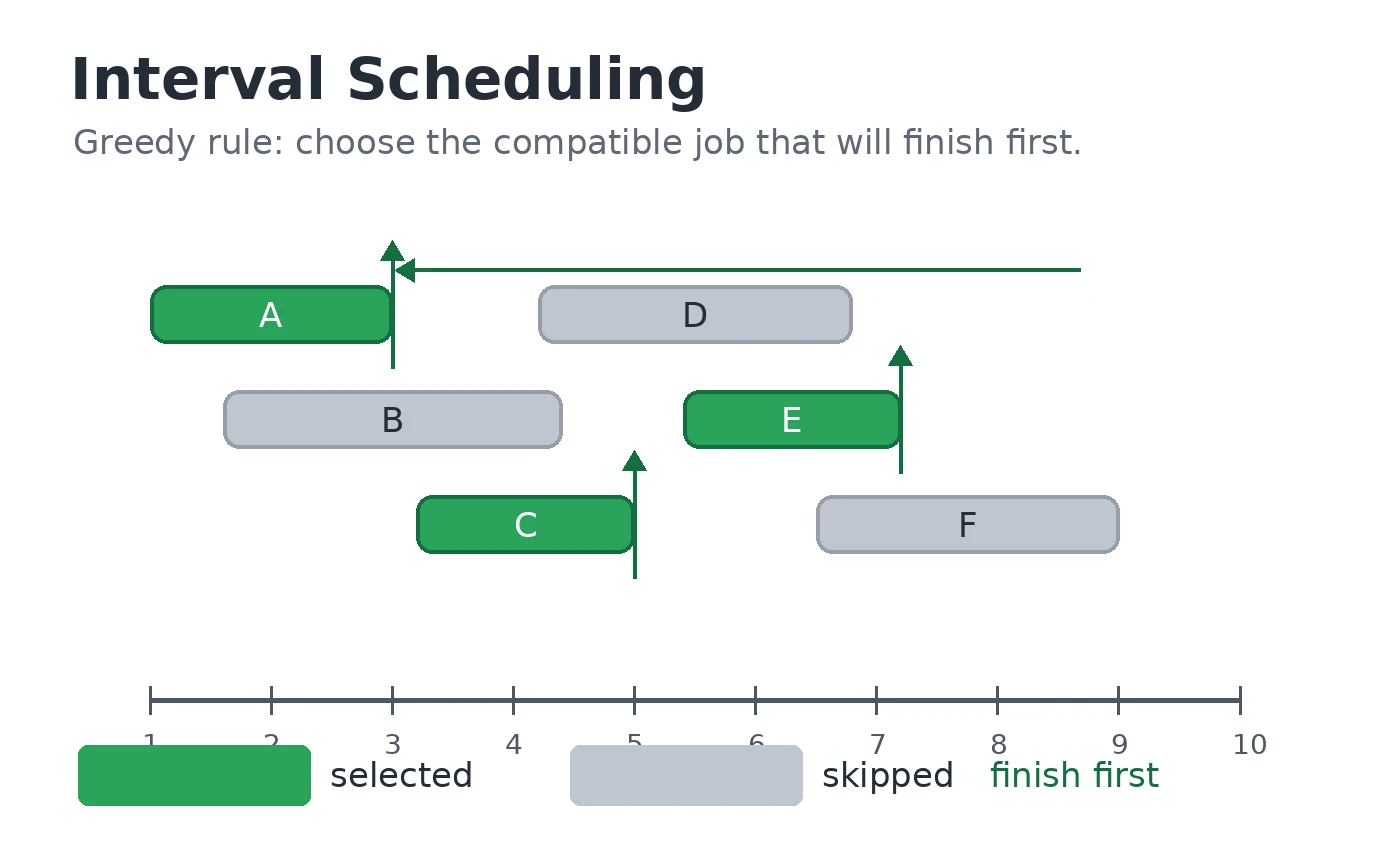
The order must fit the decision. Sorting by start supports merging because it makes old ranges final. Sorting by end supports a different question: choosing the largest number of compatible intervals. Selecting the compatible interval with the earliest finish leaves at least as much remaining time as selecting any later-finishing alternative; exchanging the first choice cannot make the rest of an optimal schedule worse.
A custom comparator makes an even stronger claim: every pairwise decision must
participate in one consistent global order. For the “largest concatenated
number” problem, ordinary numeric order fails. The strings "3" and "30"
must be compared as "330" versus "303", so "3" comes first.
This is algorithmic logic, not sorting syntax. The comparator must be
transitive, must handle equality coherently, and must not depend on state that
changes during the sort. In fixed-width integer languages, a subtraction
comparator such as a.start - b.start can overflow; explicit comparison or a
library comparison helper is safer.
Equal events are a policy decision
A sweep line turns every interval into changes on an ordered axis. Between two adjacent event coordinates, the active state is constant. At an event coordinate, however, correctness depends on what simultaneous changes mean.
For positive-duration half-open meetings [start, end), a meeting ending at
10:00 releases its room before one starting at 10:00 claims a room:
def maximum_rooms(meetings):
    events = []
    for start, end in meetings:
        events.append((start, 1))
        events.append((end, -1))

    # -1 sorts before +1 when times are equal.
    events.sort()

    active = 0
    maximum = 0
    for _, change in events:
        active += change
        maximum = max(maximum, active)

    return maximum
Here active means rooms occupied after applying each event in the declared
tie order. If endpoints were inclusive, a start and an end at the same time
would overlap, so starts would need to be processed first. More complicated
events may need an explicit priority such as (coordinate, event_kind, id).
The tie-break is the policy in executable form.
Merging and sweeping answer different questions. Merge when the output is the union of covered ranges or the gaps between them. Sweep when the output depends on changing active state: maximum overlap, concurrent resource usage, or another aggregate over an axis. The shared input noun “interval” does not choose the algorithm.
Selection stops when one rank is settled
Full sorting determines every rank. If the result needs only the kth item, quickselect can stop as soon as that rank becomes final.
target = k - 1            # kth smallest, zero-based
lo = 0
hi = n - 1

while lo <= hi:
    pivot = partition(values, lo, hi)

    if pivot == target:
        return values[pivot]
    if target < pivot:
        hi = pivot - 1
    else:
        lo = pivot + 1
After a correct partition, the pivot is in its final rank position. Nothing on
the other side can be the target, so quickselect abandons that entire region.
Randomized pivots give expected O(n) time, while consistently poor pivots can
degrade to O(n²). A three-way partition is often clearer when many values
equal the pivot.
The output contract decides whether selection is enough. For kth largest,
the ascending zero-based target is n - k. For an unordered top-k collection,
partitioning may suffice. For top k in sorted order, the selected region still
needs ordering. For a stream, quickselect cannot retain a boundary over future
arrivals; a fixed-size heap is the better fit.
Spend only the order the result uses
These algorithms differ in how much order they purchase:
- binary search consumes an existing monotonic order and resolves half of the remaining uncertainty at each step;
- sort-and-scan pays for complete order once so earlier decisions become final;
- a sweep orders changes, then maintains only the active state between them;
- quickselect creates just enough partition order to settle one rank;
- a heap continually repairs enough order to expose one changing extreme;
- a balanced search tree preserves ordered lookup while updates continue.
Asymptotic cost matters, but it is not the only budget. Mutation, stable output,
worst-case guarantees, comparator complexity, and the ease of explaining an
equality case all belong in the choice. An O(n log n) sort is often the
stronger engineering answer when it makes the proof and output contract plain.
Practice by moving the boundary
Implement lower and upper bound once, then use them to return the first and last occurrence of a target. Test an empty array, a missing value between two elements, duplicates at both ends, and a target larger than every value.
Change the shipping problem from minimum feasible capacity to maximum feasible spacing. Before changing the loop, write the new truth pattern across the answer domain and decide whether you are looking for the last true value or the first false one.
Merge the same intervals twice: first as closed ranges, then as half-open
ranges. Use [1, 2] and [2, 3] so one inequality must change the result.
Then compute maximum overlap from events and explain the equal-time policy
without referring to the code.
Find kth largest by sorting, by a size-k heap, and by quickselect. For each
version, change the requested output to a descending top-k list. Notice which
algorithm has already paid for that order and which still owes it.
The durable habit is to name the settled region before optimizing the loop. Say what lies beyond reconsideration, why equality belongs on one side, and what new contract would move the boundary. Once those statements are exact, the code usually becomes shorter—and its failures much easier to find.