Senior Engineering Interview Handbook / Chapter 11
Deconstruct the Job Description
Learn how to read senior software engineering job descriptions for real hiring signals, separate requirements from recruiter boilerplate, infer likely rounds, and decide how to position your evidence.
Preparing audio…
Audio edition
Deconstruct the Job Description
Page tools
What this analysis process controls
A job description is not a contract, a syllabus, or a clean statement of what the team needs. It is a recruiting artifact. It may contain hiring-manager priorities, legal language, old template bullets, compensation-band requirements, recruiter phrasing, and optimistic wishlist items in the same paragraph.
The senior move is not to believe every line. It is also not to dismiss the posting as meaningless. You are trying to produce a working hypothesis:
“This role appears to need a senior backend engineer for commerce-platform ownership: payments reliability, billing migration, auditability, and cross-functional delivery. The likely loop is coding, system design, project depth, and behavioral leadership. My strongest evidence is migration safety and service ownership; my risk is limited direct payment-provider experience.”
That is a useful output. It changes the resume, the recruiter screen, the stories you rehearse, and the system designs you practice.
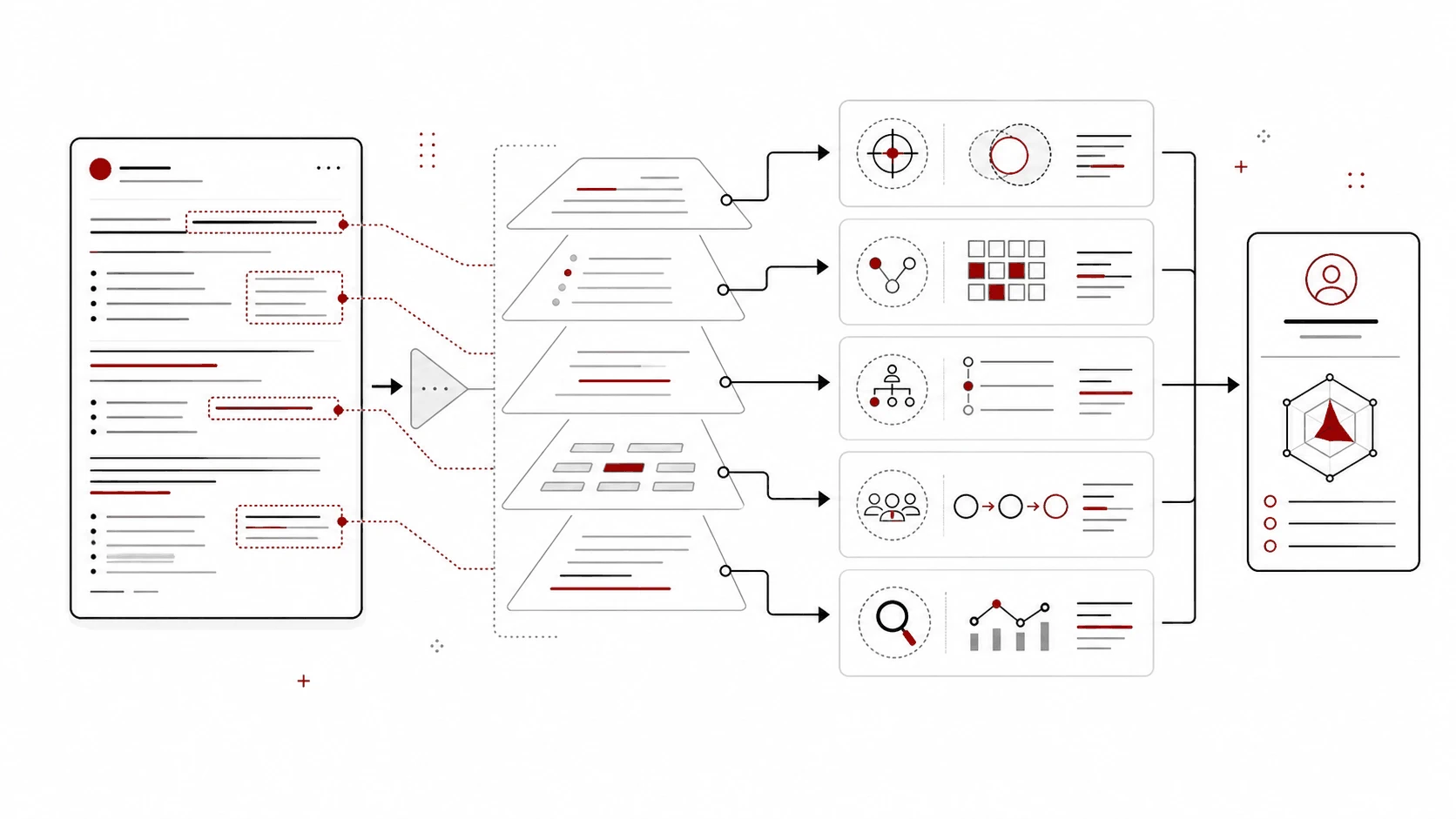
Build the role hypothesis from constraints
The input is a single posting plus whatever public context you already have: company page, team name, product surface, level title, and location or work constraints. Do not turn this into full company research yet. That comes later. This pass is about deciding what the posting itself suggests.
The output is a role hypothesis card: the actual work shape, the likely loop, the evidence to foreground, the gaps to validate, and the apply decision. It should be concrete enough to change your next action.
The constraint is uncertainty. You are not proving what the company will ask. You are building a better first model than “senior backend role with some tools.”
Deconstruction workflow: work, loop, evidence
Use three passes: work, loop, evidence. Do them in that order. If you start with your own resume, you will see only the parts you already want to see.
Pass 1: What work is this role really hiring for?
Read the responsibilities before the requirements. Responsibilities usually describe the job the team is trying to get done. Requirements often describe the candidate profile someone copied from a level guide or previous posting.
Extract verbs, objects, and repeated nouns.
| Posting language | Better reading |
|---|---|
| “Build and operate checkout services” | Hands-on backend work plus production ownership. |
| “Lead migration from legacy billing” | Change management, correctness, rollout, compatibility, and stakeholder coordination. |
| “Partner with finance, risk, and support” | Cross-functional judgment matters; the system has business consequences outside engineering. |
| “Improve observability and participate in on-call” | Reliability is not decorative. Expect operational questions. |
| “Set technical standards across teams” | Possible staff-shaped or platform-lead scope, not ordinary feature delivery. |
Then group repeated signals. One mention of “scale” may be marketing language. A cluster of latency, capacity, cost, sharding, high traffic, and reliability is preparation material.
Common clusters:
- Reliability: SLOs, on-call, observability, incident response, runbooks, fault tolerance.
- Migration: legacy systems, modernization, compatibility, rollout, dual-write, deprecation.
- Platform: internal customers, developer experience, service templates, adoption, standards.
- Product: customers, experimentation, product managers, UX, launch, conversion, retention.
- Data correctness: pipelines, reconciliation, lineage, backfills, auditability, finance or compliance users.
- Security or compliance: privacy, audit, access control, regulated data, abuse prevention.
- Leadership: mentor, lead, align, influence, drive, define, set direction.
The goal of this pass is a five-line role brief, not a highlighted page. If you cannot summarize the work in five lines, you have not deconstructed the posting yet.
Pass 2: What interview loop would collect that evidence?
The posting will not always list the loop, and recruiters may not know the final version yet. Still, the language points toward likely evidence collection.
| Role signal | Likely interview emphasis | Preparation implication |
|---|---|---|
| Data structures, algorithms, CS fundamentals | Coding screen or online assessment | Practice the company’s likely coding style, not only domain examples. |
| Large codebase, maintainability, debugging | Practical coding, code review, or debugging | Prepare trade-offs around tests, refactoring, and readable change design. |
| Scalable services, distributed systems | System design | Practice designs in the role’s domain, not only generic social feeds. |
| On-call, SLOs, observability, incidents | Production design and incident stories | Prepare operational metrics, rollback, alert quality, and post-incident learning. |
| Migration, modernization, platform adoption | Project deep dive | Prepare compatibility, sequencing, risk controls, adoption, and metrics. |
| Product, design, customers, launch | Product or cross-functional conversation | Prepare prioritization and trade-off stories with non-engineering partners. |
| Strategy, standards, across teams | Leveling and architecture narrative | Prepare scope, authority, influence mechanisms, and staff-shaped risk. |
This pass should produce a probable loop map:
- coding: likely or unlikely;
- system design: generic, domain-specific, or production-heavy;
- project deep dive: which project should you lead with;
- behavioral themes: ambiguity, conflict, incident ownership, mentoring, stakeholder trade-offs;
- leveling risk: senior IC, tech-lead-shaped, staff-shaped, specialist, or unclear.
Use probability language. “Likely production-heavy design” is more honest than “they will ask SLO questions.” The point is to choose better preparation and better recruiter questions, not to pretend you can predict the loop perfectly.
Pass 3: What evidence should you foreground?
Now compare the role hypothesis to your evidence. Senior positioning is selective. You do not need every good project in the first conversation; you need the most relevant proof.
For each core competency, name one resume hook, one interview story, and one gap or caveat.
| Competency | Resume hook | Interview story | Gap or caveat |
|---|---|---|---|
| Migration safety | “Led dual-write migration for subscription renewals” | Rollout gates, validation, rollback, and customer impact | Different business domain from payments. |
| Production reliability | “Reduced failed renewal recovery time” | Provider failure, idempotency, alert tuning, support states | Need fresh numbers before screen. |
| Cross-functional delivery | “Partnered with support and finance on billing states” | Launch trade-off between correctness and timeline | No direct risk-team partnership. |
If you cannot fill this table for a target role, the role may still be worth applying to, but it is no longer a low-preparation role. That distinction matters when you are choosing where to spend interview energy.
Decision points: requirements, preferences, and boilerplate
Requirements are not all requirements. Treat each bullet by its function, not by its position under a heading.
| Type | Example | How to treat it |
|---|---|---|
| Hard constraint | “Must be authorized to work in Canada.” | Non-negotiable logistics; do not hand-wave. |
| Core competency | “Design and operate distributed services.” | Interview signal; map evidence directly. |
| Domain anchor | “Payments, risk, invoicing, or subscriptions.” | Advantage if direct; prepare adjacent stories and ask how deep the domain bar is. |
| Stack preference | “Go, Kotlin, Java, or similar.” | Usually negotiable if fundamentals and ramp story are strong; not always negotiable for specialist roles. |
| Level signal | “Lead ambiguous projects across teams.” | Calibrate scope and down-level risk. |
| Boilerplate | “Excellent written and verbal communication.” | Weak alone; interpret through nearby work. |
| Wishlist | “10+ years with every major cloud technology.” | Discount unless repeated in responsibilities or tied to a specific constraint. |
Two rules keep this sane.
First, repetition beats section labels. If Kubernetes appears once in a tools list, it may be incidental. If the role says platform runtime, cluster operations, service mesh, capacity, and incident response, Kubernetes or equivalent infrastructure depth may be central.
Second, boilerplate becomes meaningful when attached to concrete work. “Excellent communication” means different things in a developer-platform team, a regulated enterprise integration team, and a startup product team. Translate it into the likely behavior: design docs, incident updates, customer-facing trade-offs, migration announcements, or stakeholder negotiation.
Worked example: commerce platform posting
Posting excerpt:
Senior Backend Engineer, Commerce Platform
Build and operate services that power checkout, subscriptions, and invoicing for millions of customers. Partner with product, finance, risk, and support to improve payment reliability and launch new billing capabilities. Lead migrations from legacy billing systems while maintaining correctness and auditability. Mentor engineers, improve observability, and participate in on-call. Experience with distributed systems, relational databases, event-driven architecture, and payment systems preferred.
A keyword reading says: backend, distributed systems, relational databases, event-driven architecture, payments.
A senior reading says something sharper:
| Layer | Interpretation |
|---|---|
| Work shape | Backend commerce-platform role with production ownership. |
| Core competencies | Service design, payment or billing correctness, migration safety, reliability, cross-functional delivery. |
| Architecture implications | APIs, relational data model, idempotency, event processing, reconciliation, provider integration, audit trails, rollback. |
| Domain constraints | Money movement, finance correctness, support visibility, failure isolation, auditability. |
| Likely rounds | Coding, commerce or billing system design, project deep dive, behavioral leadership, hiring-manager scope discussion. |
| Behavioral themes | Incident ownership, launch-risk trade-offs, mentoring through complex change, partner alignment. |
| Leveling risk | Senior if bounded to team services; staff-shaped if the migration defines commerce standards across product teams. |
The candidate’s role hypothesis might be:
“This is not a generic backend opening. The team likely needs a senior service owner who can keep billing systems correct while migrating legacy flows and launching new capabilities. I should lead with migration safety, production ownership, and cross-functional trade-offs. I should validate whether payment-domain depth is required or whether adjacent billing/reconciliation experience is enough.”
That hypothesis changes preparation.
Resume bullets should foreground correctness, rollout, incidents, and operational impact. The project deep dive should probably be a migration or reliability project, not the candidate’s most elegant greenfield design. System design practice should include payments-adjacent concerns: idempotency, ledger-like state, retries, provider failures, reconciliation, audit trails, support visibility, and rollback.
Recruiter questions should validate the model:
- “Is the immediate priority new billing features, legacy migration, reliability, or some combination?”
- “How much of the role is hands-on implementation versus technical coordination?”
- “Does the interview loop include a production or project-deep-dive round?”
- “How deep is the payment-domain requirement? Would adjacent billing or financial correctness experience be credible?”
- “Is the team calibrating this as senior service ownership or broader platform leadership?”
Notice the posture. The candidate is not asking, “What should I study?” They are testing a role model.
What realistic posting judgment looks like
Good deconstruction is partly restraint. You need to infer enough to prepare, but not so much that you invent a company from five bullets.
Trust these signals more:
- responsibilities that name the work and its users;
- repeated clusters across title, team name, responsibilities, and requirements;
- operational language such as own, operate, on-call, SLO, incident, observability, rollback;
- domain language tied to consequences such as auditability, privacy, money movement, safety, abuse, or compliance;
- scope language such as across teams, standards, strategy, platform adoption, roadmap, or technical direction.
Trust these signals less:
- generic adjectives such as world-class, fast-paced, passionate, rockstar, or excellent;
- long tool lists without a stated problem;
- years-of-experience numbers that do not match the role scope;
- “nice to have” items that appear nowhere else;
- culture language that could fit any company.
Contradictions are data. A posting may say “hands-on senior engineer” and “set strategy across the organization.” It may ask for “deep frontend craft” under a backend title. It may describe a lead-heavy coordination role while claiming heavy coding. Do not resolve those contradictions in your head. Turn them into early questions.
Missing detail is also data. If a posting says “scale the platform” without naming users, traffic, reliability, cost, product growth, or internal adoption, ask what kind of scaling is actually painful. Scaling users, engineers, data volume, compliance obligations, and product complexity are different jobs.
The role hypothesis card
Before tailoring a resume or taking a recruiter screen, write one card for the posting.
| Field | Fill it in |
|---|---|
| Role brief | Five lines describing the actual work, not the title. |
| Core competencies | Three to five capabilities the role cannot compromise on. |
| Requirements classification | Hard constraints, core competencies, domain anchors, stack preferences, boilerplate, wishlist. |
| Probable loop | Rounds you expect and what each would likely sample. |
| Implied architecture | Systems, data, reliability, security, integration, product, or operational constraints. |
| Ownership scope | Service, feature area, platform capability, migration, multi-team standard, strategy, or lead-heavy coordination. |
| Evidence to foreground | Resume bullets, projects, incidents, metrics, artifacts, and stories. |
| Gaps and risks | Missing domain, weak hands-on evidence, staff-shaped scope, specialist depth, logistics. |
| Validation questions | Recruiter or hiring-manager questions that test the hypothesis. |
| Decision | Primary target, secondary target, selective apply, or skip. |
The card should be short enough to use. If it becomes a research memo, you are probably compensating for uncertainty by writing more. Senior preparation is not more notes; it is better decisions.
Recruiter-screen positioning
A good deconstruction should make your recruiter screen more specific.
Recruiter: “What interested you in this role?”
Candidate: “The posting reads like a commerce-platform role rather than generic backend. The parts that stood out were payment reliability, billing migration, auditability, and partnering with finance and support. Those line up with my strongest work.”
Why it works: the candidate names the work shape and the match.
Recruiter: “Which experience feels most relevant?”
Candidate: “I led the service-side migration for subscription renewals. The team outcome was fewer failed renewals and cleaner support states. My specific ownership was the idempotency model, dual-write validation, rollout gates, and rollback plan.”
Why it works: the evidence is concrete and attributable.
Recruiter: “The team uses Kotlin. Your resume is mostly Go and Java.”
Candidate: “That should be a manageable ramp. The higher-risk parts of this role appear to be billing correctness, service ownership, and migration safety. I have direct evidence there. I would want to understand whether the loop has Kotlin-specific practical coding or whether language choice is flexible.”
Why it works: the candidate does not dismiss the stack, but keeps the conversation centered on the real risk.
Recruiter: “The hiring manager wants someone who can lead.”
Candidate: “I would like to clarify the flavor of leadership. I am looking for senior IC ownership: design, implementation, review, rollout, and mentoring. If the role is mostly program coordination or people management, it may be less aligned.”
Why it works: the candidate validates scope before investing in a mismatched loop.
Quality bar for a deconstruction
Your deconstruction is strong when it lets you make choices.
| Question | Weak answer | Senior answer |
|---|---|---|
| “What is this role?” | “Backend with Kotlin and AWS.” | “Commerce-platform backend: billing correctness, migration safety, production reliability, and partner trade-offs.” |
| “Do you fit?” | “I match most keywords.” | “I match service ownership, migrations, relational modeling, and reliability. I am lighter on direct payment-provider work.” |
| “What should you prepare?” | “Coding and system design.” | “Coding, a billing/payment design, a migration project deep dive, and behavioral stories about launch risk and stakeholders.” |
| “What might go wrong?” | “Maybe I do not know their stack.” | “They may require deeper payments domain or broader platform leadership than my evidence proves.” |
| “What will you ask early?” | “What is the process?” | “Is the main problem migration, reliability, or feature delivery? How hands-on is the role? How deep is the domain bar?” |
If the deconstruction does not change your resume, stories, questions, or decision to apply, it is probably just note-taking.
Failure modes
- Treating every bullet as equal.
- Reading only requirements and ignoring responsibilities.
- Optimizing for stack keywords while missing ownership and domain constraints.
- Self-rejecting over negotiable preferences.
- Ignoring non-negotiable logistics such as location, authorization, clearance, or schedule.
- Missing repeated clusters such as reliability, migration, compliance, platform adoption, data correctness, or product delivery.
- Preparing generic system design when the posting points to domain-specific design.
- Applying with the same resume even when the posting names a specific problem.
- Mistaking staff-shaped or lead-heavy language for ordinary senior IC scope.
- Turning vague posting language into certainty instead of recruiter questions.
Interviewer and recruiter red flags:
- “I saw Kubernetes, so I thought it was a fit” when the role is really product-platform ownership.
- “I can do anything in backend” with no role-specific evidence.
- “I have not thought about the domain yet” after applying to a domain-heavy role.
- “I am open to staff scope” without examples of multi-team influence.
- “What should I study?” when the posting already gives clues about the work.
Practice drills
Fifteen-minute posting teardown
15 minRequirement sorting
20 minContradiction scan
15 minEvidence foregrounding
20 minSelf-check and readiness gate
Score the deconstruction from 0 to 4.
| Category | 0 | 2 | 4 |
|---|---|---|---|
| Work hypothesis | Lists title and stack. | Names broad work type. | Summarizes the actual role shape, users, constraints, and ownership. |
| Requirement judgment | Treats every bullet equally. | Separates obvious noise. | Distinguishes hard constraints, competencies, domain anchors, preferences, level signals, boilerplate, and wishlist items. |
| Loop inference | Guesses generic rounds. | Infers likely rounds. | Connects posting language to specific rounds, prompts, and preparation choices. |
| Architecture inference | Ignores implied systems. | Names components loosely. | Infers data, reliability, integration, security, operational, or product constraints. |
| Evidence mapping | Has vague relevant experience. | Maps one or two stories. | Maps each core competency to resume proof, project stories, incidents, metrics, and gaps. |
| Validation questions | Asks generic process questions. | Asks about process and stack. | Asks targeted questions that validate role shape, level, domain depth, and risk. |
Readiness gate: do not tailor the resume or enter the recruiter screen until the work hypothesis, loop inference, and evidence mapping are at least a 3. Otherwise you are likely to sound generally qualified but not specifically matched.
One-page field reference
Field reference
Job description deconstruction checklist
- Read responsibilities before requirements.
- Summarize the actual work in five lines.
- Track repeated clusters: reliability, migration, scale, platform, product, data correctness, compliance, leadership.
- Classify bullets as hard constraint, core competency, domain anchor, stack preference, level signal, boilerplate, or wishlist.
- Infer likely rounds from verbs, risks, domain constraints, and ownership language.
- Convert architecture clues into design and project-deep-dive preparation.
- Calibrate ownership: service, problem area, migration, platform capability, multi-team standard, staff-shaped strategy, or lead-heavy coordination.
- Map each core competency to a resume bullet, story, metric, and gap.
- Turn contradictions and missing details into recruiter questions.
- Decide: primary target, secondary target, selective apply, or skip.