Senior Engineering Interview Handbook / Chapter 30
Interview-Language Fluency
A technical-foundation chapter on the language mechanics senior engineers must control in live coding interviews: data structures, mutability, equality, ordering, errors, tests, and complexity explanations.
Preparing audio…
Audio edition
Interview-Language Fluency
Page tools
When the idea is right and the code is wrong
Take a familiar prompt: return the length of the longest substring without a repeated character.
The algorithm is a sliding window. Keep its left boundary, remember the last
position of each character, and advance the boundary when a character repeats.
That explanation is correct—and an implementation can still fail on abba.
After reading the second b, the window starts at index 2. When the final a
arrives, its remembered position is 0. The careless update moves the left
boundary back to 1, admitting a repeated b into the window. Nothing is wrong
with the sliding-window idea. The code has violated a fact the idea depends on:
the left boundary never moves backward.
The repair is small:
if character has been seen:
    left = max(left, last_seen[character] + 1)
last_seen[character] = right
best = max(best, right - left + 1)
But producing that repair under a clock requires several kinds of fluency at
once. You must distinguish a missing map entry from a stored index of zero,
know what the lookup returns, update state in the right order, and choose the
test that exposes a stale index. abc will not do it. abba will.
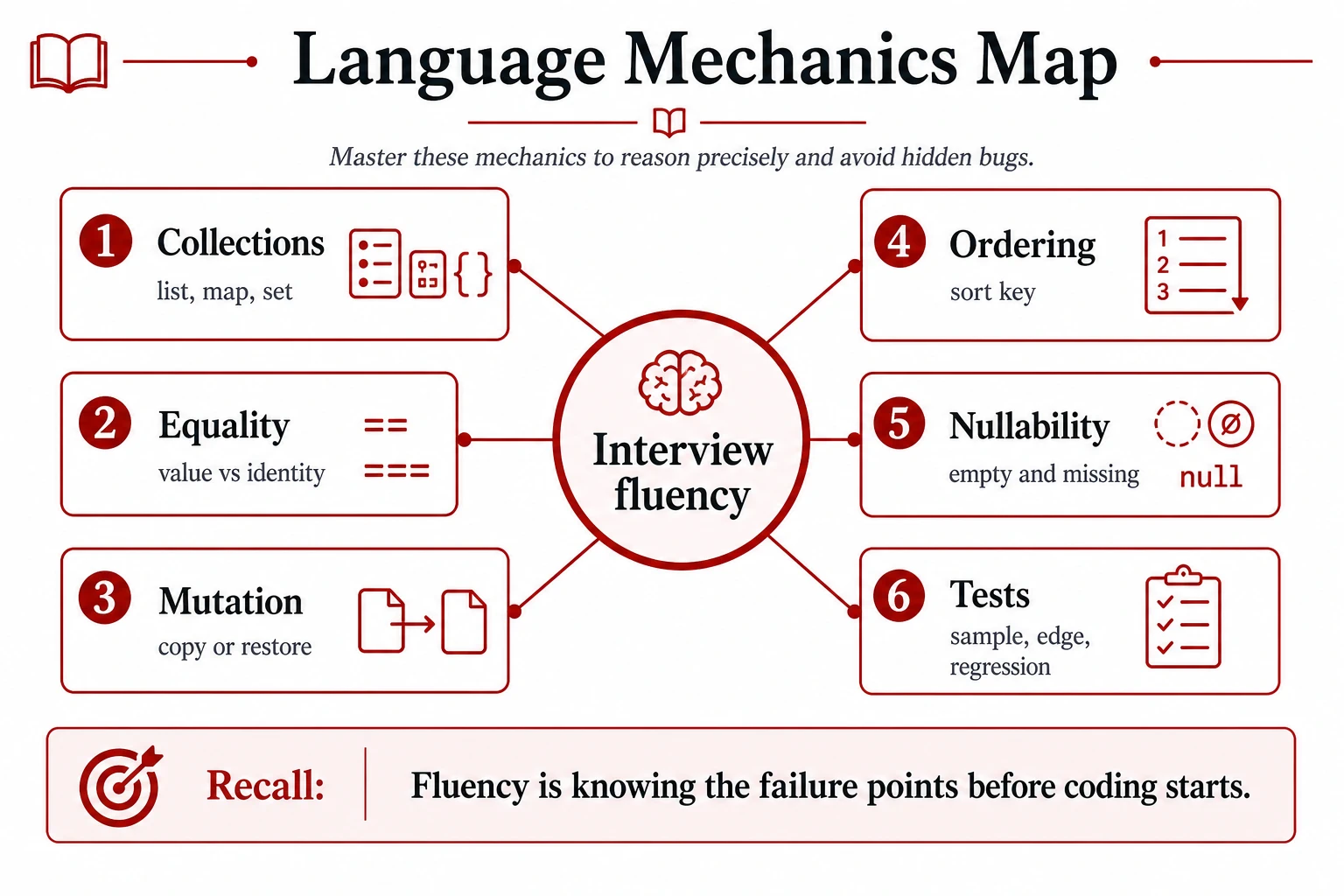
Interview-language fluency is control of those small semantic details. The language should carry the reasoning, not quietly change it.
Make the invariant executable
Before implementation, bind the algorithm to a representation and name the language risks that representation creates. For the sliding window, a useful statement is:
I will keep
leftat the start of the current duplicate-free window and map each character to its latest index.leftnever moves backward. I will test a repeat outside the current window because that is where a stale index can break the invariant.
This is more useful than narrating each line as you type. It says what must remain true, what state represents it, and where the language can betray it.
The same discipline changes other prompts:
- In a grid traversal, a coordinate pair must compare and hash by value. A visited set keyed by the displayed cell value is wrong when values repeat.
- In interval processing, the comparator must encode the full tie rule. “Sort by start” is incomplete when equal starts require a particular end order.
- In backtracking, the current path can be shared while exploring, but a
completed result must own a snapshot. Saving the working path itself saves a
value that later
popoperations will continue to change. - In breadth-first search, the queue must remove from the front at the cost you claim. A convenient array operation may shift every remaining element.
These are not syntax facts detached from algorithms. Each one determines whether the representation still means what the explanation says it means.
Collections are operations, not nouns
Knowing the names of a map, set, stack, queue, heap, and growable array is not enough. For each structure you use, you need a small set of moves available without research.
For a map, insert and update a value, test presence explicitly, and iterate in a way that does not assume a useful order. For a set, represent composite keys safely and know whether the elements you want to store are hashable. For a queue, enqueue and dequeue without accidental linear work. For a heap, encode priority and ties, then remember whether the library exposes a min-heap, max-heap, or configurable comparator. For strings and arrays, know which operations copy, which create views, and which mutate shared storage.
The right interview structure is not the cleverest available one. It is the simplest structure whose behavior you can implement, test, and explain. A slice with a head index may be a clearer queue than unfamiliar library machinery. A built-in sort is preferable to handwritten sorting when its comparator expresses the prompt directly. A tuple can be an excellent key or priority only when its equality and field ordering match the job.
Built-ins do not need to be avoided; they need to be understood at the point where correctness or cost depends on them. Chapter 31 develops the cost model. Here, the immediate question is simpler: does this operation do what the invariant assumes?
Ordering is part of the program
Suppose a prompt asks for the k most frequent words, with higher frequency
first and alphabetical order for ties. Counting is easy. “Use a heap” is not
yet a solution, because eviction order and final output order may be opposites.
State the ordering in full before choosing the API:
Better output means higher frequency, then alphabetically smaller word. If I keep only
kentries, the heap must evict lower frequency first and, on a tie, the alphabetically larger word.
Now test equal frequencies. A sample with no ties proves nothing about the comparator. If the language expects a negative, zero, or positive comparator, a Boolean return is not a shorthand. If the heap compares tuple fields, every field participates in the order unless you deliberately wrap or transform it. If a stable sort is required, either confirm stability or include the missing tie field explicitly.
Comparator code often looks polished while being subtly wrong. A tie-heavy case is therefore not an edge test added at the end. It is evidence that the ordering rule was actually implemented.
Mutation needs an ownership boundary
Backtracking makes shared state visible. A single working path is efficient and easy to inspect:
append choice
if solution is complete:
    save a copy of path
else:
    explore next choices
pop choice
The copy belongs at the result boundary. Copying on every recursive call may be correct but needlessly expensive. Never copying means every saved answer can refer to the same object. Fluency is knowing which value is temporary, which value escapes, and what assignment, slicing, append, and function calls do to the underlying storage in your chosen language.
The same question appears without recursion. Does sorting mutate the input? Does a helper receive a reference or a value? Can appending reallocate a buffer while another view still points to old or shared storage? Is a default collection created once and reused across calls? You do not need a theory of ownership for every prompt. You need a reliable answer at every boundary where one piece of code may change a value another piece believes it owns.
Absence must not impersonate a value
Missing, empty, zero, false, and null-like are different states unless the prompt makes them equivalent. Truthiness often erases that distinction.
In the sliding-window example, index 0 is a valid remembered position. In a
counting map, a stored zero may be meaningful. In a search, -1 is safe as a
sentinel only when it cannot also be valid data. Prefer the language’s explicit
presence operation when the value domain overlaps its missing-value shortcut.
Settle error behavior at the function boundary. If the prompt guarantees valid input, say so and do not bury the algorithm under production-style validation. If invalid input is part of the problem, choose deliberately among an error result, optional value, exception, or documented sentinel. The function signature should make the choice visible.
Numeric behavior deserves the same attention. Ask whether values can exceed
the chosen integer type. Know how division rounds, how the remainder operator
behaves for negative inputs, and whether overflow traps, wraps, or silently
loses precision in the environment. Never use “infinity,” a maximum integer,
or -1 as a marker until the input range leaves room for it.
Strings have a model too
“Character” can mean a byte, code unit, Unicode code point, or user-perceived grapheme. Different languages make different units easy to index, and some string indexing operations are not constant time.
Most algorithm prompts intend a simpler model. Ask once when the distinction can change correctness:
Should I treat the input as ASCII-like characters, Unicode code points, or user-perceived characters?
Then implement the agreed model consistently. Do not derail a routine prompt with production text concerns, and do not claim production-grade Unicode handling when the code iterates bytes or code units. The same honesty applies to normalization and case folding: use them only when the contract requires them.
Test the semantic risk
A useful test is aimed at the assumption most likely to fail. The sliding
window needs abba, not another all-distinct string. A comparator needs equal
primary keys. A saved backtracking path needs an assertion after the working
path has been mutated. A presence check needs a valid falsey value. A queue
needs enough breadth to reveal an unsuitable front-removal operation.
During debugging, name the failed assumption before rewriting:
- “I want to see whether this lookup is absent or contains index zero.”
- “I want to confirm which entry wins when priorities tie.”
- “I want to inspect the saved path after the restoration step.”
- “I want to confirm this iteration produces bytes, code points, or characters under the agreed model.”
That keeps the investigation local. It also makes recovery legible to an interviewer: you are testing a hypothesis about the code rather than replacing a mostly correct solution at random.
Build recall from a blank file
Chapter 29 asked you to choose one primary language. Now make its interview surface ordinary. From a blank file, without autocomplete or notes, write the forms you expect to need:
- function and test boundaries, including the language’s ordinary error form;
- arrays, maps, sets, stacks, queues, heaps, and graph adjacency;
- sorting by two fields, with a tie that reverses only one of them;
- safe composite keys and explicit missing-key checks;
- string iteration and efficient output construction;
- recursive traversal, restoration of shared state, and an iterative version;
- integer boundary, division, remainder, and sentinel examples.
Then run the file. Retrieval that feels effortless but has not been compiled or executed is still recognition. The language field guides in Appendix B provide starting forms for common choices; they are references, not substitutes for producing the forms from memory in your actual interview environment.
Turn each failure into the next small drill. “Heap practice” is too broad. “Equal priorities emerge in the wrong order; write ten tied entries and assert the complete removal order” can be rehearsed. If the same mechanic fails in three full problems, stop collecting problems and isolate it.
A short rotation can cover the language surface without becoming another study system:
- Map and set semantics: missing keys, falsey values, composite keys, and iteration order.
- Ordering: two-field sorts, heap direction, ties, and stability assumptions.
- Ownership: slice or collection copies, saved recursive state, and input mutation.
- Runtime edges: queue behavior, recursion depth, string units, integer limits, and error returns.
- Evidence: one example, one boundary, and one regression test chosen for the exact semantic risk.
Repeat the weak mechanic, not the calendar. Fluency is visible when an error log stops recording the same language surprises and starts recording mistakes in the problem reasoning itself.
Leave room for the problem
The purpose of language practice is not to perform language expertise. It is to recover attention for the work the interview is actually sampling.
You are ready when a prompt can change shape without sending you back to a reference: a list becomes a graph, output order becomes significant, mutation is forbidden, a comparator gains a tie, or a failed test reveals shared state. You can make the representation explicit, identify the semantic risk, write a test that reaches it, and repair the code without losing the invariant.
The next chapter asks whether the resulting implementation fits the input constraints. That analysis begins with an honest account of the operations the language actually performed. Fluency makes that account possible.