Senior Engineering Interview Handbook / Chapter 38
Complete Annotated Coding Interviews
Five annotated coding interviews: a strong round, a borderline senior performance, correct code with hidden reasoning, an excellent recovery, and an overengineered solution.
Preparing audio…
Audio edition
Complete Annotated Coding Interviews
Page tools
Five rounds, five changes in trust
Two candidates can submit the same correct function and leave different impressions. One has made the contract, proof, and trade-offs available for inspection. The other has left the interviewer to guess whether the code was derived, remembered, or reached by luck.
That difference does not come from narrating every keystroke. It appears at a few hinge moments: a boundary question before code, an invariant before a loop, a test chosen for the likely failure, a disciplined response to a contradiction, or the decision to stop designing once the contract is met.
The five rounds in this chapter use familiar problems so that the algorithms do not obscure those moments. Read the exchanges as performances, not scripts. Notice when the interviewer has enough evidence to trust the work—and when that trust has to be supplied by prompting.
The strong round: one question changes one line
Given a list of intervals, merge all overlapping intervals and return the merged intervals sorted by start time.
A strong merge-intervals round
Candidate: “Before choosing the overlap comparison: are these closed
intervals? In other words, should [1,4] and [4,5] merge?”
Interviewer: Yes. Treat them as closed.
Candidate: “May the input be empty, and may I return new interval lists rather than preserve the identity of the input objects?”
Interviewer: Yes to both. Every interval has start <= end.
Candidate: “Then I need to return the same covered points as the input, ordered and without overlapping output intervals. A repeated pairwise merge would work but can be quadratic. I’ll sort by start and scan.”
Interviewer: Why does sorting make one scan enough?
Candidate: “After I process the first i sorted intervals, merged is
sorted, non-overlapping, and covers exactly those intervals. The next start
cannot overlap an earlier output interval without also overlapping the last
one, so only merged[-1] needs inspection.”
Interviewer: Go ahead.
def merge_intervals(intervals):
    if not intervals:
        return []

    ordered = sorted(intervals, key=lambda interval: interval[0])
    merged = []

    for start, end in ordered:
        if not merged or start > merged[-1][1]:
            merged.append([start, end])
        else:
            merged[-1][1] = max(merged[-1][1], end)

    return merged
Testing and follow-up
Candidate: “I’ll start with [[1,3],[2,6],[8,10]], which should become
[[1,6],[8,10]]. The contract-specific test is [[1,4],[4,5]]; it must
become [[1,5]]. I also want an empty input, reversed input order, and
[[1,10],[2,3]] so a nested interval cannot shrink the result.”
Interviewer: Those pass. What is the cost?
Candidate: “Sorting dominates at O(n log n); the scan is O(n). The output
can take O(n) space. sorted also allocates a list, which is how I avoid
reordering the caller’s input.”
Interviewer: Now suppose touching intervals must remain separate.
Candidate: “Then equality changes meaning. I would start a new interval
when start >= merged[-1][1] and keep the touching pair as the regression. If
the input were already sorted, I could remove the sort and make the operation
O(n), while keeping the same scan invariant.”
The code is ordinary. The strength of the round lies in how little remains implicit. The endpoint question changes a comparison. The mutation question changes the ownership behavior. The invariant explains why the loop need not search the whole result. The tests are not a generic collection of edge cases; each protects a claim the candidate has already made.
Notice also what the candidate does not do. There is no speech during each assignment, no proof longer than the algorithm, and no attempt to impress the interviewer with a more exotic data structure. Visible reasoning is selective.
The borderline round: knowledge supplied on request
Return the
kmost frequent integers from a list. Output order does not matter,kis valid, and tied values may be returned in any order.
A correct answer that needs drawing out
Candidate: “I’ll use a heap.”
Interviewer: What work happens before the heap?
Candidate: “Right—I count each value in a map.”
Interviewer: And what do the relevant input sizes mean?
Candidate: “Let n be the list length and m the number of distinct
values. Counting is O(n).”
Interviewer: Why not sort the counts?
Candidate: “Sorting all m values would be O(m log m) and is simpler. A
size-k min-heap is O(m log k), so it is useful when k is much smaller than
m.”
Interviewer: What exactly stays in the heap?
Candidate: “Pairs of (count, value). After each insertion, if the heap
has more than k entries I remove its smallest pair. It therefore retains the
best k frequencies seen so far. The value may break count ties, which is
allowed by the contract.”
from collections import Counter
import heapq

def top_k_frequent(nums, k):
    counts = Counter(nums)
    heap = []

    for value, count in counts.items():
        heapq.heappush(heap, (count, value))
        if len(heap) > k:
            heapq.heappop(heap)

    return [value for count, value in heap]
The rest of the round
Candidate: “For [1,1,1,2,2,3] and k = 2, I expect 1 and 2. I’ll
also test a single value and a tie at the cutoff, where either tied value is
valid.”
Interviewer: Suppose the result must be deterministic and ordered by decreasing frequency.
Candidate: “Then the current output contract is no longer enough. I would
define the secondary order—say increasing numeric value. The tie rule affects
selection at the cutoff, not just presentation, so the heap must evict the
larger value when counts tie. I can store (count, -value, value), then sort
the selected items by (-count, value) before returning them. The total is
O(m log k + k log k) after counting.”
Nothing here is technically weak. The candidate knows the variables, the alternative, the heap invariant, and the consequence of a stronger output contract. The borderline signal comes from ownership: each important part of the reasoning appears only after the interviewer asks for it.
A stronger opening would have taken one sentence:
“I’ll count in O(n), then choose between sorting
mdistinct counts in O(m log m) and keeping a size-kheap in O(m log k); ifkis expected to be small, I’ll use the heap.”
The lesson is not to talk more. It is to lead with the reason for the chosen structure instead of its name.
Correct code, concealed recurrence
Given a non-empty binary tree whose node values may be negative, return the maximum sum of a path. A path may begin and end at any nodes but follows parent-child links.
The interviewer cannot see the proof
Candidate: “This is the standard recursion. I’ll write it.”
Interviewer: Define the recursive result first.
Candidate: “The helper returns a value to its parent, and there is a global maximum.”
Interviewer: Those sound like two different kinds of maximum. What does each permit?
Candidate: “The returned value uses one side. The global answer can use both.”
Interviewer: Why, and what happens in an all-negative tree?
Candidate: “The code handles that.”
def max_path_sum(root):
    best = float("-inf")

    def gain(node):
        nonlocal best
        if not node:
            return 0

        left = max(0, gain(node.left))
        right = max(0, gain(node.right))

        best = max(best, node.val + left + right)
        return node.val + max(left, right)

    gain(root)
    return best
The implementation is correct, but “the code handles it” asks the interviewer to certify understanding from familiar syntax. The recurrence needs a precise name. An upward gain begins at the current node and may be extended by its parent. It can therefore contain at most one child branch. A complete path may have the current node as its highest point and use both child branches.
The missing explanation could have been brief:
Making the same code inspectable
Candidate: “gain(node) returns the best path that starts at node and
can continue through its parent. Because that path must remain a chain, it
returns the node plus at most one child gain.”
Candidate: “Separately, this node may be the highest point of a finished
path, so best considers node.val + left + right. I clamp a negative child
gain to zero because extending through it can only reduce a path. I initialize
best to negative infinity, not zero, because the contract forbids an empty
path and an all-negative tree must return its least-negative node.”
Now the revealing tests follow from the explanation. A root 1 with children
2 and 3 must return 6, proving that a finished path may use both sides. A
single node -3 must return -3, proving that zero does not masquerade as an
empty path. A tree rooted at -10 with children 9 and 20, where 20 has
children 15 and 7, must return 42, proving that the best path need not
touch the root.
Private reasoning is especially costly in recursive problems. The surface code can look polished while the state definition is wrong. The interviewer needs to hear the distinction that makes the recurrence correct, not a tour of the recursive calls.
The wrong first answer and the strong recovery
Given a grid of
0s and1s, return the size of the largest connected component of1s. Connectivity is up, down, left, and right. Empty input returns zero, and the function must not mutate the grid.
The candidate chooses a breadth-first search from each unseen 1, with a
separate visited set because the caller retains ownership of the grid. The
first implementation accidentally includes diagonal neighbor offsets.
A contradiction becomes a useful test
Interviewer: Try this grid:
[
  [1, 0, 1],
  [0, 1, 0],
  [1, 0, 1],
]
Candidate: “Under four-directional connectivity, every 1 is isolated,
so I expect 1.”
Interviewer: Your function returns 5.
Candidate: “I’ll keep this input unchanged as the regression. A result that is too large means I either counted a cell more than once or connected cells that should be separate. This input is built entirely around diagonal separation, so I’ll inspect the neighbor definition first.”
Candidate: “There it is: I included diagonal offsets. I’ll reduce the set
to (1,0), (-1,0), (0,1), and (0,-1), then rerun this exact grid before
trying anything else.”
from collections import deque

def largest_component(grid):
    if not grid or not grid[0]:
        return 0

    rows, cols = len(grid), len(grid[0])
    visited = set()
    directions = [(1, 0), (-1, 0), (0, 1), (0, -1)]
    best = 0

    for start_row in range(rows):
        for start_col in range(cols):
            if grid[start_row][start_col] != 1:
                continue
            if (start_row, start_col) in visited:
                continue

            size = 0
            queue = deque([(start_row, start_col)])
            visited.add((start_row, start_col))

            while queue:
                row, col = queue.popleft()
                size += 1

                for dr, dc in directions:
                    next_row = row + dr
                    next_col = col + dc
                    in_bounds = (
                        0 <= next_row < rows and 0 <= next_col < cols
                    )
                    if not in_bounds:
                        continue
                    if grid[next_row][next_col] != 1:
                        continue
                    if (next_row, next_col) in visited:
                        continue

                    visited.add((next_row, next_col))
                    queue.append((next_row, next_col))

            best = max(best, size)

    return best
Recovery after the fix
Candidate: “The diagonal regression now returns 1. I’ll add an all-zero
grid for no component and [[1,1],[0,1]] for a component of size three. The
scan and traversal together are O(rows × cols), and the visited set may use
the same order of space. Since mutation is forbidden, that auxiliary state is
intentional. Iterative BFS also avoids recursion depth becoming the next
failure on a large component.”
Interviewer: What if diagonal connectivity becomes the requirement?
Candidate: “Then I would deliberately restore all eight offsets and change
this regression to expect 5. The traversal does not need a redesign; the
neighbor policy is the rule-bearing part.”
The first answer was wrong. The recovery is nevertheless strong because the candidate does not become random or defensive. They state the expected result, classify what an overly large answer could mean, connect the peculiar input to the most likely state, make one change, and preserve the contradiction as a test. A senior signal can survive a bug when control of the investigation remains visible.
The unfinished answer hidden inside an architecture
Return whether two strings are anagrams. Comparison is case-sensitive; spaces and punctuation count as characters; ordinary language-level character iteration is acceptable.
Designing past the contract
Candidate: “I’ll introduce a tokenizer, a normalizer interface, and a comparator strategy. Then we can support case folding, locale rules, and ignoring punctuation later.”
Interviewer: For this prompt, case, spaces, and punctuation all count.
Candidate: “Yes, but the abstractions will make it easier to extend.”
Interviewer: Can you first finish the specified function?
Candidate: “I need a little more time to connect the strategy objects.”
The candidate has noticed real complexities of text processing. None belongs to the stated contract. The unfinished framework offers less evidence than this complete function:
from collections import Counter

def is_anagram(a, b):
    return len(a) == len(b) and Counter(a) == Counter(b)
Counting takes expected O(n) time and O(k) additional space for k distinct
characters. Sorting both strings would also be defensible at O(n log n) time,
especially if brevity and available library behavior make it the clearer
choice. Tests should protect the actual contract: "listen" and "silent"
are a positive case; "rat" and "car" are not; "a b" and "ab " are
anagrams because spaces count; and "aA" and "Aa" are anagrams without any
case folding.
A right-sized follow-up
Interviewer: Now the product wants case-insensitive comparison that ignores spaces.
Candidate: “That changes the unit being counted, so I would add an explicit
normalization step before Counter. I’d test something like Dormitory
against dirty room. I still would not introduce a strategy interface until
we have multiple real normalization policies or callers that need to select
among them.”
Overengineering is not merely an aesthetic fault in a timed round. It spends the available time, hides the rule among invented extension points, and may leave no behavior to evaluate. Production judgment means matching the design to the promise in front of you, then identifying where a real change would enter.
Read the hinge, not the verdict
The labels on these rounds are outcomes, not personality types. The borderline candidate knew the heap argument. The quiet candidate wrote the correct recurrence. The candidate with the initial bug showed the strongest recovery. A different interviewer or time limit could change the eventual decision.
What transfers is the location of the hinge:
- In merge intervals, one endpoint question determined the comparison and its regression test.
- In top-k frequency, the choice became credible only when
n,m, andkmade the trade-off explicit. - In maximum path sum, two meanings of “best” had to be separated before the recursion could be trusted.
- In the grid, the failing input pointed directly to the neighbor policy.
- In the anagram problem, stopping at a complete small solution was the design decision.
Use the cases for rehearsal by pausing at those moments. Before reading the candidate’s next line, answer the interviewer yourself. Then vary the rule: make intervals half-open, require deterministic top-k ordering, allow an empty tree, permit diagonal adjacency, or introduce one genuine normalization policy. The useful follow-up is the one that reveals whether you know which part of the solution owns the changed requirement.
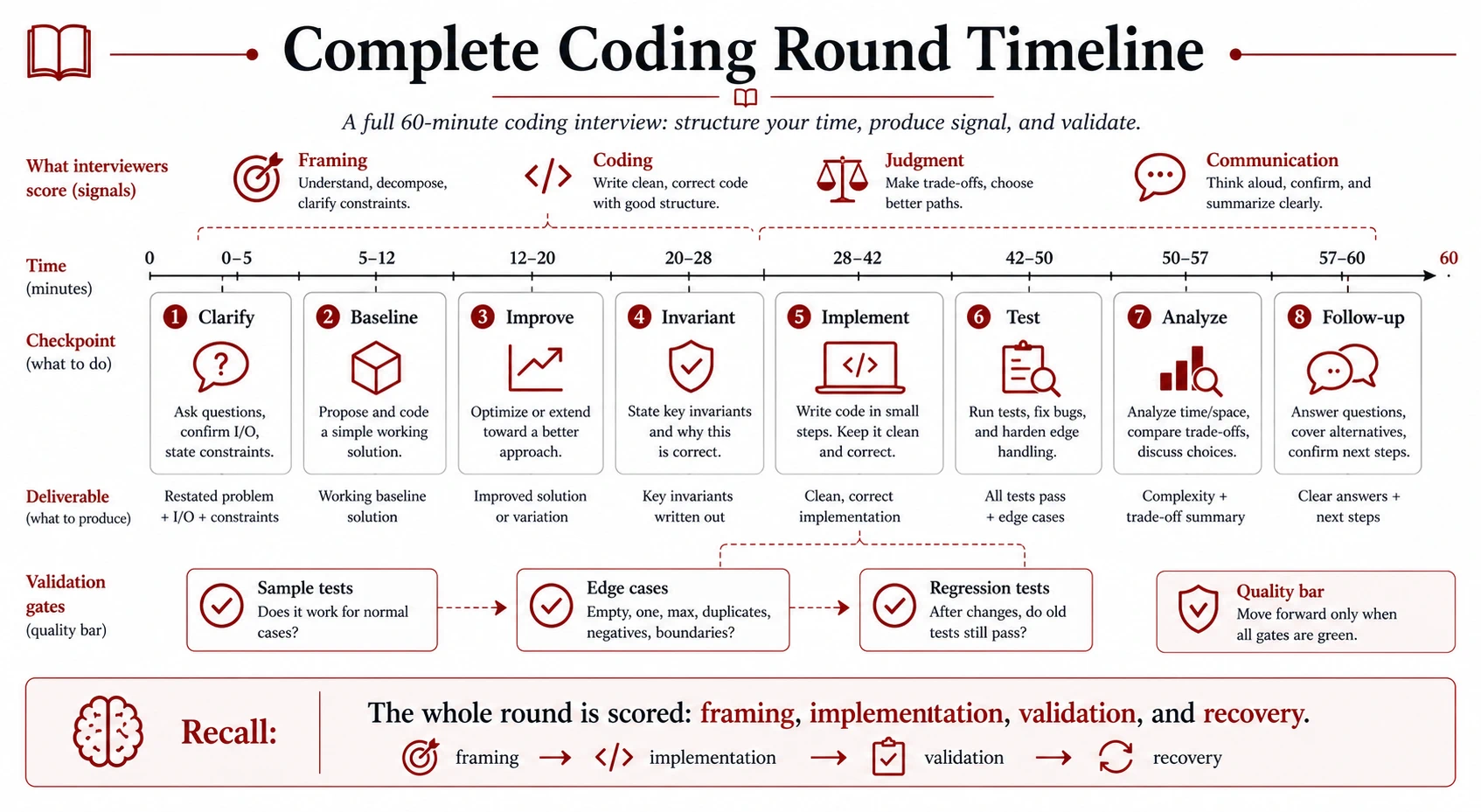
The coding-round chapters have now supplied a workflow, a standard of correctness, implementation habits, testing, debugging, and review. A complete round does not display those subjects one after another like a checklist. It uses them when the work demands them. The reader—and the interviewer—should be able to see why the next move is safe.