Solo Founder Product Engineering Handbook / Chapter 59
Developer Tools for Solo Founders
Build a narrow developer tool whose docs, errors, test path, and operating promises carry a stranger from first run to production trust.
Preparing audio…
Audio edition
Developer Tools for Solo Founders
Five Minutes in a Stranger’s Terminal
A solo founder has built a hosted webhook inspector. It accepts test events, shows headers and payloads, verifies signatures, and can replay an event to a local endpoint. The founder has used it for weeks. On their machine, the setup takes less than a minute.
Then a developer at a small subscription business tries it alone.
The developer opens the quickstart between two other tasks. The install command works, but the next instruction says to create an endpoint without explaining whether it is public or local. The dashboard calls the secret a signing key; the CLI calls it a token. The first event appears, yet its signature is marked invalid. The error gives no reason. After eight minutes, the developer closes the tab.
Nothing dramatic failed. The service was up. The core code was correct. The founder may never learn that an evaluation happened. But the product failed at the place where developer tools are actually bought: inside a stranger’s attempt to make them work.
Documentation, commands, API names, examples, errors, logs, test boundaries, and change promises form one path. A developer judges the whole path long before a team discusses procurement. For a solo founder, that path is also the most economical product boundary. Every ambiguity removed from it saves both an abandoned trial and a future support conversation.
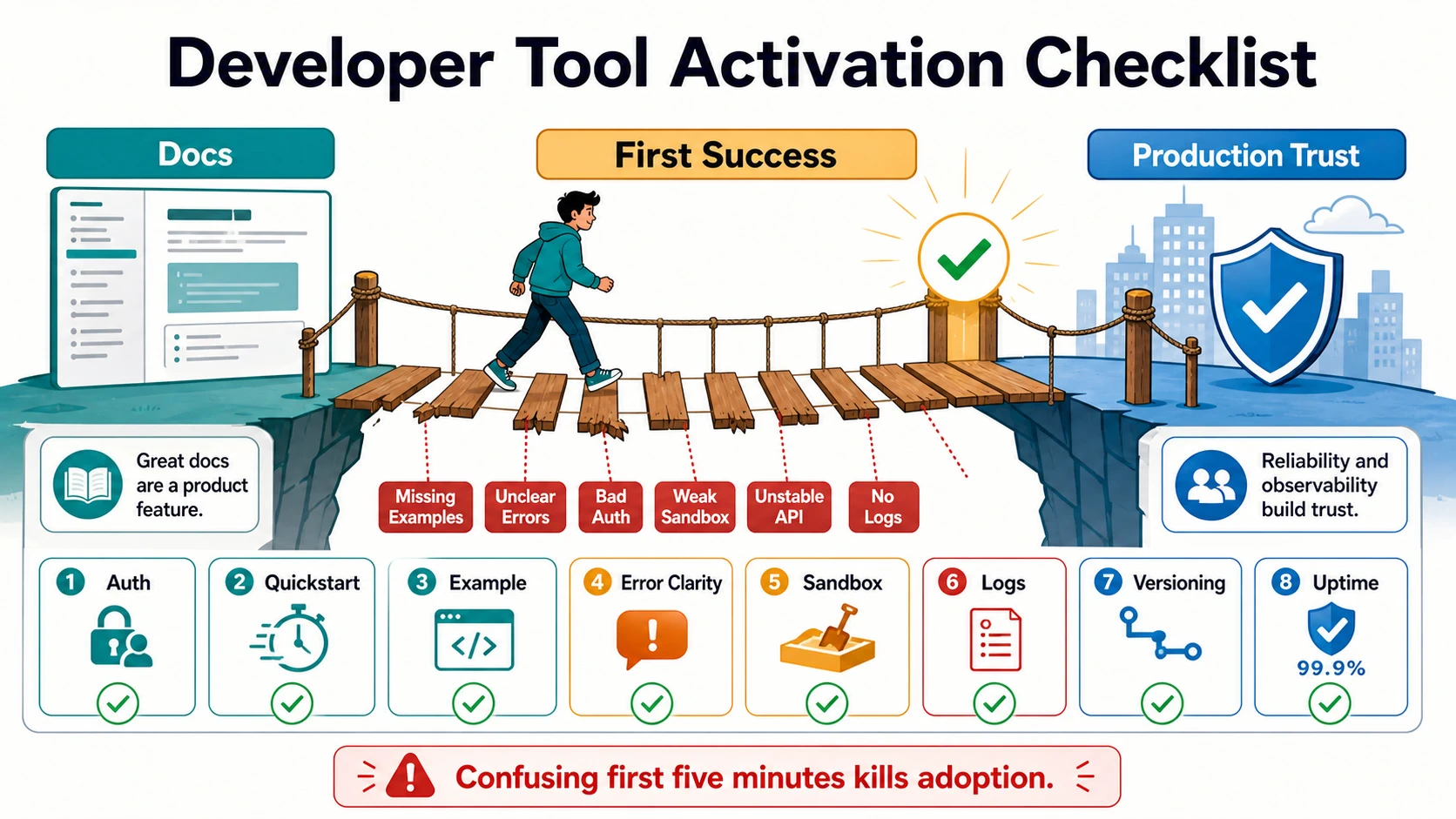
Define a Success Worth Reaching
“Installed the package” is convenient to measure and nearly worthless. So is a 200 OK response that proves only that the service can answer. First success should demonstrate the narrow value the developer came for.
For the webhook inspector, the event is complete when a developer can send a realistic test webhook, see whether its signature is valid, inspect the delivery attempt, and replay it safely to a local handler. That sequence proves more than connectivity. It lets the developer answer a real question: can this tool shorten the work of reproducing a failed webhook?
Writing that event forces useful product decisions. The founder must decide which webhook source to support first, how test credentials differ from production credentials, what a successful signature check displays, what a replay may affect, and where the developer sees the result. “A webhook tool for every stack” gives no such discipline. “Inspect and replay test billing events in Node” is narrow enough to make excellent.
The target developer matters as much as the event. A platform engineer with an existing event pipeline does not need the same first path as an agency developer adding subscriptions to a small application. Stack, environment, current workaround, urgency, and acceptable setup burden determine which quickstart deserves support. Broad documentation cannot rescue an undefined first user.
Write the Quickstart as an Executable Promise
The founder rewrites the guide from a blank terminal. It states the prerequisites, uses one name for each credential, and keeps the first path on test data. The developer runs one command to create a local listener, copies a test-only secret, sends the supplied fixture, and sees the expected event ID, signature result, delivery status, and replay control.
The guide also shows one likely failure. If the signature is invalid, the page identifies the secret that was used, shows the signed timestamp, explains the common causes, and links the request to its inspector record. Cleanup is explicit: stop the listener, revoke the test secret, and know that no production event was changed.
This is more than documentation. It is a claim the product must keep. Examples, package versions, field names, output, and links should be exercised whenever the active interface changes. A quickstart that silently drifts from the product teaches the developer that every later promise may drift too.
Resist the urge to offer six languages at once. One idiomatic Node example with real input, output, failure, and cleanup is stronger than thin examples that the founder cannot maintain. Add another SDK when users in the chosen segment repeatedly reach for it and the founder can test its full path. Until then, show the plain HTTP exchange so an unsupported-language user can still understand the contract.
The same economy applies to surfaces. A local CLI needs predictable configuration, scriptable output, and safe uninstall behavior before it needs a hosted dashboard. An API needs request IDs, retry guidance, rate-limit behavior, and a clear schema before it needs many wrappers. The first wedge should feel coherent, not large.
Let Failure Teach the Interface
On the second attempt, the developer’s test event reaches the inspector but fails verification. An opaque invalid_signature code would push the investigation back into search, source code, or support. A useful response closes more of the loop:
Signature verification failed for event
evt_test_1042. The request was received and stored in the test workspace; it was not forwarded. The signature timestamp is outside the five-minute acceptance window. Check that the sending machine’s clock is synchronized, then send a new fixture. Inspector record:req_7F3A.
The message identifies the failure, offers the known cause, states what did and did not happen, gives a corrective action, and preserves a reference. Not every error can be that certain. When several causes remain possible, the product should say what it knows, expose the relevant evidence, and avoid accusing the user’s code.
This is API design, not cosmetic wording. The response body needs stable machine fields as well as a readable message. The CLI should preserve a useful exit status. The inspector should show the same request ID as the SDK exception. Logs should make clear which environment and product version handled the event. Each surface should help the developer move without inventing a different story.
Errors also reveal side-effect policy. A timeout is especially dangerous if the developer cannot tell whether a replay occurred. The tool must define whether replay requests are idempotent, how duplicate attempts are recognized, when retry is safe, and where a developer can confirm the outcome. A polished message cannot compensate for an ambiguous operation.
For the founder, every repeated private explanation is evidence of missing product surface. The first explanation belongs in support. The recurring explanation belongs in an error, example, default, log, or sharper boundary. This migration of knowledge is how a one-person company prevents its support load from growing with every integration.
Make the Test Path Honest
The developer now reaches first success, but production use raises a harder question: did the test path teach the truth?
A sandbox need not duplicate an entire production system. It does need to preserve the behaviors developers will build against. The webhook inspector’s test mode should use the same signature algorithm, payload shape, event ordering rules, retry semantics, and inspector fields as production. It may use synthetic accounts, isolated credentials, lower limits, and shorter retention. Those differences should be visible.
False safety is worse than a small test surface. If replaying a test event cannot trigger a real side effect, say why. If a dry run validates a request but does not exercise delivery, name that gap. If latency and rate limits differ, publish both. A developer should know what the test proves and what remains untested before changing credentials.
The boundary also protects the founder. Separate test and live keys. Mark environments in commands, logs, and dashboards. Default dangerous operations to a preview where possible. Require an explicit production destination rather than inheriting one from a test configuration. Record actor, event, destination, attempt, and outcome well enough to investigate without collecting secrets or unnecessary payload data.
When the developer switches to a production event, the experience should not become a different product. The same event ID should connect the API response, SDK exception, dashboard record, and support request. The same documented retry rule should apply. The same error fields should exist. Production trust grows when the mental model formed in the test path survives contact with real work.
Promise Less, Then Keep the Promise
Young developer tools must change. The credible response is not to freeze every early choice; it is to be precise about which choices users may depend on.
The founder marks the webhook inspector’s surfaces separately. Test replay is experimental: behavior may change and it should not drive production automation. The event-inspection API is beta: schema changes will be announced and migration guidance will be supplied. Event IDs and signature-result codes are stable: breaking them requires a new version and a deprecation window.
That distinction is more useful than one maturity badge for the whole company. Developers build against fields, commands, event names, auth scopes, config formats, retry rules, and error codes. Those are the contracts. A dashboard can evolve freely while an API field remains stable; a CLI command can be beta while the underlying endpoint is production-ready.
Narrow stability suits a solo founder. Fewer SDKs, endpoints, deployment modes, and integrations mean fewer promises to test, document, support, and migrate. The founder can publish a plain changelog, mark deprecated behavior where developers encounter it, and provide one tested migration path. Casual breakage saves time only by spending trust.
Reliability promises should match the consequence of failure. A tool used only during local development can tolerate an outage differently from an API placed inside payment processing or deployment. Uptime, support response, retention, backup, security, and incident communication all become part of the product as reliance grows. If the founder cannot yet support consequential use, “not production-ready” is valuable information, not a marketing defect.
Bottom-Up Adoption Changes the Question
After two weeks, the developer uses the inspector repeatedly and adds its event IDs to the team’s debugging runbook. That is stronger evidence than a signup, repository star, or launch-day compliment. The tool has entered work.
Team adoption now exposes needs that individual evaluation did not. A second developer needs access without sharing a key. An engineering lead wants to know who replayed an event. A security reviewer asks how payloads are retained. An operator needs a status page and a way to export delivery history during an incident. These requests do not automatically justify a broad enterprise platform. They reveal the next trust boundary around the successful path.
The founder should also identify who pays and why. The original developer values shorter debugging sessions. The lead may pay for shared history and consistent incident work. A platform owner may value access control and reliability. A security reviewer may require auditability and retention controls. The business must connect individual usefulness to an organizational consequence without burying a promising self-serve tool under premature procurement features.
Open source creates a similar distinction. A repository can improve reach, trust, extensibility, and community learning while leaving the business unanswered. The paid product might be hosted delivery, team workflow, longer retention, managed upgrades, scale, compliance controls, or support. If the founder cannot name the scarce operational value, attention alone is not product-market fit.
Expand only along evidence from the working path. Do not add another cloud, framework, language, event source, and deployment model because each appeared once in a conversation. Ecosystem breadth multiplies examples, fixtures, compatibility tests, support cases, and release promises. A narrow tool can be dependable; a nominally universal tool may be mostly unsupported surface.
Read Activation as Product Evidence
The founder instruments the path without turning it into a vanity funnel. The useful trace begins when a target developer reaches the quickstart and ends when the tool becomes part of repeated work.
Record whether the developer chooses the right guide, creates a test credential, sends the fixture, reaches the meaningful success event, encounters an error, opens its inspector record, returns after setup, and eventually uses a live environment. Measure elapsed time and support touches, but retain the sequence. A median time to first event can hide a step where many developers leave and a few experts race through.
Corrections suggest different work. If developers copy the wrong key, credential naming or placement is weak. If events arrive but cannot be found, the inspector and request IDs need work. If test activation succeeds but production never follows, the missing piece may be reliability, security, a buyer, or enough value to justify integration risk. If production begins and support explodes, the wedge is wider than the founder can currently operate.
The strongest signals arrive after the tutorial: repeated use in real projects, another teammate adopting from the docs, users writing their own runbooks or examples, expansion into production, and willingness to pay for a trust or operating surface. These behaviors show that the product has survived the developer’s environment rather than merely impressed them.
Build the Activation Packet
For one target developer and one stack, write a packet that another person can execute without you:
- Name the job, environment, and first meaningful outcome.
- Provide the smallest realistic fixture and test-only credential path.
- Give the exact command or request and the expected observable result.
- Show three plausible failures with cause, side-effect status, correction, and request reference.
- Explain what test mode simulates, persists, charges for, or cannot affect.
- State the maturity promise for every surface the developer touched.
- Provide the log or inspector trail that connects an attempt to its outcome.
- End with safe cleanup and the first deliberate step toward production.
Hand the packet to a developer who matches the segment but lacks the founder’s context. Watch without rescuing the attempt. The important notes are not opinions about the prose. Record where the developer formed the wrong model, which noun they searched for, what they feared might happen, what evidence restored confidence, and what required an explanation.
Revise the product path, then repeat. A guided setup can be excellent research, but it is not evidence of self-serve activation until the guidance has moved into the tool.
Choose the developer-tool path when a specific developer has an urgent job, the founder can make one integration unusually clear, and production reliance can grow without demanding an ecosystem one person cannot support. Narrow it when languages, environments, or private setup work spread faster than retained use. Avoid it when broad compatibility or high-consequence reliability is required before anyone receives value, or when the attraction is developer attention without a buyer or a durable operating advantage.
The webhook inspector earned its place when a stranger could cross the path alone: from a test event, through an honest failure, to an outcome they could explain. The production product begins there. It grows by keeping that explanation true as credentials, teammates, traffic, and consequences change.