Solo Founder Product Engineering Handbook / Chapter 19
Distribution Strategy for Solo Founders
Validate a first reachable channel, message, conversion action, and follow-up path before treating product value as enough.
Preparing audio…
Audio edition
Distribution Strategy for Solo Founders
The Offer Is Ready. The Route Is Not.
Continue the fictional reporting-product example. Its founder has a plausible paid offer: turn a small agency’s campaign changes into two client-ready reports. The promise is narrow, the pilot has a price, and the minimum product can be run partly by hand. The founder also has a spreadsheet containing one hundred agencies.
Nothing in that spreadsheet explains why an agency owner would read the message this week.
This is where distribution becomes part of product strategy. The founder does not simply need a list of possible buyers. They need a route into a moment when the problem is present: a difficult client meeting, a reporting deadline, an unexplained performance change, or an account manager spending Friday afternoon rewriting charts into careful prose.
A useful first channel joins six things: a specific customer, a visible trigger, a place where that customer already pays attention, a message allowed in that place, proof strong enough to reduce doubt, and a next action worth counting. If one link is missing, reach turns into undiagnosed traffic.
For a solo founder, this route must be small enough to test personally. The first channel is not a permanent growth engine or a declaration that the company is “product-led,” “community-led,” or “content-led.” It is an evidence loop that can answer a harder question:
Can I reach the intended customer at the right moment, make a credible offer, and observe a commitment that should change what I build next?
Begin With the Trigger
Channel names are seductive because they make an unfinished strategy sound concise: SEO, Reddit, partnerships, an app store. None says who is reachable, why the problem is urgent, or what the founder has permission to do.
A trigger supplies that missing motion. It is the event or condition that makes the customer newly receptive. A finance lead has missed a reporting deadline. A developer has hit an integration limit. A compliance officer has received an audit request. An agency owner has had to explain an abrupt campaign change to a nervous client.
For the reporting product, “small agencies on LinkedIn” is an audience label. “Owners of paid-search agencies whose account teams must explain a major weekly performance change before the next client call” is the beginning of a distribution hypothesis. It suggests where the trigger may be visible, whose language matters, what proof could help, and how small the first request should be.
Work outward from the trigger:
- Segment: name the buyer or user narrowly enough to find real people.
- Attention: find where they search, ask, browse, listen, or compare when the trigger occurs.
- Permission: learn what kind of contribution or approach is acceptable there.
- Proof: prepare the result, example, referral, demonstration, or explanation that lowers the risk of responding.
- Action: ask for a behavior that costs enough effort to reveal interest without demanding a full purchase decision too soon.
The order matters. Starting with a favored channel encourages the founder to invent an audience for it. Starting with the customer’s situation makes the channel compete for the right to carry the offer.
Choose Access You Can Operate This Week
The earliest useful channels usually fall into three families: direct access, borrowed attention, and product-borne reach. Their names are less important than the work each asks from the founder.
Direct access includes warm introductions, founder-led outreach, and cold outbound. A warm introduction transfers some trust, but friendly access can flatter a weak offer; the founder still needs a specific request and must distinguish politeness from commitment. Founder-led outreach is broader: the founder selects the account, researches the trigger, sends the message, and conducts the follow-up. Cold outbound is the version without prior trust. It works only when the segment and trigger are precise enough that the message feels observed rather than sprayed.
Direct access is often the fastest learning path for a narrow business product because the founder can hear the refusal. Its limit is founder time. Twenty careful messages can test an offer; two thousand generic messages create a deliverability problem and little understanding.
Borrowed attention includes communities, search, content, directories, marketplaces, app stores, developer ecosystems, and partnerships. Each already gathers some combination of audience, intent, or trust, but none grants free access to it.
In a community, usefulness precedes promotion. Listening, answering a real question, or publishing a teardown can reveal vocabulary and earn a conversation; arriving with a disguised pitch burns the channel. Content can perform similar work in a form the founder controls. Search is a distribution path only when customers use recognizable queries with meaningful intent. A dozen valuable conversations may arrive from one narrow comparison or workflow page, while a year of broad “thought leadership” produces readers who will never buy.
Directories, marketplaces, and app stores put the product near category demand, but they also impose comparison, ranking, reviews, listing rules, screenshots, support expectations, and sometimes platform review. Developer ecosystems add quickstarts, stable behavior, permissions, error handling, and integration support. Embedded distribution can be powerful when the product’s output travels naturally into another person’s workflow—a client-ready report forwarded to a client, for example—but the shared artifact must create value without turning customer data into unwanted promotion.
Partnerships exchange some control for another party’s access or credibility. They are promising when the partner benefits from the product and can identify the right customer. They are a poor first refuge when the founder would need enablement material, co-selling, revenue sharing, lead operations, and repeated coordination before meeting one buyer.
Product-borne reach includes referrals and product-led growth. A referral works when a customer can explain the result to a peer and has a reason to do so. Product-led growth asks still more: a user must reach value quickly, usually without founder explanation, and use or collaboration must expose the product to others. That may require invitations, shared artifacts, templates, permissions, lifecycle messages, and reliable self-service onboarding. Calling the strategy “product-led” does not make that machinery free.
Paid acquisition can amplify any of these paths once audience, intent, message, conversion, retention, and rough economics are understood. Before then, it often buys ambiguous attention. A click can test a phrase. It cannot prove pain, budget, trust, activation, retention, or supportability. The early paid test should therefore ask one narrow question and count something stronger than a page view: a qualified reply, booked call, representative sample, activated trial, or paid-pilot request.
The best first channel is not the one with the largest imagined scale. It is the one that can expose the most consequential uncertainty without requiring cash, brand, systems, or a team the founder does not have.
The Channel Changes the Minimum Product
Distribution does not sit outside the product. A channel limits how much context the message can carry, what proof a prospect expects, and which product mechanics must exist before the next action feels safe.
Cold outreach can carry a sentence or two, so the offer needs a recognizable trigger, a compact result, and an easy reply. Search can support a longer explanation, but the landing page must use the customer’s existing language and satisfy the intent behind the query. A community contribution must be useful before the pitch. A marketplace listing needs a narrow integration, clear permissions, setup guidance, and a support path. A developer channel needs working examples and honest error behavior. A referral needs an outcome that remains intelligible when the founder is absent.
These demands can improve the product. They can also inflate it. A marketplace fantasy may pull screenshots, review collection, platform compliance, polished onboarding, and permanent support into the backlog. A product-led fantasy may pull collaboration, invitation flows, templates, analytics, and email automation into a product whose core result has not survived five customers.
Build only the mechanics required to make the current channel test credible. For founder-led outreach to agencies, that may mean one convincing report made from fictional but realistic campaign data, a short page naming the workflow and pilot terms, a safe manual intake path, a delivery promise, and a follow-up script. It does not yet require a self-serve client portal, generalized integrations, or an automated referral program.
This is channel-message-product fit at the scale that matters before product-market fit. The message fits the permission and attention available in the channel; the product can keep the promise made by the message; and the resulting behavior is strong enough to guide another product decision.
Run One Complete Test
Return to the fictional reporting product. Search looks plausible because agency employees search for report templates and client-communication advice. A niche community contains candid discussions of the work, but a new participant has little right to pitch. Founder-led outreach offers quicker feedback because agencies can be identified through public case studies, job posts, tool directories, and their own sites.
The founder chooses outreach as the test and community listening as research, not as a second campaign. After several hours reading how account teams describe the work, the founder selects twenty-five agency owners or account leads whose public material suggests recurring paid-search reporting.
The first draft of the message says, “I built an automated reporting platform.” It asks the recipient to translate a category into value and gives no reason to answer now. The revision carries the trigger and the proof:
When campaign performance changes, do your account managers spend time turning the numbers into a client-safe explanation? I am testing a two-week paid pilot that turns one messy weekly update into a client-ready note. I can send a sample made from fictional campaign data. Would you tell me whether it fits your reporting workflow?
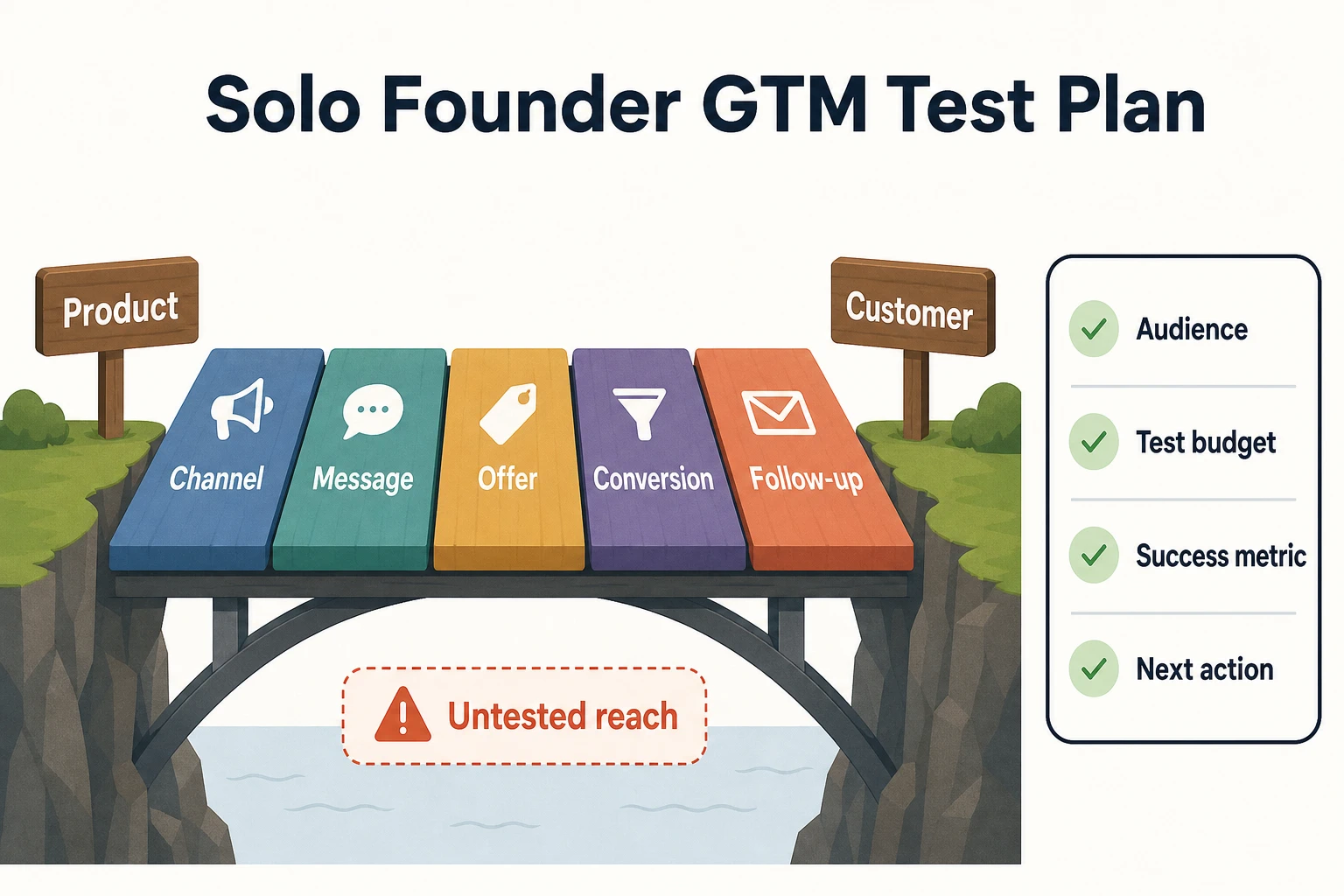
The complete Solo Founder GTM Test Plan for this run is short enough to inspect:
- Audience: owners or account leads at small paid-search agencies with recurring client reporting.
- Trigger: a campaign change that must be explained before the next client update.
- Channel and message: twenty-five researched founder-led messages using the trigger language above.
- Offer and proof: a two-week paid pilot, supported by a before-and-after report made from fictional data.
- Conversion: a qualified workflow reply, sample review, pilot call, or invoice—not an email open or page view.
- Budget: twenty-five contacts and eight hours of founder time, including research and follow-up.
- Threshold: five qualified conversations and two serious pilot decisions are enough to continue; the numbers are test boundaries, not market laws.
- Follow-up: send the sample, ask how the work happens now, record objections and authority, and propose the pilot when the fit is real.
- Stop rule: if the intended audience understands the offer but will not spend time, share a representative scenario, introduce the buyer, or discuss payment, revise the segment, pain, proof, or offer before adding product scope.
This plan prevents the test from dissolving into “do outreach.” It records what the founder will spend, which action counts, when to stop, and how the response can alter product work.
Read Behavior, Including Silence
A useful distribution test produces a path of observable events: selected prospect, delivered message, reply, qualified conversation, proof viewed, scenario shared, pilot discussed, invoice accepted or refused, result delivered, and follow-up requested. The founder does not need analytics infrastructure for twenty-five contacts. A plain log with dates, source, stage, objection, and next action is enough.
Different breakpoints imply different work. Replies that ask for a sample point toward proof. Interest from users without budget authority changes the buyer hypothesis. Refusal to share data exposes a trust or intake problem. Repeated requests for unrelated report types pressure the wedge. Internal forwarding suggests that the output may support referrals or a sales handoff. Clicks without replies may show curiosity without urgency.
Silence deserves diagnosis, not a comforting story. The audience may be wrong, the trigger invisible, the subject line generic, the proof thin, the request too large, or the problem unimportant. Change one important variable at a time and preserve the log. Otherwise each new message begins a new experiment whose result cannot be compared with the last.
Attention is the weakest common signal. Likes, launch-day visits, upvotes, bookmarks, and compliments can identify language or places worth studying, but they do not reveal enough sacrifice. Stronger signals expose effort, authority, workflow access, data access, risk, money, or repeat use. The purpose of the conversion action is to decide which kind of evidence the test is designed to earn.
Even a successful first test has limits. Twenty-five hand-picked contacts can show that the founder knows how to reach and sell to some customers. They do not show that the channel scales, that acquisition will remain affordable, or that customers will retain. The next test should answer the next uncertainty rather than promote a small win into a growth forecast.
Refuse the Hidden Team
Every channel sends an invoice in work. Enterprise outbound brings research, procurement, security questions, implementation, and persistent follow-up. Daily content brings editorial planning and production. Partnerships bring enablement and coordination. Marketplaces bring review rules and support. Product-led growth brings onboarding, invitations, activation instrumentation, and lifecycle work. Paid acquisition brings creative testing, attribution, landing-page iteration, and economic discipline.
One founder may eventually choose any of them. The first proof should not require all of that machinery before one qualified customer can act.
Before committing more architecture, the founder should be able to name one reachable audience and trigger; one channel with acceptable permission; one message and credible proof; one offer and observable conversion; a founder-time and cash budget; a success threshold and stop rule; a follow-up path for replies, refusals, and silence; and the minimum product mechanics needed to keep the promise.
Then run the plan. Do not replace contact with channel research, infrastructure, a content calendar, or an integration roadmap. The exercise is complete when evidence forces a decision: continue the route, change its message, choose a different segment, strengthen the proof, narrow the offer, or stop building.
Pricing made the product’s promise consequential. Distribution now asks whether one founder can place that promise in front of the right customer at the right moment. If the route works, the next constraint arrives immediately: can the revenue model, support load, trust obligations, and operating work behind the promise still be carried by one person?