Solo Founder Product Engineering Handbook / Chapter 1
What You Are Actually Building
Define a product as a value system before reducing it to an app, feature list, or codebase.
Preparing audio…
Audio edition
What You Are Actually Building
The App Is Not the Product
The first product mistake usually happens before the first line of code. The founder names the thing too narrowly.
They say they are building a dashboard, an AI assistant, a Chrome extension, an API, or a scheduling tool. That description may guide implementation, but it is a dangerous starting point for product judgment. It points toward screens, data models, and integrations before the founder has named the exchange the software is meant to create.
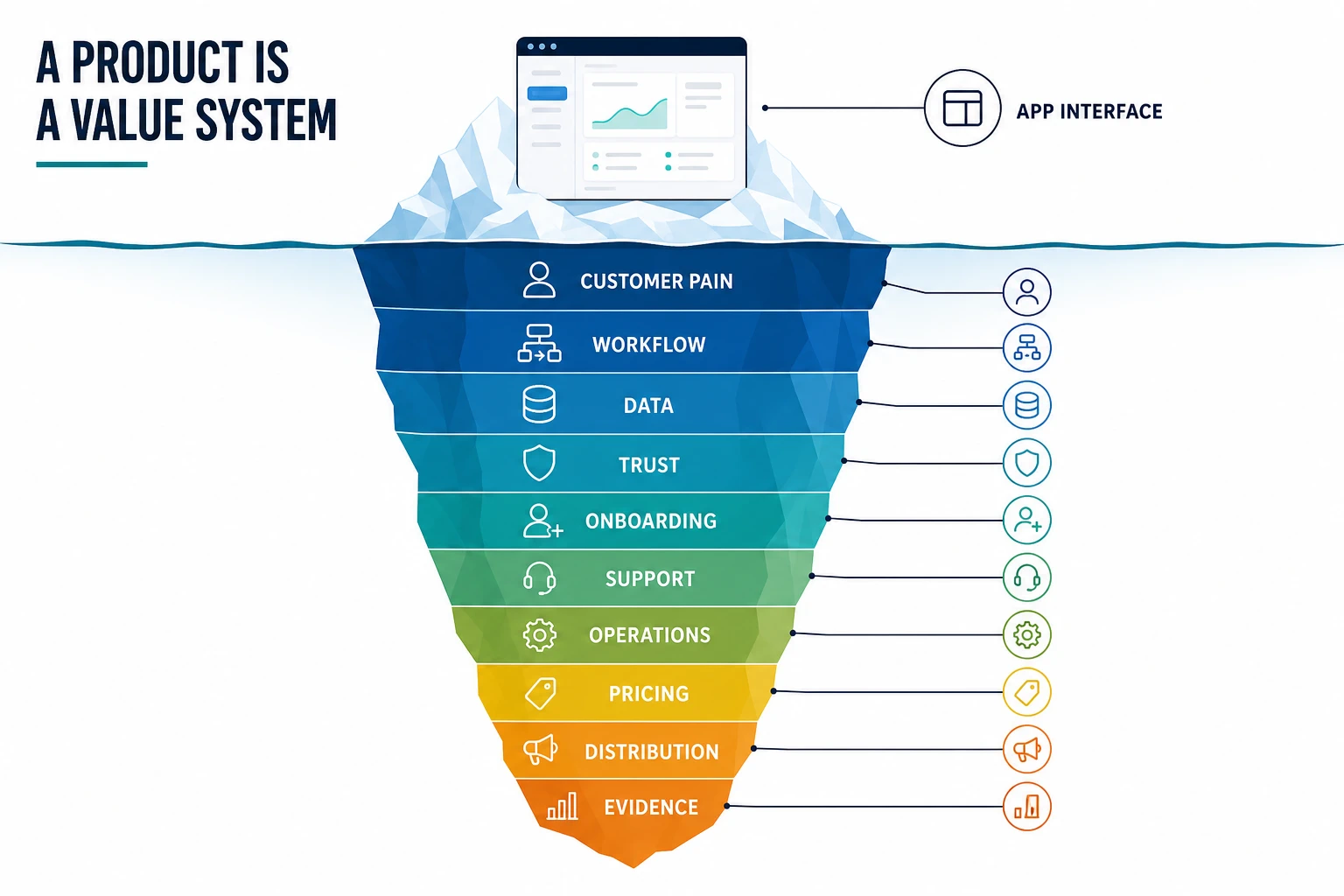
A product is not the visible software. A product is a system that creates, delivers, and captures value for a specific customer in a specific context.
That definition changes the first build decision. Define the product as “a dashboard for contractors,” and charts, filters, permissions, and visual polish seem central. Define it as “a way for a small contractor to know which invoices are late, who owns the next follow-up, and whether payroll is at risk this Friday,” and the shape changes. The first useful system might be a weekly import from accounting software, a follow-up queue, a cash-risk note, and a reminder email. It may not need custom charts. It may not need a dashboard at all.
Every invented feature becomes something to explain, test, observe, secure, support, operate, and eventually remove. A large team can sometimes absorb the consequences of a vague product definition. One person cannot.
So the opening question of this book is not “Can I build it?”
It is: What is the smallest value-delivery system that can prove whether a reachable customer will change behavior?
Value Has to Appear in Behavior
Every product contains an exchange. The customer gives something: money, time, attention, workflow change, data, trust, political capital, or switching effort. The product gives something back: saved time, reduced risk, new capability, better coordination, status, revenue, confidence, or relief from an annoying job.
The software only matters because it makes that exchange repeatable.
This is why “people would use it” is a weak standard. Someone can click through a demo, praise the design, or sign up from curiosity and still never pull the product into real work. Early evidence has to connect to behavior that costs the customer something.
Useful early behaviors include:
- sending real data instead of sample data;
- replacing a spreadsheet, checklist, or manual step;
- inviting another person into the workflow;
- returning at the next natural work interval;
- asking for a missing capability that would unlock more real use;
- paying, requesting procurement, or spending political effort to keep using it;
- depending on the output when making a decision.
In this modeled contractor product, viewing a chart is weak evidence. Importing current invoices is stronger because the customer has trusted the system with real data. Assigning a follow-up changes a workflow. Returning the next Friday suggests that the cash-risk note belongs in the rhythm of the business. Depending on it before approving payroll is stronger still—and raises the standard for data quality and reliability.
The exchange also reveals who the product must satisfy. The office manager may import invoices and chase payment. The owner may buy the product because late receivables threaten payroll. An external bookkeeper may need to trust the calculations. In a small firm, those roles might belong to one person; in another, they do not. A product that delights its operator but cannot earn the buyer’s approval or the bookkeeper’s trust is incomplete.
Write the product in customer language, not builder language. Name who has the pain and can act on it, what happens today, what changes if the product works, and which behavior would prove that the change is real. “Everyone who manages projects needs better visibility” answers none of those questions. “Small electrical contractors need to see which unpaid invoices put Friday payroll at risk” begins to.
The wording does not need to be elegant. It needs to be specific enough that the codebase cannot become a hiding place for an unclear product.
Follow the System Below the Screen
The visible interface rarely creates value by itself. Behind a simple cash-risk screen sit invoice records, payment status, customer contacts, follow-up ownership, accounting imports, calculation rules, reminders, permissions, and exceptions when the data is stale or wrong. There is also onboarding, support, pricing, distribution, and the customer’s willingness to trust the result.
Seeing that hidden system does not mean building all of it. It lets you decide what must be real, what can be manual, what can be bought, what can be borrowed, what can be faked, and what should be excluded.
The first version may use a CSV instead of a live accounting integration. The founder might review each cash-risk note before sending it. Follow-up reminders might be ordinary email rather than a notification system. Those choices are not shortcuts around the product if they still deliver the value moment and preserve trust. They are part of the first product system.
Work backward from that moment:
- What makes the customer act now?
- Why does the current workaround survive?
- What is the earliest useful change in the customer’s work or decision?
- What behavior shows that the change was valuable enough to repeat?
- What technical and manual system can deliver it credibly?
- What trust, support, operational, and distribution obligations come with that system?
The answers should usually narrow the product. If they keep expanding it, you probably have a category rather than a first product.
Feature, App, Product, and Business
A feature is one capability. An app is a packaged interface. A product is a repeatable value exchange. A business is the economic and operational system that makes the exchange worth sustaining. They may occupy the same repository, but they are different decisions.
Importing invoices and flagging late ones is a feature. A weekly cash-risk workspace is an app. The product is the exchange in which a contractor gives the system accounting data and attention, then receives earlier warning and a clear follow-up action. The business exists if enough contractors will pay for that exchange and the founder can deliver it at a sustainable cost.
Separating these layers makes scope easier to cut. You can test the invoice import without pretending the app is complete. You can validate the value exchange before automating every exception. You can discover that the product works but the business does not, perhaps because every customer requires a custom accounting cleanup. Adding more features would not repair that economics.
A project is different again. It can be complete when the maker has learned something or produced an artifact. A product has to create value repeatedly for someone else. A business has to make that repeated exchange worth continuing. Impressive software may be a successful project while remaining an unproven product and an impossible business.
The Product-System Definition Canvas
The canvas below is the first operating artifact in the book. Use it before building a first version, rewriting a landing page, accepting a custom request, adding a major feature, or deciding that a product needs more architecture.
Do not score it. Do not turn it into a ritual. Use it to expose the assumptions that are currently hiding inside the phrase “my product.”
| Field | Fill it with a concrete answer |
|---|---|
| Target customer | The specific person or team with the pain |
| Painful situation | The repeated moment where delay, cost, risk, confusion, or effort appears |
| Current alternative | The tool, spreadsheet, service, person, habit, or avoidance used today |
| Desired behavior change | What the customer should do differently if the product works |
| First value moment | The earliest useful outcome the customer can experience |
| Smallest delivery system | The minimum interface, workflow, data, manual process, and support needed |
| Trust requirement | What the customer must believe before using it with real work |
| Distribution path | How the first ten relevant customers can discover it or be recruited |
| Evidence | The behavior, payment, retention, referral, or dependency that would justify the next decision |
| Founder burden | The ongoing build, support, operations, and explanation load |
A blank current alternative is a warning: the problem may not occur often enough to have forced a workaround. A vague first value moment makes activation hard to see and harder to improve. Heavy founder burden may mean the first version is becoming a custom service with software attached.
The fields should resolve into one operating definition:
We help small electrical contractors see which unpaid invoices put Friday payroll at risk. The office manager currently exports an aging report, checks the bank balance, and asks the owner which customers to chase. The first value moment is a short list of late invoices, each with an owner and next action, beside a cash-risk note the owner can verify. The smallest delivery system is a weekly CSV import, a founder-reviewed calculation, a follow-up queue, and an email summary. We will know it is working when firms use the system for four consecutive payroll cycles and assign follow-ups from it without reconstructing the answer in a spreadsheet.
That paragraph is not a brand message. It is an operating definition. It tells the founder what to build, what to ignore, what to test, who to recruit, and what evidence matters.
Small Means the Whole System Fits
A large company can distribute sales, onboarding, implementation, support, analytics, infrastructure, security, and customer success across several teams. A solo founder owns all of them.
That changes the meaning of “small.”
Small means the whole system can fit inside one person’s week without collapsing the learning loop. A CSV import is not small if every file requires a custom cleanup. An integration is not small if every failure becomes an urgent support incident. A pricing model is not small if every sale requires a bespoke negotiation. A workflow is not small if the founder must reconstruct every customer’s result to learn whether the product helped.
The contractor example exposes an important boundary. Payroll risk depends on correct and current numbers. The first system may be manual behind the screen, but it cannot be casual about provenance. The customer should be able to see when invoices were imported, which balances were included, and how the warning was calculated. A decorative dashboard can wait. Traceability cannot.
The same definition also reveals founder burden. If every import uses a different schema, every cash-risk note needs judgment that cannot be captured, and every customer expects the founder to chase invoices, the founder has not built a small software product. They have taken responsibility for part of the customer’s finance operation. That might be a useful way to learn, but it must be named honestly and bounded deliberately.
Narrow does not mean trivial. It means inspectable. You can watch the customer reach value, see where trust breaks, and identify which manual steps are worth automating. You can decide whether the next unit of code will increase evidence or merely increase surface area.
When the Definition Is Still Too Broad
Technology-first language is one warning. “An AI finance copilot for small business” names a mechanism and a market, but no behavior. “A weekly cash-risk note for electrical contractors who invoice after completing jobs” gives the founder something to investigate.
An unnamed current workaround is another warning. Customers do not use spreadsheets, email threads, phone calls, or manual services because they are ignorant. Those alternatives are flexible, trusted, available, cheap, or already woven into the job. The product must defeat the real workaround, not the inferior version imagined for a pitch.
A third warning is evidence that stops at praise. The system compiles, the demo works, and prospective customers call it useful. None of that proves a workflow has changed. Until someone imports real invoices, assigns a follow-up, returns next Friday, or pays to preserve the routine, the value exchange remains a hypothesis.
When the product still feels large, ask:
- Can I name the first ten reachable customers?
- Can I describe the current workaround without insulting it?
- Can I observe the first value moment?
- Could I deliver that moment manually before automating it?
- Can I support the first ten users without pausing all learning?
- Can I say what I will not build yet?
Weak answers point to the real uncertainty. If the first ten customers are imaginary, distribution needs attention before architecture. If the value moment cannot be observed, activation is undefined. If manual delivery is impossible, the first build may be too large for the evidence it can produce. If support for ten users would consume the founder, the system is already too heavy.
Decision Gate
Proceed when you can write one specific paragraph that names:
- the target customer;
- the painful situation;
- the current alternative;
- the desired behavior change;
- the first value moment;
- the smallest delivery system;
- the trust or support obligation;
- the evidence that the product is being pulled into real use.
Change direction when the paragraph is mainly a technology, category, feature list, or market-size claim. Stop building for now when the only evidence is founder excitement, a broad trend, generic praise, or encouragement from people who do not have the painful workflow. Personal pain can be a useful source of ideas, but it becomes product evidence only when the pain also exists among reachable customers with enough urgency to change behavior.
This gate is not caution for its own sake. It protects the founder’s ability to learn. If you cannot define the value system, more code will mostly make the confusion more expensive.
Practice
Write your current product definition three ways:
- The feature version: “It lets people…”
- The app version: “It is a…”
- The value-system version: “It helps [specific customer] move from [painful current situation] to [better behavior or outcome] by using [smallest delivery system], and we will know it works when [evidence].”
Then circle every noun in the value-system version that creates work for you: data, onboarding, permissions, support, trust, billing, outreach, monitoring, documentation, manual operations, integrations, and explanations.
Now name the person who uses it, the person who approves it, and the person who has to operate it. If those are different people, revise the definition until it accounts for each of them.
Finally, cut the first version until the remaining system can produce one credible value moment for one reachable customer segment. Keep the canvas. Discard any feature that does not help produce that moment, protect trust, or gather the evidence needed for the next decision.
That is the foundation for the rest of the operating system. The next constraint is attention: once you know what value system you are building, you have to decide which uncertainty deserves the founder’s week.