Solo Founder Product Engineering Handbook / Chapter 17
Positioning Before Product
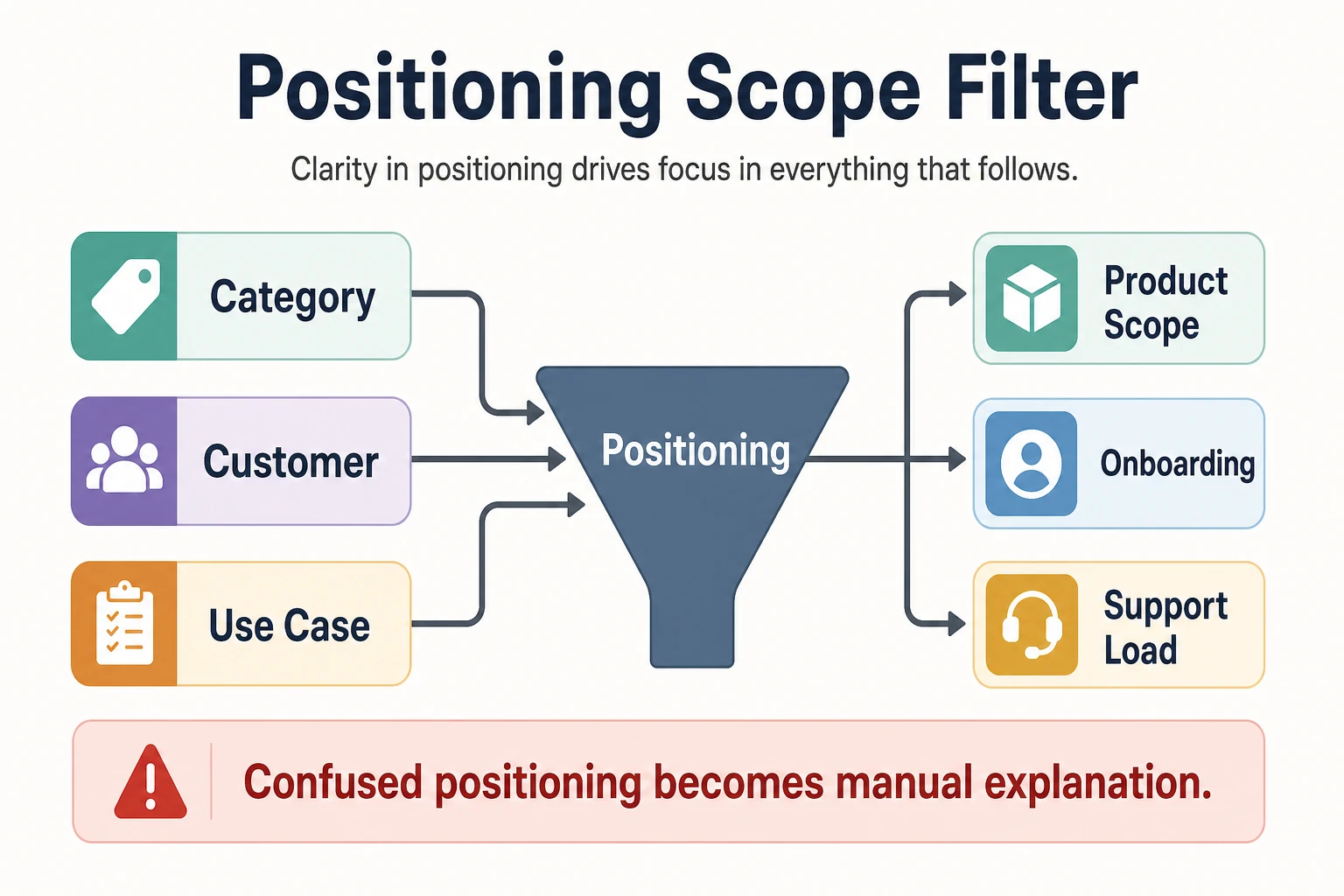
Use positioning to reduce product scope, onboarding confusion, sales effort, and solo support burden before building too broadly.
Preparing audio…
Audio edition
Positioning Before Product
Confusion Becomes Work
A solo founder pays for weak positioning with time. The bill arrives as sales calls that start from zero, demos that explain too much, onboarding that must teach an unfamiliar category, support threads caused by mismatched expectations, and a roadmap pulled apart by customers who thought the product was meant for a different job.
This is why positioning cannot wait until the product is more real. The words used to place a product in the customer’s mind create product obligations. Call something an analytics platform and customers will look for dashboards, filters, exports, permissions, integrations, and history. Call it a weekly client-change digest for paid-search agencies and they will look for trustworthy explanations, source visibility, review control, and reliable delivery.
Those products may share code. They do not share a product boundary.
For a solo founder, positioning is the smallest honest interpretation of the product that helps the right customer recognize it, compare it with the right alternative, and expect only what one person can build and operate. It is not polish applied after strategy. It is one of the constraints from which the product should be designed.
Find the Shelf the Customer Already Uses
Customers do not evaluate a new product from a blank page. They place it on a shelf they already understand: a product category, an existing workflow, a service they buy, a spreadsheet they maintain, a recurring meeting, a budget line, or a job they already know is painful. The shelf determines what they compare, what they expect, and sometimes who can approve the purchase.
Consider a fictional composite that will carry this chapter. A founder has learned that account managers at small paid-search agencies spend Friday afternoons turning campaign changes, platform exports, Slack context, and private notes into explanations for clients. The same underlying capability can be placed on at least three shelves.
“Analytics platform for agencies” puts it beside reporting and business-intelligence products. Customers can reasonably expect live connections, dashboards, filters, permissions, exports, and historical analysis.
“AI reporting assistant” puts it beside flexible writing and productivity tools. Customers may expect prompting, editable drafts, source citations, model controls, and workflow customization.
“Weekly client-change digest” puts it inside an existing reporting moment. Customers will expect intake, a clear explanation, evidence they can check, a review step, and a dependable output. A founder can initially deliver that promise through uploads, a narrow internal tool, manual review, and email.
None of these shelves is inherently correct. Each becomes wrong when it implies a product the founder cannot honestly prove, deliver, or support at the current stage. The grandest phrase is often the most expensive because the founder must build both the product and the customer’s understanding of it.
The best starting shelf usually appears in discovery evidence. Ask what the customer says they are doing when the pain occurs. Notice the tool they open, the colleague they ask, the deadline they fear, the workaround they protect, and the budget that already absorbs the cost. “Reporting work before a client update” is more useful evidence than a founder’s preference to enter the analytics category.
The shelf is a working constraint, not a life sentence. It may change when the customer, product, or evidence changes. Its immediate job is to make the next product coherent.
A Position Is a Claim About Progress
A shelf alone is not positioning. The founder still has to name the customer, the situation, the painful before state, the better after state, the current alternative, and the reason this product deserves a trial.
Weak positioning often hides those choices behind adjectives: simple, powerful, intelligent, seamless, modern, all-in-one. “Save time with AI” could describe thousands of products. It tells neither the customer nor the founder what must happen.
A more useful claim is concrete:
Turn scattered Friday campaign changes into a client-ready explanation before the account manager’s weekly update.
That sentence identifies the user, the trigger, the current mess, the output, and the deadline. It also exposes product requirements. The product must receive campaign evidence, understand enough account context to avoid nonsense, produce a client-safe explanation, allow review, and create an output the agency can use. “Client-ready” is a trust claim; it cannot be satisfied by fluent text alone.
Now add the comparison. The current alternative is not “doing nothing.” It is a durable collection of exports, screenshots, dashboards, notes, Slack threads, copied slides, and account-manager judgment. The new product should preserve the control and context agencies value while reducing the repeated assembly work. Its differentiator is not that it uses AI. It is that it is built for a reviewed client explanation instead of open-ended dashboard exploration.
Proof must fit the claim. A long feature list does not prove trustworthiness. A sample digest made from representative exports, with visible sources and realistic edits, does. A founder-reviewed pilot and repeated weekly use are stronger still. Positioning that promises a specific progress should point naturally toward the evidence that would make that progress believable.
Let the Promise Design the First Product
Write a Positioning-to-Product Scope Map before adding significant scope. It can fit on one page. Its purpose is to connect every market claim with work the founder will have to carry.
For the agency digest, the map begins like this:
- Customer and situation: agency owners or operations leads at small paid-search agencies, responsible for five to twenty recurring client accounts and a weekly reporting rhythm.
- Trigger and pain: campaign changes have to be explained before a client update; evidence and context are scattered, so account managers reconstruct the story by hand.
- Alternative: platform exports, screenshots, dashboards, private notes, Slack threads, copied slides, and senior review.
- Promise: turn those changes into a concise, reviewed explanation of what changed, why it changed, and what happens next.
- Reason to believe: a source-linked sample digest, followed by a founder-reviewed pilot using real data handled under clear terms.
- Product boundary: secure intake, account context, change extraction, source trace, an explanation template, review, and delivery. No broad analytics workspace.
- Operating boundary: the founder handles missing data, ambiguous context, corrections, and delivery during the pilot; the product does not claim autonomous client communication.
The entries should agree with one another. If the promise says “client-ready” but the map has no review or traceable evidence, the product is under-specified. If the product boundary includes a client portal, team administration, forecasting, and every ad platform, the proposed product has escaped the position.
This map also reveals what the founder can refuse. A prospect may genuinely want a live dashboard. Another may want multi-channel reporting or automatic recommendations. Those requests are not bad ideas; they belong to different promises. The founder can say, “The first product produces the weekly client explanation reliably. It does not replace your analytics stack.” A position earns its place when it makes that sentence true rather than defensive.
The same reasoning reaches pricing. If the customer buys a recurring client explanation, a pilot fee, per-client price, or per-report price is easier to understand than a seat price. Seats would suggest that access to software is the value. Here, the value arrives when a client workflow reaches a usable output. Chapter 18 will test that pricing belief, but positioning determines what the buyer thinks is being sold.
The Experience Must Tell the Same Story
Positioning fails when the landing page, product, and founder teach different products.
A page promising client-ready weekly explanations should show the explanation, its evidence, and the review moment. Opening with an empty dashboard sends the customer back to the analytics shelf. “Review a sample digest” is a more faithful first action than “Get started” because it lets the customer judge the promised outcome.
Onboarding should collect only what the promise requires. The agency may need to provide account context, sample campaign data, reporting cadence, client names, and tone preferences. Team hierarchy, logo customization, advanced permissions, and every integration setting can wait. A narrow promise followed by broad setup makes the customer wonder why simple value requires so much work.
Support must hold the same boundary. If the homepage sounds enterprise-grade while one founder supplies informal support, customers will infer procurement help, administrative controls, service commitments, and escalation paths that do not exist. Words such as “real-time,” “autonomous,” “all-in-one,” “mission-critical,” and “end-to-end” import operational obligations. Use them only when the product and the founder can carry those obligations.
Write a short messaging hierarchy so that outreach, the landing page, demo, onboarding, and support do not drift apart. Begin with the one-line description, then the primary promise, the target customer and triggering moment, the current alternative, the differentiator, the proof, and one next action. For this example, the sequence is simple: weekly client-change digests for small paid-search agencies; clear explanations instead of another dashboard; show one real account and review a sample.
This is an operating document, not a collection of taglines. If a customer repeats the product back as “another analytics dashboard,” the founder has heard a product decision, not merely copy feedback.
Test What the Market Heard
Positioning can be tested before the full product exists. The question is not whether people like the phrase. It is whether the intended customer understands who the product is for, what it replaces, why it matters now, and what kind of product to expect.
Put the one-line description in front of people from the target segment and ask what they think it replaces. Their comparison reveals the shelf they actually used. Ask them to describe the product back in their own words. Show the before and after, then ask what proof they would need. Use the same promise in outreach to an owner, an operations lead, and an account manager; the role that responds is evidence about user, buyer, and pain, not just message quality.
A landing-page draft can compare positions, but page views alone are weak. Watch qualified prospects take consequential steps: share sample data, introduce the buyer, agree to a pilot conversation, or let the founder solve one live reporting case. Behavior distinguishes clear language from an interesting slogan.
Interpret the response instead of reducing every result to conversion. If the right people understand the offer but demand proof, the next job is evidence. If the wrong people respond, the customer or shelf may be wrong. If people care but expect a much larger product, the position has imported too much scope. If they understand it and do nothing, the pain, urgency, or differentiation may be weak.
Useful tests make the position more exact. They do not merely select the highest-performing sentence.
Narrow Enough to Be Honest
Founders often resist narrow positioning because it feels like surrendering the larger vision. Early positioning has a smaller and more demanding job: create the first market interpretation that one person can test. It allows the founder to learn from a coherent customer group, design one onboarding path, and carry one product promise.
Narrow does not mean easy. A weekly digest for small paid-search agencies still encounters data quality, explanation trust, review, client communication, recurring delivery, and pricing. Its narrowness comes from choosing a customer, moment, and progress—not from pretending the work has no depth.
Nor should narrowness become a disguise. A founder-assisted pilot may be the right evidence, but customers should know what is manual, what is productized, and what may change. Otherwise a custom service can look like product validation. A position is only useful while it remains honest about delivery.
Sometimes technology belongs in the position because it changes the customer’s risk or ability to adopt. A security team that cannot send logs to third-party models may care that an issue-triage tool is local-first. The mechanism matters because the constraint matters. “AI-powered security automation” names a technology without naming that reason.
Creating a new category can also be rational, but it makes the founder educate the market, establish the problem, prove urgency, and sell the product at once. Strong evidence may justify that cost later. A familiar shelf is usually the cheaper place to begin.
The Positioning Decision
Before the next significant feature, a stranger in the target segment should be able to answer four questions quickly: Is this for someone like me? What does it replace or improve? Why does that matter now? What kind of product should I expect?
Then the founder must answer a fifth: Which promise requires this feature?
If the market cannot answer the first four, the positioning needs more work. If the founder cannot answer the fifth, the feature belongs in a later product, a manual process, or the refusal list.
To make the decision concrete, write three one-line positions for the same capability using three plausible shelves. Follow each one into the product it implies: the required proof, first-run experience, onboarding inputs, support questions, pricing unit, and operational commitments. Choose the position that creates clear customer understanding with the smallest honest product scope. Complete its Positioning-to-Product Scope Map, then write five promises it gives you permission to refuse.
Once the customer understands the product on the intended shelf, pricing can test whether the value they understood is strong enough to support a business. The unit they are willing to pay for—a report, a client, a seat, a workflow, a transaction, or a service period—will make the next set of product obligations visible.