Solo Founder Product Engineering Handbook / Chapter 3
Product-Market Fit for Solo Founders
Recognize product-market fit as repeated market pull from a defined segment, not launch attention, compliments, or founder effort.
Preparing audio…
Audio edition
Product-Market Fit for Solo Founders
The Week After the Launch
A founder launches a tool that turns sales calls into CRM updates. The demo is easy to understand: connect a calendar, record a call, extract the next steps, and write them into the right opportunity.
The launch goes well. Hundreds visit. Fifty sign up. Five sales representatives connect their calendars. Two managers ask when team dashboards will be ready. A founder friend says every sales organization needs this.
The following Friday, only three representatives review an update before their pipeline meetings. One accepts the suggested fields unchanged. The other two correct the opportunity stage and next-action date. By the third Friday, one has stopped using the tool. Another returns only after the founder sends a reminder. The third opens it before every pipeline review and complains immediately when a sync fails.
Which week contains the best evidence?
The launch had the largest numbers. The third Friday reveals the product. One user has pulled it into a recurring job, trusted it enough to depend on it, and made failure consequential. The other behavior is useful too, but it tells a different story: curiosity, incomplete value, or value still sustained by the founder.
For a solo founder, product-market fit is best treated as a behavioral pattern rather than a declaration. A defined segment repeatedly pulls the product into a real workflow, receives value when the problem recurs, makes a credible economic commitment, and needs less founder persuasion over time.
The last condition is unusually revealing when one person is doing the selling, onboarding, support, and custom work. A team can hide weak fit behind sales headcount, customer-success labor, bespoke integrations, and investor-funded runway. A solo founder feels every hidden subsidy in the calendar. If the product works only because you remind, explain, reconcile, discount, customize, and rescue, you may have a valuable service or a promising experiment. You do not yet have evidence that the product can carry the relationship.
The question is not “Do people like this?” It is:
Which specific people keep pulling this into their work or life when I stop pushing?
Evidence Changes Meaning Over Time
Attention, signups, and praise are not fraudulent evidence. They answer small questions. A launch can show that a message creates curiosity. A signup can show that the promised outcome is worth a low-cost action. A connected calendar can show that a user will cross a setup boundary. None of those actions establishes repeated value.
Evidence becomes more useful as it survives time and acquires stakes. The CRM founder learns more when a representative lets the tool write to production data than when that representative praises the demo. A second use at the next pipeline review says more than the first. A team paying for another cycle says more than a friendly pilot. A colleague joining through an internal invitation says more than a stranger joining through launch traffic.
The evidence pyramid is a reminder of that progression, not a score that every product climbs in order.
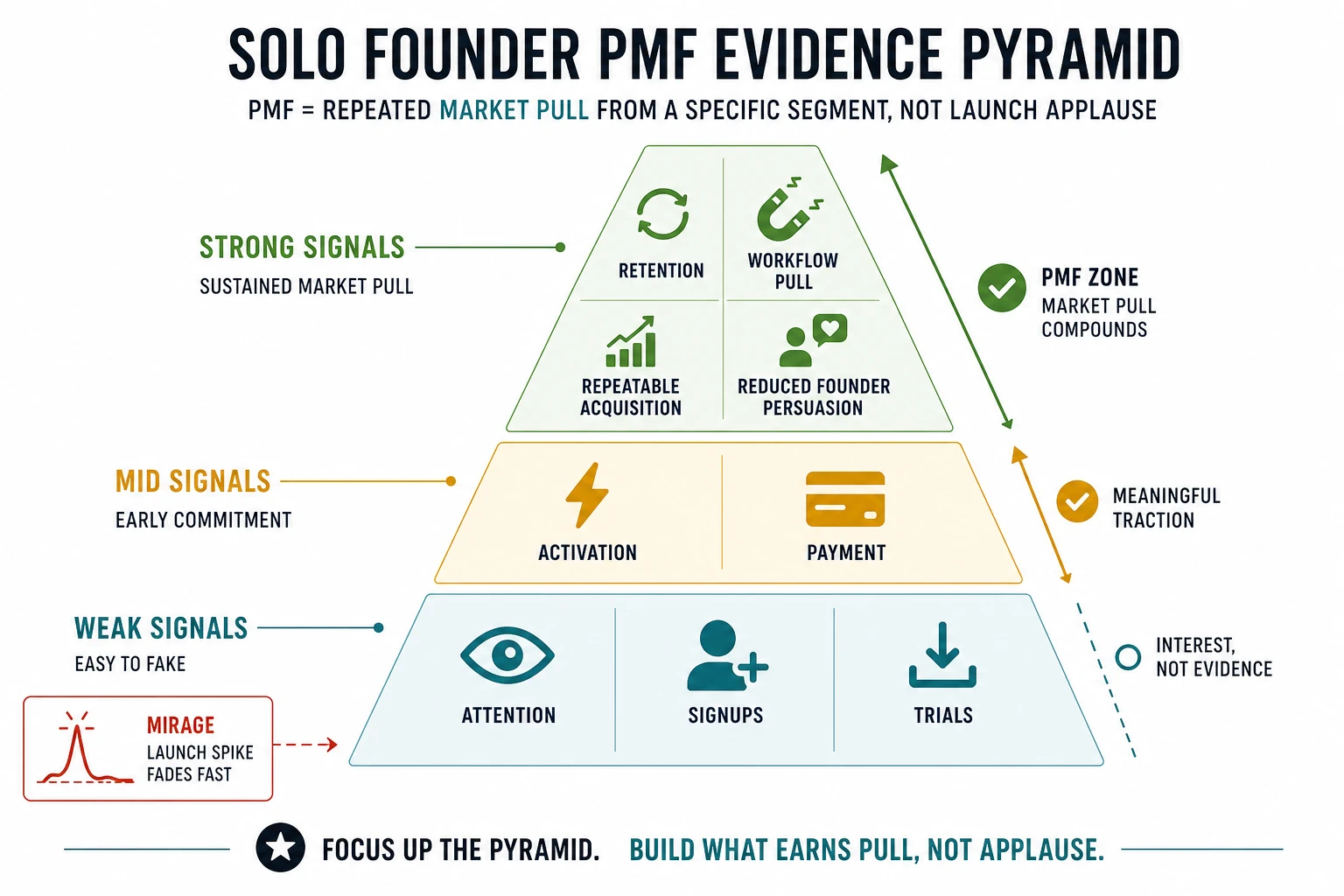
The base of the pyramid helps you choose where to investigate. The middle shows that somebody has accepted cost or risk: setup time, real data, a budget conversation, a pilot, or a change to an existing process. Near the top, the evidence begins to cohere. The same kind of user returns at the natural frequency of the problem, pays or allocates budget, brings the product into a shared workflow, refers a similar user, or notices quickly when the product fails.
Raw numbers conceal this movement. “Two hundred signups” combines people with different jobs, motives, and expectations. “Nine finance operators at venture-backed clinics imported real transactions twice during month-end close” names a segment, a recurring moment, and a behavior. It may still be too early to declare fit, but it can now direct the next decision.
The solo founder’s job is not to collect more evidence at the same level. It is to design the next encounter that could strengthen, qualify, or overturn the current story.
Read Pull Through Five Questions
Start with the segment. “Small businesses,” “developers,” and “sales teams” are markets in conversation, not yet operating segments. A useful segment shares enough context that one product decision can serve it: a role, a recurring situation, a current workflow, a reason to change, and some path to budget or adoption. Ten retained payroll managers at seasonal employers can teach more than a thousand curious visitors who vaguely dislike HR software.
Then ask when the problem returns. Retention has to be measured against that rhythm. A planning tool may create daily behavior; a board-reporting product may matter monthly; tax preparation may have an annual cycle with smaller events throughout the year. Daily activity is meaningless when the job itself happens once a month. Conversely, one successful use says little when the problem returns every Friday.
Ask what the user has placed at stake. Payment is strong evidence, but it is not the only kind. A user may give the product production data, migrate a workflow, invite colleagues, spend political capital with an approver, or rely on an output in front of a client. These commitments make polite enthusiasm expensive enough to become informative.
Ask whether another suitable customer can reach the same value through a path you can repeat. Early acquisition may remain manual. The founder can write the emails, run the demos, and conduct the onboarding. The important change is that the language, qualification, and value path become less improvised. Referrals from similar users and shorter explanations are especially useful because they show that the market is beginning to carry part of the message.
Finally, account for founder force. Write down every reminder, custom import, private analysis, discount, manual correction, and rescue that stands between the customer and the result. Early manual work is often excellent discovery. The test is whether it reveals a productizable pattern and diminishes as the same workflow repeats. If every new customer requires a new invention, revenue may be proving a consulting business rather than a product.
These questions need to agree. A clear segment without retention is a market hypothesis. Retention without economic commitment may be a useful habit with a weak business. Payment without repeated use may be a good sale. Repeat use created by weekly founder reminders is not yet pull. Product-market fit begins to look credible when the same narrow story survives all five questions.
A Pilot Can Hide the Product
Return to the CRM tool. A sales manager offers to pay for a six-week pilot, which sounds like decisive evidence. But the contract includes custom call categories, a private weekly report, cleanup of inconsistent opportunity fields, and a promise to support a second CRM before the pilot ends.
The money proves that the manager has budget and that CRM hygiene hurts. It does not yet prove which product the manager is buying. The founder may be renting out analysis, data cleanup, implementation work, or responsiveness.
To find the product inside the service, hold the workflow steady. Support one CRM and one opportunity-update path. Keep a visible review step because users are correcting fields before pipeline meetings. Record which corrections recur. Let the manager’s weekly report come from the same product state rather than a private spreadsheet. Ask the team to begin a second cycle without individual reminders.
Now the pilot can answer a harder question: will representatives repeatedly trust reviewed updates before the meeting that makes CRM completeness valuable? If they do, the correction pattern tells the founder what to improve. If the manager pays but representatives stop reviewing, the sale and the product have separated. If every useful output still depends on private cleanup, the founder has located the current boundary between software and service.
Revenue has not lied. The founder has asked it the wrong question when treating an invoice as proof of a repeatable product.
Pull Tells Engineering Where to Become Serious
Before product-market fit, engineering should increase validated learning per unit of founder effort. That often calls for a deliberately narrow system: one integration, managed infrastructure, manual review, basic analytics, and operational work performed by the founder. Narrow does not mean careless. Production data, security boundaries, recovery, and honest communication still matter from the first real user.
As pull appears, the retained workflow earns more care. For the CRM tool, the first successful update, accepted-update rate, correction rate, sync failures, and return before pipeline review are worth instrumenting. Review states and clear write previews protect trust. Reliable retries and visible failure recovery matter more than sales coaching, territory analytics, or a large manager dashboard because users already depend on the update path.
The change is gradual. Product-market fit is not a switch that suddenly justifies scale. It identifies the slice of the system where better reliability, permissions, billing, backups, observability, imports, exports, and support tooling can compound existing value.
Harden too early and you maintain infrastructure around imagined use. Harden too late and pull becomes broken trust: failed syncs, lost work, confusing invoices, and support queues that one founder cannot carry. The evidence should decide which path earns reliability. Everything else stays small enough to change.
Make One Decision From the Evidence
Review product-market fit whenever you are tempted to widen the roadmap, scale acquisition, rebuild the architecture, hire help, or announce traction. Use the actual observation window, not the lifetime total.
Name the segment showing the strongest pull and the moment when its problem recurs. Describe what those users do again without prompting, what outcome they value, and what they have put at stake. Record how they reached the product and every place where founder labor still completes the promise. Then identify the engineering weakness that prevents you from observing or protecting that behavior.
The weakest part of that account becomes the next operating question. A vague segment sends you back to discovery. Thin return behavior calls for a clearer activation path and another observation cycle, not more features. Retention without payment calls for a budget or packaging test. Payment without retention calls for an honest separation of sale, service, pilot, and product. Strong use with heavy founder force calls for simplification, automation, or refusal.
One segment may retain while the broad launch audience merely browses. Narrow around the retained segment. A segment may have painful urgency but fail to reach value. Change the product. Users may receive value but lack authority, budget, or a reachable acquisition path. Reconsider the segment or buyer. Repeated use may make reliability the bottleneck. Harden that workflow. Several honest cycles may produce no concentrated segment, no credible commitment, and no way to reduce founder force. Stop or reset.
Broad weak interest feels safer because it preserves options. For one founder, those options are expensive: more messages, features, support paths, objections, and promises. Small, sharp pull gives the company somewhere to stand.
Exercise
Take the evidence from your most recent product cycle and sort it into three bands: interest, commitment, and repeated pull. Do not sort by how encouraging an event felt. Sort by the behavior it actually demonstrates.
Tag each item with the segment, the predicted next behavior, the natural time window for that behavior, and the founder force required. “Three agency owners used the Friday report in real client calls for two consecutive weeks, with manual data cleanup but no reminder to use the output” is useful. “Customers loved the report” is not yet an observation you can build from.
Finish with one sentence:
The segment showing the strongest pull is ___, the repeated behavior is ___, the remaining founder force is ___, and the next engineering decision is ___.
If you cannot fill the sentence honestly, do not widen the roadmap. Design the next encounter with the market. The following chapter turns that encounter into a working rhythm across discovery, building, and distribution.