Solo Founder Product Engineering Handbook / Chapter 55
B2B SaaS for Solo Founders
Use B2B SaaS carefully by choosing a reachable buyer, narrow workflow, manageable security baseline, and sales motion one founder can sustain.
Preparing audio…
Audio edition
B2B SaaS for Solo Founders
The First Paid Account
A founder is helping a small healthcare software vendor answer a customer security questionnaire. The vendor’s operations lead has spent two days searching for screenshots, policy files, and old answers. Some evidence is stale. Nobody knows which version was sent during the previous sale. A prospective customer is waiting before it will sign.
This is attractive B2B pain. It recurs, delays revenue, and already consumes paid time. The operations lead can show the founder the current workaround. The vendor’s own founder controls a budget and wants the deal to move. A narrow product could create visible value before it becomes a large platform.
It is also easy to misread. “Compliance software” suggests control libraries, risk registers, vendor reviews, policy management, approval workflows, cloud integrations, and customer portals. That product may be valuable, but it is not the product this account has proved.
The first useful version is an evidence-packet workspace. It keeps evidence items, owners, due dates, and source files together; warns when an item may be stale; and produces a clean packet for a prospect. The founder can build, sell, and support that workflow. Whether it becomes good solo-founder B2B SaaS depends on what the next accounts demand.
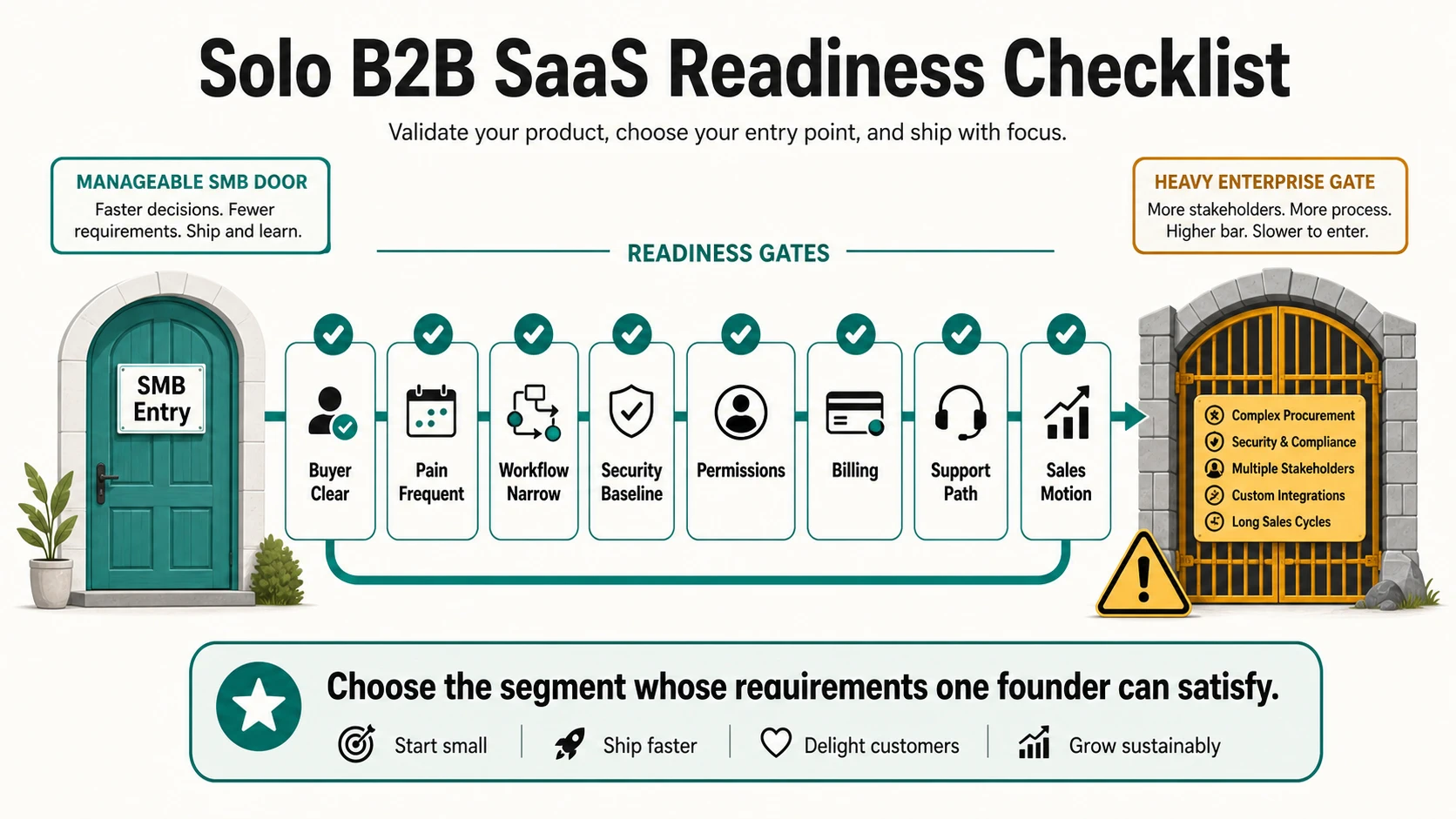
B2B SaaS gives a solo founder something consumer products often do not: a small number of customers can support meaningful revenue. In return, the founder inherits part of each customer’s organization. Buying, access, data, billing, onboarding, support, security review, and renewal all become product surfaces. The opportunity is real when those surfaces repeat. It becomes disguised consulting when each account requires its own version of them.
The Account Exists Before the Application
“The customer” is rarely one person. Someone performs the work, someone argues for change, someone owns the budget, someone administers the product, and someone can block it because of security, privacy, legal, or procurement concerns.
In the healthcare-vendor account, these roles are compressed. The operations lead is both daily user and champion. The company founder is the economic buyer. One of them can administer the workspace. The approving conversation is short because the company is small and the product’s promises are bounded.
That compression is a strategic advantage. The founder can hear the operational pain from the person who experiences it, connect the pain to delayed revenue with the person who pays, and resolve setup questions without waiting for several departments. The sales conversation still has to survive more than user enthusiasm, but it can reach a decision.
Now imagine selling the same workspace to a large hospital network. The daily user may love it while a director owns the budget, information security reviews the service, legal negotiates data terms, procurement onboards the vendor, identity administrators require centralized access, and an integration team controls the source systems. The underlying workflow has not disappeared. The route to it has become a different business.
Map these roles during discovery. Ask the user what event starts the work and where it breaks. Ask the champion what makes the problem worth raising internally. Ask the buyer which cost, delay, risk, capacity limit, or revenue consequence justifies spending. Ask the admin how accounts, access, and mistakes will be handled. Ask what an approver must know before the product may touch company data.
The answers control scope. They reveal whose problem must be solved now, whose risk must be reduced now, and which impressive request belongs to a later segment.
Give the Pilot a Finish Line
The founder offers the first vendor a bounded pilot: assemble one evidence packet for a live prospect, using a defined set of documents, within two weeks. Success means the operations lead can see what is missing, obtain contributions without losing ownership, and send a coherent packet without searching through old folders. The founder records setup time, repeated questions, manual corrections, and the prospect’s response.
A pilot without a finish line is unpaid ambiguity. “Try the platform and tell me what you think” produces feature requests but little evidence. A useful pilot names the workflow, the account participants, the data involved, the time window, the value event, and the decision that follows.
This pilot also keeps services honest. The founder may organize the first evidence set manually because doing so exposes the real data shapes and failure points. That help earns its place if the second account receives a better default, import path, template, or explanation. If every account needs private configuration and founder interpretation before it can succeed, the business has not yet found a repeatable software shape.
The commercial terms should preserve the experiment. A free pilot may be appropriate when access to the workflow is unusually valuable, but payment is stronger evidence that the buyer recognizes a business consequence. A short paid pilot can convert to a subscription or annual contract when the workflow repeats and both sides understand the continuing service. A long contract should not be used to hide weak use; renewal risk merely arrives later.
Build the Trust This Segment Requires
The narrow workflow still holds customer-confidential material. “Small business” is not permission to be casual. Before accepting payment, the founder should be able to explain how an account is separated from other accounts, who can see its records, how access is removed, how data is backed up and recovered, what can be exported or deleted, and what support is available when something goes wrong.
For the evidence workspace, a credible first account model may have three roles: an owner who manages the workspace and billing, contributors who update assigned evidence, and viewers who can inspect or export a packet. Reliable authentication, safe session handling, server-side authorization, tenant separation, and a tested recovery path matter more than a decorative catalogue of permissions. A simple role model that is enforced everywhere is safer than a flexible one full of exceptions.
The product also needs an honest record of consequential actions: who changed an evidence item, when it changed, and which version entered an exported packet. That audit trail serves the workflow itself. It should not be marketed as satisfying a formal standard unless the product and the company have actually met that standard.
Billing and entitlement need the same discipline. The workspace should know whether an account is in a pilot, active, overdue, canceled, or read-only; what its plan permits; and what happens to its data after cancellation. The founder needs an administrative path to diagnose an account, resend an invitation, correct a billing problem, and inspect job failures without editing production data blindly.
Imports and integrations should arrive from observed repetition. The first two accounts may upload a documented folder or use a structured template. If the same source appears repeatedly and manual transfer causes mistakes, an integration has earned investigation. A custom connection requested by one prestigious prospect has not.
The engineering baseline is therefore not “enterprise architecture.” It is a defensible promise to one segment: dependable access, protected data, clear ownership, coherent billing, observable operations, tested change and recovery, and support that does not depend on hurried production improvisation.
Follow the Account to Value
The sales call, setup session, import, invitation email, first export, invoice, support reply, and renewal conversation form one path. Friction anywhere along it can prevent an otherwise useful application from becoming a product.
The founder should follow the first accounts closely enough to see the path rather than merely collect requests. Why did the buyer search now? Which output counted as first value? What slowed setup? Which explanation had to be repeated? What did the user do the next time a questionnaire arrived? At renewal, what result did the buyer believe it was paying to preserve?
In the evidence workspace, the first account reveals that “upload your documents” is too vague. People do not know which artifacts belong in a packet or who should refresh them. The founder turns the successful manual setup into a starter template with owners, review dates, and plain examples. The second account activates faster. That is customer success becoming product knowledge.
Another request should remain manual for longer. Customers describe the same control in inconsistent language, and automatic matching sometimes joins evidence that only looks related. The founder keeps the suggestion visible and requires confirmation instead of claiming certainty. Productizing a repeated step does not mean removing the human judgment that makes it safe.
Support should produce the same kind of learning. A recurring invitation problem may justify clearer role copy or a better recovery path. A one-off request for a private report may deserve a courteous refusal. The test is not whether a customer asked. It is whether solving the request strengthens the same workflow for the same segment at an operating cost the founder can sustain.
The Deal That Changes the Business
After several small vendors use the workspace, a large prospect appears. It offers more annual revenue than the existing accounts combined. It also asks for single sign-on, a detailed security review, negotiated terms, regional data commitments, a deeper role hierarchy, custom retention rules, an integration with its governance system, and a named response time.
None of those requests is absurd. Together they change the product, sales cycle, architecture, support obligation, and risk carried by one person. The founder is not choosing whether to add a feature. The founder is choosing whether to enter a heavier segment.
Evaluate the deal as a portfolio of obligations:
- Which requests will recur among the segment the company deliberately wants?
- Which customer and product promises would continue after the first contract?
- What expert review, operational coverage, and evidence will the security or legal work require?
- Which roadmap work and smaller customers will wait?
- Can the price cover implementation, support, infrastructure, review, and renewal work rather than only code?
- If the prospect leaves, which new complexity remains?
Expansion is healthy when existing accounts pull the product deeper into the same repeated job: more evidence owners, more packets, or a nearby workflow that shares the trust model. It is dangerous when one account pays the founder to maintain private behavior. Large revenue can conceal concentration risk and convert the roadmap into outsourced product management.
The founder may eventually choose the enterprise gate. The choice should follow repeatable pull, a higher trust capability, appropriate help, and enough margin to operate the promises. A flattering inbound request is not that evidence.
Write the Readiness Memo
Before building a B2B SaaS wedge, write one page about one segment. “Businesses,” “teams,” and “operators” are too broad. For each answer, mark what is proven, assumed, or unknown.
Name the companies with the repeated workflow and how you can reach them. Describe the event that makes them search now, the user doing the work, the champion carrying the idea, the buyer controlling the budget, the administrator handling access and mistakes, and the concern most likely to block approval. Then state:
- the first complete job the product will do better than the current alternative;
- the business consequence that makes the job worth paying for;
- the smallest account, permission, data, recovery, export, deletion, billing, and support promise required;
- the path from first conversation to first visible value;
- the manual onboarding work that is teaching you, and the work that is merely bespoke;
- the price logic after support and operating burden;
- the larger requests you will defer until several similar accounts pull in the same direction.
The memo should force a decision. A vague buyer calls for more discovery. A broad workflow calls for a narrower entry point. A trust baseline beyond the founder’s current ability calls for a different segment, added capability, or both. A support path built on heroics is not ready to scale.
Look for Account-Shaped Pull
B2B product-market-fit evidence accumulates across accounts, not isolated signups. Strong accounts reach first value, repeat the workflow at its natural frequency, pay, renew, and introduce the product to similar companies for similar reasons.
Watch the shape of that evidence. Setup time should fall as the product learns. Support questions should become more predictable. Users and buyers should describe the same business consequence in their own words. Objections should repeat. Expansion should reinforce the product thesis. Renewal should not depend on a new discount or another piece of custom work, and churn should reveal a lost job or weak fit rather than disappear into a percentage.
Revenue needs context. One large custom account can improve the bank balance while making the product less repeatable. Five smaller accounts with the same trigger, buying path, workflow, trust needs, and onboarding pattern may be better evidence of a business one founder can operate.
Return to the evidence-packet workspace after the next three sales. If each buyer appears after a delayed questionnaire, each operations lead reaches a current packet through roughly the same path, and each account can be supported with improving defaults, the wedge is becoming credible. If one wants policy authoring, another wants vendor risk management, and a third will buy only after a bespoke integration, “compliance software” is still a category label rather than a product.
Choose B2B SaaS when a reachable segment has a painful recurring workflow, a buyer who can act, a trust baseline you can honestly meet, and an account path that becomes more repeatable as customers arrive. Narrow it when services hide product weakness or approval work overwhelms learning. Walk away, for now, when the first useful account already requires a company larger than the one you have.
The best first segment is not necessarily the one behind the grandest gate. It is the one whose next customer lets you use what the previous customer taught you.