Solo Founder Product Engineering Handbook / Chapter 18
Pricing Before Overbuilding
Use pricing as evidence about customer value while keeping billing, entitlement, and support complexity appropriate for the stage.
Preparing audio…
Audio edition
Pricing Before Overbuilding
A Price Makes the Promise Concrete
The founder of a weekly reporting product can spend another month improving the output, or ask an agency owner to pay for the next two reports. The first choice may improve the product. The second reveals whether the product has crossed a commercial boundary.
That boundary cannot be inferred from enthusiasm. A person can praise a demo, join a waitlist, request an integration, and still decline an invoice. Payment brings budget, authority, timing, trust, and alternatives into the decision. Until those forces appear, the founder knows that someone likes the idea, not that the problem can support a business.
Pricing also changes what must be built. A paid pilot creates a defined outcome and an end date. A per-seat subscription creates accounts, roles, invitations, and questions about inactive users. Usage pricing creates meters, limits, cost visibility, and disputed counts. A transaction fee creates reconciliation, refunds, and a larger trust obligation.
Price is therefore both market evidence and a design input. The useful early question is not “What is the perfect price?” It is:
What is the smallest paid commitment that can test the value, and what is the smallest system that can honor it?
Ask for Commitment Before Building Checkout
Pricing evidence becomes more useful as the customer assumes a real consequence.
A value conversation can reveal the current alternative, its cost, the budget owner, and the words the customer uses for urgency. A reaction to a proposed price reveals objections and approval questions. A signed pilot, deposit, preorder, paid invoice, or prepaid month adds an actual commitment. Each step answers a different question; none should be dressed up as the next one.
“That sounds reasonable” is language evidence. An introduction to the budget owner is buying-process evidence. A paid invoice is purchase evidence. Even payment is not proof of retention, repeatability, or healthy economics, but it tells the founder something that free use cannot.
The first pricing test rarely needs a public pricing page or automated checkout. It needs a buyer, a narrow promise, a price, terms the customer can understand, and a consequential next action. For a business product, that action might be approval for a paid pilot or payment of a manual invoice. For an unfinished product, a deposit or preorder can test commitment, provided the founder is explicit about what exists, what remains uncertain, when delivery is expected, and how cancellation or refunds work.
A pricing page has a later and narrower job: test whether qualified visitors understand the offer without a conversation. Clicks alone say little. A request for a pilot, a completed checkout, or a serious approval step says more.
Let One Paid Pilot Cut the Product Down
Continue the fictional agency example from the previous chapter. A founder is building a tool that turns paid-search campaign changes into client-ready weekly explanations. The possibility space is large: multiple advertising platforms, dashboards, client portals, approval workflows, team comments, templates, history, automated delivery, and performance recommendations.
Instead of pricing that imagined platform, the founder offers this:
For a fixed pilot fee, I will turn one client’s campaign changes into two weekly, client-ready reports. You provide the exports and account context; I deliver a source-linked draft for review. The pilot succeeds if your account manager would send the report with only light edits. A follow-on package will be priced per active client workflow. The pilot does not include a client portal, automatic recommendations, additional platforms, or unlimited revisions.
The offer is deliberately smaller than the product vision. It names the buyer—the agency owner or operations lead—and the outcome being purchased. It also names customer responsibilities, delivery cycles, success, renewal, and exclusions. Those details keep a software pilot from silently becoming open-ended consulting.
Now the price begins to design the product. The founder needs reliable intake, account context, a trace from claims to source evidence, review, and dependable delivery. The founder does not yet need team administration, generalized analytics, self-serve onboarding, or tiered billing. A manual invoice, a small internal tool, a spreadsheet, and a clear email trail are enough to test whether agencies will pay for the outcome.
This is not an argument against automation. It is an argument about sequence. Automate after repeated behavior reveals which offer, unit, and terms deserve to become software.
Choose a Unit the Buyer Recognizes
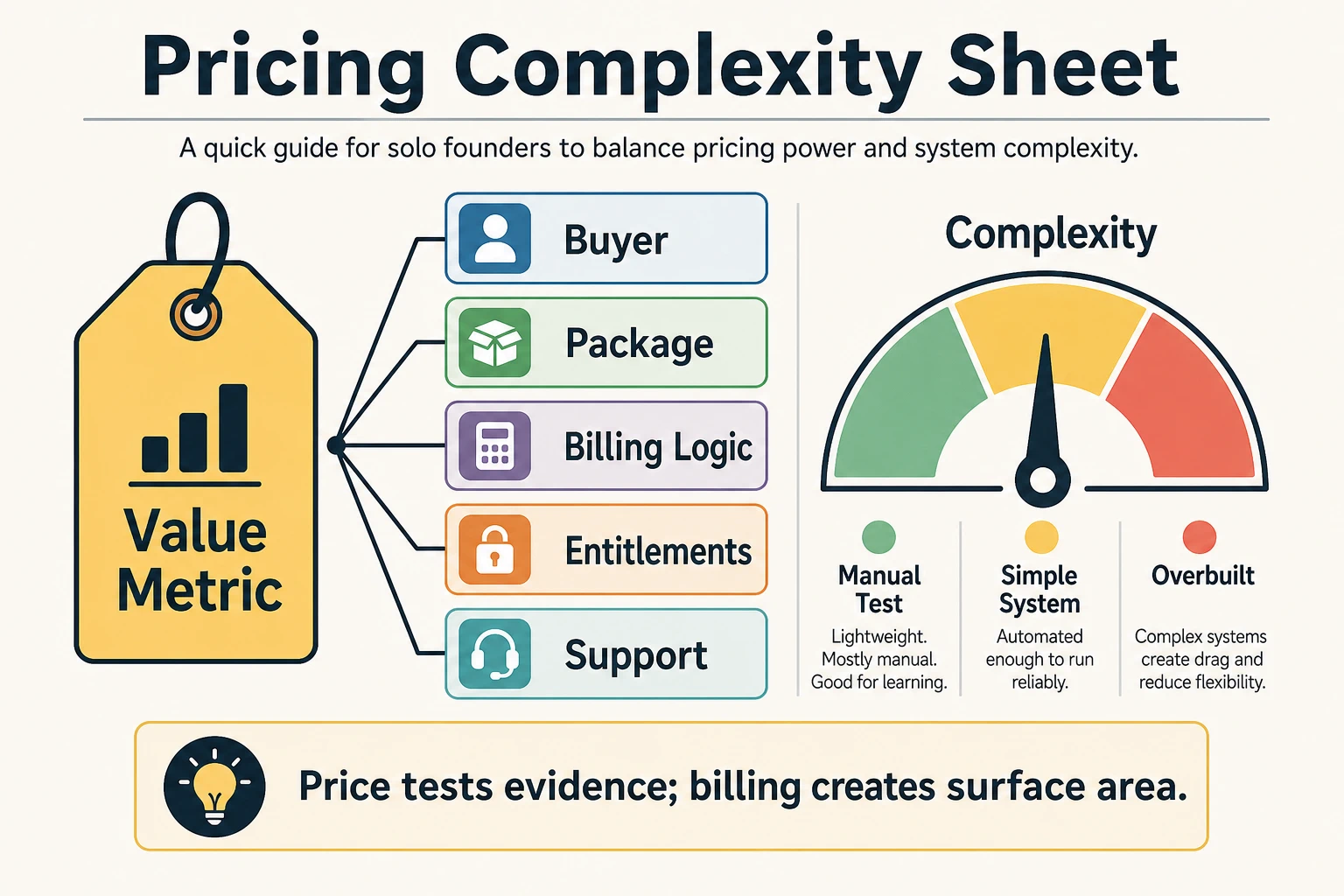
A value metric is the unit against which price changes. The best early metric usually names something the customer already sees as value: a client workflow, completed report, project, location, processed document, protected transaction, or period of service.
Test a candidate metric against four questions:
- Does the customer receive more value as the unit grows?
- Can the buyer understand and forecast the charge?
- Can one founder track, limit, and support it reliably?
- Does it encourage the behavior that makes the product useful?
The last question prevents superficially tidy choices. Seat pricing may discourage collaborators from joining even when shared context creates the value. Usage pricing may discourage use when customers fear a surprise bill. Flat pricing is easy to buy but can conceal heavy users whose compute or support cost makes an account unhealthy.
For the agency product, a seat is a weak first metric. The agency does not benefit because another person can log in; it benefits when a client update reaches a usable result. A fixed pilot fee, a per-report price, or a monthly package per active client workflow is closer to the buyer’s world. If the product later becomes a team workspace, the appropriate metric may change. Early pricing is a hypothesis, not a constitutional amendment.
Follow the Price Into the System
Before choosing a pricing model, follow it past the pleasant center of the purchase and into the edges the founder will have to operate.
A flat subscription is relatively easy to explain, but it still creates renewal dates, failed payments, cancellations, refunds, and decisions about when access ends. Tiers add entitlement rules and upgrade or downgrade behavior. Seat pricing adds invitations, deactivation, shared-account questions, and arguments about who counts. Usage pricing adds metering, customer-visible counts, limits, overages, cost controls, and a way to resolve disputes. Transaction pricing adds reconciliation, failed transactions, refunds, disputes, and financial reporting. Free trials create their own states: start, expiration, reminders, conversion, extensions, and expired access.
These are not merely payment-processor features. They are promises the product and founder must keep. A checkout service may collect money without deciding what a canceled customer can still access, how a mid-cycle change works, or whether a disputed unit was counted correctly.
The same test applies to packaging. An early package should answer what the customer receives, what it costs, what is included, and what is explicitly outside the promise. One pilot package and one possible follow-on package are often enough. Three polished tiers can make uncertainty look mature while creating comparison anxiety and plan logic before the core offer is proven.
Manual billing is a sound early system when it is reliable. Keep a billing ledger with the customer and buyer, offer and price, invoice and payment dates, service period, entitlement, promised deliverables, renewal date, cancellation or refund terms, and open support promises. If those records are confused for five customers, adding subscription software will preserve the confusion rather than resolve it.
Charge When Money Is Part of the Risk
Charge early when the product thesis depends on budget, urgency, business value, or buyer authority. This is especially useful when the customer already pays for an alternative, the product saves labor or protects a business outcome, the buyer differs from the user, delivery creates direct cost for the founder, or a paid pilot would produce a more serious working relationship.
Free access can still be strategic. It may be the right next step when trust, data access, collaboration, or habit must form before payment can be tested. But “free” needs a written reason and an exit condition. A research beta might run for a fixed period to observe a workflow. A free diagnostic might lead to a paid implementation. A customer might receive access in exchange for unusually valuable data, structured feedback, or a credible introduction, provided the exchange is explicit.
“I need more users first” is not yet a reason. Which uncertainty will those users resolve, and when will the price test begin? Without those answers, free access can become a refuge from rejection.
Learn From the Refusal
A price conversation is useful when the founder is trying to understand a purchase, not perform confidence. Ask what the customer uses now and what it costs in money, time, risk, or attention. Ask who approves the spend and which budget would pay. Ask what would change operationally if the product worked, what proof would justify a pilot, and what would make the offer not worth paying for.
Then put a real proposal in the conversation. Abstract willingness-to-pay questions make it easy to be agreeable. A defined outcome, term, price, and next step gives the buyer something they can accept, refuse, or reshape.
Treat “too expensive” as the beginning of diagnosis. The pain may be mild, the buyer may be wrong, the package may be vague, the value metric may be misaligned, the customer may lack budget, or the product may not have earned trust. Lowering the price immediately collapses those distinct problems into one and discards the lesson.
Discounts can discard the lesson too. A discount is useful when it buys something specific: a bounded pilot, fast access to the workflow, scheduled feedback, a case study, representative data, or an early decision. Write its end date, the normal renewal price, and the unchanged entitlement before work begins. A permanent “early adopter” exception offered because silence felt uncomfortable is neither a pricing strategy nor clean evidence.
Write the Hypothesis Before the Billing Code
The Pricing Hypothesis and Billing Complexity Sheet is a compact decision record, not a pricing-page draft. Complete it in five movements:
- Name the purchase. Identify the user, the buyer who can approve payment, the painful outcome, and the current alternative paid for with money, labor, delay, or risk.
- Define the offer. State the package, price, value metric, term, customer responsibilities, included result, and exclusions.
- Choose the evidence. Specify the next consequential act—deposit, invoice, signed pilot, paid month, or approval step—and what refusal or acceptance would teach.
- Expose the operations. Record the minimum payment path, entitlement, delivery or access end, support boundary, renewal, cancellation or refund rule, and any compute or service cost.
- Set the decision. Write what result would preserve the hypothesis and what result would change the price, package, segment, metric, or product scope.
For practice, write three hypotheses for the same product: a manual paid pilot, a simple subscription, and a model tied to a value unit. Follow each one into the billing, entitlement, support, refund, and founder-time work it creates. Do not choose the model with the most upside on a spreadsheet. Choose the least expensive test that can produce real evidence about willingness to pay.
The chapter’s decision gate is concrete: the founder knows who pays, why they would pay now, which unit they are buying, what commitment will test the belief, and what minimum system can keep the promise. Until those answers exist, more billing code is premature.
Price has now constrained the product from another direction. Positioning named what the customer should understand; pricing tested whether that understood value can carry a commitment. The remaining strategy question is reach: can one founder put this offer in front of the right people often enough to learn? That is the work of distribution.