Solo Founder Product Engineering Handbook / Chapter 48
Pivoting When You Have Already Built
Use evidence to pivot without being trapped by sunk implementation cost or discarding useful learning.
Preparing audio…
Audio edition
Pivoting When You Have Already Built
Code Gives the Old Thesis a Vote
Pivoting before you have built anything is mostly a strategy decision. Pivoting after launch is also an architectural, operational, and emotional one. The repository remembers late nights, hard integrations, clever fixes, support promises, and the first customers who trusted you. Every working screen offers an argument for the product that already exists.
That argument is sunk cost wearing the clothes of evidence.
A pivot replaces a central product assumption because observed behavior has made the old one untenable or uneconomic. The customer may change, or the problem, use case, segment, business model, channel, positioning, or technical approach. The change may be narrow: one feature becomes the product, or one narrowly useful tool becomes part of a larger workflow. What makes any of these a pivot is not its size. It is the replacement of an old thesis with a more defensible one.
The founder’s job is to preserve what the old product taught, protect people who depend on it, and carry forward only the implementation that fits the new thesis. Code does not earn a vote merely because it works.
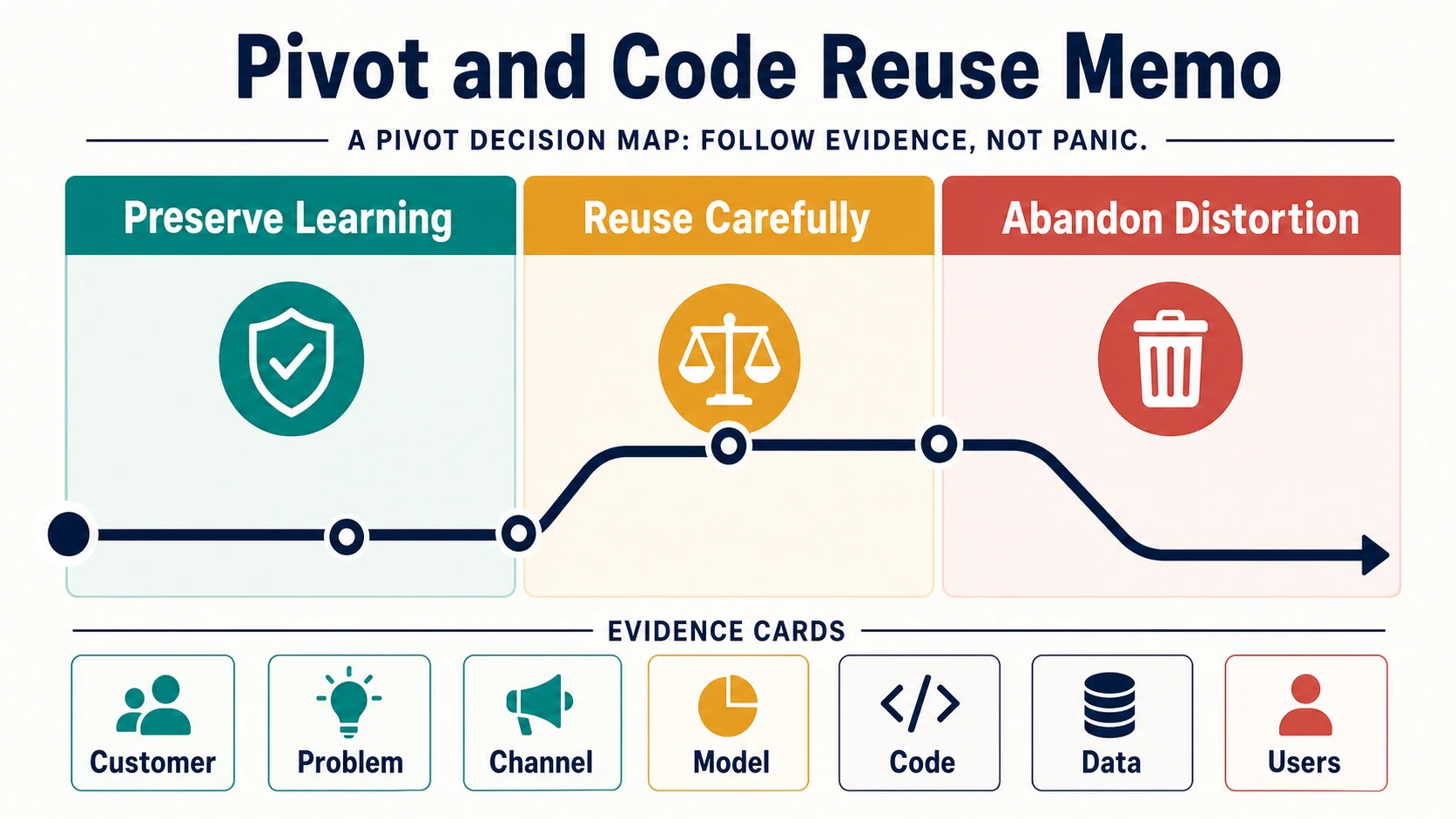
A Pivot Begins With a Failed Sentence
Suppose a founder has built a client-feedback dashboard for freelance designers. The thesis was plausible: independent designers need one place to collect client comments, tasks, files, and approvals. The product is polished enough to demo, sign-ups arrive, and a few designers import projects. After the first week, most return to email, Figma comments, or Notion. Payment is rare.
“Growth is slow” does not yet justify a pivot. Neither do exhaustion, embarrassment, a quiet launch, or envy of a cleaner competitor. Those feelings may justify a diagnostic pause, but they do not identify a truer direction.
The founder keeps interviewing users and reviewing behavior. A different pattern appears. Small design agencies use one part of the product to create weekly client-approval packets. They invite teammates, care about export quality, ask for approval history, and complain when clients cannot find the sign-off link. They ignore the general dashboard. Their requests cluster around making the packet a reliable record of approval.
Now the failed sentence can be stated precisely:
We believed freelance designers would adopt and pay for a broad feedback workspace. In practice, they tried it and returned to tools already embedded in their work, while small agencies repeatedly used approval packets and asked for a durable sign-off record.
That statement identifies both failure and residue. The broad workspace did not create enough urgency for the intended customer. The agency approval ritual did.
Before rebuilding, the founder still needs a replacement thesis: small design agencies will pay for approval packets that reduce review confusion and preserve a clean audit trail. The next validation event is not “launch version two.” It is that several agency teams send packets repeatedly and pay for approval history, client access, and branded exports.
Without a failed assumption, observable evidence, a replacement thesis, and a named validation event, a pivot is only motion. The founder may need another discovery cycle, a pricing or positioning test, or a narrower iteration instead.
Change Only What the Evidence Changed
Naming the failed assumption prevents frustration from turning one discovery into a total reset.
If the right customer cannot be reached through the current channel, test another channel before rewriting the product. If users value the outcome but reject the package or procurement path, the business model may be wrong while the workflow remains sound. If the same product begins to sell when described around a different trigger or buyer, positioning changed; the underlying system may not need to. A technology pivot is justified when the implementation cannot deliver the validated workflow safely or economically, not when a newer stack becomes fashionable.
Customer, problem, use-case, and segment pivots cut closer to the product itself. A different user group may show stronger urgency and budget. An adjacent pain may drive action where the original problem produced only interest. Users may depend on one narrow job and ignore the broad suite. One segment may activate, retain, and refer while the general audience stalls.
The size of the product can change too. In a zoom-in pivot, a feature such as the approval packet becomes the whole product. In a zoom-out pivot, a useful but incomplete tool becomes one step in a broader customer workflow. Either change must be supported by behavior beyond the founder’s desire for a smaller or larger story.
Most pivots should be smaller than the founder’s frustration. The agency evidence changes the target segment and use case. It does not invalidate everything learned about client communication, nor does it prove that the database, deployment system, pricing, and acquisition channel must all be replaced at once.
Preserve the Map of Reality
The most valuable asset from a weak product is often not its repository. It is the map of reality that the product paid to reveal.
For the feedback product, that map includes the phrases agencies use when an approval goes missing, the weekly timing of review, the people who must sign off, the exports clients trust, and the point at which the founder has to intervene. It also includes negative evidence: independent designers praised the workspace but did not change their habits or pay for it.
Preserve the evidence before deciding what code survives. Gather the customer language from calls, messages, sales objections, and support tickets. Separate urgent segments from encouraging ones. Record activation, retention, cancellation, payment, and reactivation patterns at the natural frequency of the workflow. Keep the promises and demonstrations that caused action, along with the reasons people declined to switch or asked for refunds.
This material belongs in a decision artifact, not only in memory and source code. Otherwise the implementation becomes the easiest surviving account of what happened, and the old product keeps arguing for itself.
Write the Memo Before Opening the Editor
The pivot and code reuse memo should be short enough to reread before each consequential implementation decision. For the modeled agency product, it might say:
PIVOT AND CODE REUSE MEMO

Old thesis:
  Freelance designers need a general workspace for client feedback,
  tasks, files, and approvals.

Failed assumption and evidence:
  Designers who reached first value returned to their existing tools
  and rarely paid. Small agencies repeatedly sent approval packets,
  invited teammates, and requested approval history and better exports.

Preserved learning:
  Client communication is fragmented. Approval needs an accountable
  history. Export quality affects trust. Agencies have a weekly ritual.

New thesis:
  Small design agencies will pay for approval packets that reduce
  review confusion and create a durable sign-off record.

Reuse:
  Client and project records, comments, export rendering, permission
  primitives, deployment and backup operations.

Rewrite or abandon:
  Replace the public dashboard with a focused packet review path.
  Remove portfolio pages and the generic task board. Replace dashboard
  analytics with packet sent, opened, approved, and revision requested.

User transition:
  Invite agency accounts into the packet workflow. Give active
  freelancers notice, export, and a support window before retirement.

Primary risks:
  Breaking old links, losing approval history, confusing clients,
  or maintaining both products indefinitely.

Next validation event:
  Within 45 days, five target agencies send packets in three weekly
  cycles and at least three pay for approval history and branded export.
The quantities are modeled; a real memo should use the product’s actual evidence and admit uncertainty. The memo is not a promise that the new thesis is correct. It states what would make it more credible and what the founder is willing to stop carrying while testing it.
Let the New Thesis Judge the Old System
Reuse is valuable when it shortens the path to the new value moment without importing an obsolete customer, workflow, or business model. Judge assets individually. “Keep the backend” is too coarse to be a decision.
The client, project, comment, export, and permission concepts still belong to agency approval packets. The export renderer is especially valuable because export quality has moved from a secondary convenience into the value moment; it should be reused and hardened. Deployment, backup, and security work may continue to reduce operational risk without shaping what the product means.
The public client dashboard is different. Its navigation asks clients to inhabit a workspace, while the new thesis asks them to review and sign off on one bounded packet. Reusing it would make the new customer learn an old mental model. The focused review path should replace it.
Portfolio pages serve the abandoned freelance segment. The generic task board pulls the product back toward project management. Old analytics events celebrate dashboard activity when the new evidence depends on packets being sent, opened, approved, or returned for revision. These assets should be removed or rewritten even if they are technically sound.
The same test applies beneath the interface. A data model is reusable only if its relationships, history, permissions, and tenancy represent the new workflow honestly. An integration stays only when the new buyer needs it. Infrastructure stays when it reduces present operating risk, not when it preserves scale assumptions the new product has not earned.
If reusing an asset forces weaker positioning, a legacy feature, or a concept the new customer should not have to understand, reuse is more expensive than replacement.
Discarded code is not necessarily wasted work. It may have purchased the evidence that now prevents a more expensive mistake. Archive screenshots, migration scripts, or representative exports when they preserve useful history. Do not keep the running product alive as a museum for them.
Existing Users Are Part of the Architecture
A pivot with users is a trust event. Migration is therefore part of product design, not cleanup after the strategic decision.
First identify actual dependency. Agency accounts that fit the new thesis can be invited into the packet workflow and told what will improve. Freelancers who depend on legacy work need a retirement date, export, and a bounded support path. Paying customers who no longer fit may need refunds, contract handling, or explicit grandfathering. Anyone with data at risk needs a backup and a clear account of what will remain accessible. People who signed up but never activated usually need a short closure, not a campaign.
The system must support those promises. Inventory active accounts and shared links before changing routes. Preserve approval history through a tested migration. Redirect links only where the destination remains truthful; an old workspace link must not silently land on an unrelated packet. Run the old and new paths together for selected accounts when comparison is useful, but give that overlap an end date. Otherwise a cautious transition becomes two permanent products.
Communication should be as plain as the migration plan:
We are narrowing the product around client approval packets because
agency teams use that workflow repeatedly, while the general feedback
workspace has not become part of most customers' work.

Your existing projects remain available for export until September 30.
Agency accounts can move approval history into the new packet workflow.
If a current client review depends on an old shared link, reply before
September 1 and we will plan that transition with you.
Do not disguise a removed workflow as an exciting upgrade. Say what changes, why, what happens to the user’s work, and what they can do next. Early customers are not obsolete test fixtures. The new product begins with how the old one treats them.
Keep the Pivot From Becoming a Zombie
The dangerous middle state is easy to recognize: the homepage names the new customer, but onboarding still offers the old workflow; new events measure the new value moment, but old dashboards still demand support; the founder hesitates to sell either product because every promise needs qualification.
Avoid that state by attaching an end condition to every legacy promise. Stop new adoption of abandoned workflows. Set migration and support dates. Remove retired screens, jobs, tests, events, documentation, alerts, and sales language after dependencies are handled. A hidden route and an unlabeled background job still consume attention.
At the same time, do not rebuild the full new product before testing its thesis. Manually assemble approval packets for a few agencies. Charge for the narrow workflow. Observe whether teams return at the weekly interval, whether clients complete sign-off, and whether approval history resolves a problem worth paying for. The next system should grow around that evidence, not around the amount of reusable code waiting in the old one.
Pivot when the current thesis has failed on evidence, the replacement thesis is sharper, and the transition separates learning from implementation. Do not pivot because of one quiet week, before enough of the right people have encountered the product, or toward a direction whose only virtue is that it rescues the repository.
When the new thesis remains vague, run the smallest diagnostic that could disprove it. When the old thesis has failed and the new one has real pull, continuing the old product is no longer perseverance. It is a decision to spend future attention defending past effort.
Practice
Write a pivot and code reuse memo for the strongest alternative direction you are considering. Name the failed assumption, the observed evidence, the replacement thesis, the code and data that fit, the users who need protection, and one dated validation event.
Then delete every reuse argument that is not tied to the new customer or workflow. If the memo becomes weaker, the implementation was carrying real value. If it becomes clearer, the old code was trying to remain the product strategist.