Solo Founder Product Engineering Handbook / Chapter 37
Support as Discovery
Turn early support into product insight without becoming a custom-service business.
Preparing audio…
Audio edition
Support as Discovery
The Next Close Talks Back
The bookkeeping founder ended the previous chapter with a product that could finally bring an operations lead to a useful priority list without a call. At the next monthly close, the messages begin.
One firm says that clients with blank due dates have fallen to the bottom of the list, even though some are waiting on documents requested by phone. Another asks whether uploading a tracker gives the founder access to every client name. A third wants a custom “waiting on partner” column. The fourth firm says nothing and does not return.
These are not four votes for four features. They are different kinds of evidence: a possible failure in the value-producing workflow, a trust question, a request whose underlying job is still unclear, and a churn warning that may never arrive in the support inbox at all.
Before product-market fit, support is one of the closest views a founder gets of the product under real conditions. It reveals where the product breaks, where its language creates the wrong expectation, which work users are trying to preserve, and what it costs to keep them successful. But support becomes discovery only when a message survives the reply and changes a decision. Otherwise it is interruption with a pleasant tone.
The founder needs to respond generously without letting the newest or loudest user write the roadmap.
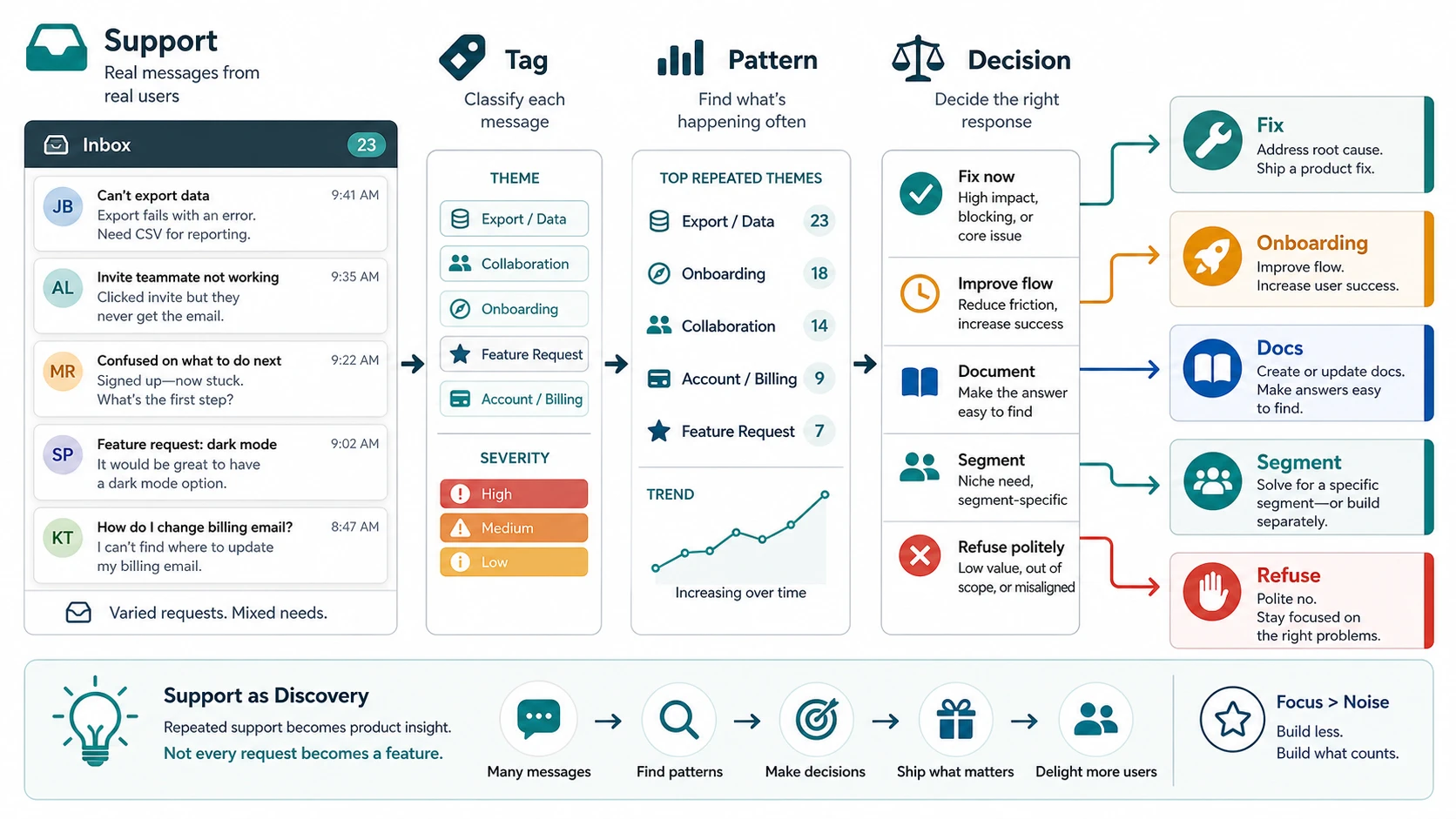
Give Every Conversation One Memory
Early support arrives wherever early users already know the founder: email, chat, direct messages, calls, launch threads, bug forms, and cancellation notes. Forcing every user into one channel is unnecessary. Allowing the evidence to remain scattered is expensive.
The founder creates one support register and gives every meaningful interaction a short record. A spreadsheet, issue tracker, CRM view, or lightweight helpdesk is enough. Each record preserves:
- the user, account, and target segment;
- the workflow step and the user’s own words;
- the observed impact and response urgency;
- a theme and likely cause, kept distinct when possible;
- what the founder did, what decision follows, and when the user should hear back.
This is deliberately smaller than a customer biography. The register has to be easy enough to update after a hurried call. A screen recording can show a failure that is hard to describe, and a chat widget can make contact easy, but neither replaces the record. The message, recording, relevant logs, and resolution should meet in the same place.
Preserving the user’s language matters. “I don’t know whether you can see my clients” contains fear, an actor, and an object. Reducing it immediately to permissions confusion throws away the sentence that might improve the upload screen, help documentation, and sales conversation. Tags help the founder find a pattern; they should not erase what the pattern means.
The silent fourth firm belongs in the register too. Non-renewal, abandonment after an error, and a cancellation reason are support evidence even when no one asks for help. An inbox sees only the users willing to write.
Reply at the Speed of Impact
The message’s tone does not determine its severity. User impact does.
The founder uses four internal levels. S1 means the core value workflow is blocked or money, data, or trust may be at immediate risk; planned work stops for diagnosis and communication. S2 means activation or continued use is damaged and the user must endure friction, use a workaround, or rely on founder help to proceed. S3 covers a working product that repeatedly leaves users confused about what to do or expect. S4 is a preference or edge case that does not obstruct the target workflow.
These labels are local shorthand, not an industry law. Their purpose is to change behavior. The blank-date report is initially S1 because a target firm may act on a misleading close list. The privacy question deserves a prompt and exact answer, but it is not automatically a product incident. The custom-column request can wait while the founder learns what work the column performs.
Severity also changes as facts arrive. The founder checks the affected account, reproduces the import, and finds that the product treated a missing date as “no urgency” rather than “urgency unknown.” No source data was lost, but the ranking can mislead every firm with the same convention. The founder pauses new close-list generation, tells affected users what happened, and prepares a corrected result.
Fast response and product commitment are separate decisions. A user can deserve an immediate reply without receiving a promised feature. That distinction protects trust on one side and product direction on the other.
Find the Job Inside the Request
“Please add custom columns” sounds specific enough to estimate. It is not yet specific enough to build.
The founder asks the third firm’s operations lead to show the last close tracker. “Waiting on partner” is not a display preference. It prevents staff from chasing a client while the firm’s tax partner resolves an internal question. The user is trying to preserve responsibility and next action across an import. A generic column builder would reproduce the source shape but leave the product ignorant of the job.
A few questions expose the real constraint:
- What decision changes when this value is present?
- Who writes it, and who acts on it?
- How often does it occur across a close?
- What goes wrong if it remains a note for another month?
- Do other firms express the same state in a different way?
The smallest honest test is a manual mapping for the next close, not a configurable schema system. If several target firms need an internal-waiting state and it changes prioritization, the founder may add a product concept that survives their different column names. If only one firm needs its private process mirrored exactly, the request may remain custom work that the product should refuse.
This is how chat support and short walkthroughs earn their place: they let the founder inspect the work around a request. They are not standing appointments that permanently compensate for missing product behavior.
Read the Pattern, Not the Volume
Ten tickets do not necessarily outweigh one. A poor-fit user can generate more support than several successful target accounts, while a quiet target user can leave after a single failure at the value moment.
The founder weights evidence by who encountered the issue, what behavior preceded it, and what consequence followed. Signal grows stronger when the user fits the target segment, the issue occurs in the core workflow, it repeats across accounts, or it predicts failed activation, non-renewal, or continuing founder labor. Willingness to pay matters, but payment does not make one customer’s private workflow the market.
This corrects loud-user bias in both directions. A forceful free user asking for cosmetic variations should not outrank three activated firms whose imports express uncertainty incorrectly. Nor should the founder dismiss a single privacy question if it exposes an inaccurate promise about data access. Frequency is evidence; it is not the only evidence.
At the end of the week, the founder reviews the register beside product behavior rather than counting themes in isolation. Which target users were blocked before or at value? Which questions appeared just before abandonment? Which workarounds required the founder to touch data? Which requests came from a segment the product can support repeatedly? The review joins support, activation, retention, and operating burden into one product reading.
Make the Evidence Choose a Destination
Every meaningful issue needs a destination, though “observe through the next close” can be an honest temporary state.
The blank-date behavior becomes a product fix. The product must represent unknown urgency explicitly, warn when ranking confidence is incomplete, and preserve the affected source rows for review.
The access question first becomes an onboarding and documentation change. The import screen should say what is uploaded, what the system does with it, and under what conditions the founder can inspect it during support. If the actual access policy cannot support that sentence, the product or operating practice must change before the copy does.
Repeated questions about changing the billing contact belong in documentation while the path is rare and safe. If the founder keeps making the change manually, the pattern may justify a narrow operations control rather than a customer-facing feature.
The partner-waiting state remains an observed manual mapping until another close establishes whether it is a shared product concept. A prospect that requires enterprise compliance work outside the product’s present promise may reveal a segment boundary, not a roadmap opportunity. A private color scheme for one firm’s clients may simply be refused.
Those are the useful destinations: product, onboarding, documentation, operations, segment, or refusal. Routing keeps the support register from becoming a disguised feature backlog. It also makes the weekly review consequential: something changes in what the founder builds, explains, controls, sells to, or declines.
Help documentation is especially easy to misuse. A repeated explanation deserves a document when the product’s behavior is correct and the reader benefits from a stable reference. If every user asks what the primary button does, a help article hides weak interface language. If users need an article to understand a dangerous product limitation, the limitation should be visible where the decision occurs.
Refuse the Product You Cannot Support
Many reasonable requests are wrong for the current product. Accepting them can create customer-specific logic, unusual permissions, fragile configuration, new data obligations, and a support promise that one founder cannot carry.
A useful refusal acknowledges the job, states the present boundary, offers the nearest honest alternative, and makes no fictional roadmap promise:
I understand why a separate partner-approval stage would help your close. I am not adding firm-specific approval workflows while the product is focused on producing a reviewable priority list for small operations teams. For the next close, you can keep partner-owned items in the source tracker and exclude them during import. I have recorded the need, but I do not want to imply that a configurable approval system is planned.
The answer is clear without treating the request as foolish. The founder is refusing an obligation, not arguing with the user.
Refusal also improves discovery. If the boundary causes several well-fit firms to leave, the founder has learned something consequential about the product promise. If only a costly edge segment objects, the boundary may be protecting the business. Saying “maybe later” to everyone conceals both results.
Close More Than the Ticket
After correcting the blank-date ranking, the founder writes to each affected firm with the scope of the problem, what changed, whether any action is required, and when the corrected list is ready. That closes the loop with the user.
The product loop is different. The importer now preserves unknown dates as uncertainty, the list makes that uncertainty visible, and a regression case covers the firm’s source convention. The onboarding copy explains how missing dates are handled. The change addresses the class of failure rather than repairing one output.
The operating loop records the affected accounts, response, decision, and follow-up. It adds a short recovery note for rerunning a close list safely. If the same question returns, the founder can see whether the product change failed, the documentation is hard to find, or a different cause merely sounds similar.
The first answer helps one user. These three loops—user, product, and operation—keep the same issue from consuming the founder again without producing new knowledge.
Notice When Support Is Hiding the Product
Support stops serving discovery when heroic founder effort makes weak behavior look viable.
The warning signs are concrete: the same activation question returns without a product change; ordinary use depends on private walkthroughs; one account needs recurring data repair or custom explanation; support crowds out discovery, engineering, sales, or rest; the founder fears adding a well-fit user because one more close could overwhelm the system.
Automation is only one possible response. Repeated confusion may need clearer product behavior. A fragile workflow may need to be narrowed. A costly segment may need to be declined. A manual pilot may need an explicit price and boundary. Sometimes the honest result is a refund and a polite goodbye.
Other patterns point beyond the customer-facing product. If the founder repeatedly reruns imports, corrects account state, inspects private data during diagnosis, or reconciles billing by hand, support has revealed an operational surface that needs safer controls and records. That is the work of one-person operations: not eliminating every manual action, but making necessary actions visible, bounded, and trustworthy.
Practice: Run One Support Review
Take the last ten support interactions, cancellation notes, or silent abandonments you can identify. For each, preserve the user’s words, name the workflow and impact, assign a severity, and choose a destination: product, onboarding, documentation, operations, segment, refusal, or observe.
Then make three decisions. Address the highest-impact issue affecting a target user’s value. Turn one repeated explanation into a product or documentation change. Refuse or defer one request whose burden exceeds its evidence.
Finally, write the follow-up each affected user should receive. The review is complete only when the support stream changes a decision and the user is not left guessing what happened.