Solo Founder Product Engineering Handbook / Chapter 34
Early User Recruitment for Solo Founders
Recruit early users manually from the right segment and turn outreach into activation, retention, and product evidence.
Preparing audio…
Audio edition
Early User Recruitment for Solo Founders
The Empty Week Proves Almost Nothing
Consider a founder who has built a tool for bookkeeping firms. It flags missing client documents before month-end close. The happy path works, the quality boundary is responsible, and the landing page is live.
The founder posts about “AI productivity for service businesses.” The post gets a few approving replies. Six people agree to calls. They include two founders, a consultant, an accountant who no longer does client work, and two bookkeepers. Everyone agrees that chasing documents sounds painful. Nobody supplies a real checklist. Nobody uses the product during close week.
The founder has been busy, but the week has produced almost no product evidence. The audience was broad, the ask was vague, and the conversation ended before anyone had to change behavior.
A quiet product page has the opposite problem. It also produces no users, but its silence cannot distinguish weak demand from weak reach, unclear positioning, or a request nobody understood.
Early recruitment resolves that ambiguity by creating a small stream of qualified exposure. The founder finds people close to the pain, asks for the next behavior the product is ready to support, and follows what happens through first value and return. This is manual work because the product has not yet earned a repeatable acquisition system. The work is useful precisely because the founder can still see every handoff.
Begin With a Person You Could Recognize
“Bookkeeping firms” is not yet a recruiting definition. It includes solo bookkeepers, large firms, tax practices, advisory shops, firms with assistants, and firms whose clients supply every document on time. A list built from that category will be easy to fill and hard to learn from.
The founder narrows the first user to:
Owners or operations leads at bookkeeping firms with five to twenty recurring monthly clients who chase missing documents by email during close week.
This describes a person who can be found and a workflow that may be happening now. It also implies the present alternative: inbox searches, spreadsheets, memory, and repeated reminders. The cost is not generic inefficiency. Missing documents delay the close, consume the firm’s most compressed days, and force awkward escalation with clients.
Two more details turn a target segment into a recruiting hypothesis. First, name a safe activation behavior. For this product, it might be supplying a sanitized checklist for one client and using the resulting priority list during the final two days of close. Second, name the natural return. If the tool works, the firm should use it for another client or at the next monthly close.
The definition is sharp enough when it answers five questions in ordinary language: Who has the pain? What do they do now? Why does that fail badly enough to change? What real action can they try? When would useful work bring them back?
Friends, investors, other founders, and broad social audiences can help the founder practice an explanation. They count as early users only if they live inside the target workflow. Encouragement from everyone else is not harmless evidence; it can pull the product toward people who will never depend on it.
Go Where the Pain Leaves Traces
The best early channel is not the one with the largest audience. It is the one that gives the founder a reason to believe this person faces the problem now.
A referral from an accountant to a bookkeeper is close to the pain. So is a niche forum thread about close-week document chasing. A LinkedIn search for bookkeeping firm owners can be useful when company size and client model are visible. A broad productivity audience is far from the pain even if it is large and friendly.
Warm outreach is usually the simplest place to begin, but ask the introducer for a specific person rather than “anyone interested in bookkeeping software.” Direct outreach can work when public context supports the hypothesis. Communities, Slack and Discord groups, Reddit, professional forums, LinkedIn, and social feeds are places to listen for workflow language before they are places to promote a product. Their norms matter. A founder who has not contributed should not arrive with a disguised advertisement and call the resulting resistance a market signal.
Content can earn access when the product’s value can be demonstrated in a useful teardown, template, or example. The risk is mistaking readers for users. A guide about month-end close may attract the right role, but the recruiting evidence begins only when a qualified reader takes the next workflow action.
For every name on the list, the founder should be able to complete this sentence:
This person may have the problem because…
“They might like the product” is not an answer. A recurring client model, a close-week complaint, a visible manual service, or a relevant referral is.
Ask for the Next Piece of Reality
Early outreach often fails at the ask. “Can I get your feedback?” produces opinions. “Would you check it out?” transfers the founder’s uncertainty to the prospect. A request to buy before either side understands the workflow can produce rejection without revealing why.
The right ask depends on what is unknown.
During discovery, ask how the work happens now: “How do you know which clients are blocking the close by the final two days?” If the problem is real, deepen it: “What happens when a missing document is discovered too late?” These questions ask for workflow, not approval.
Once the founder needs to test an output, the ask should include real material: “Could we use one recent, sanitized client checklist to see whether this priority view matches how you escalate?” A manual MVP asks for an exchange: the user supplies a real input and the founder returns a bounded result. A product trial asks for use in a named account before a named date. A pilot adds scope, success criteria, support terms, and a review date. A referral ask comes after the pain is recognized: “Who else handles this same close-week problem?”
Each step should require the smallest behavior that can answer the current question. The founder is not moving contacts through impressive labels. The founder is moving uncertainty into observable work.
Qualification Is the First Support Decision
Interest does not entitle someone to access. For one person operating the product, a bad-fit user is expensive: they need exceptions, request features outside the wedge, encounter irrelevant friction, and leave behind objections that appear to condemn the product.
Before offering a trial, check whether the prospect matches the segment, feels the pain now, can describe a current workaround, and has the data, permission, time, or account needed to activate. Establish whether they are the user, buyer, administrator, or internal champion. Ask when the workflow repeats. Finally, notice whether supporting them would require the product to make a promise it has not made.
A clean refusal preserves both attention and trust:
I do not think the current version is right for your workflow yet. I am focusing on small firms that run recurring monthly closes and chase missing documents during close week. If I expand toward one-off project reporting, I will reach back out.
Exceptions can be deliberate. A design partner may reveal an important workflow boundary. A prospective buyer may expose a security or procurement requirement that the product will eventually face. Name the exception and the question it is meant to answer. Otherwise the most articulate user becomes the market by accident.
Commitment labels should remain literal. An early adopter accepts roughness because the pain is acute. A design partner shares workflow context and reviews changes over time. A beta user operates a nearly real product closely enough to expose activation, quality, and repeat-use problems. A pilot customer tests business value under explicit scope, timing, and success criteria. Someone who watched a demo is still a lead; calling the conversation a pilot only hides the missing commitment.
Keep One Line per Prospect
Memory favors warm conversations and forgets quiet nonuse. The first recruiting system can be a spreadsheet, but every prospect needs a line and every line needs an outcome.
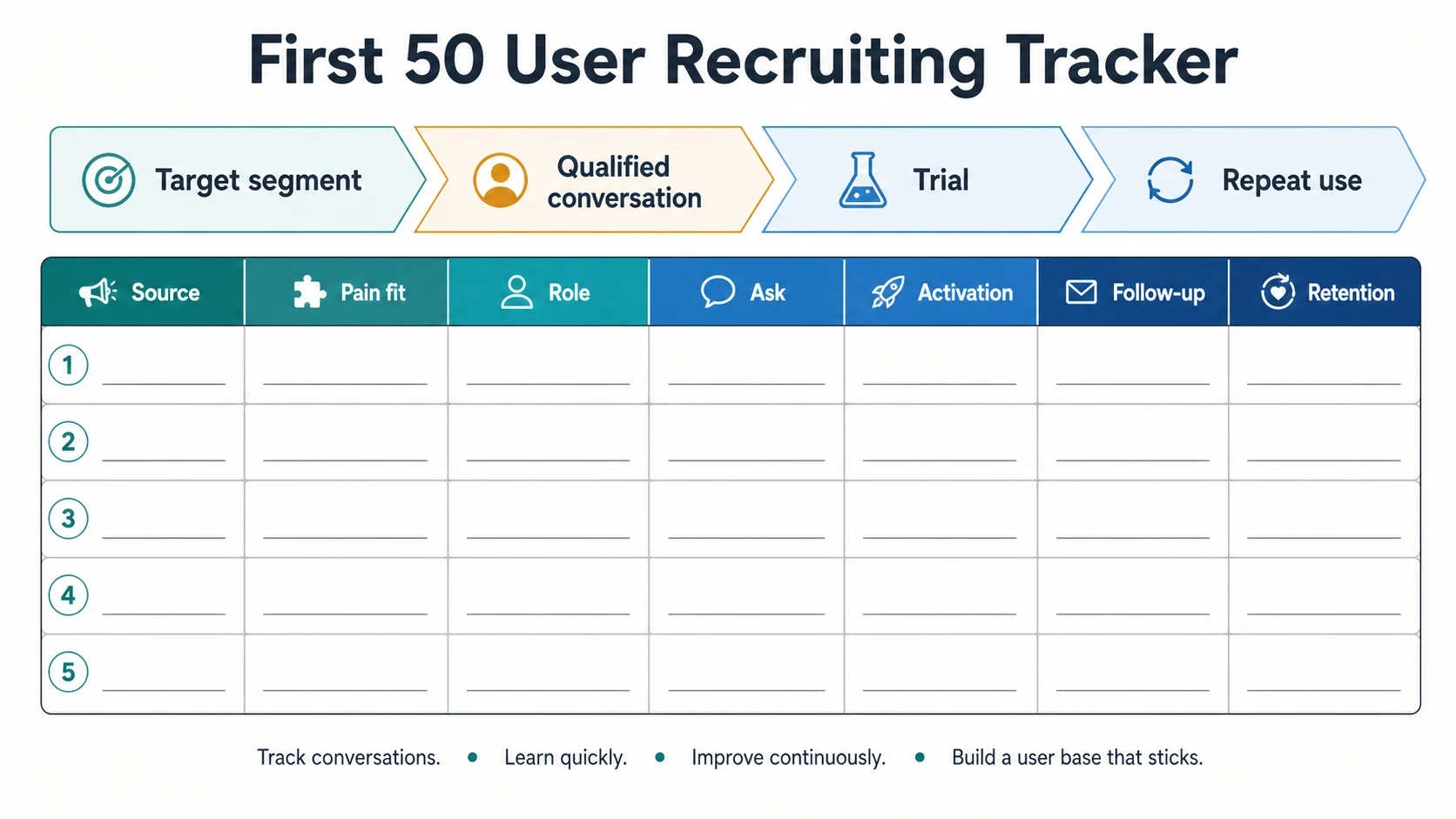
Record the source and the evidence that the pain may be present. Capture the prospect’s own description of the pain and current workaround. Note their role, the ask made, and the next date. Then record the behavioral outcome: whether they qualified, activated, reached value, returned, paid, referred, or stopped—and why. Support notes belong on the same line because repeated rescue is part of the product evidence.
Update the line immediately after contact and after the natural return interval. Review the tracker at least twice during a recruiting push, not only when the list is exhausted. It should reallocate the next outreach hour.
If warm referrals create conversations but no trials, the introduction may be too loose or the ask too large. If direct outreach gets no qualified replies, either the segment evidence or the message is weak. If people activate but do not return, look at value, timing, onboarding, and fit before finding a larger audience. If return requires repeated personal reminders, record the reminders; retention supported by founder pursuit is not yet product pull.
Cross From Interview to Use
A strong interview should end with a decision, not automatically with a trial. Sometimes the useful result is a narrower segment, a rejection, or a product change. When the fit is real, however, the founder needs a deliberate bridge from conversation to behavior.
Reflect the pain in the prospect’s words. Name the current workaround and its consequence. Offer one bounded use tied to that consequence. Agree on what activation means, set the follow-up before the call ends, and state what help the founder will provide.
For the bookkeeping tool, that bridge could sound like this:
You said the last two days of close are spent finding which clients still owe documents, and late discovery pushes work into the following week. If you send one sanitized checklist, I can help you run the priority view for this close. The test is whether it changes who you contact first. Could we review what happened next Tuesday?
This is founder-led sales in its earliest useful form. It is not persuasion detached from the product. It joins a painful workflow to a test, an activation event, and a return conversation.
B2B trials may also require the founder to identify who can approve data access and who decides whether the test continues. A developer product may cross into use at the first successful API call. A consumer product may need a second use at the natural moment of need. The transition changes with the product; it always ends in behavior the founder can observe.
Follow One Recruiting Push to Its Decision
The bookkeeping founder replaces the broad audience with a list of twenty-four firms that appear to fit the close-week workflow. Referrals and practitioner discussions produce twelve conversations. Seven prospects match the segment. Four describe acute pain. Three agree to try the manual workflow during the same close cycle.
One owner uses the priority list twice and asks for help drafting client reminders. A second uses it once, then explains that escalation language—not tracking—is the hard part. The third never activates because an assistant already maintains a reliable spreadsheet and owns the workflow.
Those outcomes resist a simple victory story. The tracker did not prove that bookkeeping firms want a missing-document dashboard. It revealed that the strongest pain occurs in the final two-day escalation, that the user may be an operations lead rather than the firm owner, and that a working spreadsheet is a meaningful competitor. The next cohort should be recruited around that narrower condition.
The founder may test prioritized outreach and a reviewable reminder draft while refusing the gravity of a general bookkeeping platform. That is the return on manual recruiting: not fifty names, but a more precise product question earned from real use.
Protect the Signal From Founder Effort
Founder-led recruiting creates unusually rich learning and several ways to corrupt it.
One articulate design partner can pull the roadmap toward a private preference. Look for the same pain in other qualified conversations before building deeply. Manual help can reveal where the workflow bends, but hidden service can also make a weak product appear retained. Record which steps the founder performed and whether the user could repeat the work without them.
Visible channel activity creates another temptation. Replies, demo attendance, and waitlist growth feel like progress because they move. If they do not lead to qualified activation, they are distribution clues, not product validation.
The emptiest pipeline produces the hardest temptation: accepting anyone. Wrong-fit users consume the same follow-up capacity needed to find better ones. Protecting the wedge can make the list smaller and the evidence denser.
There is an opposite avoidance as well. A founder can remain in interviews after the product is ready for use because trials, pricing, and rejection are more consequential. Once the important uncertainty is behavior, ask for behavior. Once the uncertainty is commercial, make the terms and continuation decision explicit.
Run the First Cycle
Write the first-user definition with the role, recurring workflow, present workaround, painful consequence, safe activation, and expected return. Build a list of twenty people or organizations and give each a pain-proximity reason. Remove the names supported only by broad interest.
Choose the five closest prospects. Make an ask suited to the current evidence stage. Record the response and qualification outcome before sending the sixth. When a conversation reveals strong fit, bridge it into one bounded use and schedule the follow-up. At the end of the natural return interval, decide what the tracker changes: the segment, message, channel, product, onboarding, support boundary, price, or next ask.
The cycle is ready to run when the founder can create the promised activation safely, decline users outside the wedge, observe whether value occurred, and support the planned cohort. If any of those conditions is missing, repair the path or make the ask smaller. Do not compensate with a larger list.
Early recruitment has done its job when the founder can say: these are the people I can reach, this is the pain they recognize, this is the behavior they will try, this is where the workflow resists, and this is whether they return. The next chapter can then treat launch as what it should be: a deliberate increase in exposure, not a leap into an unknown audience.