Solo Founder Product Engineering Handbook / Chapter 27
Security, Privacy, and Trust for the Solo Founder
Set a pragmatic trust baseline for early products without pretending one founder can run an enterprise security program.
Preparing audio…
Audio edition
Security, Privacy, and Trust for the Solo Founder
The First Serious Question
The agency-reporting pilot now remembers which accounts import data, generate a digest, send it, and return the following week. Then an agency owner asks a question that no event dashboard can answer: “If we upload client data, who can see it?”
The founder opens a reply and discovers that the honest answer is scattered across the product. Users sign in through a maintained authentication service. Every agency has an account record. Reports sit in private object storage. But the support console can open any report, document names appear in analytics, removal from an agency does not end old download links, and nobody has tested whether a backup can be restored.
None of those facts alone describes the product’s trustworthiness. Together they decide whether the agency can responsibly bring a client into it.
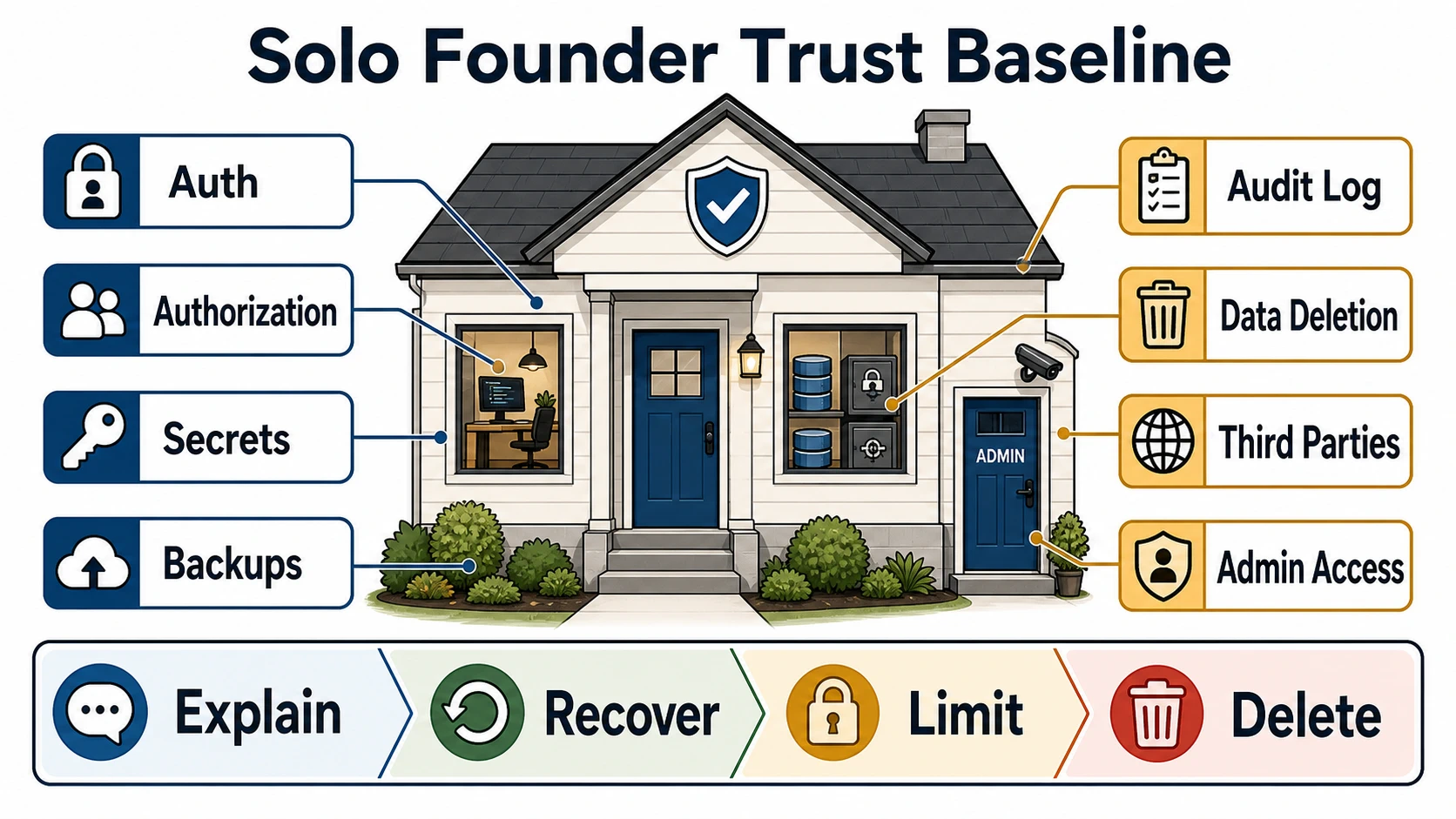
A solo founder does not need to reproduce an enterprise security program before an MVP. The founder does need a trust baseline: a small set of protections and promises that match the product’s actual risk and can be operated by one person. It is adequate when the founder can explain who has access, limit that access, detect consequential actions, recover essential data, and honor the product’s data promises without improvising.
Choose the Risk Before the Controls
“Secure enough” has no useful meaning until the founder names what the product receives, what harm a failure could cause, and what the first customer expects.
The reporting product can begin with manually exported advertising totals rather than permanent access to a customer’s advertising account. It can accept aggregated campaign metrics rather than contact-level audience data. It can generate a draft for the agency to review rather than sending directly to the agency’s clients. Each choice reduces the consequence of a mistake while preserving the learning the pilot needs.
That is security work. Risk is shaped by product scope before it is managed by controls.
Map one real workflow from entry to erasure. For the agency product, the path is: an account owner invites a colleague; the colleague uploads an export; the product parses it; a background job creates a digest; the colleague reviews and sends it; analytics records the workflow state; backups retain the database and generated files; support may inspect a failed job; account deletion eventually removes the active records and files.
At each step, ask four questions:
- What customer data exists here, including copies in logs, analytics, support, and vendors?
- Which person, service, or administrator can read or change it, and why?
- What failure would expose, corrupt, strand, or silently retain it?
- Could one founder detect the failure, contain it, and restore honest service?
If the answers are unknowable, shrink the workflow or delay the customer. A metadata-only pilot, synthetic file, narrower first segment, or manual handling agreement may preserve the experiment without accepting a risk the founder cannot carry. Products involving regulated records, intimate data, identity, safety, substantial financial harm, or contractual security obligations require qualified legal, privacy, compliance, or security help before customer dependence—not after the first incident.
Make Every Access Explainable
Authentication establishes an identity. Authorization decides whether that identity may perform this action on this account and object. A login screen solves only the first problem.
The reporting product needs a sentence that remains true on every data path: this user may read this digest because the user is an active member of the agency that owns it. The rule must cover the page, download endpoint, API, export, background job, and support tool. Hiding a button in the browser does not protect the underlying object. A guessed identifier, altered account field, stale invitation, or old download link must not create a second route around the rule.
Keep early roles few. An owner who manages membership and billing and a member who performs the workflow may be enough. The founder does not need an abstract policy engine merely because large organizations have one. The founder does need denied-by-default behavior, checks on each request, and negative tests: a member from Agency A cannot read, edit, export, delete, or obtain a file URL for Agency B’s data; a removed member cannot continue through a previously valid path; an ordinary member cannot acquire owner or founder powers.
Authentication itself is usually commodity work. A maintained provider or framework path can own password hashing, sessions, recovery, and common protections better than an improvised subsystem. If the application stores passwords, they require a purpose-built adaptive password-hashing scheme rather than plaintext, reversible encryption, or a fast general-purpose hash. For a founder whose product is not identity infrastructure, buying this machinery is usually the more responsible implementation choice.
Founder access belongs inside the same model. An internal console that bypasses account boundaries is the product’s most powerful account. It should show metadata before content, require a deliberate reason before sensitive access, use strong authentication, and record consequential actions. Direct production database access may occasionally be necessary during an early support incident. It should feel exceptional. When routine support depends on unrestricted queries, the missing feature is constrained admin tooling.
Follow the Data Beyond the Main Database
The owner’s question cannot be answered with “the database is encrypted.” Customer data has a habit of escaping the system diagram.
In the reporting workflow, a document name might appear in a browser event, a parser error, a background-job payload, an error tracker, a support screenshot, and an email notification. The original file can be private while its contents or identifying metadata spread across services with broader access and longer retention.
The smallest useful rule is to collect and copy only what a named purpose requires. Analytics may need account and digest identifiers, workflow states, reason categories, and duration bands. It does not need client names, report bodies, raw exports, access tokens, or confidential free text. Logs may need a safe correlation identifier and failure category. They do not need secrets or the customer document that caused the failure. Support may need a customer-provided example; it does not follow that every support vendor or inbox should receive production data by default.
File uploads deserve their own boundary. Limit accepted types and sizes to the workflow. Generate storage names rather than trusting user filenames. Store files outside the public web path or behind an authorized retrieval handler. Check access again when issuing a download, not only when the file is uploaded. Decide whether parsing or rendering requires scanning or isolation. Preserve enough metadata to operate the job without turning analytics into a shadow document store.
Secrets are another data flow: database credentials, signing keys, webhook secrets, API tokens, payment credentials, AI-provider keys, and deployment credentials. Keep them out of source code, logs, screenshots, support messages, and shared notes. Store them in deployment configuration or a maintained secret facility, grant only the access their use requires, and know how to rotate and revoke them. A secret that cannot be replaced after exposure is an operational trap.
Use standard transport protection and the storage protections supplied by maintained platforms. Custom cryptography, customer-managed keys, or application-level encryption with a novel key lifecycle is not a casual hardening step. It changes backup, recovery, support, search, rotation, and incident behavior. When the product genuinely requires it, the founder has reached the boundary for specialist design and review.
Prove Recovery Before Promising It
A successful backup job proves that bytes were copied. It does not prove that the product can recover.
For the reporting product, the founder must name the recovery unit. Can the database be restored only as a whole, or can one agency’s records be recovered? Are uploaded exports and generated digests protected with the database, separately, or not at all? Which configuration is required to make a restored system work? How much customer work can disappear between copies? How long are copies retained?
Then perform one restoration into a non-production environment. Open a restored agency, confirm that memberships still enforce account boundaries, retrieve a file, and run the important workflow far enough to expose missing keys, storage objects, or job state. Record the commands and the limits. Recovery that exists only in the founder’s memory is weakest when it is needed most.
The restore test also corrects product language. If active deletion happens immediately but protected backups expire on a schedule, say so. If a restored whole-system backup could temporarily reintroduce records previously deleted from the live system, the recovery procedure needs a way to reapply those deletions or keep the restored data beyond use. The exact legal obligation depends on jurisdiction, contract, data, and role; the engineering obligation is to know what the system actually does and avoid promises it cannot keep.
Give Consequential Actions a History
The founder does not need a surveillance system. The founder needs enough history to investigate customer-impacting actions and tell the truth.
Record events where control or data changes hands: membership and role changes; password recovery; token creation and revocation; exports and bulk downloads; deletion and restoration; billing or entitlement changes; imports and integrations; and founder access to sensitive customer content. A useful record names the actor, account, action, object, result, time, and safe request context. It does not repeat the secret, report, or confidential field being protected.
Return to the agency owner’s question. “Only your active agency members can view a digest” is a control claim. “Sensitive founder access is deliberate and recorded” is an accountability claim. “If a cross-account request is denied, we can investigate the attempt” is a detection claim. These claims are modest, testable, and far more useful than calling the product “secure.”
Audit records also reveal design mistakes. If a removed member’s download succeeds, if the founder must alter the database without leaving a record, or if one export produces no attributable event, the history is showing where the product’s boundary is porous.
Vendors Remain Inside the Answer
Managed authentication, hosting, storage, email, payments, analytics, error tracking, support, and AI services often reduce risk and founder burden. They do not make the data flow disappear.
Maintain a short processor and vendor inventory beside the workflow map. For each service, write down what data it receives, why it is needed, who can enter its console, how access is revoked, what retention and deletion behavior is available, how data can be exported, and what the product does when the service fails. Review dashboard access as carefully as production access; a vendor console can expose customer data without touching the application.
This inventory creates product choices. If the AI provider would receive entire confidential reports but the experiment only needs structured totals, send the totals. If the analytics tool makes deletion or data residency impossible for the first buyer, replace it, change what is sent, or choose another buyer. If a vendor is essential and has no workable outage path, describe that dependency honestly rather than inventing resilience.
Buying a component transfers operation of that component. Responsibility for selection, configuration, access, disclosure, and fallback remains with the founder.
Write the Trust Note the Product Can Honor
The agency owner does not need a stack inventory disguised as reassurance. They need a plain account of the product behavior that affects their decision.
Write a one-page trust note with these sections:
- Scope. The customer data the product accepts, the purpose for each category, and the sensitive data it deliberately does not accept.
- Access. How users authenticate; how accounts, roles, objects, and founder access are authorized; and which sensitive actions are recorded.
- Data path. Where data is stored, which vendors receive it, and which data is excluded from analytics, logs, support, and AI tools.
- Protection and recovery. How secrets, transport, private files, backups, restoration, and security reporting are handled.
- Retention and deletion. What active deletion removes, what must be retained, how vendors participate, and how protected backups age out or remain beyond use.
- Limits. The certifications, contractual controls, residency guarantees, regulated uses, availability promises, or security capabilities the product does not currently offer.
Now test the note against the system. Try a cross-account request for every sensitive object and export path. Remove a member and retry an old link. Inspect a real analytics event, application log, error report, and support path for unnecessary customer content. Rotate a non-production secret. Restore a backup. Delete a test account and trace the record through storage and vendors. Review who can enter each production console.
Every mismatch has one of three honest resolutions: change the product, change the note, or refuse the use case. Copying ambitious claims from a mature vendor is not a fourth option.
The baseline is ready for the next customer when the founder can answer, without guessing:
- Who can access this customer’s data, through every product and administrative path?
- What prevents one account from crossing into another?
- What leaves the product for vendors, logs, analytics, support, or AI processing?
- What would reveal a consequential mistake or misuse?
- What can be restored, how recently has restoration been tested, and what cannot be recovered?
- What does deletion mean in the live system, retained records, vendors, logs, and backups?
- Which promise or customer would exceed the founder’s present competence and operating capacity?
The reporting founder can now reply to the agency owner with a bounded answer instead of a confidence performance. That answer may still lose a buyer who needs certification, strict residency, a negotiated incident process, or controls the product does not have. Losing that buyer is less costly than accepting a trust obligation the founder cannot operate.
Trust is not the claim that nothing will fail. It is the discipline of limiting what failure can reach, noticing consequential failure, recovering what matters, and saying exactly what the product does. The next chapter adds a powerful source of new code to this system. AI assistance can accelerate the work, but none of these boundaries can be delegated to its fluency.