Solo Founder Product Engineering Handbook / Chapter 36
Onboarding as the First Product
Find the shortest path to first value, then reduce the explanation and setup work required to travel it.
Preparing audio…
Audio edition
Onboarding as the First Product
The First Useful Priority List
The bookkeeping founder ended the previous chapter with a narrow launch decision: keep the product invite-only for another close cycle, recruit operations leads at firms with recurring monthly clients, and learn whether they can produce a useful priority list with less help.
Return to the fourth firm in that launch’s first group. Its operations lead accepts the invitation on Monday morning, creates a workspace, and stops.
By ordinary launch metrics, this looks like progress. The account exists. The welcome email was opened. The user reached the product. None of those events has improved a close.
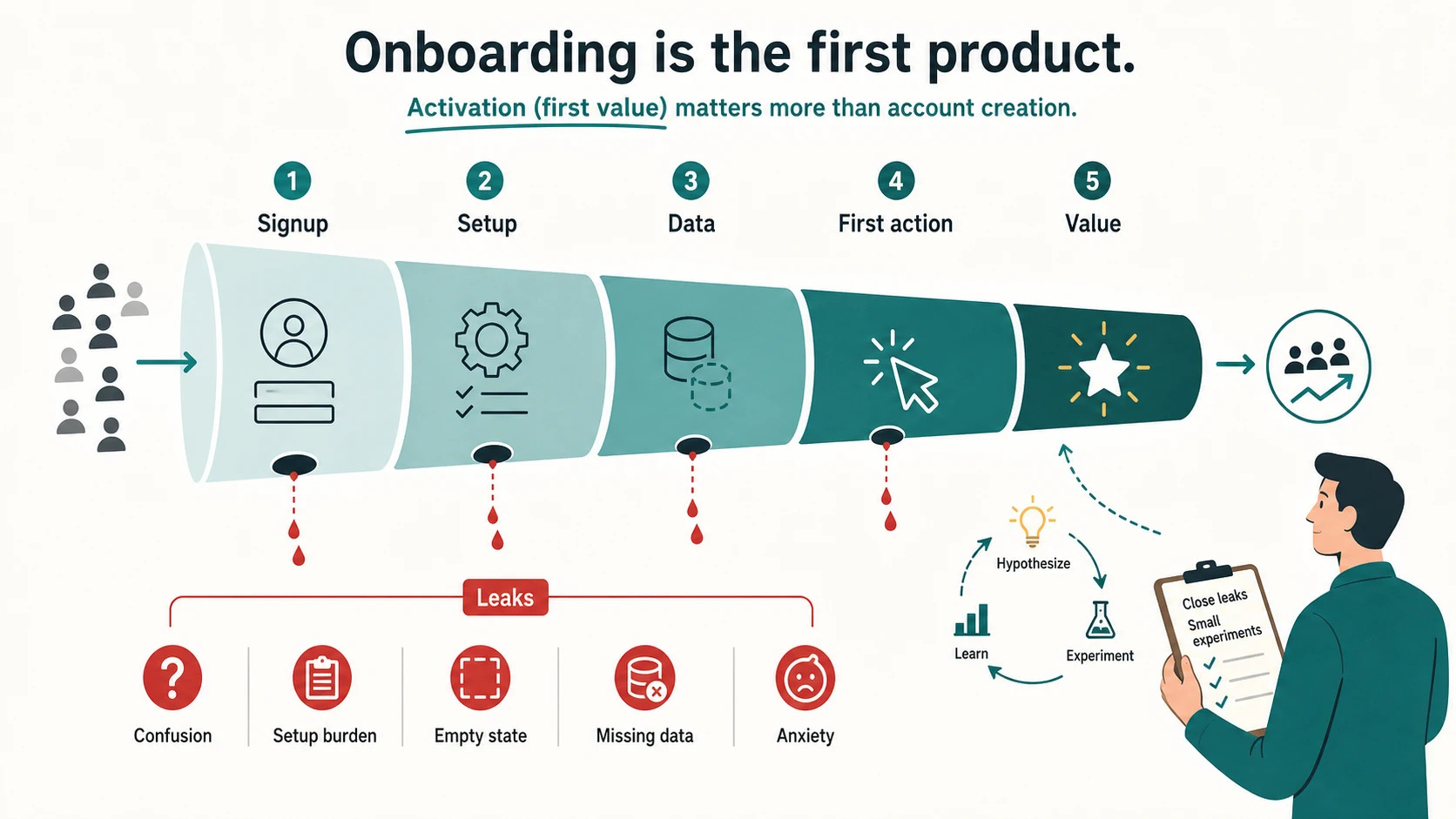
Onboarding is the first product after launch because it has to turn the promise into an experienced result. Until the operations lead can use a priority list to change whom the firm contacts, the founder has acquired only an opportunity to deliver value. Every required permission, import, choice, and explanation spends some of that opportunity.
The founder’s task is not to make every first-run screen pleasant. It is to find the shortest honest path to value for the target user, watch where that path breaks, and repair the break without creating more product than one person can support.
Name the Event That Would Count
Before changing the stalled workspace, the founder needs a definition of activation.
Activation is the first observable behavior that gives credible evidence that a target user has experienced the product’s value. It is not the earliest event analytics can count. Creating an account, completing a profile, connecting an integration, or viewing a dashboard may be necessary, but each is still a cost the user pays before value.
For this product, “checklist imported” is too early. Even “priority list generated” is incomplete: a plausible-looking list that nobody trusts or uses has not changed the workflow. The founder chooses a stricter event:
An operations lead generates a priority list from a real close checklist and uses it to change at least one follow-up.
That sentence joins the product’s input, output, target user, and promised consequence. It is narrow enough to observe and strong enough to guide a decision.
The event should fit the commercial motion. A low-priced self-serve tool must usually reach first value quickly and with little founder help. A paid B2B pilot can tolerate an admin step, a data review, or a scheduled kickoff when the price, risk, and workflow justify them. Neither product gets to call setup value merely because setup is expensive.
The definition will sometimes change. If firms consistently find the list useful before acting on it, “changes one follow-up” may be too late. If they act only because the founder urges them to, it may be too generous. Activation is a decision claim, not a permanent analytics constant; the founder should revise it when observed behavior shows that it overstates or understates first value.
Follow Behavior, Not Screens
The founder opens the workspace record and arranges the path in the order the user must travel it:
- Accept the invitation and understand the close-week promise.
- Create a firm workspace.
- Import a current checklist.
- Resolve missing or ambiguous columns.
- Generate the priority list.
- Review why each client appears where it does.
- Change a real follow-up.
This is an activation path, not a tour of the interface. It immediately separates different failures. A wrong-fit visitor who does not recognize the close-week problem belongs to recruiting or positioning. An operations lead who recognizes the problem but will not upload a checklist may have a trust concern. A successful import followed by an abandoned list may reveal unclear output, a missing explanation, or a product that has not earned its place in the workflow.
The path also makes time visible. The founder records when the invitation is accepted, when an import begins, when the list is ready, and when it first affects follow-up. The useful measure is not a universal “good” time-to-value. It is whether the time and effort are reasonable for this problem, this price, and this user’s urgency. Ten minutes may be intolerable for a casual utility and remarkably fast for replacing part of a monthly B2B process.
At the stalled firm, the path ends before import. The empty workspace says “Add your first data source” and offers three integrations. The operations lead has a spreadsheet, not a “data source,” and cannot tell whether uploading it will send reminders automatically. The product has combined a language problem, too many choices, and a trust question in one empty screen.
Installing a generic product tour would explain the controls while leaving all three obstructions intact.
Sit Beside the Failure Once
The founder invites the operations lead to a short working session. Manual onboarding is appropriate here because the product is still learning how the target user understands the job. The call is not evidence that onboarding works; it is a way to discover why it does not.
Before the call, the founder writes three questions:
- What did the lead expect to happen after accepting the invitation?
- What prevents the checklist from being uploaded?
- What would make the resulting list safe enough to use during close?
On the call, the founder asks the lead to share the current workflow, then watches the first attempt without taking the controls. The lead calls the file a “close tracker,” hesitates at “data source,” and asks whether the product will contact clients. When shown that the import only prepares a draft list, the lead uploads the sheet. Two columns do not match the expected names. The founder maps them manually, generates the list, and asks the lead to inspect the first three priorities.
One recommendation is wrong because the source sheet uses blank due dates for documents requested by phone. That resistance is valuable. A polished demo with sample data would have hidden it. The founder corrects the mapping, regenerates the list, and the lead moves one client ahead of another in the day’s follow-up order. The firm has activated, with substantial founder help.
The call has exposed four different facts: the product used the wrong noun, its empty state implied more automation than it performed, its importer assumed a tidier sheet, and its output needed enough explanation to be challenged. “The user needed onboarding” would have concealed all of them.
Manual help becomes dangerous when it supplies the product’s missing judgment without leaving evidence behind. A persuasive founder can carry a confused user through almost any flow. Bespoke data cleanup can make a fragile importer look viable. Repeated calls can turn a $19 product into an unpriced service. After each session, record what the user did unaided, what the founder explained, what the founder performed, and whether the promised behavior happened. Assisted activation and independent activation must remain distinguishable.
Turn Repeated Help Into Leverage
The next question is not “How do we automate this call?” It is “Which part of the help should the next user no longer need?”
The founder keeps a short record for each session: the user’s trigger, the farthest unaided step, the first hesitation, the manual action, the activation result, and the next natural use date. Alongside it, the founder records possible leverage. That leverage may be copy, a template, a sample file, a safer default, an import preview, a lifecycle email, documentation, or an admin action. Code is one option among several.
For the bookkeeping product, the founder makes three small changes before inviting the next firm:
- “Add your first data source” becomes “Import a close tracker to draft your priority list.”
- The empty state shows one accepted spreadsheet template and states that no client is contacted automatically.
- The importer previews column matches and asks the user to confirm them before generating a list.
The founder does not add three integrations, a configurable mapping studio, or an automated reminder sequence. Those additions would enlarge the system before the current obstruction is understood. Nor does the founder perfect a demo dataset. Demo data can help a user understand an unfamiliar product, but this product’s central risk lies in handling the firm’s real, irregular tracker. A sample is useful only if it prepares the user for that encounter rather than replacing it.
The second firm imports without a call but stops at the preview. Its operations lead does not have permission to decide how client data is processed. This is not the same leak. More import polish will not solve it. The founder sends a brief account-setup note for the owner or administrator: what is uploaded, what the product does with it, who can inspect it during support, and how it can be deleted. B2B onboarding often belongs partly to the buying and administrative path, not only to the operator clicking through the product.
Team invitations follow the same rule. Asking users to “invite your team” at signup creates work before value and often reaches the wrong role. Invite another person when their participation unlocks the next meaningful step: an administrator approves data access, a colleague reviews the priority list, or an owner needs to see the close outcome. Collaboration is part of onboarding only when it advances the value path.
Test One Leak at a Time
Broad onboarding projects are hard to interpret. If the founder changes the copy, import format, defaults, email sequence, and output screen together, a higher activation rate reveals little about which assumption was wrong.
Choose the largest observed obstruction and the smallest change that can test it. Confusing language may need one rewritten sentence. Missing data may justify a template or a founder-assisted import for the next cohort. Permission anxiety may need an explicit scope, preview, sandbox, or admin conversation. Too many choices may need one opinionated default. An empty state should offer the first useful action, not describe every future capability. Output that users cannot judge may need source references, a before-and-after example, or human approval before action.
A lifecycle email belongs after the same diagnosis. Send it at a moment the workflow creates: when an import is ready to review, when an administrator must act, or when the next close begins. A sequence of generic “tips” can increase messages while leaving the value path unchanged.
For the next four firms, the founder tests only the revised empty state and import preview. The cohort record preserves segment, invitation time, farthest unaided step, first value time, founder minutes, repeated explanation, and activation outcome. Those facts need not live in a complex analytics stack; product events and a disciplined customer tracker are enough.
The comparison has two dimensions:
Did more target users reach the activation event, and did they require less repeated founder explanation to do it?
An improvement in only one dimension is still informative. More activation with more founder effort may justify a deliberately high-touch pilot, but it has not produced a self-serve motion. Less founder effort with unchanged activation means the product has become quieter, not more useful.
Results should be read as paths, not just percentages. If four of eight invited firms activate, the founder needs to know whether the other four were wrong-fit, blocked by permissions, defeated by import errors, or unconvinced by the list. Each diagnosis implies a different decision. Aggregating them into “50 percent activation” throws away the product work.
Know What the Onboarding Result Permits
Before widening acquisition, the founder should be able to name the target segment, activation event, current path, time-to-value, largest pre-value leak, manual help provided, and next experiment. They should also know which explanation keeps recurring and what it costs to deliver.
If those answers are missing, more traffic usually buys more abandoned workspaces and support. If activation is possible only on a founder-led call, keep learning manually but do not describe the product as self-serve. If users complete setup yet reject the output, stop polishing setup and investigate value or trust. If one role wants the product but another controls data or budget, design the account path around the real decision structure. If the economics can support paid implementation, price and bound it instead of hiding the service inside software revenue.
The bookkeeping founder ends the cycle with a narrower claim than “onboarding improved.” Target operations leads now understand the empty state and can map ordinary spreadsheets without a call. Irregular trackers still need help. Account owners still need a clear data explanation. The founder keeps assisted import available for the next cohort, postpones new integrations, and measures whether firms return at the next close.
Some of what happens next will arrive as support: a broken import, a trust question, a request for a custom column, a user who cannot explain why the list is wrong. Those messages should not become an accidental feature queue. They are the next evidence stream, and they need their own boundaries.
Practice: Reconstruct One Path
Choose the last five target users or prospects who tried the product. For each, write the farthest step reached before first value, the first point of hesitation, any help supplied, and whether the promised behavior occurred.
Then choose one repeated leak. Name the activation event it obstructs, make one change small enough to interpret, and state which founder explanation or action should disappear if the change works. Do not add acquisition until the result can change a product decision.