Solo Founder Product Engineering Handbook / Chapter 2
The Solo Founder Equation
Use founder attention, not code output, as the binding constraint for weekly product and engineering decisions.
Preparing audio…
Audio edition
The Solo Founder Equation
The Week Has One Operator
A team can hide bad priorities for a while. Discovery can happen in one room, engineering in another, sales in another, and support somewhere else. A solo founder has no such separation. The same person has to hear the customer, decide what matters, build the first system, explain it, sell it, support it, operate it, read the evidence, and still have enough judgment left to make tomorrow’s trade-off.
That is why code output is a dangerous primary measure. A solo founder can ship a large amount of software and move the product no closer to a market. They can also spend a week in conversations, support tickets, or manual delivery and make the next engineering decision much clearer.
The solo founder equation is therefore:
Useful learning per unit of founder effort, bounded by trust, cash, and stamina.
Before product-market fit, the most valuable week is rarely the fullest one. It is the week in which one important uncertainty becomes materially less uncertain without adding a load the founder cannot carry. Shipping matters when it creates evidence. Research matters when it changes a decision. Sales matters when it exposes a reachable buyer, a real objection, or a pricing boundary. Support matters when it reveals a pattern instead of remaining a private drain on the founder’s day.
The weekly question is not “How much did I do?” It is “Which decision is now clearer because I spent the week this way?”
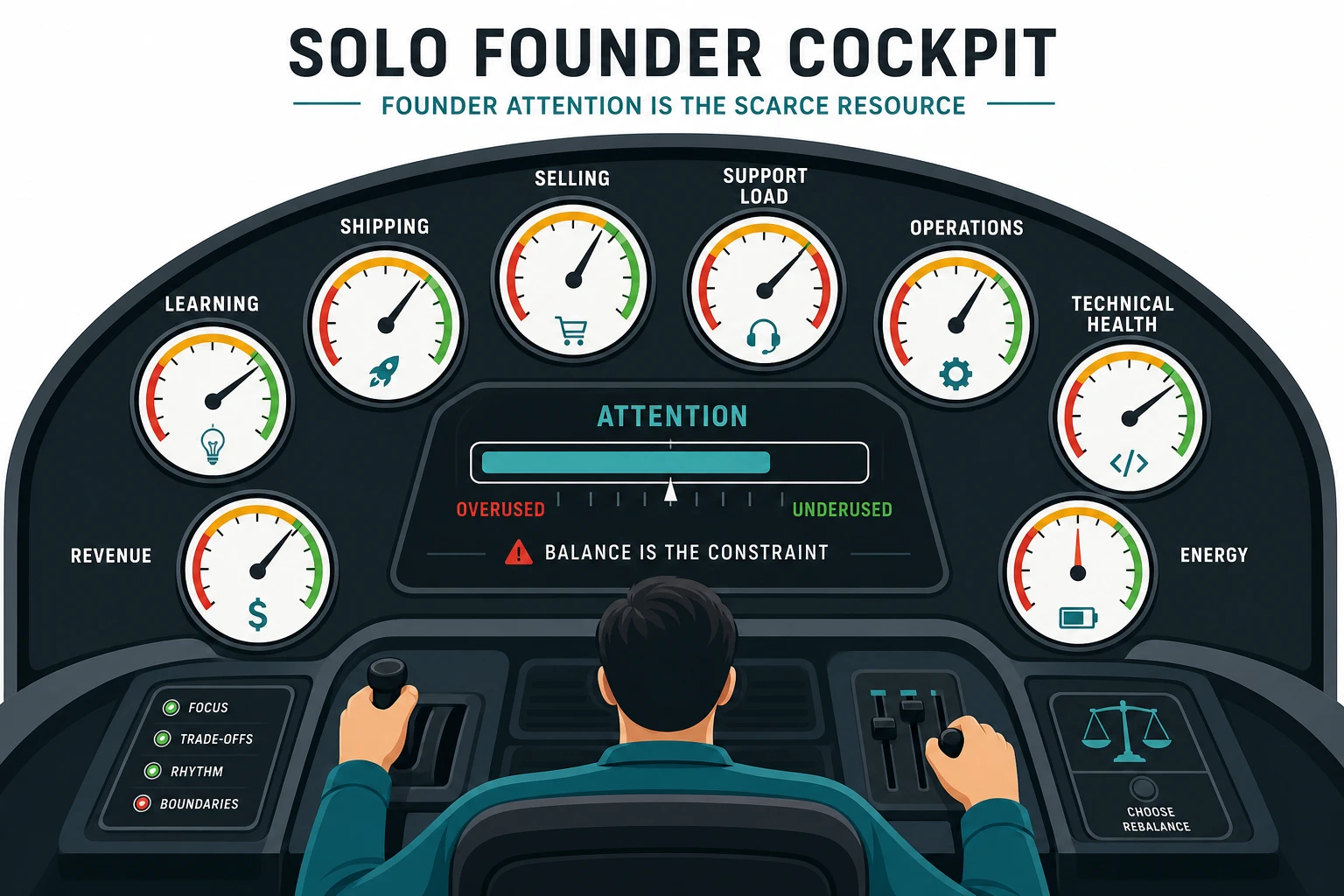
Output Is the Easiest Place to Hide
Building feels honest because the feedback is local. A test passes. A component renders. A migration runs. A deployment finishes. The work produces artifacts that look like progress.
Customer learning is rougher. People do not answer. Interviews contradict each other. Buyers say the price is too high. Users praise the demo and never return. A founder who is fluent in engineering can retreat into work that gives cleaner feedback even when the business needs messier evidence.
Engineering is not the enemy. Often the best way to learn is to build something narrow enough that real users can behave honestly. The mistake is building without naming the uncertainty the build is meant to reduce. A new onboarding flow should answer whether more target users reach value. An analytics event should support a decision. A feature should change behavior, protect trust, or remove a demonstrated bottleneck. Otherwise the artifact is evidence only that the founder can make artifacts.
Shipping velocity still matters, but it has to buy something. It is useful when it increases learning velocity, reduces risk around retained users, or protects a promise the product has already made. It becomes vanity when it mostly increases surface area.
Every New Surface Sends a Bill
The visible plan lists features, outreach, fixes, calls, and launches. It rarely lists the attention taxes those choices create.
A feature is not only code. It brings onboarding copy, empty states, error handling, analytics, documentation, pricing implications, support questions, regression risk, and the future decision of whether to keep it. A tool is not only a subscription. It is another dashboard, integration, bill, permission model, incident path, and mental tab. A new customer segment is not only a larger market. It brings new language, objections, workflows, buying criteria, support expectations, and edge cases.
These taxes can be worth paying. A payment provider may be worth buying early because trust and cash collection matter. An audit log may be necessary if the first credible customers handle sensitive workflow data. A manual service step may be worth carrying because it reveals what software must eventually automate.
They become dangerous when they are accepted accidentally. Three analytics tools can consume more attention than the decision they were meant to inform. A second customer segment can split the landing page, sales conversation, roadmap, and support vocabulary before either segment has shown pull. Custom work can produce welcome revenue while filling the product with private promises that never become a repeatable pattern.
These costs compound through context switching. Moving from a support incident to a discovery call to a half-finished migration does not merely consume the minutes on the calendar. Each mode has to be loaded into the same mind. A week with ten open loops can feel strenuous while completing none of the learning cycles that would simplify the next week.
The equation is not an argument for less serious work. It is an argument for refusing work whose cost is hidden and whose evidence value is weak.
A Strong Week Buys a Decision
Not every hour has the same product value. One hour writing a setup script may remove a repeated support interruption. One hour polishing a settings page may only make an unvalidated product feel more complete. One hour on a sales call may reveal that the buyer is not the user. One hour on a sales call with no notes may produce only a vague sense that “people are interested.”
Useful learning is tied to a decision the founder will actually make. It comes from a credible source: behavior, payment, repeated objection, observed workflow, retained usage, or a qualified customer conversation. It changes what the founder builds, refuses, sells, prices, instruments, or supports.
Founder effort has a time cost, a switching cost, and a carrying cost. The first appears on the calendar. The second appears when unrelated modes compete for the same stretch of attention. The third arrives later as software, promises, tools, customers, and manual processes that must be maintained.
A week is strong when useful learning is high and carrying cost is controlled. A week is weak when the founder produces output that creates more future obligation than present evidence.
Give the Week a Budget
Use a weekly budget because daily plans are brittle and monthly plans hide drift. The Founder Attention Budget is not a calendar. It is a short decision record that says what the week is meant to buy.
Write five entries:
- Primary uncertainty. Name the question most likely to change scope, segment, message, price, or architecture. “Keep improving the product” is not a question.
- Product experiment. Choose the cheapest credible way to reduce that uncertainty this week. “Get feedback” is not yet an experiment; name the people, behavior, or transaction that can answer the question.
- Engineering commitment. Commit to the smallest build, fix, instrumentation, or hardening required to run the experiment, preserve trust, or remove a demonstrated bottleneck.
- Customer-facing action. Put the week in contact with reality through a named outreach, interview, observation, onboarding, sales, support, or review action.
- Operating guardrail. State what you will not add, promise, or ignore. A useful guardrail protects focus, reliability, support load, cash, or recovery.
The guardrail is easy to skip, and it is often what saves the week. Without it, “add one import path” becomes “support every source system.” “Talk to agencies” becomes “serve agencies, freelancers, consultants, and internal marketing teams.” “Fix onboarding” becomes “rewrite the whole app.”
This budget does not pretend that discovery, building, selling, support, and operations can always be scheduled in clean proportions. Existing customers may need help. Production may fail. An invoice may need chasing. Protect those obligations explicitly, then spend the remaining discretionary attention on the primary uncertainty. If everything is allowed to become primary, the budget has made no decision.
The Reporting Suite That Does Not Need to Exist Yet
Consider a small agency reporting product. The founder believes paid-search agencies waste too much time preparing Monday client updates. The first product definition is narrow: one CSV upload, one account-level summary draft, one manual review step, and one exportable client note.
After two encouraging calls, the founder’s task list expands:
- add ad-platform OAuth integrations;
- build a client portal;
- create report templates for paid search, paid social, SEO, and email;
- add team comments;
- compare current spend with last month;
- rewrite the landing page;
- set up a CRM;
- research usage-based pricing;
- answer a prospect who wants white-label PDF exports.
The list feels like momentum. It is mostly ambiguity hiding inside work.
The most important uncertainty is not whether the founder can build a reporting suite. It is whether agency operators will trust a generated client update enough to use it on three consecutive Mondays.
The attention budget turns the week into a sharper plan.
Primary uncertainty: Will paid-search agency operators trust and reuse a generated Monday update after reviewing the source numbers?
Product experiment: Run a concierge test for six operators. Each uploads last week’s CSV, receives a draft, edits it, and decides whether they would send it to a client.
Engineering commitment: Build only the CSV intake, source-number display, draft generation, edit capture, and export. Record every edit the operator makes before sending.
Customer-facing action: Recruit operators who already discuss reporting time or agency-operations workload, and observe at least four review sessions.
Operating guardrail: No OAuth integrations, client portals, white-label exports, or non-paid-search templates until three operators use the workflow on two Mondays.
This plan ships less visible product and produces better evidence. It tests trust, workflow fit, activation, and reuse before the founder accepts the surface-area tax of integrations and portals.
It also protects engineering judgment. If operators keep rewriting the summaries, the problem may be trust, missing source context, weak generation, or incorrect positioning. If they value the draft but refuse to upload CSVs weekly, integration may be the next bottleneck. If they use it twice and ask for client-specific tone controls, the founder has evidence for a narrower feature. Each outcome changes the next build decision.
Let Evidence Rewrite the Plan
The budget is a decision, not a promise to your past self. Change it when evidence reveals that another uncertainty is more important.
Support and sales belong in the same learning system. A ticket is more than a closed task when repeated confusion changes onboarding or removes a feature. An objection is useful when it is tagged to a segment, urgency, current alternative, and next action. Ten calls that do not alter a decision are activity; one observed workflow that changes the experiment can be progress.
Stop parallel work when no single decision depends on it. Parallel experiments feel efficient, but they often produce evidence too noisy to interpret and work too scattered to finish.
Trust, Cash, and Stamina Set the Bounds
“Learning” can become an excuse to avoid hard engineering, avoid selling, or keep a product permanently in research mode. When code is the cheapest credible test, write the code. When trust requires reliability, build the reliability. When a retained workflow depends on boring administrative work, do the administrative work.
The equation also fails if the founder measures only immediate learning and ignores the system being created. A manual service may teach quickly, but it can become a hidden job. A quick script may unlock evidence, but it can corrupt data if nobody owns validation. A cheap integration may save a week and create a year of edge cases.
Use the equation with its bounds. Do not run an experiment that damages customer trust. Do not spend months perfecting evidence that the company cannot afford to pursue. Do not design a product that works only while the founder is permanently exhausted.
Stamina is not sentiment placed beside the “real” business constraints. It affects the founder’s ability to notice patterns, respond to incidents, speak to customers without resentment, and make reversible decisions before they become expensive. Productive intensity has a purpose and an end. Unsustainable grind borrows judgment from the following weeks and records the loan as progress.
Recovery therefore belongs in the operating system. It is not automatically the primary work of the week, but neither is it leftover time to be consumed whenever the roadmap expands. A plan that repeatedly requires exhaustion has failed its burden test even if each individual task appears rational.
Before You Commit the Week
Read the attention budget once from beginning to end. The uncertainty should change a real decision. The experiment should be capable of producing behavior, payment, retained use, an objection pattern, or an observed workflow. The engineering commitment should be the smallest credible path to that evidence or to preserving trust. The customer-facing action should put the plan beyond the founder’s imagination. The guardrail should refuse a specific expansion of feature, segment, channel, tool, or promise.
If one of those statements is vague, revise the plan. If there are several primary uncertainties, choose the one whose answer would make the others easier or irrelevant. If no customer-facing action is possible, ask whether the week is protecting an established obligation or hiding from the market.
Exercise
Take your current task list and mark each item as discovery, build, distribution, support, operations, analytics, administration, or recovery. Beside each item, write the uncertainty it reduces.
Keep the items that reduce the week’s primary uncertainty. Keep the items that protect trust, revenue, safety, or operational continuity. Cut, defer, or explicitly refuse the rest.
Then write the five entries of the Founder Attention Budget somewhere you will see during the week. If the plan cannot name a refusal, it is not yet a solo-founder plan.
The solo founder equation is not a productivity slogan. It is the first operating control in the book: spend founder attention where it produces evidence, and refuse the work that makes the product larger before the market has earned it. The next chapter asks what that evidence must eventually become: repeated market pull.