Solo Founder Product Engineering Handbook / Chapter 7
Founder-Market-Engineering Fit
Decide whether you are the right instrument for a market by testing access, interpretation, credibility, buildability, sales, and support capacity.
Preparing audio…
Audio edition
Founder-Market-Engineering Fit
The Market Meets You First
An idea can come from real pain and still be wrong for you.
This is difficult for a technical founder to accept because the next question feels so buildable. If a workflow is broken and the current software is clumsy, why should the founder matter? Write the better software.
Before product-market fit, however, the product is only one part of the offer. The founder is also the research instrument, first distribution channel, sales conversation, support desk, and operator of every manual workaround. The market meets you before it meets a mature company.
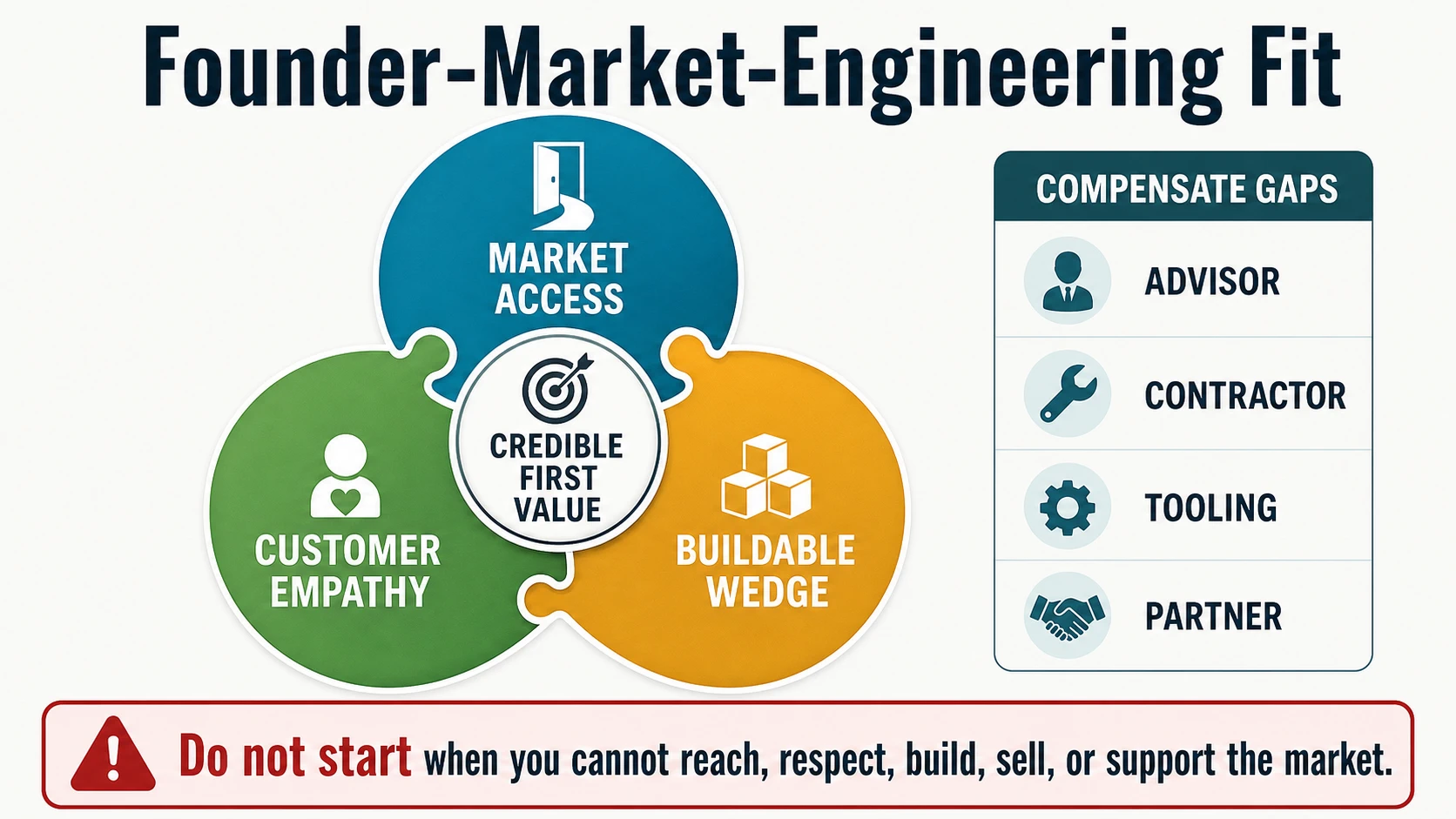
Founder-market-engineering fit exists when something about your position makes the truth cheaper to reach. You can get close to the right people, interpret their work, earn enough trust to see what is usually hidden, deliver a credible first result, and remain present for the selling and support that follow. Your engineering ability may be part of that advantage. It cannot stand in for the rest.
The Same Idea Is Not the Same Bet
Suppose two founders notice the cost of missed appointments at independent dental practices. Both can imagine reminder sequences, easier rescheduling, and a dashboard that shows recoverable gaps in the calendar.
The first founder is a strong backend engineer. She has no contacts in dentistry, has never watched a practice handle a cancellation, and does not want support work involving patient communication. Her product sketch is likely to emphasize what she can see from outside: the calendar, the message, and the report. The risky parts remain offstage—staff handoffs, patient exceptions, consent, existing practice software, the office manager’s incentives, and the consequences of a message sent at the wrong time.
The second founder has built internal tools for multi-location clinics. He knows several office managers, understands how no-shows move through a working day, and can ask five operators to review a manual recovery service. Independent practices will still surprise him. He needs careful boundaries around patient information and communication, and deep software integrations may be a bad first move. But his starting position lowers the cost of access, interpretation, trust, and first-value delivery.
The market did not change. The path to learning did.
This is why fit is not a verdict on talent or worthiness. It is a property of a founder, a market, a wedge, and a moment. A poor starting position can sometimes be repaired. It should never be concealed by enthusiasm.
Follow the Cost of Reaching the Truth
The useful question is not, “Do I feel aligned with this market?” It is, “Where will my position make learning easier, and where will it distort what I see?” Follow that question through the work the first customers require.
Access
Can you name the first people who could reconstruct a recent instance of the problem with you? “Small businesses need this” names a category, not a path. Three practice owners, two office managers, and five billing coordinators you can reasonably contact is a path.
Warm access helps where trust matters, but cold access can be real access when the buyer is identifiable and the pain is concrete. An audience is useful only when the people in it are close to the work you need to understand. Paid traffic may test a message; it rarely grants access to the workflow behind the click.
Interpretation
Customers describe work from inside it. They omit what everybody around them already knows, use one word for several different states, and often name a desired remedy rather than the cause.
Domain knowledge helps a founder hear that “approval” may mean transfer of risk, “manual review” may mean distrust of source data, and “automation” may mean fewer embarrassing follow-ups. Taste and empathy appear here as operational judgment: knowing which details signal good work and which inconvenience belongs to a necessary safeguard.
An outsider can learn, but must move more slowly. Shadow the work, inspect artifacts with permission, map the handoffs, ask an expert to challenge your interpretation, or perform a narrow service by hand. Ignorance is repairable. Fast confidence built on shallow interpretation is much harder to repair.
Trust
Some customers will let a stranger ask naive questions. Others will not expose records, exceptions, money, employment decisions, patient communication, or fragile operations without a reason to believe the conversation is safe and useful.
Credibility need not come from a famous résumé. A respected introduction, a careful artifact, a narrow promise, fluent questions, or a small service delivered well can earn it. The practical test is whether people will show you the real workflow and correct you honestly. Polite generalities produce polite products.
First Value
Engineering fit is not the ability to build the final system. It is the judgment and capability to create enough value for the next question to become answerable.
The first useful result might come from focused code, a script, a spreadsheet model, a managed service, a vendor API, an open-source component, or a manual process behind a thin interface. Technical speed is an advantage when it shortens the route to evidence. It becomes a liability when it creates more product surface before the market has earned it.
Look carefully at what the first honest result requires. Complex permissions, sensitive records, mission-critical uptime, difficult migration, many integrations, advanced quality control, or team-scale support can make a small-looking product an irresponsible first bet. Build, buy, borrow, fake, or defer commodity pieces, but do not fake the boundary that keeps a customer safe.
Sale
Can you connect the pain to money, time, risk, status, or a missed opportunity in the buyer’s language? Can you identify who decides, what the change displaces, why it deserves action now, and what proof would justify a small commitment?
Feature fluency is not sales capacity. Interest without a decision path can keep discovery comfortably inconclusive. Distribution advantage belongs here too: a trusted community, a professional network, a repeatable outreach path, or a product-adjacent service can lower the cost of finding and convincing the next buyer. Hope that content or advertising will eventually find the market does not.
Ordinary Operation
Finally, consider the work after “yes.” Every market has an ordinary texture: anxious questions, untidy data, urgent failures, repetitive onboarding, patient education, custom exceptions, or careful writing. Can one person support the first users without creating avoidable risk or losing the capacity to learn?
You need not enjoy every ticket. You do need respect for the customer’s work and tolerance for the recurring tasks around it. Contempt becomes careless product judgment. Boredom becomes neglect. If the market’s normal sales, support, or operating work repels you, success will only produce more of the job you refuse to see.
Borrow Capability Without Borrowing Conviction
Perfect fit is unnecessary. Honest fit is not.
An advisor can expose hidden workflow rules or buyer incentives. A contractor can close a bounded design or implementation gap. Managed tools can remove commodity infrastructure. A partner can create an introduction or lend trust to a carefully scoped pilot. These are sensible compensations when they keep the founder close to the evidence.
They become dangerous when somebody else owns the learning. A market report cannot substitute for customer access. A polished contractor-built interface cannot substitute for observed behavior. A partner who supplies every relationship may be the distribution strategy rather than a temporary bridge. An advisor’s confidence does not become your conviction merely because it is well informed.
Use a simple test: if the person or tool disappeared tomorrow, would you understand the customer better than you did before? If so, the compensation probably repaired a gap. If not, it probably hid one.
Technical skill can carry more of the bet when the customer is reachable, the trust bar is modest, and the wedge lies close to work you understand. A developer tool for a problem you have repeatedly encountered may begin this way. So may a small automation for a community you already serve. Technical skill carries much less when the hardest questions concern regulated responsibility, buyer behavior, sensitive data, operational continuity, or access to a closed market.
The conclusion is not that solo founders should avoid difficult fields. It is that difficult fields require a more credible route to truth: better access, narrower promises, explicit exclusions, and less fantasy about what an early product may safely own.
Write a Fit Memo
Take one idea from the inventory you made in the previous chapter. On a single page, write evidence under these headings:
- Access: the first qualified people you can contact and the path to them.
- Interpretation: the workflows, incentives, artifacts, and exceptions you already understand—and the ones you do not.
- Trust: why customers might show you real work or accept a narrow first promise.
- First value: the smallest responsible result you can deliver with your actual code, tools, vendors, and manual effort.
- Sale and distribution: the buyer, reason to act, switching friction, and repeatable path to the next conversation.
- Support and operation: the onboarding, questions, exceptions, failure consequences, and founder labor the first users create.
Mark each heading blocked, repairable, usable, or advantage. Every mark needs a concrete reason. “I learn fast” is not evidence. “I can ask four agency owners to reconstruct last Friday’s client update” is.
Do not average the marks. One genuine advantage can justify focused discovery because it materially lowers access, interpretation, trust, build, sales, distribution, or support risk. A blocked path to the customer, a first version you cannot operate responsibly, or a market you do not respect can stop the idea regardless of your other strengths.
For each repairable gap, write one next move: narrow the customer, shadow the workflow, inspect an artifact, find an introducer, run a manual service, borrow a bounded capability, or reduce the promise. Then finish the memo with one decision.
- Pursue when an advantage shortens the path to evidence and no gap blocks learning.
- Narrow when fit exists for one segment, workflow, channel, or safer implementation but not the broad idea.
- Repair when a specific act of access, study, compensation, or manual service could change the evidence.
- Do not start when you cannot reach the customer, understand the work, earn necessary trust, create first value, sell the result, or support its consequences.
Founder-market-engineering fit does not prove that an idea is good. It establishes that you can investigate it without your own position hiding the answer. The next filter is stricter: even a founder who fits the market must still refuse an idea whose pain, business shape, or operating burden does not fit one person.