Solo Founder Product Engineering Handbook / Chapter 21
The Boring Stack Doctrine
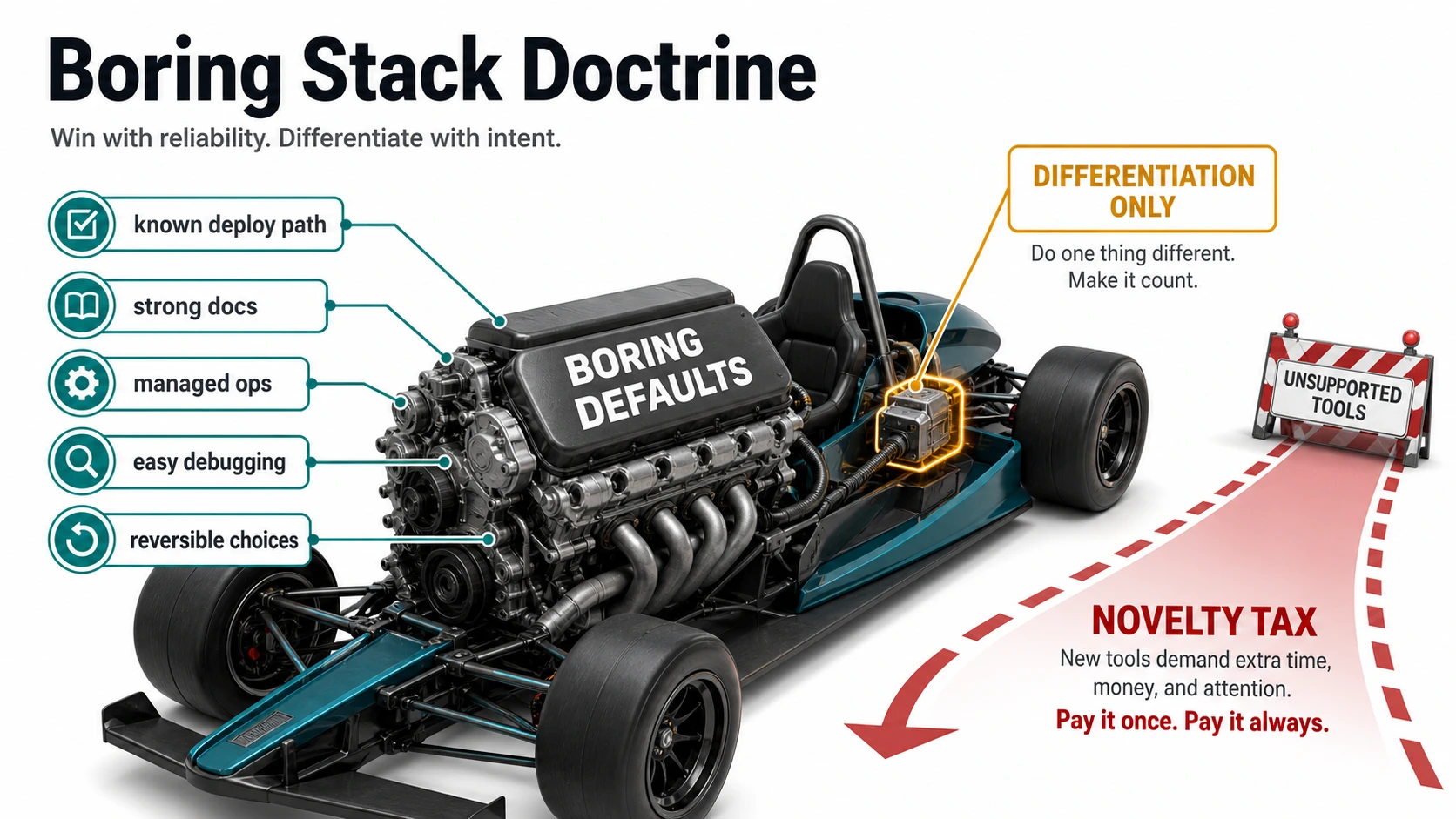
Choose reliable, familiar technology for everything that is not the product's differentiation.
Preparing audio…
Audio edition
The Boring Stack Doctrine
Your Stack Is a Weekly Operating Commitment
A solo founder rarely loses a product because one technology choice is imperfect. The loss is quieter. A deploy consumes half a day. An integration has no current examples. A queue fails silently. An auth upgrade breaks onboarding. Every ordinary change begins with research because the founder never learned where the system keeps its state or how it fails.
None of that reveals whether customers want the product. It only spends the founder’s attention.
The boring stack doctrine protects that attention:
Use reliable, familiar, well-supported technology for everything that is not the product’s differentiation.
Boring does not mean old or crude. It means one person can follow the normal path, recognize the failure path, deploy a repair, and return to the customer problem. Novelty may belong in the product, but it has to earn its place through customer value, better evidence, or a capability simpler tools cannot provide.
The previous chapter ended with an operating contract: who receives value, who pays, what the company promises, and which exceptions the founder owns. Stack selection begins there. The stack should make that contract cheaper to test. It should not turn an uncertain product into an infrastructure research program.
Follow the First Paid Pilot
Return to the fictional agency-reporting product. The founder has sold a two-week pilot: ten client-ready explanations of paid-search campaign changes, with one review pass for each report. The product must accept an export, turn campaign changes into a draft, let the founder review it, deliver it by email, and preserve enough history to answer a support question.
Only one part of that path is an open product bet: can the system produce an explanation an agency trusts and reuses? Account creation, file storage, email delivery, job status, backups, and deployment can certainly ruin the pilot, but making them original will not improve the answer.
This is the commodity-differentiation split. Differentiation is the part that creates the reason to choose the product. Commodity infrastructure is everything the customer expects to work while choosing for some other reason. Commodity does not mean unimportant. Login and backups matter precisely because their failure can destroy trust. The right response is dependable implementation, not invention.
The founder therefore gives the report-generation pipeline one explicit boundary. It may use a model, specialized ranking, domain rules, or an unusual review interface. It receives a stored input, returns a versioned draft or a visible failure, and can be retried or bypassed without disturbing accounts, billing notes, or delivery history. The rest of the application stays conventional.
That boundary keeps one experiment from recruiting a whole experimental stack around itself. A novel value engine does not require a novel database, framework, auth system, queue, deployment platform, and analytics tool. One product bet is already enough to learn from.
Familiarity Compounds
Founders often underrate technology they know because it no longer feels exciting. Familiarity is a practical asset. It makes estimates less theatrical, data models easier to change, local development routine, and production failures less mysterious. It lets the founder support a customer without first rediscovering how the application works.
Prior experience is not the only form of familiarity. A widely used tool can lend the founder other people’s experience through clear official documentation, maintained examples, searchable errors, migration guides, common deployment paths, and libraries that receive security and compatibility work. For a solo operator, this support surface is part of the product’s operating capacity.
Inspect it before adopting a tool. Try to answer ordinary questions from the material that exists now: How is production configured? How are credentials handled? What does a failed migration look like? Can a background job be retried safely? How does an upgrade change the application? Can data leave the service in a usable form?
If those answers depend on scattered conversations or one maintainer’s availability, the founder is accepting an operational bet. That may be justified inside the differentiated component. It is a poor default for the floor beneath it.
Buy Back Attention Without Giving Up Ownership
Managed hosting, databases, authentication, email, file storage, observability, and queues can remove routine operations from the founder’s week. They are often worth more than the difference in the monthly bill because they make deploys, patches, backups, delivery, and failure inspection ordinary.
Managed does not mean absolved. The customer still has a contract with the product. Before depending on a service, the founder should know where customer data lives, who can access it, how it is exported, how restore is tested, what an outage does to the promised workflow, and where pricing or usage limits can jump. Logs and status pages are useful; a recovery path is better.
The trade is sound when the provider absorbs undifferentiated work while the founder retains enough visibility and control to support real users. It is unsound when the provider hides core data, dictates an unproven product model, or makes cost impossible to relate to customer behavior.
Cash still matters. A managed service that saves several hours a month may be a bargain; a stack assembled from many small services may create its own integration and billing burden. Count the whole operating cost: money, setup, upgrades, incidents, support investigation, and the attention lost when the system behaves unexpectedly.
Let the First Constraint Set the Threshold
The doctrine does not say performance, scale, or security can wait indefinitely. It says each concern needs a customer promise or observed pressure.
If the first agencies will upload large files, the pilot needs limits, durable storage, background processing, visible job state, and recovery. If the product handles sensitive client data, access control, retention, and trustworthy deletion are part of the first offer. If model calls can create runaway cost, usage limits and cost visibility belong in the MVP. These are present constraints.
A likely constraint in the next six months deserves a boring expansion path: a database with enough headroom, a queue that can add workers, or storage that does not require an early migration. A concern that appears only after a different product, customer segment, or scale succeeds should be recorded and left alone.
Early scale planning is mostly boundaries, measurements, and limits. It is knowing which job is slow before splitting services; knowing which query is expensive before replacing the database; knowing the cost per useful report before redesigning for volume. A microservice estate or orchestration platform cannot compensate for the absence of that evidence.
Write the Six-Month Stack Memo
The agency pilot now has enough shape for a decision. The founder chooses one server-rendered application and one managed relational database so accounts, uploads, reports, job state, and delivery history can be traced together. A mature auth library or managed provider handles login. Managed object storage holds exports. A small queue or scheduled worker moves parsing and generation out of the request path. Transactional email handles delivery. Product events and error tracking reveal activation and failure. The founder invoices the first pilots manually.
The report-generation pipeline is the only novel component. A small internal view shows its inputs, draft, revisions, cost, and failure state before any report is sent. If generation fails, the founder can repair or complete the report without losing the customer record or delivery trail.
This stack declines more than it includes. It declines real-time dashboards before the report has proved useful, platform integrations before the import workflow is understood, automated billing before pricing repeats, enterprise permissions before an enterprise buyer exists, and distributed services before there is a second operator.
Write the decision in a paragraph short enough to remain honest:
For the next six months, we will use a conventional web application, managed relational data and file storage, mature authentication, simple background work, transactional email, and manual invoicing. These choices let us learn whether agencies will pay for client-ready explanations while keeping accounts, uploads, delivery, recovery, and support ordinary. The report-generation pipeline is our only novel component because it creates the customer value. We will revisit this stack when pilots renew into a repeatable offer or a measured constraint blocks delivery.
The time boundary prevents a default from becoming doctrine. The learning goal explains why this stack exists. The revisit trigger keeps anxiety from scheduling a rewrite.
Put Novelty on Trial
When novelty is justified, name the claim it is meant to prove. A new model may improve report usefulness. A specialized database may make the central interaction possible. A less familiar framework may cut the time to first value because the founder already knows it deeply. Each claim can be observed.
Then contain the bet. Record where the novel component lives, which customer outcome it changes, how failure becomes visible, what the boring fallback is, and what evidence would remove or expand it. If the component cannot be bypassed without taking down login, customer history, or support access, its blast radius is larger than its product role.
Wanting to learn a tool is a valid personal goal. It is not customer evidence. Nor are modernity, the architecture of a much larger company, or a fear that success may someday arrive. The product should pay the novelty tax only when the product receives the return.
Use the Stack Selection Scorecard as a Conversation
Compare real options against the next product test. A scorecard is useful when it exposes a weak choice; a total score is not a verdict. Work through these questions:
- Product fit: Does the choice support the first value moment and the trust level the pilot requires?
- Familiarity: Can the founder build and debug ordinary features without learning the tool from scratch?
- Support surface: Do current docs, examples, errors, upgrade notes, libraries, and deployment paths cover normal work?
- Operations: Can backups, patches, delivery, job recovery, and routine scaling happen without creating a second job?
- Observability: Can the founder inspect errors, user state, slow paths, variable cost, and the outcome of background work?
- Reversibility: Can the choice be replaced without rewriting the product or breaking a customer promise?
- Cost shape: Are early fixed and variable costs visible, bounded, and related to usage?
- Ecosystem: Could a contractor or future collaborator operate the system without inheriting a private toolchain?
Do not average away a dangerous answer. Weak observability can corrupt learning even when every other dimension looks good. Weak export and recovery can turn convenience into captivity. A familiar tool that cannot meet the product’s trust requirement is still the wrong tool.
End the comparison with a decision, its one deliberate exception, and a trigger for review. If those cannot be stated plainly, the stack is probably expressing preference more clearly than product strategy.
Rewrite Only When the Evidence Changes
The urge to rewrite often arrives before a constraint does. The current framework feels inelegant, another language looks cleaner, or an imagined future company seems to deserve a more impressive foundation. Before reopening the stack, ask which customer evidence the change will unlock.
A measured bottleneck can justify work. So can an unacceptable security boundary, a provider cost that breaks the model, a missing capability central to value, or operations that repeatedly consume the week. First prefer the smallest response: change a query, isolate a job, add a limit, replace one provider, or extract the pressured component. Rewrite the whole system only when the pressure crosses the whole system.
This is stack reversibility in practice. The founder does not need a stack that can become anything. The founder needs ordinary components, visible boundaries, usable exports, and customer promises that do not depend on accidental vendor behavior.
Make the Decision Before Drawing the Architecture
List the technologies in the next product test: language, framework, database, auth, hosting, email, payments, storage, background jobs, analytics, error tracking, AI services, admin tooling, and deployment. Mark each as differentiated, commodity, uncertain, or avoidable.
For every differentiated choice, write the customer claim and the fallback. For every commodity choice, use the scorecard to choose the least surprising option that meets the trust requirement. For every uncertain choice, ask whether a manual step can expose the real need. Remove the avoidable choices.
Then write the six-month stack memo. It should name the product evidence the stack exists to produce, the ordinary parts the founder refuses to reinvent, the single strongest case for novelty, and the event that will reopen the decision.
That memo becomes the input to architecture. Once the stack is intentionally boring, the next question is concrete: how should these pieces be arranged so one founder can deliver value, observe what happens, recover from failure, and change direction without fear?