Solo Founder Product Engineering Handbook / Chapter 38
One-Person Operations
Build enough operational control to diagnose, repair, refund, restore, notify, and document common failures alone.
Preparing audio…
Audio edition
One-Person Operations
When the Fix Creates a Morning’s Work
The bookkeeping founder has corrected the close list that mishandled blank due dates. The product fix is sound. The operating work has only begun.
Four firms need new lists. One rerun finishes, one rejects the same source file, one remains in a queue with no visible state, and one completes but never sends its email. Meanwhile, the payment processor shows that a pilot has paid, while the product still marks the workspace as a trial. The firm’s operations lead needs access before a client meeting.
The founder has a database console, a payment dashboard, application logs, an email provider, and the support register. That sounds like control until each tool tells a different fragment of the story. A hurried change could send two reports, overwrite a corrected import, grant the wrong entitlement, or leave the customer with a receipt and no access.
This is the second product a launch reveals: the means by which the founder keeps the first one truthful. A product is operable when one person can notice a failure, find its scope, make a safe change, verify the outcome, tell the customer what happened, and leave a record for the next occurrence.
Manual work is compatible with that standard. Improvisation is not.
Give Each Failure One Trace
The founder starts with the stuck close-list job. The useful question is not “Which dashboard should I build?” It is “What must I know and do from the moment this fails until the customer is whole?”
That path has six movements:
- Notice. A job status, alert, scheduled check, or support message reveals the failure.
- Scope. The founder identifies the account, workflow, affected records, user-visible result, and any risk to money, data, access, or trust.
- Stabilize. New work is paused when continuing could multiply harm.
- Act. A bounded action retries, restores, refunds, reconciles, disables, corrects, or manually fulfills the work.
- Verify and communicate. Product state and customer outcome are checked independently, then the affected user hears an accurate account.
- Record and improve. The action, evidence, and follow-up decision survive the incident.
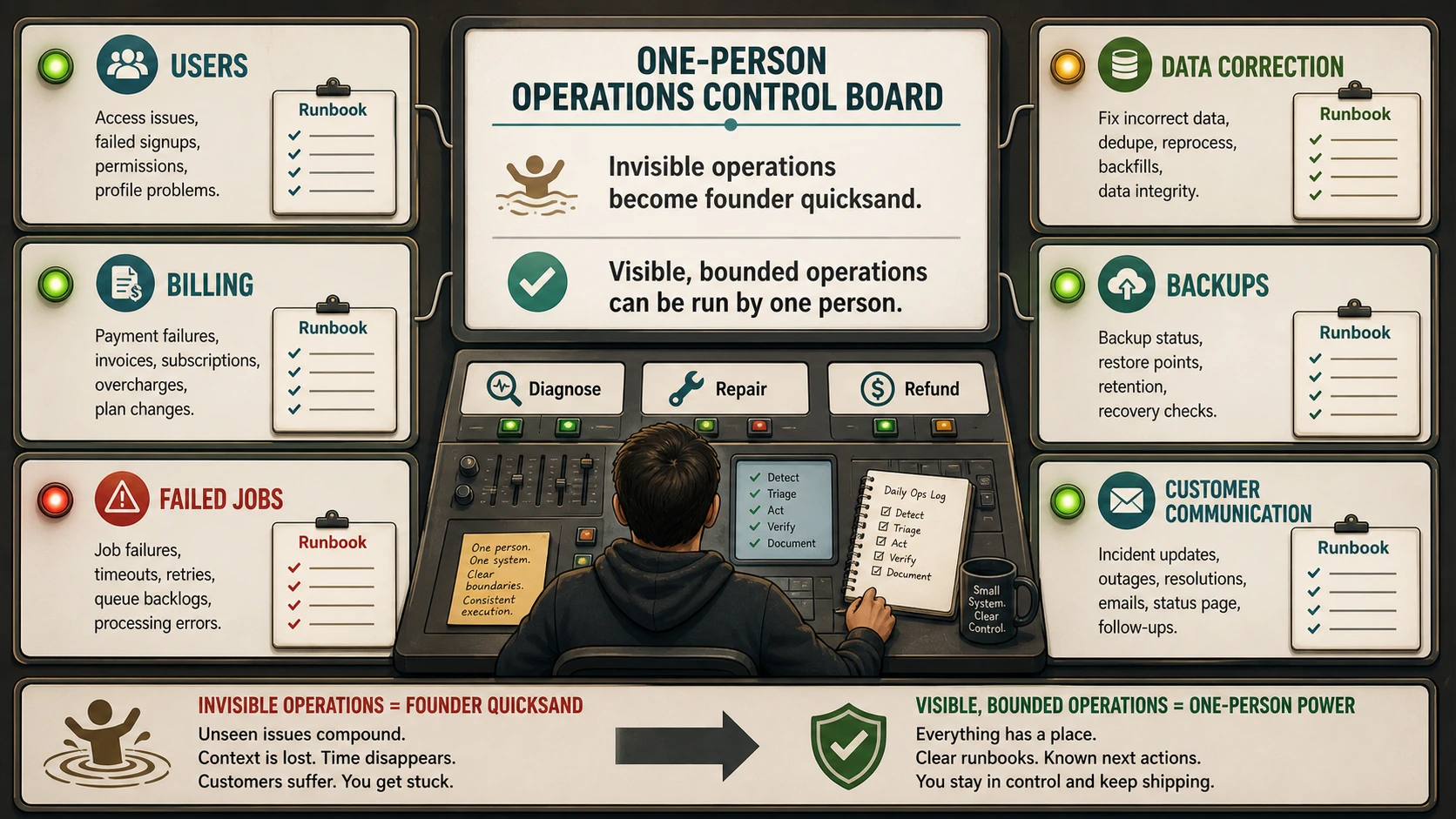
The operating surface is simply the set of controls and records needed to carry important failures through that trace. Start with verbs, not tools: find an account, inspect recent activity, change an entitlement, review a failed job, correct a narrow data error, issue a refund, resend an email, restore a record, pause a risky workflow, and notify an affected customer.
For the bookkeeping product, every close-list job now records its account, source import, start time, completion state, output, notification state, and failure reason. The founder can distinguish a job that never ran from one that produced a list but failed to deliver it. That distinction decides whether to retry computation, resend an email, or do neither.
Logs serve as operational memory here. Domain events such as import_failed, job_retried, email_bounced, refund_issued, and access_granted preserve what changed without dumping private customer content or secrets into a log stream. The test for a record is modest: can it help the founder explain what happened, who was affected, and what action followed?
Put Controls Where Improvisation Is Dangerous
The first admin controls should follow repeated risk. They do not need polished navigation, a dashboard for every metric, or the role system of a mature operations team. They need to be safer than opening production and remembering what to type.
The founder creates one account view. Searching by workspace, owner email, or payment-provider customer ID reveals recent imports, jobs, emails, payments, plan and entitlement state, support notes, and prior operator actions. From that view, only a few narrow changes are possible: retry this job, resend this message, extend this trial for a stated duration, reconcile this entitlement, or suspend this workflow.
A safe override has a defined target and reason. It validates the proposed state, limits the blast radius, prevents duplicate side effects where possible, and writes an audit record. Reversibility is valuable, but verification is mandatory even when reversal is impossible. The founder should never have to wonder whether a button both changed access and sent an email, or whether running a script twice will apply the correction twice.
Data correction needs an especially small aperture. A reviewed form or script may correct one field or replay one known transformation while preserving the old value, the source of the correction, and the affected account. A general-purpose editor invites the founder to repair one inconsistency by creating another.
“View as customer” can shorten diagnosis, but it also crosses a trust boundary. Prefer a read-only mode that is visibly marked, time-limited, and logged. Use write access only for a defined support action, and do not perform an action that could later be mistaken for the customer’s intent. Products handling sensitive data may also need explicit customer permission before the founder enters an account context.
Account recovery follows the same principle. Fixing an email typo or restoring workspace ownership is not merely changing a string. The path must establish identity to a degree appropriate for the product, say which access changed, and record who requested and performed the recovery.
The rule is not to build an admin panel for everything. It is to give repeated actions involving money, access, data, or trust a safer home than private scripts and memory.
Reconcile Money and Access as One Operation
The paid bookkeeping pilot exposes a boundary that many young products hide. The processor owns the payment transaction; the product owns what that transaction means for access.
The founder inspects three facts: the successful invoice in the processor, the received or missing webhook event, and the entitlement recorded in the application. A “paid” badge copied from one system would not be enough. Billing support needs to reveal the provider customer ID, current plan and trial state, invoices, refunds or credits, cancellation state, and the product entitlement that should agree with them.
In this case the webhook failed after payment. The founder uses a reconciliation action that consumes the provider’s event identifier, checks whether it has already been applied, grants the expected entitlement, and records the change. They then sign in through the normal customer path to verify access. The operations lead is no longer asked to prove payment or wait while the founder compares screenshots.
Refunds require the reverse trace. Issuing money in the processor is only the financial action. The operating record should connect the refund to the account, invoice, reason, product-access decision, support conversation, and customer notice. A cancellation may stop renewal while leaving access until the end of a term; a refund may or may not revoke access. Those are product policies, and the admin control should make them explicit rather than infer them during a tense conversation.
Complex pricing multiplies this work. Coupons, credits, seat tiers, usage limits, trials, annual contracts, and exceptions can all be commercially sensible. Before adding one, the founder should be able to explain how it changes invoices, entitlements, refunds, cancellations, recovery, and support. A pricing option is not free merely because the payment provider can represent it.
Recover Without Starting a Second Incident
The stuck close-list job is not safe to retry until the founder knows what the first attempt changed. It may have written part of an output, sent a notification, or updated the account’s “last completed close” marker before timing out.
Recovery begins by naming the safe state. The founder pauses new generation for the affected account, inspects the original import and job events, and sees that no output was committed and no email was sent. A retry using the original job ID can therefore proceed. The action records the new attempt and refuses to run if a completed output already exists.
Other failures need different recovery shapes. A partial import should preserve accepted and rejected rows rather than present an ambiguous success. A bounced account email may need an address correction followed by a deliberate resend, not a repeat of the entire workflow. A bad release may require application rollback while leaving a database migration in place. A data restore may recover a record but overwrite newer customer work.
Backups contribute only when restoration is understood. For important product data, the founder should know what is backed up, how much recent work could be lost, how long copies are retained, which credentials and tools restoration requires, and how a restored result is verified. Recovering one deleted record or restoring a snapshot into an isolated environment teaches more than a green “backup complete” indicator.
The smallest useful recovery path may still be manual. The founder can assemble a close list from preserved inputs, correct a record with an audited script, or notify the customer before automation catches up. The manual path remains honest only if product state records what happened and the business does not silently count founder labor as software capability.
Alerts Must Earn the Interruption
Before the new operating trace, users were the bookkeeping product’s monitoring system. A missing list became visible only when a firm complained. The founder now alerts on a missed promised output, a payment-entitlement disagreement, and a failure that risks partial customer data. Lower-impact errors remain in a scheduled review.
This is enough monitoring for the current product. A wall of infrastructure metrics would create another surface to tend without necessarily protecting a user. The useful alert identifies the workflow, account or job, user-visible impact, relevant evidence, and next safe action. “Close list 184 missed its delivery window; no output or email exists; inspect import 771 and retry runbook” is an operational signal. “Error rate high” is an invitation to start searching.
An alert is a claim on the founder’s attention. Page immediately when delay would increase harm or break a time-sensitive promise. Batch what can wait. If a signal repeatedly wakes the founder without changing an action, narrow it, change its threshold, or remove it. Alert fatigue is especially costly when the entire on-call rotation is also the entire company.
Run the Incident from a Short Page
A runbook is useful because pressure erases context. It should be short enough to follow and precise enough to prevent the most tempting mistake.
The close-list runbook begins with its trigger: a target firm’s list has failed, remained incomplete, or missed its promised delivery time. It then tells the founder to:
- locate the account, source import, job, output, and notification records;
- decide whether any result reached the customer and whether source or derived data changed;
- pause new runs if another attempt could overwrite work or duplicate delivery;
- classify the safe action as retry, restore, manual completion, or product disablement;
- check the guardrail for that action, including duplicate side effects and the rollback point;
- perform the action and verify both stored state and the customer’s visible result;
- send the incident note, including the next update time when work remains;
- record the operator, timestamp, evidence, action, and outcome;
- choose the follow-up: product fix, better validation, new visibility, automation, a narrower promise, or an intentionally manual path.
The stop condition matters. If the founder cannot establish whether an earlier attempt changed data or notified a customer, the runbook should not say “retry and see.” It should stop the operation, preserve evidence, and choose a recovery that cannot multiply harm.
Runbooks also reveal design defects. If the page requires eight tools, a remembered query, and an undocumented credential, the workflow is not yet operable. If the same diagnostic step consumes most of every incident, that step may deserve a focused control before the recovery itself is automated.
Tell the Customer What the System Knows
Incident communication is part of the operation, not the apology added after engineering is done. A useful message states what happened, who or what was affected, whether money or data is at risk, what has been restored or mitigated, whether the customer must act, and when another update will arrive.
The founder does not need to narrate internal complexity or perform certainty. They should not promise a permanent fix before understanding the cause. For the delayed close list, the note can be plain:
Your priority list was delayed after its first processing attempt stopped before producing an output. Your source tracker was preserved, and no incomplete list was sent. I reran the job and verified the corrected list in your workspace. You do not need to upload the file again. I have also added detection for this missed-delivery path.
That message gives scope, data consequence, recovery, customer action, and follow-up. If the investigation were incomplete, the founder would instead say what is known and name the time of the next update.
Close the operating record only after checking delivery. “Email sent” may mean the provider accepted a request; it does not prove the address received it. Depending on the promise, verification may be a provider delivery state, a visible in-product output, or a direct confirmation from the customer.
Let Repeated Work Choose the Next Automation
At the end of the close cycle, the founder has three candidates for more machinery: unusual import formats, payment-entitlement reconciliation, and the occasional data correction.
The payment mismatch earns automation first. It affects money and access, should recover quickly, and can be reconciled safely from provider events. File validation also earns a product change because the same target firms repeat the failure and earlier feedback can prevent wasted uploads. The rare correction remains a manual, audited operation because it is low-frequency and still teaches the founder where the data model is weak.
Frequency is only one reason to automate. Risk can justify a control before a task becomes common. Customer harm caused by waiting can make latency decisive. A manual path that no longer produces useful learning may simply be founder tax. Conversely, an inelegant manual step can remain if it is rare, safe, visible, and still informing product design.
This is how operational debt becomes legible. It is the gap between how customers use the product and how safely one person can support that use. Missing logs, repeated reconciliation, untested restoration, private scripts, fragile imports, and support threads that depend on last month’s memory all widen the gap.
Review that debt when a workflow gains paid usage, a support theme repeats, an important job becomes recurring, a manual recovery happens twice, or customers begin trusting the product with more consequential data. The answer may be a control or automation. It may also be a narrower feature, clearer onboarding, fewer pricing exceptions, refusal of a custom workflow, or removal of a promise the founder cannot operate honestly.
The One-Person Ops Record
For each important failure path, keep one short operating record. Write it in the order the incident will demand it:
- Workflow and trigger: what can fail, and how the founder notices before avoidable harm grows.
- Impact and scope: which users, records, money, access, data, deadlines, or trust may be affected.
- Evidence: the account, event, job, provider record, output, and recent change that establish what happened.
- Safe state: what must be paused or preserved before action.
- Recovery: the retry, restore, refund, reconcile, correction, disablement, or manual fulfillment path.
- Guardrail: the audit record, idempotency check, backup, approval, read-only boundary, or rollback point.
- Verification: how stored state and the customer’s visible outcome are both checked.
- Communication: what the customer hears now, whether they must act, and when the next update arrives.
- Follow-up decision: automate, repair the product, improve onboarding, write documentation, narrow scope, or keep the work intentionally manual.
The baseline is ready when the founder can diagnose, repair, refund, restore, notify, and document the common failures without blind production edits or scattered memory. A trust-critical workflow with no visible failure state or safe recovery path is not ready for more users, even if its main interface works beautifully.
Practice the Most Likely Interruption
List the five operational problems most likely to interrupt you this month. Choose the one that could do the most damage to money, access, data, a promised deadline, or customer trust.
Walk its path from detection to verified recovery. Mark every step that depends on memory, a direct production edit, an undocumented script, or a private message. Then remove one blind spot: add a domain event, a narrow action, a restore test, an incident message, or a short runbook.
Do not automate the whole path by reflex. First make it visible and bounded. Once the product can be operated calmly, the next question becomes sharper: which workflows now deserve greater reliability, and which have not earned the machinery?