Solo Founder Product Engineering Handbook / Chapter 50
Signs You Are Moving from Search to Scale
Diagnose when product-market-fit search has produced enough clustered evidence to justify durable investment in repeatability, reliability, and help.
Preparing audio…
Audio edition
Signs You Are Moving from Search to Scale
When the Question Changes
There is a moment in a solo product when the founder’s calendar starts to lie.
The inbox is busier. Support has a rhythm. Prospects use the same words. A few customers renew without a rescue conversation. The product breaks in places that used to be harmless. Work that once felt like learning now feels like drag.
That pressure can mean the product is ready to scale. It can also mean the product has accumulated too much surface area, too many half-promises, or too many custom obligations. The founder cannot tell the difference by mood. Scale is not the sensation of being overwhelmed. Scale is an allocation decision.
Search mode asks, “Which customer, problem, promise, product, price, and channel are true enough to keep pursuing?” Scale mode asks, “Which proven value path is now worth making more repeatable, dependable, and less dependent on heroic founder effort?”
The danger at the boundary is that the behaviors conflict. In search, you protect reversibility: keep scope narrow, run cheap learning loops, and avoid fixed commitments. In scale, you protect repeatability: make selected workflows durable, standardize what has become predictable, and refuse work that pulls effort away from the proven motion.
Moving too late leaves customers depending on brittle systems and founder memory. Moving too early locks the business around a thesis that has not earned it.
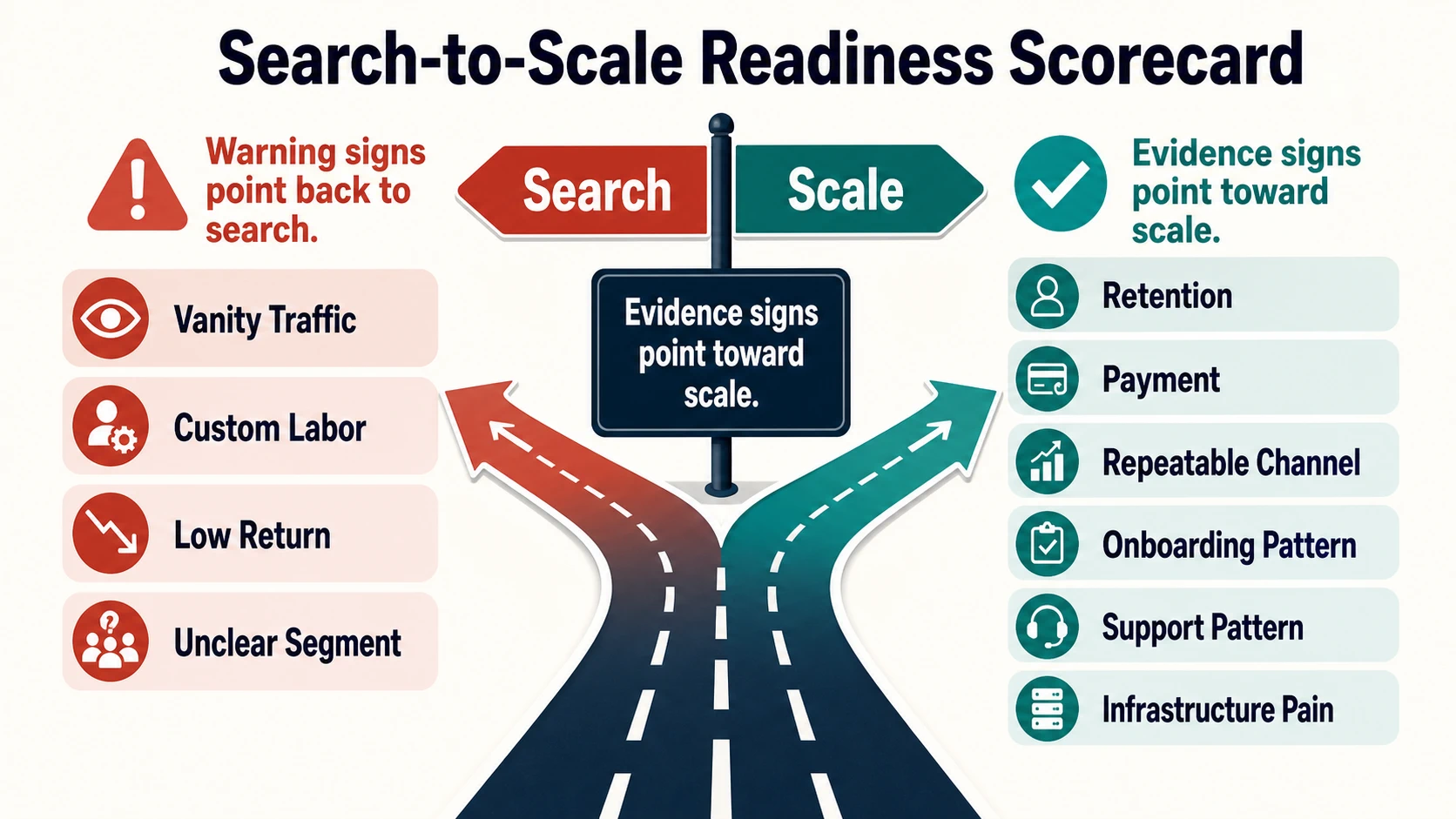
Evidence Has to Converge
The most tempting mistake is to treat one good signal as permission to scale the whole company.
Revenue alone is not enough. A founder can sell custom work that never becomes a product. Usage alone is not enough. A free tool can attract curious traffic with weak willingness to pay. Support volume alone is not enough. It may be a sign of confusion, not adoption. Infrastructure pain alone is not enough. A fragile system can hurt even when the product is still wrong.
Search-to-scale readiness appears when several signals point to the same place:
- a defined segment returns at the natural frequency of the problem;
- those customers pay, renew, expand, or make credible budget commitments;
- one acquisition path repeatedly reaches qualified buyers;
- onboarding follows a pattern instead of requiring reinvention;
- support issues repeat in ways that can be prevented, documented, delegated, or productized;
- feature requests cluster around the core job instead of pulling the product sideways;
- reliability, security, performance, billing, or data risks now come from real use;
- the founder is the bottleneck in a known motion, not merely busy from chaos.
The phrase same place carries the argument. Suppose free individual users retain, enterprise prospects pay for pilots, referrals come from friends, support comes from non-target accounts, and feature requests point in five directions. Each signal may be encouraging, but together they do not describe a business that can repeat. There is energy, not a stable operating mode.
If one segment retains, pays, refers similar buyers, asks predictable questions, and depends on the same workflow, the founder has something worth protecting. The unit of scale is therefore not the company or even the product. It is one value path for one customer segment.
Watch One Product Cross the Boundary
Consider a modeled founder building scheduling software for small property-management firms. The product began as a rough tool for coordinating maintenance requests with outside contractors. In search, the founder tried independent landlords, short-term-rental operators, commercial managers, and residential property managers. Onboarding was manual. Integrations were mocked or handled with exports. The code stayed easy to change because the market was still changing around it.
Six months later, residential property-management firms with 200 to 800 units are behaving differently from the rest. They return each week because maintenance coordination recurs each week. Several paid after a normal trial; three have renewed after a full quarter. Operations managers refer peers at similar firms. Feature requests are gathering around vendor status, owner summaries, and recurring maintenance rather than scattering across unrelated ideas.
The evidence is still modest. It does not justify scaling every feature, channel, or system. It does justify investigating whether one motion is ready to become durable: residential property managers in that size range coordinating maintenance from request to completed work order.
Begin with Return, Then Ask What It Means
The first serious sign is not that people use the product. It is that the right people return for the core workflow when the problem naturally recurs.
Retention must be interpreted against the product’s real cadence. A daily planning tool should not be judged like annual tax software. A compliance reminder product may create value weekly or monthly. A hiring workflow may be seasonal. The founder should ask whether customers return when the pain returns, not whether a dashboard shows frequent logins.
For the scheduling product, weekly return is meaningful because maintenance work arrives continuously. The retained firms are not merely opening dashboards. They receive a tenant request, assign a vendor, track the visit, and close the work order. When notifications fail, they notice because a real appointment is at risk. Some have begun writing their internal procedures around the product’s output.
This is stronger than traffic, but it needs a segment boundary. “Small businesses” would explain little. “Residential property-management firms with 200 to 800 units and outside maintenance vendors” predicts language, budget, objections, setup, and support risk. A useful segment tells the founder which similar account to seek next and which adjacent request to decline.
Look for return behavior that has these properties:
- repeat use of the value-producing workflow, not only peripheral pages;
- several accounts in the same segment behaving similarly;
- retention that survives reduced founder prompting;
- customers noticing when the product fails or is unavailable;
- users building their own workflow around the product’s output;
- return behavior that matches the problem’s natural frequency.
If retention appears only after custom founder intervention, treat it as a mixed signal. The value may be real, but the product may not yet deliver it repeatably.
Payment Must Survive the Value Cycle
Payment raises the quality of evidence because it forces priority, but one payment can reward a persuasive sales call, a generous pilot, or access to the founder. Renewal is harder to misread. It asks whether the value survived long enough to be chosen again.
Stronger evidence includes:
- customers paying after a normal sales or self-serve path, not extraordinary persuasion;
- renewals after the first full value cycle;
- expansion in seats, usage, accounts, locations, projects, or scope;
- price objections becoming predictable instead of random;
- buyers understanding the product category and value without a custom essay;
- revenue that does not require custom labor larger than the margin.
Weak payment evidence often hides in pilot language. A prospect may pay a small amount to keep optionality, obtain founder attention, or outsource a custom project. That can fund learning, but it is not yet scale evidence.
In the modeled product, three quarterly renewals do not prove a large market. They do show that the same type of account chose the same maintenance workflow after experiencing its limits. The objections are becoming predictable too: buyers ask about vendor adoption, data import, permissions, and notification reliability. Predictable objections matter because the founder can answer them once in product, sales material, or policy. A different objection in every deal would point back to search.
A Channel Should Bring Back the Same Customer
A solo founder does not need a polished growth engine before moving toward scale. They do need a believable path to more of the right customers.
Repeatable acquisition can be modest. It might be a founder-led outbound list, a niche community, a marketplace, a partner channel, a content pattern, referrals from users, a recurring event, or a specific search intent. The signal is not size. The signal is that the founder can reach similar buyers again without reinventing the story each time.
The scheduling founder’s strongest path is founder-led outreach to operations managers with a narrow message: stop losing work orders between tenants, vendors, and owner updates. It has produced several qualified conversations, and referrals are now arriving from operations managers to peers. That channel is not automated, but it is legible. The founder knows whom to contact, which problem earns attention, which objection follows, and roughly how much founder time a serious opportunity consumes.
Ask:
- Which channel has produced more than one qualified conversation from the target segment?
- What message caused the right person to pay attention?
- Which objection appears often enough to answer in product, pricing, or sales material?
- What does it cost in founder time to create one serious opportunity?
- Does the channel reach the segment that retains and pays, or a different audience?
Do not scale paid acquisition before retention. Paid traffic can be useful for experiments, but buying more attention for a leaky value path makes uncertainty more expensive. The founder should first know which customer is worth reaching and which value path will keep them.
Repetition Turns Founder Work into Product Evidence
Search often requires founder-assisted onboarding because the founder is still learning how customers understand the problem. Scale becomes possible when onboarding confusion repeats.
Predictability sounds like:
- “They always ask how to import their old data.”
- “The champion understands it, but their manager needs a short explanation.”
- “New accounts succeed when they complete these three setup steps.”
- “The objection is usually security, not price.”
- “Users fail when they invite teammates before the first project exists.”
In the scheduling product, every successful account needs the same vendor import, three default request categories, a tenant invitation template, and a short explanation of owner updates. Manual onboarding is still costly, but it no longer feels like a different consulting project each time. The repeated steps can become defaults, an import tool, a checklist, or documented work that somebody else could safely perform.
Support is becoming legible in the same way. Most valuable accounts encounter vendor-notification failures or confusion about who may close a work order. Those are not random interruptions. They expose friction and trust boundaries inside the retained workflow. They may justify a product fix, better status visibility, documentation, or an internal recovery tool.
Requests must be read in context. Better vendor status and owner summaries deepen the retained job. White labeling for one prospect or an unrelated mobile experience may pull the product sideways. A repeated request is only a scale signal when it strengthens activation, retention, trust, or expansion for the chosen segment.
These patterns matter because the founder is no longer debugging customer behavior from scratch. The work has repeated enough to be productized, prevented, priced, documented, or delegated.
If every onboarding path is unique, the scale move may be narrowing rather than automating. The founder may need to choose a smaller segment, remove customization, or kill features that attract the wrong accounts before investing in onboarding machinery.
Dependency Changes the Engineering Question
The founder should not harden for imaginary scale. But once customers depend on the product, weak infrastructure becomes a product problem.
Real infrastructure pain has a customer-facing source:
- background jobs fail on workflows that affect activation, billing, reminders, exports, or delivery;
- imports, reports, or searches exceed the safe limits of the current approach for paying accounts;
- observability is too weak to explain customer-impacting incidents;
- permissions, audit trails, or data exports are now required by the segment that retains and pays;
- deployment risk threatens active customer work;
- AI, storage, email, or third-party API costs grow with retained usage;
- manual operations introduce delays that customers experience.
Speculative pain sounds different: “What if we have a million users?” “What if enterprise buyers eventually need this?” “What if the database cannot handle future traffic?” Those questions may be worth noting, but they are not scale evidence unless current usage or credible near-term commitments make the risk concrete.
The scheduling product has narrow infrastructure pain. Background notifications sometimes fail silently. Earlier, that failure mostly interrupted an experiment. Now it causes missed vendor appointments for paying accounts. The same defect has changed meaning because customers have become dependent on the workflow.
The test is dependency. If failure would now damage activation, retention, revenue, trust, or the founder’s ability to operate the product, it belongs in the scale conversation. If failure would inconvenience an unused feature, delete or defer before hardening.
Name the Founder Bottleneck
At the edge of scale, the founder becomes the narrowest point in a known system.
That bottleneck must be named precisely. “I am too busy” is not enough. Busy may mean the product is working. It may also mean the product is confused, overbuilt, underpriced, or full of manual promises.
Useful bottleneck statements sound like:
- “Every qualified buyer needs the same security explanation before purchase.”
- “Every new account needs the same data cleanup before activation.”
- “Support is dominated by three recurring billing and invite issues.”
- “I can close deals from this channel, but follow-up slips when support spikes.”
- “The product decision queue is blocked because I spend six hours a week retrying failed imports.”
For the scheduling founder, “onboarding takes too much time” is still vague. “Every retained account needs the same vendor file cleaned before activation” is actionable. So is “I can open qualified conversations from this channel, but follow-up slips whenever support spikes.” One suggests an import path or safer internal tool; the other may justify sales operations help after the motion is documented.
Once the bottleneck is specific, the response can be chosen. It may be automation, documentation, admin tooling, pricing, deletion, contractor help, a part-time support role, a customer-success playbook, or a first full-time hire. Hiring is only one scale instrument.
The founder should avoid hiring into an unnamed bottleneck. A vague hire inherits vague work, and vague work hides product uncertainty.
Name the Motion Before Funding It
The founder should be able to state the proposed scale motion in one sentence:
For residential property managers with 200 to 800 units, make maintenance coordination from tenant request through completed work order dependable and repeatable, beginning with vendor notifications and account setup.
That sentence excludes most of the product. It does not promise an enterprise platform, every property segment, or every integration. It joins a defined customer, retained value path, and first durable investment.
Search and scale can coexist at this boundary. The founder may standardize onboarding for residential managers while continuing to test pricing. They may harden vendor notifications while leaving a new reporting idea deliberately soft. The shift is not a ceremonial company stage. It is a change in how selected decisions are made.
In search, product work tests the narrowest useful promise; engineering stays cheap and changeable; support is discovery; and distribution tries paths to qualified conversations. In scale, the founder deepens the proven value path, hardens the workflows customers depend on, removes known onboarding friction, and invests in the channel that reaches similar buyers. Speed still matters, but it serves a narrower truth.
Part of the decision is refusing to scale the wrong thing. Do not scale:
- a segment that pays once but does not return;
- a channel that creates demos but not retained customers;
- a feature requested by one impressive prospect but disconnected from current value;
- an onboarding process that works only because the founder performs custom consulting;
- an infrastructure layer that supports speculative usage;
- a support process for features that should be removed;
- a team shape copied from a larger company.
Premature scale often looks responsible. It has roadmaps, roles, dashboards, processes, and infrastructure work. If those investments are not attached to converging evidence, they reduce learning and increase fixed cost.
The solo founder’s advantage is not the ability to act like a bigger company early. The advantage is the ability to keep the operating system small until the evidence deserves more weight.
Write the Evidence as a Readiness Memo
Do not average evidence across the whole product. Write a short memo for one segment and one value path. The modeled scheduling product might produce this record:
SEARCH-TO-SCALE READINESS: MAINTENANCE COORDINATION

Segment
  Residential property-management firms with 200 to 800 units.

Value path
  Tenant request -> vendor assignment -> visit -> owner update -> closure.

Evidence
  Target firms return weekly; several paid after a normal trial; three
  renewed; founder-led outreach and peer referrals reach similar firms;
  onboarding and support work repeat around the same workflow.

Weak evidence
  Acquisition cost is not yet stable. Onboarding still needs founder
  involvement. Expansion beyond the first quarter is unproven.

First durable investment
  Add delivery visibility, retries, and a recovery path for vendor
  notifications because retained accounts depend on them for appointments.

Founder bottleneck to reduce
  Repeated vendor-file cleanup delays every activation.

Stop doing
  Defer commercial-property features and do not broaden paid acquisition.
The quantities are illustrative, not benchmarks. A real memo should use account-level evidence and the natural frequency of the customer’s work. Its purpose is to expose disagreement between signals, not to convert judgment into arithmetic.
Read each signal as weak, emerging, or strong. Weak means the behavior is mixed, founder-created, or detached from retained value. Emerging means a pattern is visible but has not survived enough cycles. Strong means the pattern recurs in the target segment without exceptional founder force. Mostly weak evidence calls for the next search experiment. Evidence split across segments calls for narrowing. Several emerging or strong signals around one value path may justify one reversible scale investment. Broad durability is earned only as the cluster survives.
The first investment should name the evidence it protects, the value path it strengthens, and the founder bottleneck or business risk it reduces. “Improve reliability” names none of them. “Add monitoring and retries for vendor notifications because retained accounts depend on them for scheduled maintenance” can be examined and bounded.
Evidence That Sends You Back to Search
A collaborator can execute a known motion; hiring cannot create product-market fit from weak value. A broad growth campaign cannot repair retention. Durability cannot make an unused workflow valuable. Process cannot settle a customer decision the founder has avoided.
Return to search when retained users and paying users belong to different segments; when every sale depends on custom labor; when acquisition repeats but retained use does not; when onboarding succeeds only through founder consulting; when requests continue to scatter; or when the supposed bottleneck is simply undifferentiated busyness.
A serious prospect may still deserve an experiment. A painful incident may still deserve a repair. Neither, alone, changes the operating mode. The test is whether the resulting work makes a repeated value path more dependable or merely makes uncertainty more expensive.
Make the Decision
Write a one-page search-to-scale readiness memo for one segment.
Use this structure:
- Segment: the precise customer group being evaluated.
- Value path: the workflow that creates retained value.
- Evidence: retention, payment, acquisition, onboarding, support, requests, infrastructure, and bottleneck signals.
- Weak signals: what still argues for search.
- First scale investment: the smallest durable move justified by the evidence.
- Stop-doing list: features, channels, custom work, or speculative hardening that should not receive more effort.
For each kind of evidence, mark what is weak, emerging, or strong and explain why. If the evidence is mostly weak, write the next search experiment instead of a scale plan. If it is mostly emerging or strong around the same value path, choose one bounded investment and one thing to stop doing.
The handoff from search to scale is not a celebration of size. It is a disciplined transfer of founder attention from discovering a true value path to making that path durable. The next question is exactly where that durability belongs.