Solo Founder Product Engineering Handbook / Chapter 20
Business Model and Operational Burden
Choose a business model whose billing, data, support, trust, margin, and operational consequences one founder can handle at the current stage.
Preparing audio…
Audio edition
Business Model and Operational Burden
The First Sale Can Create the Wrong Company
Continue the fictional agency-reporting product from the previous chapters. The founder has found a route to paid-search agencies and shown them a sample. Two prospects ask what the product costs.
The first wants a $49 monthly plan with unlimited reports. The second will pay $750 for a two-week pilot covering ten reports and one revision of each. The subscription sounds more like the software business the founder hopes to build. The pilot sounds manual.
But accept the first offer literally. “Unlimited” means the agency may import years of campaign data, generate several versions of every report, ask why two outputs differ, and expect urgent corrections before client meetings. The founder needs usage controls, quality rules, support boundaries, cost visibility, cancellation handling, and an answer when a report is technically delivered but commercially unusable. The payment is simple. The promise is not.
Now accept the pilot literally. Ten reports create ten chances to observe the inputs, revisions, delivery cost, and point at which the output becomes useful. The scope can be written before any billing system exists. The founder can invoice once, deliver partly by hand, and decide at the end whether the work deserves automation.
A business model is this entire operating contract, not the label on the price. It determines what the product must measure, which customer state it must remember, which exceptions the company must absorb, and how much founder attention accompanies each unit of revenue.
Write the Promise Before Choosing the Machinery
Start with a sentence a customer could understand:
You pay us when ___, and in return we reliably provide ___.
“Subscription SaaS” cannot complete that sentence. “Pay $299 each month for up to twenty client-report summaries, delivered from your campaign exports with email support and a stored export history” can. It names a payer, a billing interval, a unit of value, a limit, a delivery expectation, and part of the support promise.
Read the sentence from the customer’s side. What event makes the value real? What would count as a failure even if the software behaved as designed? Which limits must be visible before purchase? What happens to access, data, and unfinished work when payment fails or the customer leaves?
Then read it from the operator’s side. What must be measured or stored? Which step still requires judgment? What can create an urgent exception? Which cost grows with use? How many such promises can one founder keep in a difficult week?
Those questions turn a revenue idea into engineering requirements. A plan boundary becomes an entitlement. A per-report price becomes a meter. A renewal promise creates account and payment state. A money-back promise creates a refund path. Monday delivery creates monitoring, recovery, and support work before Monday.
The founder does not need to automate all of this. The founder does need to know what “normal” means, who handles the exception, and where the obligation ends.
Put the Uncertainty in the Model You Can Observe
Business models differ less by fashion than by where they place uncertainty.
A simple subscription places the bet on recurring value. It works best when customers can understand what access continues from month to month and when a small number of plan boundaries cover most accounts. Seats, workspaces, add-ons, annual terms, credits, proration, custom contracts, and uptime promises each add state and exceptions. Consumer subscriptions add high-volume cancellation and retention work, often with payment or app-store operations between the founder and the customer. Recurring revenue becomes useful only when the recurring obligation is supportable.
Freemium moves uncertainty into conversion. Free use is defensible when it creates distribution, produces product-qualified demand, or helps a buyer experience value before paying. Without a credible upgrade event, free accounts create storage, communication, abuse, and support work that the revenue model never repays.
Usage-based SaaS and API pricing place the bet on a measurable unit. They require a unit customers can understand, metering they can trust, limits they can see, and bills the founder can explain. API customers also buy documentation, keys, rate limits, version stability, error behavior, and integration support. The API may be small while the developer obligation around it is large.
AI products make this tension sharper. Model, retrieval, storage, and review costs can rise with use even when the customer pays a flat fee. The useful output may also require human correction. Early plans therefore need visible consumption, rate or volume limits, and a way to distinguish a failed generation from a delivered unit. “Unlimited” is not simplicity if the founder cannot bound the cost or the review work.
Transaction models place the company inside a money event. Reconciliation, refunds, chargebacks, fraud, taxes, payouts, and disputes become part of the product whether or not the interface mentions them. A marketplace adds a second uncertainty: enough suitable supply and demand must appear at the same time. Before network effects, the founder is recruiting two sides, checking quality, creating trust, and mediating the empty or disappointing match.
Services plus software put the uncertainty in founder labor. That can be exactly right at the beginning. A bounded service reveals messy inputs, hidden decisions, customer language, and which steps deserve software. It becomes a trap when every customer receives a different process or when the work leaves no reusable script, template, data mapping, exception log, or product decision behind.
Open-source commercialization puts free code and community use below a paid layer such as hosting, administration, collaboration, compliance, or enterprise control. The boundary must be real. If the only paid difference is access to the founder, community support quietly becomes the product. Hardware plus software is less forgiving still: inventory, shipping, setup, returns, warranties, supply variability, and firmware remain after the application works.
None of these models is inherently too ambitious for one person. Each becomes dangerous when its hardest obligation must exist before the model has produced evidence strong enough to justify it.
Run the Agency Pilot as an Operating Contract
Return to the two offers. The founder chooses neither “SaaS” nor “services” as an identity. They choose the $750 pilot because it can answer the current question: will an agency pay for client-ready explanations, and what does a useful explanation cost to produce?
The written offer is deliberately exact:
- ten client-report summaries delivered over two weeks;
- campaign exports supplied in the agreed format and on the agreed dates;
- a draft within two business days of receiving a usable export;
- one review pass by email for each report;
- no custom dashboards, strategy consulting, or client calls;
- a decision at the end to stop, repeat the pilot, or propose a continuing plan.
The founder sends one invoice and records payment manually. An internal sheet holds the agency, delivery dates, reports used, revision count, model and storage cost, data-cleanup time, writing time, and support time. The customer does not need a quota dashboard because the founder can state the remaining reports in each delivery message.
Now the exceptions teach. One export arrives with inconsistent campaign names and takes forty minutes to repair. One generated summary is accurate but too blunt for a client, so the agency rewrites its opening. A third report needs no revision and is forwarded immediately. These are not merely service chores. They reveal an input-validation need, a quality criterion, and a possible value moment.
At the end of the pilot, the founder can discuss a recurring plan with evidence. A quota-based subscription might include twenty reports, supported export formats, self-service upload, one support path, and paid overages. Or the agency may reveal that the valuable product is a higher-priced reviewed service. Either conclusion is better than automating an imagined model.
The temporary model has done its job if it sharpens the permanent question. Temporary does not mean vague, free, or disposable. It means bounded enough to change without betraying the customer.
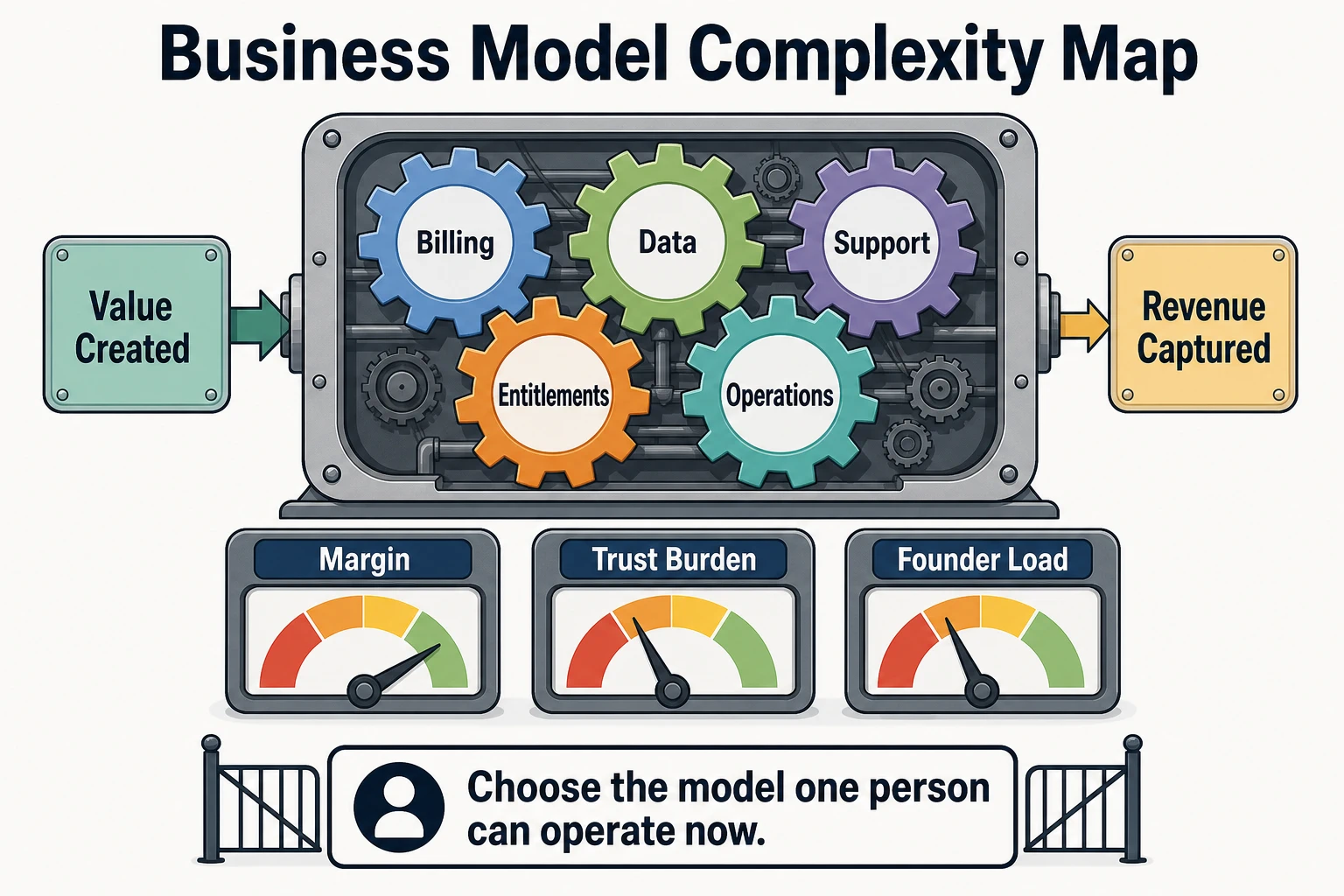
Draw the Business Model Complexity Map
Before building the pricing page, map the work behind one customer promise. Do not begin by averaging a score. A single extreme burden can dominate the company even when everything else looks easy.
Trace these seven dimensions:
- Billing: Follow money from price to invoice or charge, failed payment, refund, cancellation, and reconciliation. Mark every point that needs a rule or manual decision.
- Data and entitlements: Name what the product must retain, meter, expose, limit, and delete. Include roles, quotas, retention, and the state after cancellation.
- Support: List the failures and questions a reasonable customer will bring. Decide the channel, expected response, and what is outside the offer.
- Implementation: Follow a customer from agreement to first value. Count migration, configuration, training, cleanup, integration, and founder judgment rather than hiding them under “onboarding.”
- Trust: Ask what the customer risks when the product is late, wrong, unavailable, insecure, or difficult to leave. Revenue, compliance, security, and client reputation raise the promise even when usage is low.
- Margin: Record the cash cost that rises with each customer or unit—payment fees, model calls, storage, delivery, refunds, and third-party usage. Record founder delivery and support hours separately so apparently healthy cash economics cannot hide an impossible calendar.
- Founder load: Place the recurring work on a real week. Include sales, product work, and recovery time. A model that fits only when nothing fails does not fit.
For each dimension, write the normal path, the most likely exception, the current boundary, and what the next few customers must teach. That is the Business Model Complexity Map. Its purpose is not to produce a respectable total. It is to expose the first obligation likely to outrun the evidence.
For the reporting pilot, billing is easy and implementation is tolerable. Quality review and founder load are the pressure points; AI cost may become one as volume grows. The operating decision follows:
For the next stage, we will use a paid pilot because it proves whether agencies pay for client-ready reporting while keeping volume, review work, and AI cost bounded. We will not offer unlimited self-service generation until we know the cost per useful report and the pattern of revisions.
That sentence ties the model to evidence, burden, and a condition for change.
Keep Manual Work Bounded and Trustworthy
Automation is earned when a repeated path is understood and the saved attention is worth the build. Before that point, manual invoicing, entitlement changes, import approval, and cancellation can be sound operating choices.
Manual work still needs a policy and a record. A founder who cancels accounts by email should state when renewal stops, what happens to stored data, and when the request is complete. A founder who approves costly imports should define the limit. A founder offering email support should name the hours and avoid implying live coverage. Consistency, not software, makes the early contract credible.
Three warning signs show that the temporary arrangement has stopped teaching. The same exception appears often enough that it should become a product path. Founder delivery crowds out selling and product learning. Or customers buy the founder’s custom attention but do not value the reusable output. At that point, automate, narrow, price the labor honestly, or reject the model.
The opposite mistake is building the mature company’s machinery in advance. An enterprise contract can bring security review, procurement, implementation, custom terms, audit requests, and urgent support. A freemium launch can bring thousands of low-intent accounts. A marketplace can create disputes before it creates liquidity. The larger price or audience does not supply the missing team.
Make the Decision Before Architecture Makes It for You
Map three plausible models for the product. Complete the customer-promise sentence for each. Then trace the payment, access, delivery, exception, cancellation, variable cash cost, and weekly founder work. Name the evidence that would cause you to keep the model, change it, or abandon it.
Choose the model that can produce the strongest relevant evidence with acceptable present burden. It may be a paid pilot, a concierge workflow, a narrow subscription, a limited usage plan, or a manually reviewed service. If the model requires unbounded support, hidden implementation, unexplained metering, premature trust promises, or a second side of a market before the first customer can succeed, narrow it.
Product strategy ends with an operating contract: who receives value, who pays, what the company promises, and which machinery that promise requires now. Technical strategy begins by honoring that contract without inventing a more complicated company. The next stack should make billing, data, delivery, support, and recovery ordinary enough that the founder can return attention to the part customers came for.