Solo Founder Product Engineering Handbook / Chapter 35
Launching Without a Team
Design a launch as controlled exposure: enough reality to change a decision, within one founder's capacity to observe, support, and recover.
Preparing audio…
Audio edition
Launching Without a Team
The Launch That Almost Became an Audience
The bookkeeping founder from the previous chapter now has something more useful than a waitlist. Three firms have used a manual missing-document workflow during close week. One firm returned for a second client. Another revealed that escalation language, not tracking, was its harder problem. A third already had a spreadsheet that worked.
This is enough evidence to invite more reality, but not enough to invite everyone.
A broad launch is tempting. The product looks credible in a demo, bookkeeping communities are easy to find, and a large response would feel like progress. Yet fifty simultaneous signups could bury the founder in malformed imports and setup questions before the product answers its main question: do operations leads at small bookkeeping firms use the priority list to change whom they contact during close?
A launch does not confer maturity on a product. It exposes the product’s present maturity to other people. For a solo founder, that exposure is also a claim on the same attention needed to read the evidence, repair failures, and keep existing users whole.
The useful ambition is therefore not maximum attention. It is enough exposure to change a consequential decision.
Write the Boundary Before the Announcement
Before choosing a channel or writing launch copy, the founder writes a short exposure contract:
- Audience: operations leads at bookkeeping firms with five to twenty recurring monthly clients who chase missing documents during close week.
- Question: can the priority list improve the order in which they escalate missing documents?
- Value event: the firm uses the list during a real close and changes at least one follow-up because of it.
- Limit: eight firms, admitted in two groups of four.
- Observation: source, qualification, import outcome, value event, failure point, support theme, and use at the next close.
- Pause rule: stop invitations if two firms cannot recover from an import failure or if the support queue exceeds the promised response window.
- Decision date: review after the second group’s next close; then narrow, repair, widen, or stop.
This is not a press plan. It is a boundary around what the launch may demand and what it must teach. The numbers are not universal benchmarks. They belong to this product’s failure modes and one founder’s capacity.
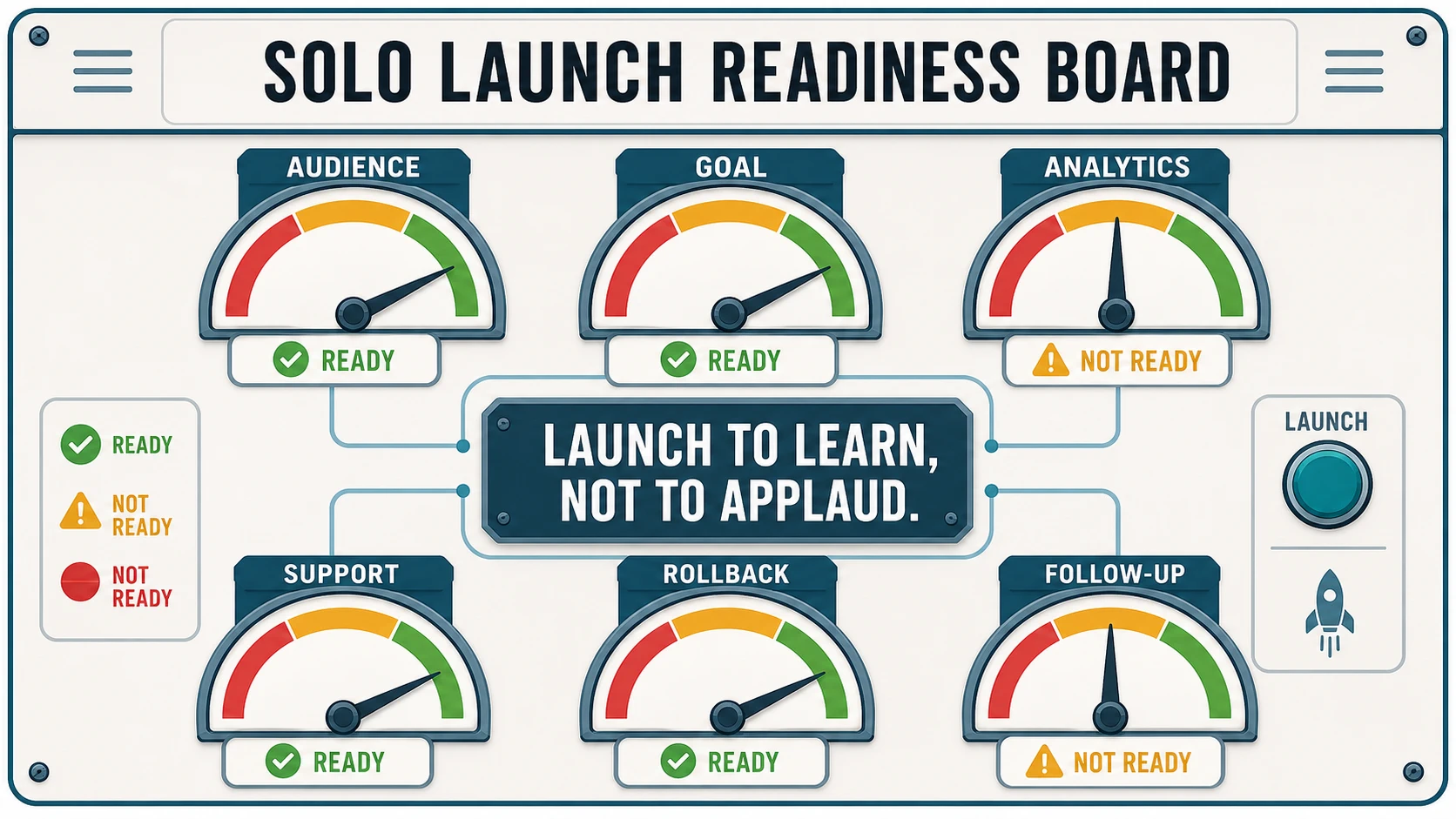
The contract prevents several kinds of false learning. If the wrong people arrive, their indifference says little about product value. If the right people arrive but the value event is invisible, traffic cannot rescue the experiment. If support overwhelms the founder, the launch has tested an unready operating system along with the product.
The success threshold should imply a next move. “Get visibility” does not. Neither does “collect feedback.” A useful threshold might be: at least four qualified firms use the list during close, and at least two return at the next natural interval. Missing the threshold is not automatically failure; the pattern of misses may identify a broken import, the wrong role, or a weak promise. The threshold forces that evidence into a decision.
Choose a Door That Fits the Question
Launch labels matter only because they control who enters and under what expectations.
A private launch or closed beta is strong when the founder needs to watch a real workflow closely. Warm relationships may conceal weak positioning, so the evidence is about use under guided conditions—not yet self-serve demand. A B2B pilot adds commercial terms, a review date, and explicit success criteria. It can test willingness to continue, but custom founder effort must remain visible or service work will masquerade as product pull.
A public beta tests a broader audience’s ability to understand and tolerate an early product. It also increases noise and support variance. A community launch can reach people who share a sharp pain, provided the founder respects the community’s rules and has earned the right to ask. A Product Hunt-style launch tests a story and demo with a broad technology audience; it is poorly suited to proving retention in a narrow operational workflow.
A waitlist can test whether positioning attracts qualified interest before access. It cannot prove activation. A content-led launch can earn attention through a useful guide, template, or calculator, but readers become product evidence only when they cross into the promised behavior. A developer launch puts different pressure on the first minutes: documentation, credentials, examples, errors, and the first successful call must work without an explanatory meeting.
The bookkeeping product needs neither a launch-day crowd nor a new label. It needs a controlled increase from three observed firms to eight. The founder chooses a closed beta and invites the first four from the qualified recruiting tracker. The second four wait until the founder has seen the first group’s imports and support load.
Make the Product Observable and Recoverable
The happy path working is not launch readiness. The founder must be able to reconstruct what happened when the path bends.
For this beta, page views and account creation are nearly irrelevant. The useful trail begins with the recruiting source and segment qualification, then follows checklist import, priority-list creation, an actual change in follow-up order, and return at the next close. Product events can record some of this. Tagged support email and a line in the customer tracker can record the rest. A solo product does not need a grand analytics stack; it needs evidence that survives memory and enthusiasm.
Observation has a trust boundary. The founder records only what is needed to operate the workflow and interpret the test. Sensitive documents are not an excuse for hidden, expansive tracking. Users should know what the product processes, what the founder may inspect during support, and how their data is handled.
Support readiness begins with the failure that costs attention, not with a generic inbox. A cosmetic defect and a partial client-data import do not deserve the same response. The founder prepares one support channel, an honest response window, known-issue notes, and four tags: import, setup, output quality, and workflow mismatch. The account view must show enough import state to diagnose a failure without asking the user to reconstruct it.
Recovery is broader than reverting code. Before the invitations go out, the founder can:
- stop admitting the second group;
- return the product to invite-only access;
- disable an unsafe automation while preserving manual review;
- identify and retry a partial import;
- restore affected data;
- tell a firm what happened and what remains uncertain;
- finish a time-sensitive task manually when that is the responsible recovery.
The pause rule turns those capabilities into action. Without one, launch momentum exerts pressure in the wrong direction: the founder keeps inviting people precisely when current users need repair.
Promise Only the Product Being Launched
Early users do not require a performance of finished-platform confidence. They require a sharp promise and honest boundaries.
The invitation says who the beta is for, which close-week task it handles, what input it needs, and that a person reviews the priority list before contacting a client. It names the support channel and response window. It also says what the product does not yet do: it does not send reminders automatically, accept every bookkeeping system, or replace the firm’s judgment about escalation.
Those limits improve the evidence. A firm seeking automated collections can decline before consuming support. A qualified operations lead can judge the actual workflow. If the product disappoints, the founder can tell whether the priority list failed—not whether an inflated promise attracted the wrong job.
Sharp communication is compatible with caution. “Find the client documents most likely to block this week’s close” is more useful than “AI operations for modern firms.” The narrower sentence makes a claim the launch can observe.
Let the First Four Change the Second Four
The first group begins on Monday. Two firms import their checklists without help. A third uses a format the product partly reads, leaving several rows with no owner. The fourth hesitates because the checklist includes client names and the data-access explanation is vague.
The exposure contract makes both problems legible. The partial import triggers support and reveals that the diagnostic view shows a failure count but not the affected rows. The founder pauses that account, identifies the rows, helps repair the import, and adds row-level error detail. The trust hesitation does not call for persuasion; it calls for a clearer explanation of storage, access, and deletion, followed by the firm’s own decision.
Support remains within the promised window, and only one account has an import failure, so the launch does not hit its pause rule. Before admitting the second group, however, the founder revises the accepted-format note and the data explanation. This is why the cohort was split. The first four were not merely an earlier slice of traffic; they earned a safer second exposure.
Across both groups, five firms produce a priority list. Four use it to change a real follow-up. At the next close, two return without a reminder and one returns after the founder follows up. The tracker keeps those outcomes separate. Founder-pursued reuse may be promising, but it is not the same evidence as a workflow pulling the user back.
The support notes sharpen the segment. Firms with recurring monthly clients and an operations lead can act on the list. Smaller firms where the owner remembers every client see less value. The original category, “bookkeeping firms,” has become narrower for reasons the product can explain.
Finish the Launch With a Decision
Run the retrospective while the sequence is still recoverable from records rather than reconstructed as a success story. Compare the launch with its contract:
- Did the intended people enter, and which source produced them?
- Where did qualified firms stop before the value event?
- Which users reached value, and which returned at the natural interval?
- What consumed founder attention: confusion, repair, reassurance, or custom work?
- Which failures changed trust or behavior?
- Which manual steps taught something reusable, and which merely kept the product alive?
- What will be different before exposure grows?
Do not average away the segment. Four value events among eight invited firms may look modest; four among five firms with an operations lead may be the more consequential result. The inverse is also possible: a lively response can be entirely wrong-fit curiosity.
The founder’s written decision is:
Keep the product invite-only for one more close cycle. Recruit operations leads at firms with recurring monthly clients, improve row-level import recovery, and test whether the revised data explanation reduces setup hesitation. Do not add automatic reminders yet.
That decision is the launch’s product. It directs the next recruiting hour and the next engineering change. It also prepares the question for onboarding: can the right firm reach the first useful priority list with less founder explanation?
Increase Exposure Only When the System Can Absorb It
There is no virtue in staying private after the relevant uncertainties have moved. A founder can widen from private use to a closed cohort, from a cohort to a community, or from a community to a public launch as the product learns to observe, support, and recover at each level.
There is also no virtue in launching through a known hole. Reduce or postpone exposure when the audience remains vague, the promised value cannot be delivered, the value event is invisible, common failures cannot be diagnosed, support capacity is unknown, or sensitive data and user trust exceed the available safeguards. Name the missing condition and the action that would change it. Otherwise “not ready” becomes avoidance rather than judgment.
Before each meaningful increase, write the audience, one evidence question, the value event, the exposure limit, the observation trail, the support promise, the pause trigger, the recovery path, the follow-up interval, and the date on which a decision will be made. Then make the launch smaller once more. If the reduced version can still answer the question, it is usually the better first exposure.
The launch is large enough when it can tell the truth—and small enough that one founder can hear it.