Solo Founder Product Engineering Handbook / Chapter 28
AI-Assisted Engineering Without Losing Judgment
Use AI coding tools as leverage while preserving architecture, product, security, testing, and ownership judgment.
Preparing audio…
Audio edition
AI-Assisted Engineering Without Losing Judgment
AI Makes the Wrong Work Cheaper Too
AI coding assistance changes the economics of being a solo founder. Work that once required a teammate, a long documentation search, or a tiring evening of boilerplate can now happen in minutes. A founder can ask for an implementation plan, scaffold a route, draft tests, explain unfamiliar code, summarize logs, refactor repetitive branches, write documentation, or analyze a messy export before lunch.
That is real leverage. It is also dangerous leverage.
The danger is not that AI will write imperfect code. Every human engineer does that. The danger is that AI can make incomplete judgment look like finished work. A vague requirement becomes a polished feature. A local fix becomes an architectural fork. A security boundary becomes an optimistic comment. A useful dependency becomes three packages the founder cannot operate. A discovery gap becomes code that feels like progress because it compiles.
The rule for a solo founder is simple: use AI to compress inspectable work, not to outsource product, architecture, security, tests, integration, maintenance, or ownership.
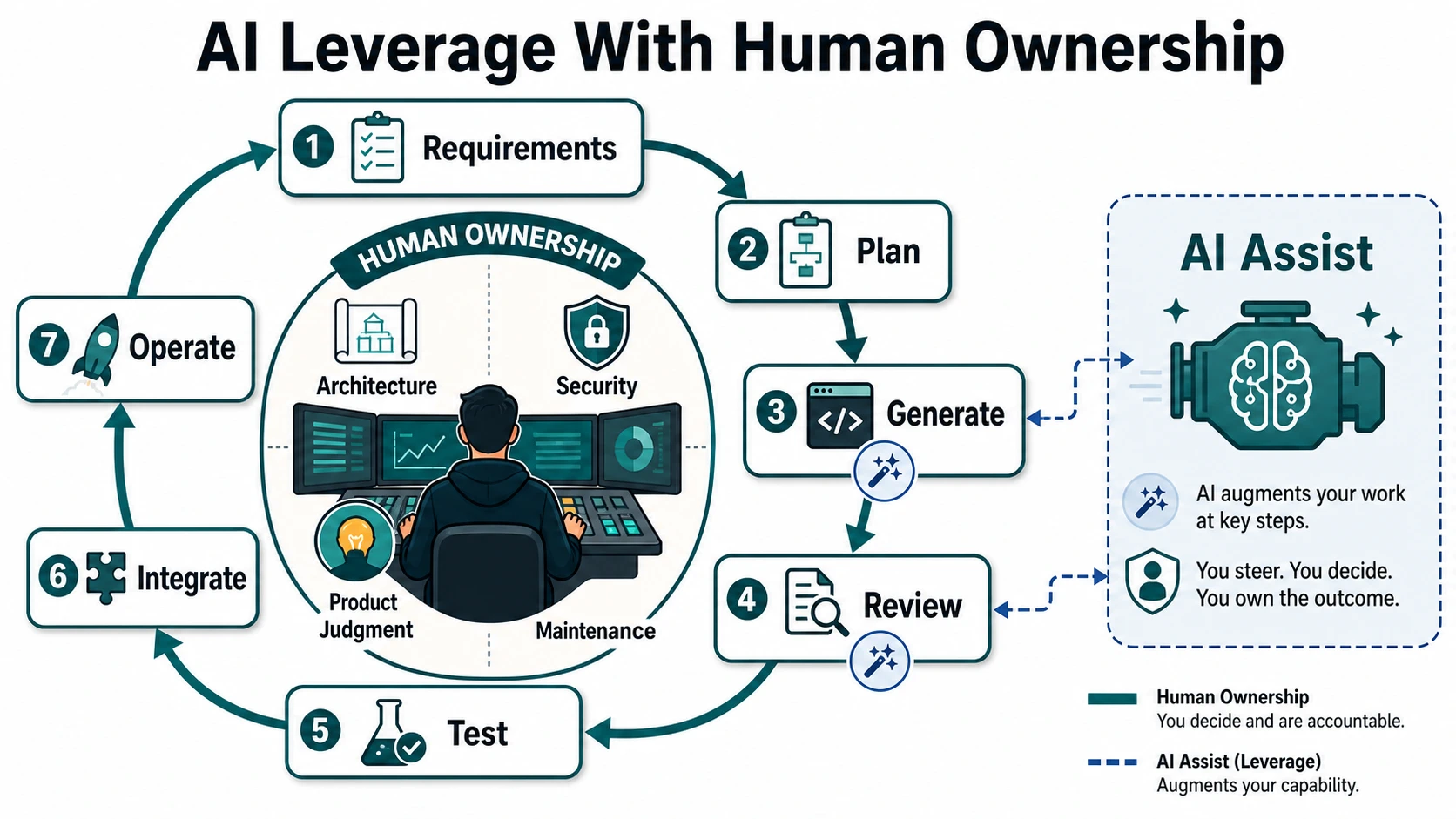
The Founder-Owned AI Loop
AI belongs inside an engineering loop that the founder controls:
- Name the customer behavior or learning need.
- State the product and technical constraints.
- Ask for options before asking for code.
- Generate the smallest useful change.
- Review the change as product, architecture, security, data, and operations work.
- Test the behavior and the failure paths.
- Integrate only what the founder can explain and maintain.
- Record the complexity accepted and the evidence gained.
This loop matters because generated code is usually optimized for the prompt in front of it. Your product is optimized for a customer, a stage, a codebase, a trust boundary, and a founder’s future attention. Those are different optimization problems.
AI can be useful at almost every point in the loop. It can draft a migration, compare implementation approaches, propose edge cases, inspect a failing test, write fixture data, summarize a long trace, turn a support thread into a bug hypothesis, or prepare a short internal note. The founder’s job is to decide which output belongs in the product.
Use AI most freely when the work is reversible, local, and easy to inspect. Use it with more scrutiny when the work changes account boundaries, data shape, payments, deletion, privacy, authorization, background jobs, integrations, or customer-visible commitments.
Start With Requirements, Not Generation
AI tools are good at making vague requests appear concrete. That is useful when brainstorming. It is risky when building.
Before asking for implementation, write a requirement note that would still make sense if no AI tool existed:
Customer behavior:
What should the user be able to do, and why does it matter now?

Product assumption:
What are we trying to learn or validate?

Scope boundary:
What is deliberately excluded from this change?

Existing constraints:
Which routes, models, services, UI patterns, jobs, events, or permissions must this follow?

Data and trust:
What records change? What could expose, corrupt, duplicate, or lose customer data?

Success evidence:
Which tests, manual checks, analytics events, logs, or customer behaviors will show that this works?
The note can be ten lines. Its value is not ceremony. Its value is that it forces the founder to separate product intent from code shape.
The same requirement can then become a prompt:
Given the requirement below, propose two or three implementation approaches.
For each approach, list trade-offs, data changes, security risks, test cases,
and operational concerns. Do not write code yet. Prefer the smallest change
that fits the existing architecture.

[Paste requirement note.]
Asking for options before code slows the first minute and saves hours later. It exposes hidden scope, risky data movement, unnecessary dependencies, and alternative paths that may answer the product question with less surface area.
Keep One Change in View
A founder building an onboarding checklist hears the same request from two early customers: let an account owner invite one teammate so both can update the checklist. The feature sounds small. The prompt “Add team invites” is not. It leaves the tool to guess the product, data model, role system, email flow, billing implications, and security boundary.
The first generated plan is polished and almost useless. It buries the necessary invitation and token lifecycle under organizations, teams, custom roles, billing seats, audit-log infrastructure, admin screens, elaborate email templates, and a new permissions layer. Much of it is plausible. None of the customers asked the founder to operate that system.
A stronger planning prompt says:
I am building an early B2B onboarding product. Existing concepts are User,
Account, Checklist, and ChecklistItem. Account owners can manage account settings.
There is no billing-seat logic yet.

I need the smallest teammate invite flow that lets one owner invite one teammate
to the same account so both can view and update the onboarding checklist.

Please propose an implementation plan using existing patterns. Include:
- files or components likely to change;
- data model changes, if any;
- authorization checks;
- token or email behavior;
- tests for cross-account access and expired invites;
- events or logs needed for support;
- what not to build yet.

Do not add organizations, complex roles, seat billing, audit-log infrastructure,
or a new permissions framework unless you can justify why this stage requires it.
This prompt gives the tool enough context to be useful while preventing it from completing the imagined final company. The non-goals carry as much product judgment as the requested behavior.
Implementation plans should be reviewed before code generation. A plan that adds a new framework for a small workflow is already failing. A plan that cannot explain authorization is not ready. A plan that touches six unrelated areas of the codebase may be too large for one AI-assisted pass.
Generate Small Changes
The revised plan needs only an invitation record, create and accept routes, the existing email adapter, the existing account policy, and tests around token behavior and account access. The founder can now divide the work at boundaries that are easy to inspect.
Large generated patches are seductive because they look like velocity. They are also hard to review. The founder ends up reading a finished answer rather than controlling the next step.
Prefer small prompts:
- “Create the migration and model changes only.”
- “Add the authorization check and tests before UI.”
- “Refactor this duplicated validation into the existing helper.”
- “Write failing tests for these three invite cases.”
- “Explain why this background job fails on retry before suggesting a fix.”
- “Draft documentation from the current behavior; mark any uncertainty.”
For the invite flow, the founder asks for the migration and failing tests first. The application behavior does not change yet, but the intended data shape and security claims become visible. Small changes keep the founder close to the work and make a bad direction cheap to reject.
Scaffolding is one of the safest uses when the founder knows the desired shape. AI can create a route, form, test fixture, CLI command, seed script, admin view, or documentation stub quickly. The founder still checks whether the scaffold follows local conventions, imports real APIs, uses supported dependencies, and leaves no fake gaps that look complete.
Review Generated Code as a Risk Surface
Generated code deserves the same seriousness as code from a contractor. It may be competent, but it has no memory of the customer’s pain, no liability for maintenance, and no operational fatigue when the product wakes the founder up later.
Review every meaningful AI-assisted change from the outside in. First, return to the product: does the patch enable the named customer behavior, or has it drifted into a merely plausible feature? Then look at its fit with the codebase: boundaries, names, validation, error handling, and data ownership. Follow the trust boundary through authentication, authorization, secrets, input handling, privacy, deletion, and exposure. Ask whether tests, events, logs, and manual checks reveal the important behavior and failure paths. Finally, imagine opening the code during a support incident next month. If the founder cannot explain, change, or remove it, the review is incomplete.
When the tool can edit files, run commands, install packages, read external material, or reach the network, review its actions as well as its patch. Limit credentials and permissions to the task, inspect every changed file and dependency, and treat issues, logs, documentation, and fetched pages as untrusted input. A concise prompt does not make broad execution authority safe.
Architecture drift is often subtle. A generated patch may add a second validation style, hide business rules in a component, create a new service pattern, bypass existing error handling, or introduce a dependency for something the standard library or current stack already handles. None of those choices may break the build today. Together they make the product harder for one person to operate.
Dependency hallucination and dependency bloat need special attention. Generated code may import packages that do not exist, use APIs from different versions, cite examples from another ecosystem, or add a maintained-looking library for a trivial task. Before accepting a new dependency, ask whether it is real, actively maintained, compatible with the stack, necessary for this stage, and worth the security and upgrade surface it creates.
Tests Transfer Ownership
Tests are not a way to prove that AI was correct. They are a way for the founder to state what the product now promises.
AI is useful for drafting tests because it can quickly enumerate normal paths, edge cases, and failure modes. But test generation has its own failure pattern: it often tests the implementation it just wrote instead of the behavior the product needs. It may mock away the real risk, assert shallow rendering, ignore account boundaries, or bless a wrong assumption because the code and test share the same misunderstanding.
For early products, prioritize tests around:
- account and role boundaries;
- billing, entitlement, and cancellation behavior;
- imports, exports, deletion, and migrations;
- the first value workflow;
- background jobs, retries, and idempotency;
- third-party integration failure;
- user-visible recovery from errors;
- activation, retention, and support events.
Ask AI for test ideas, then choose the cases yourself. For the invite flow, the important claim is not that an email can be sent. It is that an invitation grants access to exactly one account under controlled conditions. A useful prompt is:
Given this requirement and implementation plan, list the tests that would catch
product mismatch, authorization mistakes, data corruption, retry bugs, and
customer-visible failure. Separate unit, integration, end-to-end, and manual
checks. Do not assume the current implementation is correct.
One generated integration test exposes a mistake: the proposed acceptance route trusts an account identifier from the request. The implementation and its first tests agreed with each other, but the product promise did not. The founder changes the flow so the token determines the account, adds a cross-account regression test, and only then builds the thin interface around it.
Manual testing still matters. The founder accepts one invite, retries the token, uses an expired token, signs in as a user from another account, and follows the checklist through both memberships. A failed email delivery must leave a state the founder can understand and recover. If the founder cannot reproduce and explain the behavior, the code is not fully theirs.
Use AI Beyond Code, Carefully
AI-assisted engineering is not only code generation. Some of the highest leverage comes from work around the code.
For debugging, feed the tool the smallest useful context: the error, relevant logs, recent changes, expected behavior, and steps to reproduce. Ask for hypotheses ranked by likelihood and a validation step for each. Do not accept a fix until you have reproduced the problem and seen the failure disappear.
For refactoring, use AI to identify duplication, propose safer extraction steps, or draft mechanical changes. Keep behavior-preserving refactors separate from product changes. A generated refactor that changes behavior while renaming code is expensive to trust.
For documentation, AI can turn code, decisions, and support answers into a clear note. The founder must verify it against the actual system. Outdated AI-written docs are worse than no docs because they create false confidence during support, onboarding, or incident response.
For data analysis, AI can help inspect CSV exports, summarize event patterns, draft SQL, explain outliers, and turn support tickets into themes. Treat the result as analysis assistance, not evidence by itself. Check the query, sample the rows, preserve privacy, and avoid pasting sensitive customer data into tools that are not approved for that data.
These uses are valuable because they reduce founder load without pretending the tool owns the conclusion.
Failure Modes
The most expensive AI failure is not bad syntax. It is unowned code. If the founder cannot explain how the feature works, where data moves, what can fail, and how to change it, the product now contains borrowed judgment.
The second failure is insecure convenience. Generated examples may trust client-side checks, skip authorization, log sensitive data, mishandle secrets, ignore deletion, or treat admin access casually. This is why the trust baseline from the previous chapter still applies when AI writes the first draft.
The third failure is inconsistent architecture. Every generated feature can arrive with its own opinions. If accepted uncritically, the codebase becomes a collection of plausible fragments instead of a system one person can reason about.
The fourth failure is using AI speed to avoid hard product work. If the customer problem is vague, the wedge is unproven, or the prototype question is unclear, AI can produce beautiful waste. It can make the founder feel productive while the riskiest assumption remains untouched.
The fifth failure is overconfidence from generated tests and explanations. A passing suite written against the wrong behavior is not evidence. A fluent explanation is not understanding. A summarized dataset is not a conclusion until the query and sample are checked.
The AI Coding Review Checklist Is an Ownership Note
Before committing an AI-assisted change, write enough of an ownership note that another version of you could operate the result under pressure. Keep it beside the change, not as permanent paperwork for every trivial edit.
Record the customer behavior and the evidence that justified the work. Name the non-goals that remained out. Explain why the implementation fits the existing architecture and list every new dependency, service, model, job, or framework it introduces. Trace authentication, authorization, secrets, sensitive inputs and outputs, migrations, deletion, retries, duplication, and rollback wherever they apply. Name the tests and manual checks that exercise the important behavior without merely mirroring the implementation. Record how success and failure will be visible, and verify that generated comments, documentation, and support notes describe the system that actually exists.
The invite-flow note is short. Shared checklist access is the customer behavior. Seat billing, custom roles, and multi-team administration are excluded. The token, rather than request data, owns the account decision. The existing account policy protects checklist access. The regression cases cover expiry, reuse, and cross-account attempts. An acceptance event and recoverable email state give the founder enough support visibility. The new invitation record is the principal complexity added.
That note supports five plain questions: Why does this exist? Why does it have this shape? What can go wrong? How is the important behavior proved? How will the founder debug, change, operate, and remove it?
AI-assisted code is ready to integrate when the founder can answer all five without leaning on the tool’s confidence. If any answer is “the AI handled that,” shrink the plan, read the code, strengthen the test, or delete the clever part.
Exercise
Choose one AI-assisted change you are tempted to accept and write its ownership note. Then remove one piece of scope before implementing it.
AI makes production cheap enough to outrun the question. The next stage of the work is therefore not a larger generated patch. It is a prototype that proves which change deserves to become product at all.