Solo Founder Product Engineering Handbook / Chapter 16
The Product Thesis
Convert discovery into a falsifiable product strategy that guides scope, evidence, and technical choices.
Preparing audio…
Audio edition
The Product Thesis
The Bet That Lets You Say No
Discovery gives a solo founder raw material: quotes, workflows, current alternatives, contradictions, willingness signals, access constraints, and a few tempting product ideas. That material is not yet strategy. It can still pull the founder in ten directions.
The expensive moment comes after discovery, when the founder has enough evidence to feel confident but not enough discipline to refuse attractive work. A prospect asks for one more role. A friendly user suggests a dashboard. A competitor launches a broader product. The founder notices a clever architecture that would make future features easier. Each request sounds reasonable in isolation. Together they turn a narrow learning opportunity into a product surface one person cannot build, sell, support, and change.
A product thesis is the written bet that converts discovery into refusal. It says which customer is worth serving first, which problem matters, what insight makes the wedge plausible, what current alternative must be beaten, how the business might work, how customers might be reached, what technical approach is sufficient for the next test, and what evidence would change the decision.
The thesis does not make the future certain. It makes the next bet inspectable. A serious thesis can be tested, narrowed, revised, or killed before the founder has buried the question under product surface area.
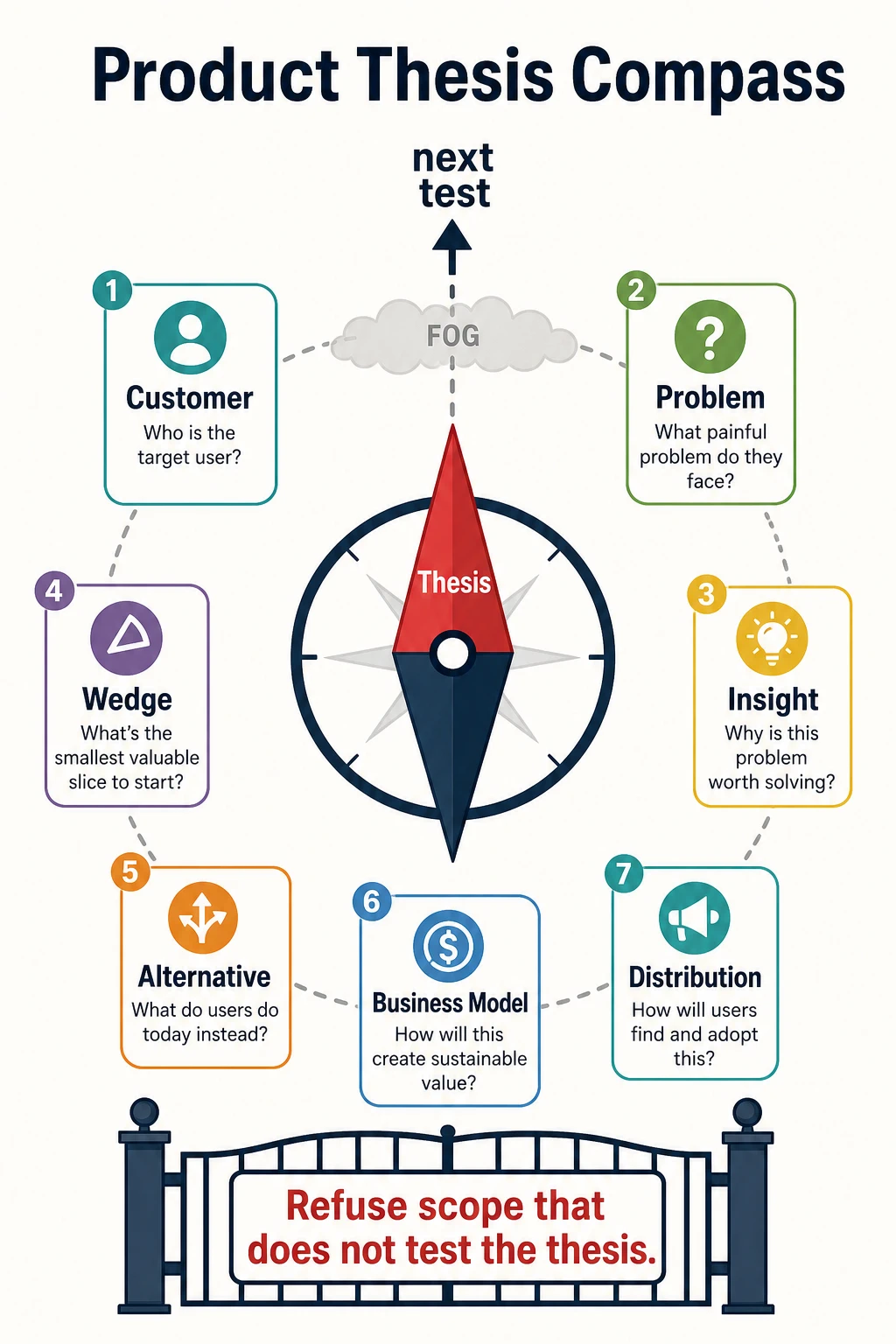
What a Thesis Is Responsible For
A product thesis is not a vision statement. A vision describes the future the founder wants to make possible. It may be useful for ambition, recruiting, or long-term coherence, but it rarely decides what to build on Monday morning.
A product thesis is not a roadmap either. A roadmap sequences work. Before the thesis is sharp, a roadmap can make untested assumptions look like commitments. It gives dates and features to a strategy that has not yet earned them.
A thesis sits between vision and roadmap:
Given what I have learned, I believe this specific customer will change behavior for this specific outcome, through this narrow wedge, if I can reach them through this path, charge in this rough way, and deliver the value with this much product and operational complexity.
That sentence is allowed to be wrong. That is why it is useful. It exposes the customer belief, the product belief, the business belief, the distribution belief, and the engineering belief at the same time.
A founder should be able to read the thesis before accepting a feature request, pursuing another segment, adding an integration, automating a workflow, choosing a channel, or deciding whether to pilot, price, pause, or stop. If it cannot guide those decisions, it is still a description rather than a strategy.
Write the Bet in One Page
Keep the Solo Founder Product Thesis Memo short enough to read before opening the issue tracker. Its job is not to preserve everything known about the market. Its job is to make the next product and engineering bet hard to misunderstand.
Begin with the first reachable customer: the role, situation, and buying context, not a category broad enough to contain incompatible workflows. Describe a recent, repeated problem in the customer’s language. Then name the discovery insight that makes this particular wedge plausible. An insight should reveal something generic market logic would miss.
Set the proposed wedge beside the current alternative. The alternative survives for a reason, even when customers complain about it. State what it preserves and which weakness the wedge can exploit first. Then describe the smallest product, manual service, prototype, or concierge workflow capable of testing whether the customer will change behavior.
Business and distribution belong in the same memo. Name the likely payer, the unit of value they recognize, the rough pricing hypothesis, the first place the founder can reach similar customers, and the message likely to earn a qualified reply. “Monetize later” and “grow through content” hide two of the most consequential assumptions in the business.
Write the technical approach in operational terms: the minimum system and data flow, any manual backstop, what the founder must monitor, and where the system stops. Finish with the primary risks, evidence that would kill or narrow the bet, and the scope being refused now.
That final refusal is where the memo earns its keep. A thesis that only says what to pursue is too weak for solo work. The founder also needs a written account of what will not be built, sold, supported, integrated, or automated while the thesis is still being tested.
Let the Evidence Set the Order
The product thesis should inherit the discipline of discovery synthesis. Do not begin from the product idea you like. Begin from the strongest decision-grade pattern and preserve the uncertainty around it.
First ask which customer type showed repeated behavior rather than interest. Recover the recent episode that created cost, delay, risk, embarrassment, or lost revenue. Look at what the customer already tried, paid for, customized, tolerated, or worked around. Those choices reveal urgency more reliably than enthusiasm does.
Next examine why the current alternative survives. A spreadsheet may be awkward but flexible. Manual review may be slow but trusted. A senior employee’s memory may be expensive but unusually good at exceptions. The product has to beat the part that hurts without casually discarding the part customers depend on.
Only then decide what the first product must do. Access, data, trust, approval, and support constraints set the technical boundary. Reachability shapes the distribution hypothesis. The strongest contradiction becomes a primary risk or kill criterion.
This order prevents the memo from becoming a defense of a preferred solution. It makes the thesis a bet against customer behavior, where it can win or lose honestly.
A Worked Thesis
Consider a fictional composite. A founder has been exploring tools for small paid-search agencies. Discovery did not show that agency owners wake up wanting another analytics dashboard. It showed something narrower: account managers spend Friday afternoons turning campaign changes, Slack notes, client context, and platform exports into plain-language explanations before weekly client updates.
The current alternative is awkward but durable. Agencies use ad-platform exports, copied slides, internal notes, and senior account-manager memory because the work requires judgment. Clients need more than numbers. They need to know what changed, why it changed, whether anything is broken, and what happens next.
A weak thesis says:
Build an AI reporting platform for agencies.
That sentence hides almost every decision the founder needs to make. It does not name the first customer situation, buying role, workflow moment, current alternative, distribution path, product boundary, technical boundary, or evidence that would disprove the bet.
Here is a thesis that can operate:
Small paid-search agencies with five to twenty active clients will pay for a weekly client-change digest because account managers lose time turning campaign data and scattered notes into trustworthy explanations. The first wedge is a founder-reviewed digest for one campaign type, produced from CSV exports and a short account-manager note form. The first distribution test is direct outreach to agency owners and operations leads in paid-search operator communities. The first technical system is a secure intake form, CSV parser, digest template, review queue, and manual delivery process. Defer dashboards, live integrations, client portals, team permissions, automated sending, and multi-channel reporting. Narrow or kill the thesis if five target agencies will not share sample data, schedule a trial, or accept a paid pilot after seeing two sample digests.
The bet is still uncertain, but its uncertainty is visible. It says whom the founder will contact, names the weekly moment, and treats the current workflow as the benchmark. It makes the technical approach small enough for learning and refuses the features that would make the product look impressive before its value is proven.
It also exposes the hard part: agencies may value the digest only if they trust it near client communication. That risk changes the product. The first version may need source visibility, review states, careful wording controls, and human approval more than it needs automation.
Complete the rest of the memo from that constraint. The likely buyer is the agency owner or operations lead; the value unit may be each client account or each reporting cycle. The founder will personally validate inputs, review drafts, deliver the digest, and record correction time. The narrowest useful test is a paid pilot using real but appropriately handled agency data. The product will not promise autonomous client communication, permanent data retention, or support for every campaign platform.
Now the memo is doing more than describing a product. It is making customer, commercial, technical, and operational choices answer to the same piece of evidence.
Pressure-Test the Weak Joints
A useful thesis often feels uncomfortable because it commits the founder to a narrower claim than the opportunity seems to offer. Pressure-testing finds the evasions before code hardens them.
Try to describe the first customer without saying “anyone who.” Tie the problem to recent incidents, workarounds, delays, or customer-visible consequences. Explain why the current alternative survives; if the explanation is merely that customers have not seen the new idea, the competitive thinking is thin.
Ask whether the wedge produces a meaningful outcome without requiring the whole platform. Name the payer, value unit, and first pricing conversation. Identify ten similar customers the founder could plausibly reach this month. If the plan depends on search traffic, virality, partnerships, or paid acquisition before the message is understood, distribution is still a wish.
Then follow the first product into the founder’s week. What must be configured, checked, explained, repaired, or customized? A technically small product can conceal a large service operation. Early theses are supposed to carry risk; the discipline is to choose which risk to accept instead of hiding several at once.
For the agency digest, willingness to pay and trust in the output are more dangerous assumptions than the ability to render a report. A pressure test should therefore ask agencies for sample data, a live trial, repeated use, and a paid pilot. Building a polished dashboard would answer an easier question.
Make the Technical Approach Serve the Test
Architecture is part of an early product strategy because it determines what can be learned, how quickly, and at what support cost.
For the agency digest, a manual report from customer-provided examples can reveal whether the output is useful and trusted. It costs founder time and may be inconsistent, but those costs are visible. A form, CSV upload, and template add enough repeatability to test whether the workflow can recur. A direct ad-platform integration may reduce customer effort, but it introduces OAuth, permissions, API changes, data quality, monitoring, and failure handling. A full dashboard tests self-serve exploration while creating the largest surface before the wedge has been proven.
The right choice is not automatically the cheapest one. It is the least durable surface area capable of testing the riskiest belief. If trust is the risk, manual review may be strategic. If data access is the risk, a lightweight upload or integration experiment may be necessary. If willingness to pay is the risk, payment belongs in the test and architectural polish does not.
Write the chosen approach as an operating boundary:
For the next test, I will use a hosted form, customer-uploaded CSV, manual validation, a generated draft, founder review, and email delivery. I will not store unnecessary client history or send messages automatically. I will track time per digest, correction rate, customer edits, and repeat usage.
That paragraph is more useful than a technology stack list. It says what the system may do, what it refuses to do, and what learning the founder must capture.
Decide What Bad Evidence Means
Kill criteria protect the founder from quietly rewriting the thesis after every weak test. Write them before the product becomes emotionally expensive. They do not require abandoning the whole opportunity at the first disappointment.
Kill the bet when its central belief receives no meaningful support and further work would mainly defend the idea. For the agency digest, compliments without sample data, a trial, access to a buyer, repeated use, or a payment conversation are not enough.
Narrow when the opportunity appears real but the claim is too broad. Agencies may care only about explanations after material campaign changes, not weekly reporting in general. That evidence preserves the problem while shrinking the workflow.
Change the customer, buyer, channel, or solution when discovery reveals a stronger adjacent bet. Account managers may value the digest while owners pay only when it reduces senior review time. The user did not disappear; the economic claim changed.
Write criteria against the risks in the memo. If pain is supposedly urgent, require the customer to spend time, share a sample, involve an owner, or change a live workflow. If the buyer is uncertain, require a budget conversation. If the workaround may be good enough, test whether customers surrender any of its flexibility or control. If support burden is the risk, track setup, corrections, exceptions, and urgent intervention for each account.
Numbers require judgment. Ten conversations are not magic. Three high-quality buyer conversations may matter for an expensive B2B product, while ten may be too few for a lightweight prosumer tool. The purpose of a threshold is to stop the founder moving the standard in private, not to turn product judgment into arithmetic.
Update Without Wandering
A product thesis should change when customer behavior changes the evidence. It should not change because the founder became bored, scared, flattered by a prospect, or impressed by a competitor’s product surface.
Useful updates become more exact. The customer is not agency owners broadly but operations leads responsible for client communication quality. The problem is not weekly reporting but explaining material campaign changes without rebuilding context. The wedge is not a dashboard but a reviewed explanation workflow. The technical approach should remain upload-based until repeat use proves integration convenience is worth its support burden.
Attach an evidence note to every change: what did customers do, share, refuse, pay for, repeat, or correct? Without that note, learning and wandering look alike.
Review the thesis after each discovery or pilot cycle rather than after every emotional spike. Keep the current version at the top of the working document. Retain old versions below it with dates and the evidence that caused the change. The history prevents the latest story from erasing the actual course of learning.
The Refusal Test
The thesis is ready to guide product work when it can refuse work in every major category. It names a specific reachable customer and a problem grounded in recent behavior. It states the discovery insight, the current alternative and why it survives, a valuable wedge, a buyer and pricing hypothesis, a channel the founder can test personally, and a technical approach bounded by the learning target.
It also names the founder’s operating burden and the evidence that would kill, narrow, or change the bet. Most important, it lists the users, features, channels, integrations, automations, and promises that must wait.
When a request arrives, ask which belief in the thesis the work will test. If it tests none of them, it waits. When a new segment appears, ask whether it brings a different workflow, trust boundary, support model, or buyer. If it does, it waits. When an integration would mainly make the product feel legitimate, it waits.
This discipline keeps the product small enough for evidence to stay louder than momentum.
Exercise
Take the discovery-to-build memo from the previous chapter and write a one-page product thesis. Include the first customer, problem, insight, current alternative, wedge, business model, distribution path, technical and operational boundary, primary risks, and the evidence that would kill, narrow, or change the bet.
Then write five refusals: one customer segment, one feature, one integration or automation, one channel, and one support promise that will not be accepted yet.
Read the memo before every product decision for the next cycle. Record the evidence behind each change. Once the thesis can say no, positioning can do its job: turning the chosen bet into words the right customer can understand quickly.