Solo Founder Product Engineering Handbook / Chapter 10
Market Selection for a One-Person Company
Choose a beachhead market by tracing the company one founder would actually have to sell, build, support, and endure.
Preparing audio…
Audio edition
Market Selection for a One-Person Company
A Market Chooses the Company Back
Two markets can want the same broad product and still lead to different companies.
One market may let customers buy with a credit card and begin alone. Another may require a pilot, a security review, a migration, and three approvals before anyone experiences value. One may produce the same support question every week. Another may bring a different data shape, exception policy, and urgent promise with every account. These differences do more than affect go-to-market strategy. They determine what must be built, how cash arrives, what can fail, and how the founder spends an ordinary Tuesday.
Market size says that money is spent somewhere in a category. It does not say whether one founder can reach the first buyers, earn enough trust to make a narrow promise, deliver the result, support its failures, and learn before runway or attention runs out.
A beachhead market is therefore the company’s first operating environment. Choose it by tracing the complete work it imposes, not by asking which label sits beside the largest number.
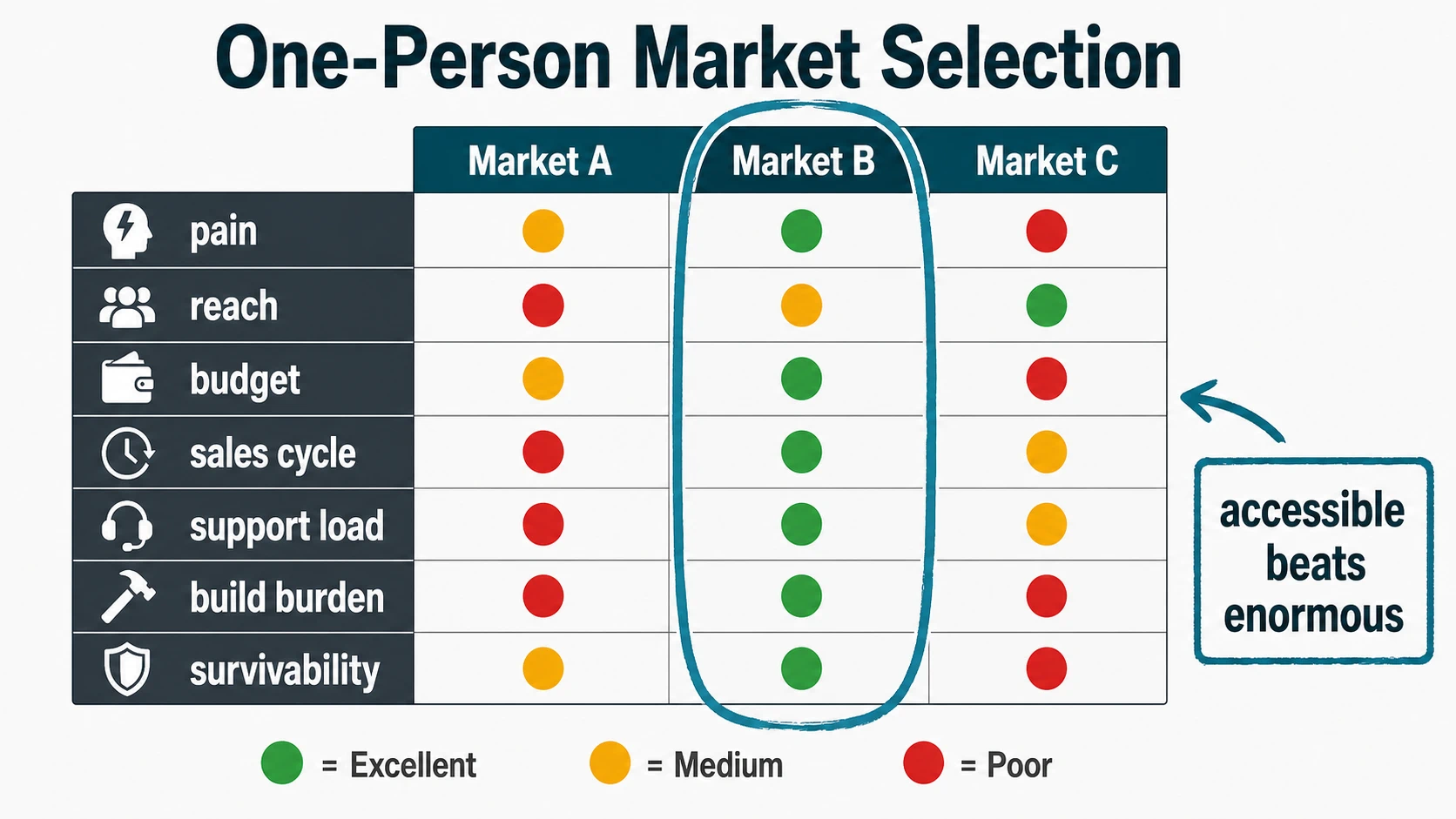
Run One Idea Through Three Markets
Take a deliberately broad idea: help professionals collect client documents, detect what is missing, send reminders, and assemble a packet for review. The software sounds similar until a market gives it consequences.
For freelance consultants, the buyer and user are often the same person. Prospects can be found in public communities and professional directories, and a purchase may require no approval beyond the consultant’s own judgment. The founder could begin with a self-serve proposal or onboarding packet generator. That easy access is valuable, but it does not settle the choice. Document work may be occasional, each consultant may organize it differently, and the price has to survive lightweight use and easy cancellation. The company this market creates is likely a low-touch product that depends on broad reach, simple onboarding, and disciplined acquisition costs.
Now put the idea inside a mid-market legal department. Document volume and budgets may be larger, but the first useful promise inherits institutional demands. The customer may expect procurement, security review, permissions, audit history, retention controls, integrations, implementation help, and several stakeholders in the sale. None of those requirements is frivolous. That is precisely the problem: the founder may have to build and prove the surrounding institution before learning whether the narrow workflow creates enough value.
A boutique immigration firm creates a third company. Client document collection is repeated work rather than an occasional task, and missing material can delay a packet that staff need to review. A narrow product might provide matter-specific checklists, reminders, and a clear view of what has arrived. Yet the work involves sensitive information and sits beside professional judgment. The founder must have a credible way to reach firms, protect the data, avoid claims about legal completeness, and keep a qualified person responsible for review.
This comparison does not prove that boutique immigration firms are the answer. It reveals the conditions under which they might be. A founder with trusted access to several such firms and the ability to keep the promise administrative has a plausible learning path. A founder without that access or respect for the boundary does not. The market is not attractive in isolation; it is attractive in relation to the founder and the first promise.
The same broad idea has now become three different products and sales motions: a low-cost self-serve generator, an institution-ready system, or a carefully bounded coordination workspace. Choosing the customer chose much of the architecture, support model, trust burden, and route to revenue.
Follow the Loop Until It Breaks
A useful beachhead lets one founder complete a loop: reach a customer, understand a costly moment, win a commitment, deliver first value, observe use, support the exceptions, and decide what to change. Trace that loop in order. The first break often decides more than a page of market statistics.
Start with reach. A market is reachable when the founder can name a manual route to relevant conversations now: prior relationships, a professional directory, a narrow community, a platform ecosystem, a local network, or a credible outbound list. “Small businesses” is a category. “Owners of ten-to-thirty-person immigration firms listed in two regional associations” is a prospecting hypothesis. If the first twenty names cannot be found, scale is not yet the problem.
Then follow the sale. Who feels the pain, who can approve money or workflow change, and what lies between interest and a real commitment? When those roles are far apart, the founder is not conducting one conversation but coordinating a political process. A long sales cycle may be worth enduring when contract value, access, and runway support it. It is fatal when the founder needs quick evidence but discovers pilots, legal review, procurement, and stakeholder alignment between every conversation and first use.
Next, reconstruct the first value moment. For the immigration-firm example, value does not arrive when an account is created or a checklist appears. It arrives when staff can see what a client has supplied, identify what still needs attention, and move the packet toward professional review without another round of inbox archaeology. If that moment requires historical migration, several integrations, custom permissions, data cleanup, and formal training, the market has pulled the wedge back into platform scope.
Stay for the failure. What happens when a client uploads the wrong document, a reminder goes to the wrong person, a matter does not fit the standard checklist, or staff disagree with the displayed status? Early support is valuable when similar cases teach the founder the language and rules of the workflow. It becomes a swamp when every account requires a different private procedure. A narrow interface cannot rescue an unbounded promise.
Finally, imagine the hundredth ordinary week rather than the launch. The founder will keep hearing this market’s objections, handling its data, reading its documents, selling through its channel, and responding to its failures. Founders do not need to feel passion for every support ticket. They do need enough respect for the customers and tolerance for the recurring work to stay attentive when novelty disappears.
Do not average these questions into a reassuring score. One broken part can dominate the decision. Strong pain cannot repair an unreachable segment. Easy access cannot create budget. High contract value cannot shorten runway. Early revenue cannot make a custom service repeatable.
Write the Choice as an Operating Memo
For each candidate market, write a one-page memo in sentences. Begin with the boundary: the specific firms, roles, workflow, and triggering event that belong in the first segment. Describe the current alternative closely enough to explain why customers still tolerate it and what would make them change.
Then trace the proposed company. Name the first twenty plausible conversations and the steps between contact and commitment. State the first observable result, the inputs needed to produce it, and the least product required. Put the build, support, and trust boundaries in writing: what will remain manual, which integrations and exceptions are excluded, what the product can responsibly claim, and where a human must retain judgment.
Finish with two futures. In the first, the wedge works: what repeated use, adjacent workflow, or budget could open next? In the second, an ordinary month has arrived: what sales, onboarding, support, paperwork, and domain learning will the founder personally do? A market memo is incomplete if it describes opportunity but omits the job.
Use concrete nouns. “Reach finance leaders through content” conceals both the buyer and the channel. “Contact controllers at regional accounting firms found through state CPA directories and ask about delays during monthly close” can be attempted and disproved. “Use AI for paperwork” is a technology theme. “Show which client documents are still missing before staff review” is a result a customer can judge.
Decision Gate
Choose the beachhead when its whole loop is coherent: customers can be reached, painful work prompts action, authority sits close enough to the user, and first value arrives before team-scale sales or platform-scale implementation. The founder must be able to support the likely failures, make a responsible promise, and see what successful use could earn next.
Narrow when the category contains several buyer types, workflows, risk levels, data shapes, or implementation needs. The first ten customers should resemble one another in the parts that drive product and support. A useful boundary might be a role, firm size, workflow, system of record, urgency trigger, geography, or trust requirement. Specificity earns its place only when it removes operating variation or strengthens access.
Defer when the pain is real but a credible first promise requires institutional trust, regulatory depth, multi-party liquidity, heavy integration, long implementation, or a sales cycle the founder cannot yet survive. Deferral is not a verdict on the market. It is an honest reading of sequence.
Reject when customers cannot be reached, no one owns the decision, the promise cannot be made responsibly, early use cannot be supported, or the ordinary work would steadily empty the founder’s attention.
Failure Modes
The obvious mistake is treating a large total market as accessible demand. A category can be enormous while remaining unavailable to a founder with no channel, no trust, and no way to produce value before a long sale.
The user-without-buyer trap is quieter. Users complain, praise the idea, and ask for features, but nobody owns the budget or priority. The founder collects encouragement instead of demand.
The enterprise-logo trap makes the founder confuse prestige with evidence. Enterprise pain can be real, but procurement, security, integrations, admin controls, data retention, references, and implementation support may become the product before the actual wedge has proved itself.
Early customer enthusiasm can hide a support swamp. Every prospect wants the same promise inside a different workflow, so the founder accepts custom setup, fields, exports, exceptions, and reporting. Revenue arrives with a private services business attached. The warning is not manual work itself; repeated manual work can reveal what deserves automation. The warning is unrelated work that refuses to converge.
Trust-heavy work can be an excellent starting point for a founder with domain knowledge, access, and careful scope. It is a poor shortcut for a founder who treats privacy, safeguards, liability, or professional boundaries as launch details. A low-risk administrative wedge can reduce the burden; it does not erase it.
Integration burden can disguise itself as product ambition. The founder thinks the market wants one result, but delivering it depends on several systems, historical cleanup, permission models, reconciliation, alerts, and dashboards. Infrastructure begins consuming the learning budget before the market has earned it.
The last failure is choosing a market whose customers the founder does not respect or whose ordinary work they refuse to do. Distribution is not a temporary obstacle before the real work. Neither are onboarding, support, domain learning, or recovery. In a one-person company, they are the work alongside the code.
Exercise
Take the wedge you chose in the previous chapter and place it in three plausible beachhead markets. Write an operating memo for each one. Do not score them. Trace reach, commitment, first value, likely failure, support, expansion, and the founder’s ordinary month until each candidate either forms a coherent company or breaks.
Choose, narrow, defer, or reject each market, and write the reason as a consequence: “defer because the first useful result requires two integrations before a buyer can judge it,” not “integration score: low.”
For the market you choose, name the first discovery target: the role you will contact, the recent pain event you will ask them to reconstruct, the current alternative you expect to find, and the boundary you will hold when the conversation turns into feature requests. Let that conversation, rather than another market-size estimate, be the first test of whether the chosen operating environment exists outside the memo.