Solo Founder Product Engineering Handbook / Chapter 54
Founder Evolution After PMF
Shift from solo builder to product leader, system designer, recruiter, and strategist without losing customer truth or product standards.
Preparing audio…
Audio edition
Founder Evolution After PMF
When Help Creates Another Inbox
A founder of a reporting product has done the sensible post-PMF work. Small agencies renew. The product engineer can run and release the application without live narration. A part-time customer success contractor knows the onboarding path. Work can finally leave the founder’s desk.
Yet the founder is busier than before. The engineer asks whether a cleaner export may change a long-standing layout. The contractor forwards every unusual customer request. Pull requests wait for line-by-line approval, and roadmap decisions arrive disguised as chat messages. Tasks moved; judgment did not.
Before product-market fit, keeping customer conversations, support, product decisions, operations, and code in one mind was an advantage. That closeness helped the founder notice weak signals and change direction quickly. Once repeatable demand appears, the same arrangement turns the founder into the product’s control plane. Nothing important happens without one person’s attention.
The job changes before the org chart does. The founder must let go of tasks without letting go of customer truth, product standards, technical trust, or the economic shape of the business.
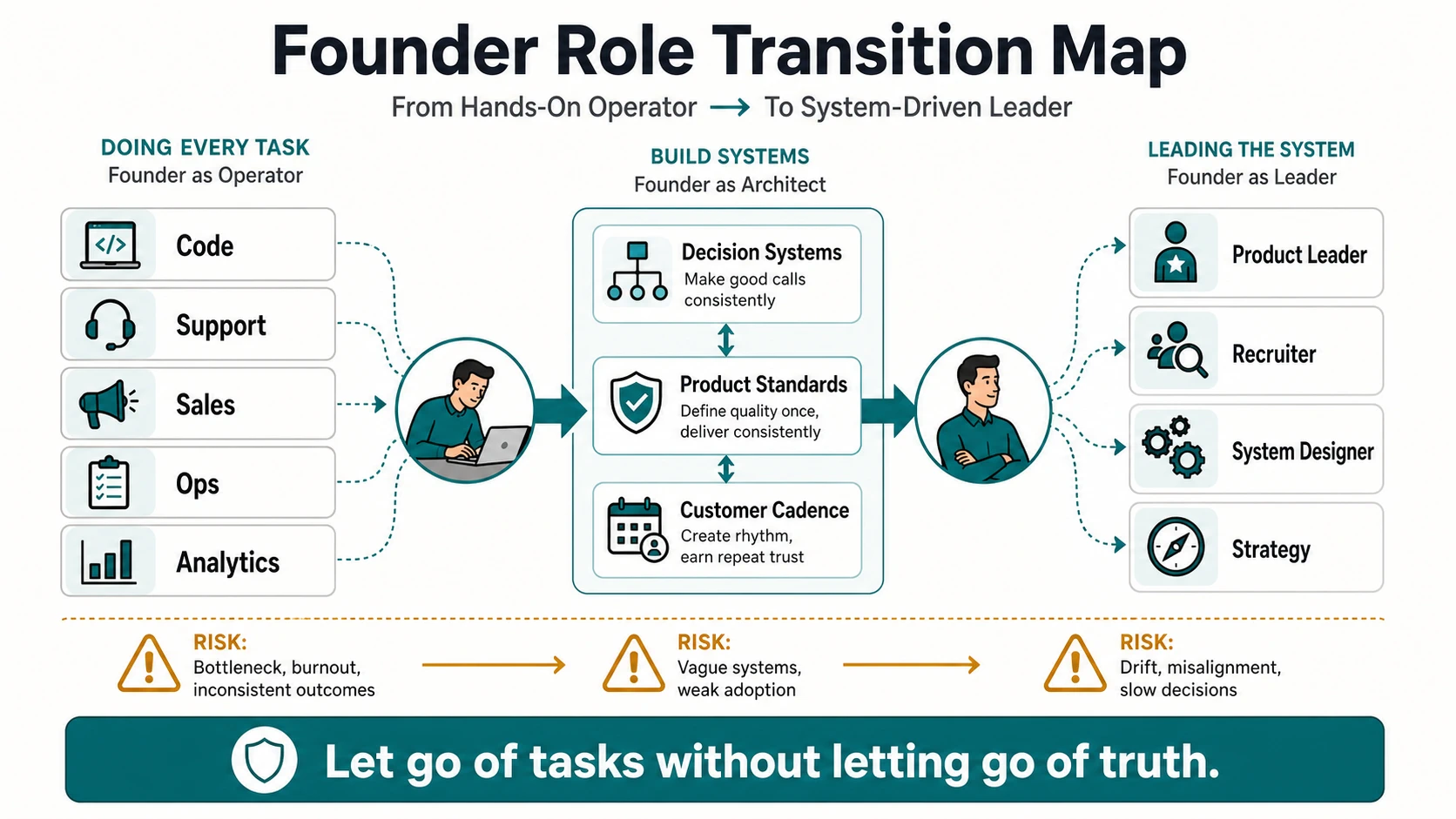
This is not a retreat from responsibility. It is a change in its form: from making every decision to designing how good decisions get made.
Name What Must Not Drift
Delegation is dangerous when every concern feels equally important. The founder either keeps everything or releases work with vague instructions to “use good judgment.” A small product needs a sharper boundary.
Four kinds of truth deserve explicit protection. Customer truth is what people actually do, buy, renew, abandon, and complain about in their own words. Product standards define the workflow the product optimizes for and the requests it refuses. Technical trust covers the boundaries where security, data integrity, reliability, or recovery cannot be casual. The economic model keeps a promising product from becoming custom services for whichever account asks most loudly.
The founder does not have to make every decision inside those boundaries. The founder does have to make the boundaries teachable.
For the reporting product, three short principles do more work than constant approval:
- reports should be client-ready without creating a custom portal for every agency;
- agencies should understand account health without assembling dashboards from scratch;
- configuration is acceptable when it serves a repeated need, not when it creates private per-account behavior.
Now a request for a custom export layout can be discussed against the shape of the product. The engineer can ask whether the need repeats across the target segment and whether one coherent export still serves it. The contractor can explain the boundary to the customer without borrowing the founder’s intuition. Taste has become inspectable.
Standards should also cover engineering consequences: the data and permission defaults, the reliability bar for the core workflow, the release and recovery path, and the kinds of change that require a decision record. A capable engineer needs enough room to act and enough constraint to protect the customer promise.
Give Away Decisions, Not Just Tasks
“You own exports” is not a decision right. It may mean design the change, implement it, or merely gather options for the founder. Ambiguity sends every choice back upstream.
The founder gives the product engineer authority over reversible improvements to the existing export workflow. The engineer may change copy, interaction details, tests, and implementation choices when the product principles still hold, the affected segment is known, and the change can be rolled back. A change to pricing, the core workflow, customer data, or permission behavior must be escalated. A new security promise, contract term, retention policy, or irreversible migration remains a founder decision, with expert advice when needed.
The customer success contractor receives a different boundary. They own routine onboarding follow-up, support classification, and first-pass feature-request notes. They may solve documented onboarding problems and communicate established product limits. They escalate when a request signals churn, contradicts the target segment, creates a new customer promise, or appears repeatedly enough to challenge the roadmap.
These rights include the evidence expected with a decision. The engineer shows the affected customer path, verification, and rollback route. The contractor preserves the customer’s original language, segment, attempted job, and business consequence. Ownership becomes useful because the person closest to the work can finish an ordinary decision without asking, while consequential ambiguity returns with its rough edges intact.
Letting go of code follows the same rule. The founder need not stop programming on an arbitrary date. Code may still be the highest-leverage place to investigate an architecture risk, prototype an uncertain capability, or repair a dangerous failure. It should no longer be the founder’s default claim on every implementation. If the engineer owns the work but waits for the founder to choose every name, query, and interface, the company has hired another pair of hands and created another inbox.
Stay Close to Customers Differently
Customer contact cannot simply be handed off as volume grows. Nor can the founder attend every call and read every ticket. Both choices destroy leverage.
The reporting founder keeps two customer conversations each week, personally reviews every churn and expansion case, and samples support tickets before product review. The contractor handles the routine queue but preserves direct customer language in the weekly themes. “Users want more flexibility” is rejected as too smooth to steer work. A useful note says which kind of agency asked, what it was trying to deliver, where the existing export failed, whether money or renewal was at risk, and what workaround it uses now.
This cadence protects signal without preserving volume. It also helps the founder separate market pull from account noise. Three agencies struggling with the same client review may reveal a missing product capability. One large customer offering money for a private reporting workflow may be asking the company to enter a different business.
Raw evidence should enter roadmap discussion before it is converted into priority. Dashboards show frequency and direction; call clips, churn notes, failed onboarding cases, and support language reveal the mechanism. The founder stays close enough to correct the team’s model of the customer, not close enough to become the handler of every customer event.
Reviews Should Return Decisions to the Work
A post-PMF operating cadence is a feedback system, not a meeting collection. Each review exists because some decision will otherwise arrive too late, lose context, or accumulate silently.
The small reporting team uses a weekly customer review to inspect churn, expansion, objections, support patterns, and surprising language. Its product review decides what to change, defer, or refuse. Technical review is triggered by risk—a migration, an architecture boundary, sensitive data, permissions, or a reliability failure—rather than by the founder’s wish to inspect every diff. Once a month, the founder steps back to examine segment focus, pricing signal, roadmap pressure, hiring constraints, and operating load. Incidents and near misses receive their own review because trust failures should not wait for the calendar.
A status update does not need a meeting. A product review that never changes priority or sharpens a trade-off is too shallow. A technical review that covers every small change is supervision wearing a process name. The useful question is: what must the founder see often enough to maintain judgment without becoming the approval queue?
The answer will change. Early in the transition, reviews may be frequent because the standards are still being tested. As judgment becomes shared and outcomes remain sound, the founder can widen the interval or narrow the scope. If errors recur, the response is not automatically another approval. Repair the standard, access, tooling, or feedback loop that made the error likely.
Hire for the Constraint Behind the Work
Post-PMF pressure makes role titles seductive. The founder feels buried in support and hires customer success; feels behind on code and hires an engineer; feels uncertain about growth and hires sales. A role only creates leverage when the founder understands the constraint it is meant to remove.
The reporting founder does not ask for a generic “full-stack engineer who can wear many hats.” The immediate constraint is that proven customer needs wait because every product and implementation choice returns to the founder. The hire therefore needs product judgment inside a bounded domain, comfort with customer evidence, and the technical ability to carry a change through release and recovery. The work sample should expose those qualities. The first thirty days should give the hire a real decision to own, not only a list of tickets to close.
The founder should keep the definition of the role, the bar for judgment, and the final hiring decision. Sourcing and scheduling can move elsewhere. More important, the founder should be able to say what authority will move to the new person. Hiring someone without decision rights adds coordination before it adds capacity.
Do not hire a role to escape work the founder has not understood. A customer success hire cannot fix unclear onboarding when nobody knows where customers fail. A sales hire cannot create a repeatable motion before the founder knows who buys and why. An engineer cannot preserve architectural intent while the product boundary changes every week. In those cases the uncertainty, not the workload, still belongs with the founder.
Roadmap Pressure Tests the System
After PMF, saying no gets harder because requests come from real customers with budgets. The danger is no longer building features nobody wants. It is allowing credible demand to pull the product apart.
Suppose the reporting product’s largest customer offers to pay for a unique hierarchy of client portals, custom permissions, and a private export format. The request may be commercially sensible. It is not merely a feature decision. It changes the target segment, support burden, data model, security surface, and perhaps the business from repeatable software toward implementation work.
The team should bring that request to the founder with evidence: expected revenue, recurrence across the segment, technical and support consequences, opportunity cost, and the customer promise it would create. The founder then makes a strategy decision. Product principles prevent the request from slipping into implementation as a sequence of individually reasonable tickets.
This is where product leader, system designer, recruiter, and strategist become one job. The founder protects the direction, builds the mechanisms through which others act, brings in judgment where the system is weak, and chooses which attractive opportunities the company will decline.
Test One Transfer of Judgment
The role transition is ready to begin when the product has repeatable value and the founder’s highest-leverage work is no longer personal execution of every task. It should still proceed unevenly. Pricing may remain close while routine onboarding moves quickly. Architecture decisions may stay with the founder until a trust baseline is written. Customer success should not disappear behind summaries while renewal behavior is still poorly understood.
Choose one repeated piece of work from the past week and test whether it can carry judgment beyond the founder:
- Write the standard: what does a good outcome protect?
- Grant the decision right: what may the owner decide without asking?
- Name the escalation boundary: which ambiguity, exposure, or product change returns to the founder?
- Choose the review signal: how will customer, product, technical, or business evidence reveal the outcome?
If the work has not repeated, the quality bar cannot be explained, the decision boundary is vague, or the result cannot be reviewed, systematize it before delegating. If several of those conditions are missing, the founder is probably trying to outsource uncertainty.
Run the transfer for a real cycle. Record each interruption. Some reveal missing access or documentation; repair those. Some reveal a standard that sounded clear but could not govern a live decision; rewrite it around the case. A few reveal uncertainty that genuinely still belongs with the founder. Keep those decisions, and say why.
The transition succeeds when capable people can extend the product without waiting for constant permission—and when the founder can still see, in unsmoothed form, what customers trust the product to do.