Solo Founder Product Engineering Handbook / Chapter 51
Hardening the Product
Turn product-market-fit evidence into a selective hardening roadmap for reliability, trust, billing, data, support, cost, and release safety.
Preparing audio…
Audio edition
Hardening the Product
The First Missed Appointment
Continue the modeled product from the previous chapter: scheduling software for residential property managers. The retained workflow runs from tenant request through vendor assignment and visit to owner update and closure. Several firms now organize real maintenance work around it.
One morning, a manager asks why a plumber never arrived. The product shows the work order as assigned, but the vendor notification failed after a provider timeout. The system recorded no final delivery state, raised no alert, and offered no safe way to retry. The founder learns about the failure from the customer, searches raw logs, sends the message manually, and wonders whether retrying the job will create a duplicate appointment.
Earlier in the product’s life, this defect would have interrupted an experiment. Now a tenant has waited, a manager has made a promise, and a paying customer has discovered the failure first. The code did not become worse overnight. The cost of failure changed.
That is the beginning of hardening. The founder does not make the whole product “enterprise ready.” The phrase names neither a customer promise nor a stopping point. The founder reinforces the parts that carry retained value, money, data, trust, or repeated founder work—and leaves the rest easy to change.
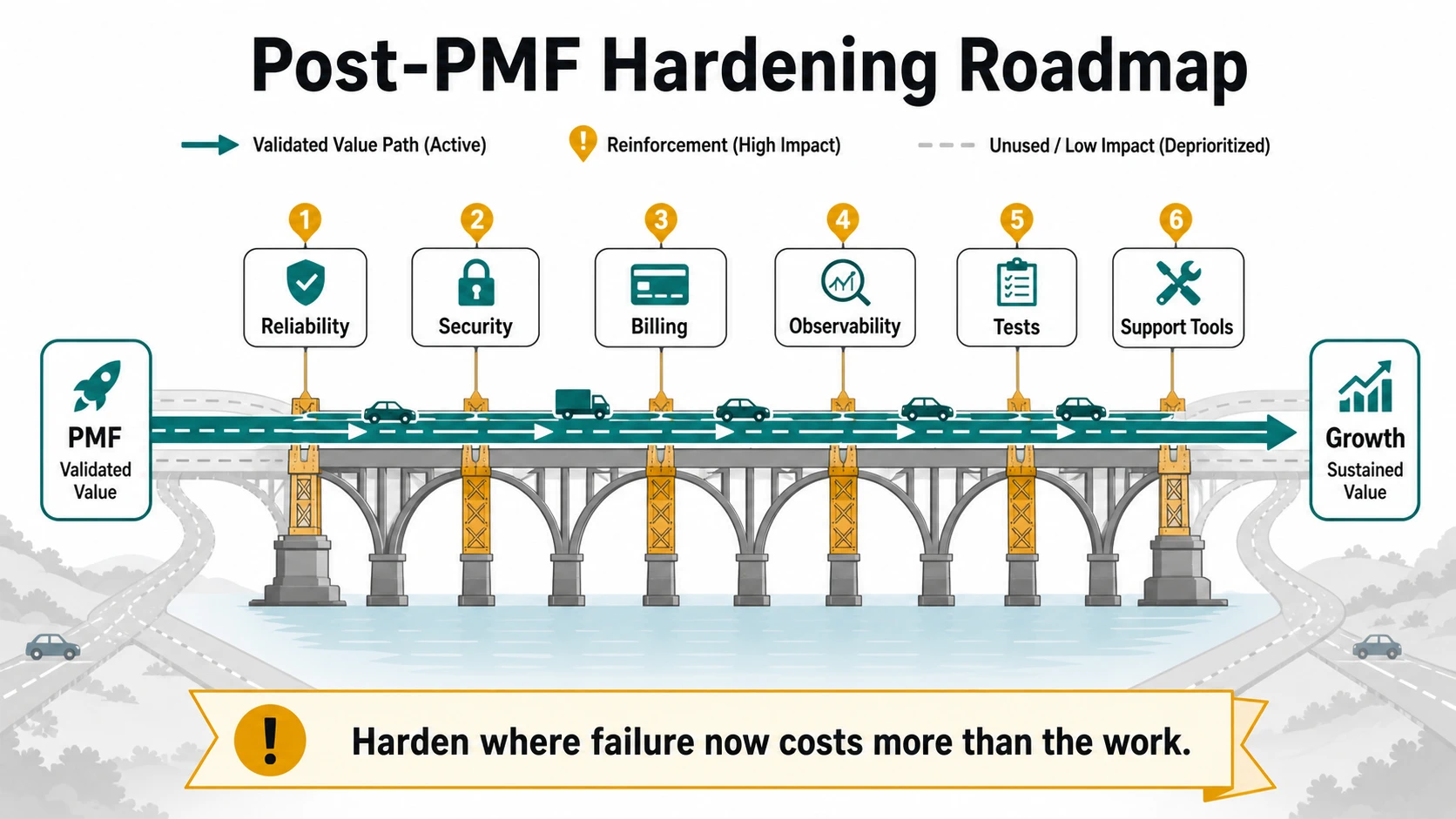
Follow the Load, Not the Backlog
Harden when failure has become more expensive than the hardening work.
The practical unit is one value path for one customer segment. Write it as a chain. For the scheduling product:
Tenant request → vendor assignment → accepted appointment → visit → owner update → closure
Then follow the chain with six questions:
- What must work for a new account to reach first value?
- What must keep working for retained accounts?
- Where does money or plan state change?
- Where is customer data created, transformed, exported, or deleted?
- Where do users, roles, integrations, or administrators cross a trust boundary?
- Where does the founder still repair, explain, approve, or remember something by hand?
This reveals dependency rather than producing a tour of the codebase. The notification failure is urgent because it breaks the retained workflow and forces founder rescue. A slow report may deserve measurement because the largest accounts complain, but not yet a rewrite. A rarely used contractor role may deserve deletion because it confuses access control. A multi-region design can wait; no current promise depends on it.
Use four verbs to keep the roadmap honest: protect a proven promise, instrument an uncertain bottleneck, simplify an unjustified surface, or defer a speculative risk. Hardening can mean a test, a limit, a warning, a runbook, a managed service, or removal. Treating every weakness as a construction project is another way to lose the advantage of being small.
Turn the Incident into a Promise
Reliability is easier to design when it is stated as customer behavior rather than abstract uptime. For this workflow, the promise is:
When a manager assigns a vendor, the system shows whether the notification is pending, delivered, or failed; a failed attempt is visible; and the founder can recover it without creating a second appointment.
That promise demands more than a retry loop. The notification needs a durable identity so a repeated attempt does not repeat the business action. Its state must distinguish queued, attempted, delivered, and failed. Timeouts and provider responses need structured records. An alert must reach the founder when the workflow cannot recover automatically. The operator needs a safe replay action and enough context to tell the customer what happened.
For each load-bearing workflow, define:
- the customer-visible promise;
- the most likely failure modes;
- the signal that tells you the failure happened;
- the recovery path;
- the smallest test that protects the promise;
- the founder action that should no longer require memory.
The same reasoning applies elsewhere. An export promise includes correct data, a visible completion state, and a safe regeneration path. An import promise includes validation before destructive changes and an account-level error report. A deployment promise may include a smoke test of the maintenance path and a rollback procedure. Database backups are only evidence of recoverability after a restore has been tried.
Performance belongs here when delay changes behavior. Measure the value path by account shape and operation before changing architecture: import duration by row count, work-order view latency for large portfolios, notification queue age, and export completion time. A measured bottleneck may justify an index, a query change, a batch limit, asynchronous work, or a clearer product boundary. “The application might become slow” does not.
Trust Lives in Transitions
As the scheduling product gains users, a work order passes among a property manager, staff, a tenant, an outside vendor, and sometimes an owner. “Logged in” is no longer an adequate permission model. Each transition asks a concrete question: who may see a tenant’s contact details, assign a vendor, close the order, change an owner’s visibility, download a portfolio export, or remove a former employee?
Start with the boundaries customers already cross:
- account ownership, invitations, role changes, and offboarding;
- admin actions that affect another user’s data or account state;
- file uploads, exports, deletion, and retention expectations;
- secrets, API keys, webhooks, and third-party integrations;
- billing ownership, plan entitlements, and cancellation behavior;
- sensitive workflow actions that customers may need to explain later.
For each boundary, decide what must be impossible, what needs confirmation, what should leave an audit event, and what can be recovered. Write a role matrix from real actions and test the dangerous edges: cross-account access, invitations, ownership transfer, offboarding, export, deletion, and administrator intervention. Remove roles that cannot be explained. Review secret storage, webhook verification, file access, and third-party credentials where integrations enter the path.
Customers also need an exit. Define what an export contains, who may request it, how it is delivered, how long it remains available, and what deletion means. Test restoration of important records before promising recovery. Documentation here is part of the product: a short, accurate account-ownership or data-retention explanation prevents improvised support answers and gives a later helper something truthful to use.
Compliance preparation should remain equally plain. Keep an accurate data map, vendor list, access model, backup practice, retention policy, and security-answer document. Do not imply a certification, audit, regulatory conclusion, or legal coverage the company has not earned. A clean account of the system is useful preparation; invented maturity is a trust failure of its own.
Money Has Failure States Too
Billing is easy to leave outside the product map. Customers do not experience it outside the product. A failed renewal can remove access while a manager is handling a live maintenance issue; a stale entitlement can provide features that were never purchased; a cancellation can destroy data the customer expected to export.
For the path customers use, trace trial start and end, upgrade, downgrade, renewal, payment failure, cancellation, refund, reactivation, and account-owner change. Include annual contracts and manual invoices when they must agree with product access. Separate the payment provider’s event from the product’s entitlement decision. Make event handling safe to repeat. Give the founder a controlled correction path. Plan changes should not silently destroy records or surprise the user about access, limits, or retention.
Cost has failure states too. The founder should be able to see which accounts and workflows drive notification fees, storage, background work, analytics volume, search indexing, third-party API calls, and support time. Begin with per-account visibility and an alert for unusual growth. Add limits, abuse controls, or graceful degradation where the expensive action can run away. If retained use grows faster than margin, pricing and packaging may need correction before infrastructure does.
Make Failure Legible
The missed appointment stayed invisible until a manager reported it. The first observability question is therefore not which dashboard to buy. It is which customer-impacting states the founder must be able to see and act upon.
Record events at the language of the workflow: work order assigned, notification attempted, provider accepted, delivery failed, retry scheduled, appointment acknowledged. Attach account, work-order, recipient, attempt, and correlation identifiers without leaking secrets or sensitive content. From those events, a compact internal timeline can answer: What happened? Who was affected? Is the state still unsafe? Which recovery action is available?
Alerts should name customer impact and point to an action. “Queue error count high” asks the founder to investigate the monitoring system. “Vendor notifications for three active work orders have exhausted retries; review and replay here” begins an operational response. A short runbook can define the check, recovery, customer communication, and escalation boundary.
Product analytics has a different job. Operational events explain whether the promise was delivered; product events show whether the value path is being used and where it stalls. Keep the distinction even if both live in one tool. The founder needs to know whether accounts reach assignment, whether vendors acknowledge, whether work orders close, and whether account size changes latency or failure. Analytics should guide a product or capacity decision, not merely make activity visible.
Repeated support makes the same state useful in another form. Account search should show owner, plan, roles, recent workflow events, billing state, and risky conditions. Safe actions might include resending an invitation, replaying a failed notification, regenerating an export, or correcting an entitlement with an audit event. These admin tools need stronger permission and logging than ordinary features precisely because they can cross customer boundaries.
Support tooling is not a detour when it removes repeated diagnosis and repair from the founder’s memory. It is also the groundwork for the next chapter: another person cannot safely help with an opaque system whose only interface is the founder’s production access.
Test and Document the Promises
Post-PMF testing should follow the consequences of failure. A small set of high-signal tests can protect more value than broad coverage of low-risk code. Test the import that activates each account, the permission boundary between customers, the notification job’s duplicate and partial-failure behavior, the billing transition that changes access, the export used during renewal, and the migration that touches any of them.
Useful layers include:
- smoke tests for the activation path;
- regression tests for billing, permissions, exports, and core workflow state changes;
- job tests for retries, duplicate events, and partial failures;
- migration checks for data shape and rollback assumptions;
- manual release checklists for risky changes that are not worth automating yet.
The suite must remain fast and trustworthy enough to run. A manual release check is a valid bridge when the risk is understood but automation would cost more than it protects. Write down the bridge and the condition that will justify replacing it. Otherwise temporary care becomes founder folklore.
Documentation belongs beside the controls. Keep a release and rollback note, restore procedure, billing-correction procedure, role definitions, data-export policy, incident response steps, and explanations for recurring customer questions. These are not a documentation program. They are the minimum memory the product now requires.
Write the Roadmap in Customer Language
The founder now has more justified work than can be done at once. The roadmap should preserve sequence. A filled version for the scheduling product might read:
POST-PMF HARDENING ROADMAP: MAINTENANCE COORDINATION

Value path
  Tenant request -> vendor assignment -> accepted appointment -> visit
  -> owner update -> closure.

Protect now
  Vendor notifications. Retained accounts depend on them for appointments.
  Add durable delivery state, safe retries, exhausted-retry alerts, an account
  event timeline, and regression tests for duplicate and partial failure.

Trust boundary
  Managers, staff, tenants, and outside vendors see different parts of a work
  order. Write the action-level role matrix, remove the ambiguous contractor
  role, and test cross-account access, offboarding, export, and admin actions.

Instrument
  Measure work-order latency by portfolio size and per-account notification
  cost before changing the application or queue architecture.

Simplify
  Retire the little-used custom notification rules that create delivery paths
  the founder cannot inspect or support.

Operational memory
  Document replay, customer communication, restore, release rollback, billing
  correction, and data-export handling.

Defer
  Multi-region deployment, a generalized workflow engine, commercial-property
  permissions, and dashboard redesign.

Stop condition for this cycle
  Finish when notification failures are visible, safe to recover, protected by
  tests, and no longer require raw-log diagnosis. Re-rank from fresh evidence.
The first item names the customer promise, the evidence that made it load-bearing, the failure cost, and a stopping condition. The roadmap also makes room for performance, cost, permissions, billing, data, compliance preparation, and future scaling bottlenecks without pretending that all of them are equally urgent.
Sequence work so that it reduces risk while creating information. Make the immediate failure visible before redesigning its architecture. Add the recovery path before optimizing rare cases. Remove unjustified branches before testing them. Put limits around uncertain load before building for imagined demand. After each bounded cycle, revisit the value path: usage may have exposed a new bottleneck, or a surface once considered core may have proved disposable.
What to Leave Soft
Hardening requires restraint. Some parts of the product should remain soft because the market evidence is still soft.
Leave a surface soft when:
- only one prospect has requested it;
- it belongs to a segment you may not serve;
- the workflow is still changing weekly;
- a manual step is still teaching you something important;
- deletion would be cheaper than durability;
- a lighter limit, warning, or runbook handles the risk for now;
- the work exists mostly to make the product feel more mature.
Restraint is part of the engineering. Hardening everything equally hides the value path and grants unused features the same claim as revenue-critical workflows. Delaying permissions, recovery, billing, deletion, or export work can create avoidable harm; building speculative capacity can consume the time needed to address it. Dashboards that do not shorten diagnosis are decoration. Tests around complexity that should have been removed preserve the wrong product. Usage growth without cost visibility can turn success into a margin emergency.
The aim is not a product that cannot fail. It is a product whose important promises are known, whose likely failures are visible, and whose recovery does not depend on founder heroics.
Make One Promise Durable
Choose one value path for one segment. Write the sequence from first customer action to retained outcome.
Then fill this compact hardening memo:
- Value path:
- Evidence that it is load-bearing:
- Customer promise:
- Failure modes that now matter:
- Trust boundaries:
- Billing or cost exposure:
- Repeated founder intervention:
- First protect-now task:
- First instrument task:
- First simplify or delete task:
- Explicit deferrals:
The exercise is complete only when the first protect-now task names the customer value it protects, the failure it prevents, the recovery it enables, and the condition under which this hardening cycle can stop.
The founder does not need to make every road permanent. Only the road carrying real traffic needs a bridge. Once that crossing is dependable enough to operate without constant rescue, some of its work may finally be clear enough to hand to another person.