Appendix N: Illustration System for the Future Book
Design AI-system illustrations that encode boundaries, uncertainty, agency, evidence, controls, and consequences without implying magic or false precision.
Draw the System Claim, Not the AI Mood
A product review shows a glowing brain at the center of a customer-service workflow. The image is polished, but it hides the retrieval corpus, the operator, the escalation route, and the fact that the system may abstain. Viewers remember intelligence and inevitability; they do not remember how the service actually works or where it can fail.
An illustration in this handbook earns its place by helping a reader retrieve a system claim. It should reveal boundaries, movement, uncertainty, decisions, controls, or consequences that prose alone makes hard to hold in working memory. The illustration system therefore begins with a retention target, not an art style.
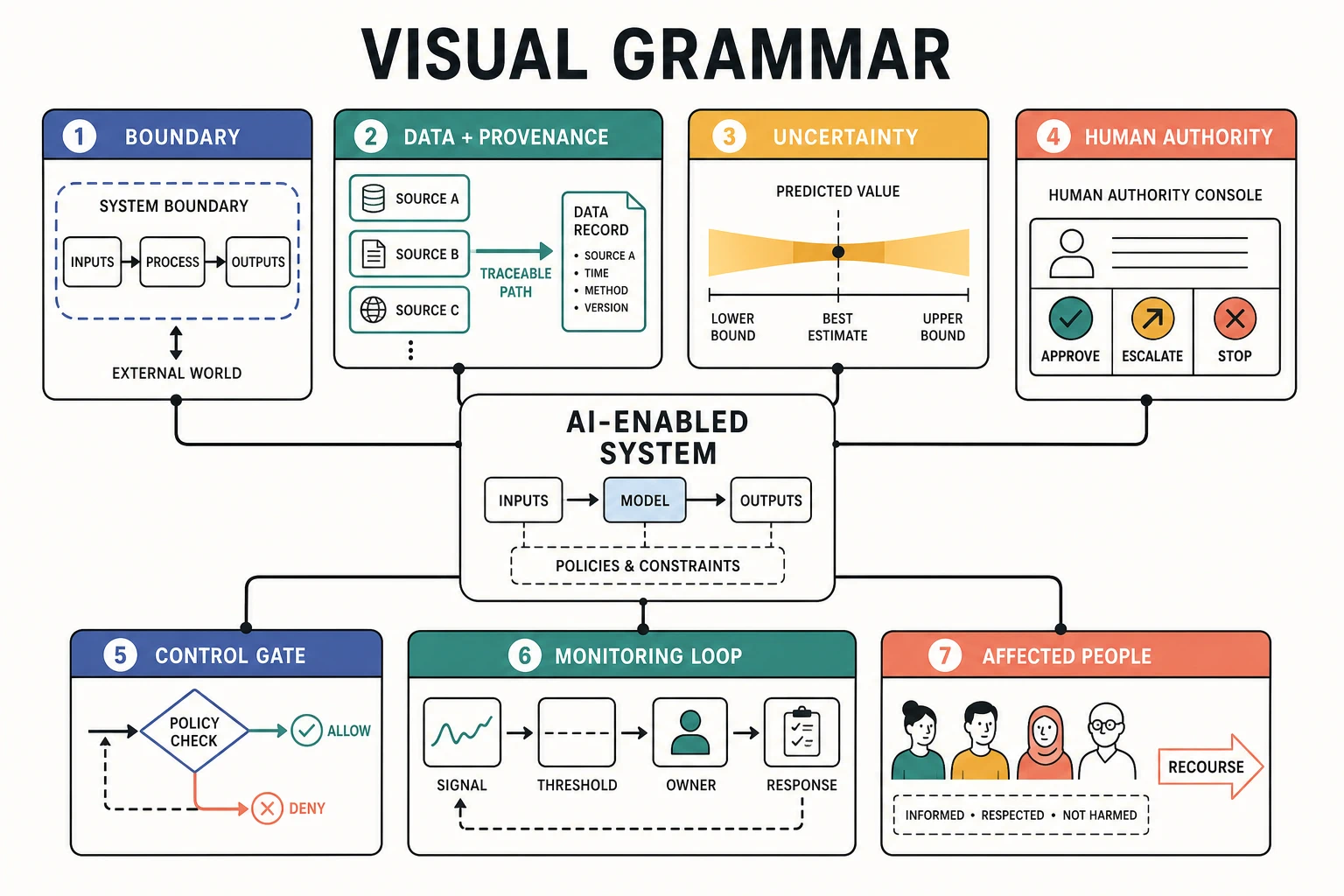
The Visual Grammar
Use recurring cues consistently enough that readers can interpret a new diagram without relearning the legend.
| System idea | Visual treatment | Required information | Avoid |
|---|---|---|---|
| System boundary | Labeled container with inputs, outputs, owners, and external dependencies | What is inside, outside, trusted, and controlled | A model floating without context |
| Model | Bounded engine, service, lens, or transformation block | Version or role; never implied authority | Brain, oracle, consciousness, magic glow |
| Data and evidence | Source-to-use chain with provenance, filtering, and access markers | Origin, transformation, permission, destination | Featureless data cloud |
| Uncertainty | Range, distribution, confidence band, competing paths, or explicit unknown state | What varies and what decision uses it | Decorative blur or a precise-looking single number |
| Evaluation | Comparison bench, test matrix, threshold line, or stress rig | Claim, dataset, segment, measure, floor | Trophy score without context |
| Human agency | Person at a named decision point with evidence, time, action, and fallback | Authority and consequence of intervention | Passive observer watching automation |
| Control | Gate, limit, permission boundary, circuit breaker, or deny path | Trigger, allowed action, blocked action, owner | Shield icon with no mechanism |
| Monitoring | Signal-to-decision feedback loop | Signal, threshold, responder, action | Dashboard decoration |
| Harm and impact | Trace from system behavior to an affected person or institution | Exposure, concentration, reversibility, remedy | Anonymous warning triangle |
| Lifecycle | Versioned stages with evidence gates and retirement | Entry, exit, owner, record | Endless circular arrows implying automatic improvement |
Color may reinforce these roles, but it must not carry them alone. Pair color with labels, shape, line style, position, icons, or patterns. Use readable type, strong contrast, generous spacing, and a logical reading order that survives mobile scaling and grayscale printing.
Choose the Aid From the Reader’s Retrieval Job
Start every commission by completing one sentence: “After closing the page, the reader should be able to reconstruct ___.” The blank must contain something testable. “The AI lifecycle” is a topic; “where evidence can stop a release as a system moves from proposal to retirement” is a retrieval job.
Then choose the smallest form that preserves the relationship the reader needs. Use a boundary map to locate parts and ownership, a numbered flow to rehearse a sequence, or a decision map when stop and escalation paths matter. A state diagram can make an invariant visible—for example, that tool execution always follows identity, policy, approval, and limit checks. Use aligned small multiples when the lesson depends on comparing threshold choices across error, workload, delay, and harm. For diagnosis, trace one symptom through cause, correction, and test rather than drawing a generic failure cloud.
Sometimes the right answer is no image. A short table is better for exact comparison; a code or state trace is better when order is the lesson; prose is better when qualification and causality matter more than spatial memory. A mandatory illustration quota produces decoration. A retention test produces instruction.
Illustration Commission Brief
ASSET IDENTITY
Book / part / chapter:
Asset name and intended file path:
Placement, display width, and reader mode:

CLAIM AND RECALL
Retention target: After closing the page, the reader can reconstruct...
One-sentence system claim:
Decision, invariant, sequence, boundary, trade-off, or failure this makes visible:
Why prose, table, or code alone is insufficient:

COMPOSITION
Required elements, actors, owners, and versions:
Reading order, transitions, and feedback:
Control, escalation, fallback, and stop path:
Uncertainty or missing evidence and the action it changes:
Affected people, consequence, and remedy:
Color roles plus non-color cues:
Exact labels and any legend:
What must not appear or be implied:

ACCESSIBILITY AND PRODUCTION
Alt text draft:
Caption draft:
Mobile, grayscale, and reading-order constraints:
Raster dimensions, format, and source or generation record:
Long description or text equivalent if needed:

REVIEW
Subject-matter reviewer:
Accessibility reviewer:
Recall prompt, asked without the caption:
Revision triggered by the first recall test:
Final file and version:
Make Uncertainty and Agency Honest
Uncertainty needs a referent. A confidence band should state what varies; a forked path should show which evidence chooses the path; an “unknown” state should show what action follows. Do not apply haze or randomness merely to signal that AI is probabilistic.
Human oversight also needs mechanics. Show what the reviewer sees, when they enter, which actions they can take, and what happens after escalation or override. A person-shaped icon beside an automated pipeline does not demonstrate meaningful control.
Represent affected people as participants with context, recourse, or consequences—not as a homogeneous crowd of inputs. Avoid stereotypes, biometric surveillance aesthetics, and imagery that turns vulnerability into atmosphere.
Worked Review: The Agent Autonomy Ladder
Suppose the retention target is: “After closing the page, the reader can name the additional evidence and control required before an agent receives more action authority.” The first draft shows five robots increasing in size from “assistant” to “autonomous.” Asked what changed between the third and fourth level, reviewers remember only that the robot became more powerful. The image communicates power, not control, and implies that greater autonomy is a natural destination.
The revision uses five lanes. Each lane names permitted actions, required approval, credential scope, time and cost limits, observability, and a recovery path. A side rail shows increasing blast radius. Between lanes, a gate names the evaluation and control evidence required to proceed; a failed gate leads sideways to the current authority level rather than upward.
Now remove the caption and ask a reviewer to explain why the system cannot advance. If the answer names the missing evidence and the action that remains blocked, the composition is teaching. If the answer is merely “the next level is riskier,” revise again. The robots were not stylistically wrong. They were instructionally empty.
Review the Memory, Then the File
Begin with the image alone. Ask a representative reader the recall prompt from the brief. Do not rescue the asset with its caption. Listen for the controlling claim, then ask the reader to point to the marks that carry it. Any major element that cannot be connected to the chapter’s prose or artifact is a candidate for removal. Any boundary, owner, flow, control, or uncertainty that the reader must guess needs a label or a different composition.
Next, challenge the implication. Does the image grant the model authority it does not have? Does a human figure possess information, time, an available action, and a fallback, or merely witness automation? If the system can abstain, escalate, fail closed, or return to a safer state, can the reader see that path? Trace consequences to affected people without reducing them to anonymous risk symbols.
Finally, inspect the delivered file at its real mobile width and in grayscale. Labels must remain readable, reading order must survive, and color must repeat information expressed by shape, line, position, pattern, or text. Alt text should convey the information available in the image; the caption should explain the claim worth remembering rather than inventory every mark. Record the source or generation method, dimensions, final path, and version so the asset can be reviewed and replaced without ambiguity.
The image is ready when a reader can reconstruct the intended claim without being coached and the file preserves that claim across its actual reading conditions. Polish cannot compensate for a failed recall test.
Apply this system alongside AI Product Requirements, Human-Centered AI Design, and the AI Launch Readiness Checklist.