AI Systems Handbook / Chapter 15
Model Documentation and Release Discipline
Release AI components only with versioned evidence, intended-use boundaries, limitations, controls, approvals, monitoring, and rollback ownership.
Preparing audio…
Audio edition
Model Documentation and Release Discipline
The Model Passes. May the System Ship?
A document classifier is ready for a claims workflow. Its evaluation report shows better routing accuracy than the existing rules and human queue. The proposed model card names the artifact, four supported document classes, and the aggregate score. The release request looks complete until a reviewer asks what happens to low-confidence documents overnight.
Nobody knows. The model abstains as designed, but the manual queue has no overnight staff. A technically successful model would create an operational failure precisely where its caution is supposed to protect the workflow.
That finding changes the release: the team approves a daytime pilot for two document sources, keeps the current rules elsewhere, and makes expansion conditional on reviewer capacity or a safer threshold design. The model did not fail its evaluation. The release packet failed to describe the system in which the result would have consequences.
Release discipline binds an exact system configuration to its evidence, limits, controls, decision owners, and rollback path. Documentation earns its place by making approval, refusal, constraint, monitoring, and reversal possible.
Give Each Artifact One Job
A model card answers whether a particular model is fit for a stated use. It covers the model and any adaptation, the evidence used to assess it, and the limits of that evidence. A data card answers what shaped and tested the model: provenance, rights, coverage, quality, labeling, and lifecycle. Neither describes what happens when software, thresholds, people, and controls interact.
That is the system card’s job. It records the end-to-end workflow, architecture, data flows, human authority, controls, operational evidence, and residual risks. The release record then answers the narrowest and most consequential question: which exact approved configuration entered an environment, under what scope, with which rollback target?
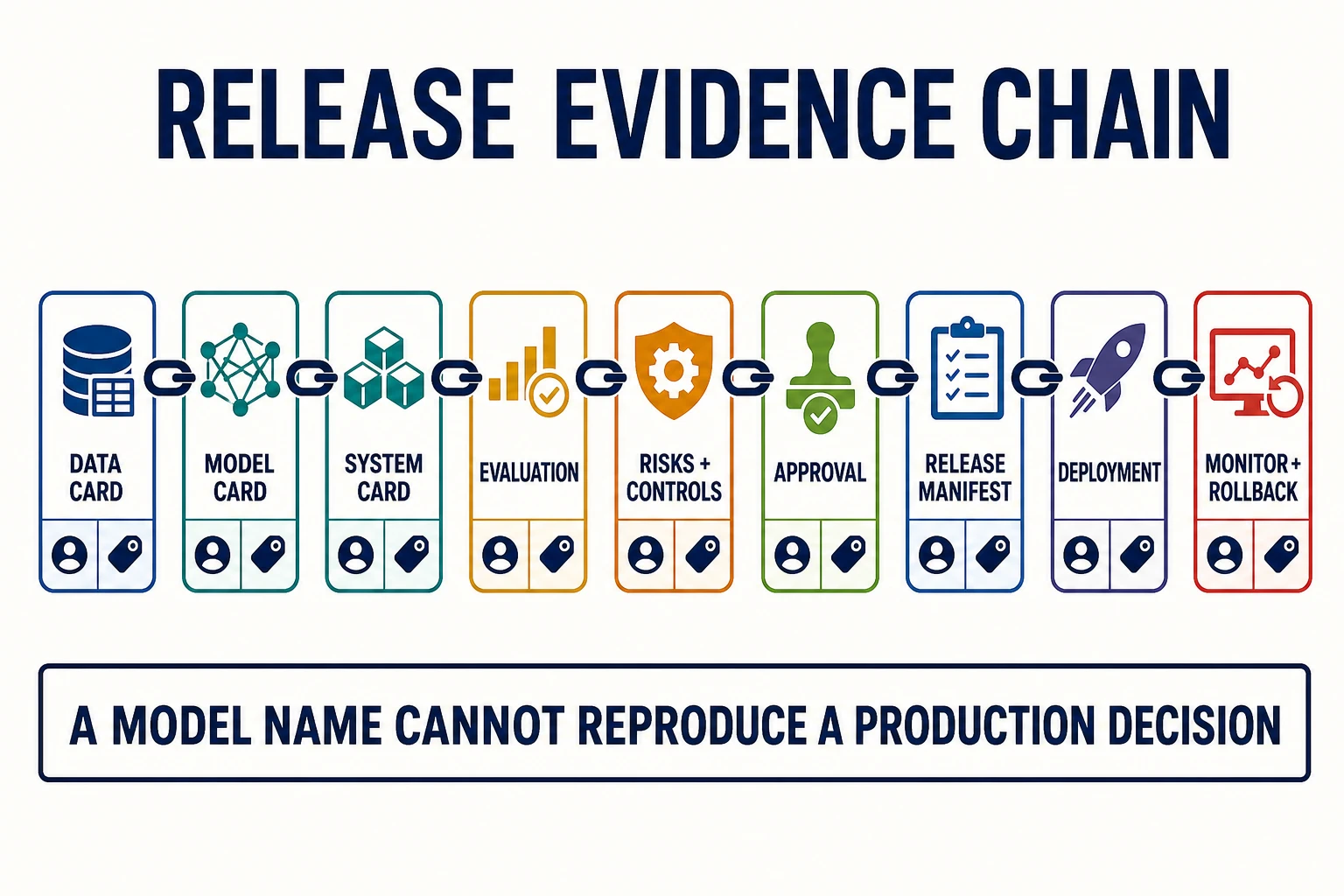
Link these artifacts instead of copying them into a master document that immediately drifts. The release record should identify the approved card and report versions; each underlying artifact should remain understandable without the release record.
Define the Release Unit
The claims team’s first task is to define what it is actually releasing. For a conventional predictive service, the unit may include model weights, feature code, threshold policy, label map, runtime image, and serving configuration. Restoring old weights while retaining the new threshold or label map does not restore the old behavior.
For a generative or agentic system, include:
- base model and provider endpoint version or alias;
- fine-tuning checkpoint or adapter;
- system and developer prompts;
- few-shot examples;
- retrieval corpus snapshot, index, embedding model, chunker, and reranker;
- tool definitions, credentials scope, permissions, approval policy, and sandbox;
- safety policy, filters, validators, and refusal behavior;
- application code, dependencies, feature flags, and routing;
- evaluation suite, judge or rater configuration, thresholds, and results;
- monitoring rules, dashboards, and incident runbook.
The governing test is simple: if a component can change behavior, it belongs in the release unit and needs a version or immutable identifier, a change owner, and a way to restore a known combination. This is why “claims classifier v1” is not an adequate production identity.
Write a Decision-Grade Model Card
A decision-grade model card gives the reviewer enough bounded evidence to accept, reject, or constrain use. For the claims classifier, it should include:
- Identity: name, version, type, owner, supplier, license, artifact integrity.
- Intended uses: tasks, users, environments, input conditions, action boundaries.
- Out-of-scope uses: unsupported populations, domains, languages, autonomy, and prohibited uses.
- Data summary: training, adaptation, and evaluation provenance at the appropriate disclosure level.
- Performance: metrics, thresholds, uncertainty, baselines, segments, and error analysis.
- Robustness: shift, stress, adversarial, missing-input, and dependency tests.
- Fairness and impact: relevant segment results, affected parties, limitations, mitigations.
- Safety, security, and privacy: threat assumptions, controls, testing, residual risk.
- Interpretability and explanation: methods, audience, limits, known instability.
- Deployment constraints: hardware, latency, throughput, region, access, dependencies.
- Monitoring: leading indicators, quality signals, blind spots, review cadence.
- Limitations: credible failures and conditions where evidence is absent.
- Approval and history: reviewers, status, dates, changes, superseded versions.
The headings alone prove nothing. “Bias tested,” “enterprise safe,” and “high accuracy” conceal the decision a reviewer needs to make. Name the test, dataset, segment, threshold, date, version, result, and remaining limitation. When disclosure must be limited for security, privacy, or supplier reasons, state the disclosure boundary and give the reviewer a controlled route to the evidence.
Document the Composed System
A system card follows the classifier into the claims operation. It should explain:
- system purpose and non-AI baseline;
- users, affected parties, and action path;
- architecture and trust boundaries;
- data flows, access controls, and retention;
- prompt, retrieval, tool, and policy composition;
- human review, override, escalation, appeal, and fallback;
- component and end-to-end evaluations;
- abuse cases and security tests;
- operational metrics, incident response, and change rules;
- residual risks and accountable risk owner.
The overnight queue appears only at this level. Document where the system can abstain, what receives the abstention, and what happens when that destination is unavailable. A confidence score does not create meaningful oversight unless reviewers have time, evidence, authority, and a safe alternative.
Make Limitations Operational
“May produce inaccurate output” is not a useful limitation. Write each limitation as:
condition -> observable symptom -> consequence -> detection -> control -> owner
Example:
Documents scanned below the supported resolution
-> key fields are omitted or merged
-> payment details may be assigned incorrectly
-> image-quality check and field-evidence mismatch
-> reject automatic processing and route to manual verification
-> document operations owner
The same form exposes the claims release’s missing control:
low-confidence document arrives outside staffed hours
-> classifier abstains and the queue age rises
-> time-sensitive correspondence may miss its service target
-> abstention-volume and oldest-item alerts by shift
-> keep overnight traffic on current rules; page the queue owner before breach
-> claims operations owner
A useful limitation changes tests, monitoring, scope, or staffing. If the team cannot detect a severe limitation, automatic action may be inappropriate.
Let the Gate Change the Release
The claims review begins by freezing the candidate: model artifact, feature code, label map, thresholds, runtime, data and evaluation snapshots, and monitoring configuration. Reviewers can now tell whether every reported result belongs to the candidate rather than to a nearby experiment.
They inspect evaluation isolation, representative source and language slices, severe misroutes, calibration, uncertainty, and known gaps. The model card bounds the model’s fitness; the data card explains the selective historical labels; the system card reveals optical character recognition, routing thresholds, reviewer queues, access, correction, appeal, and monitoring. Failure modes acquire preventive, detective, and corrective controls with named owners.
The gate then tests operation, not just prediction: capacity, latency, access, fallback, rollback, alerts, incident evidence, and the human workflow. That is where the overnight capacity gap defeats the proposed full launch. Required product, technical, data, security, privacy, risk, legal, and domain reviewers vary with the system’s consequences, but every required reviewer must be able to impose a condition or refuse release.
The signed decision records the narrower daytime pilot, two allowed sources, residual risk, a six-week expiry, and provider-version change as a mandatory reassessment trigger. Deployment proceeds progressively. Post-deployment reconciliation confirms that the live versions, permissions, logs, alerts, and routing scope match the manifest. A mismatch pauses or reverses the release; it does not become undocumented production reality.
Documentation written after deployment may describe what happened, but it cannot support the decision that already exposed users. Draft evidence during development and freeze it with the candidate at the gate.
Build an Immutable Release Manifest
The release manifest binds the decision to an operable configuration. It should be machine-readable where possible and human-reviewable always:
release_id: claims-route-2026-07-10.1
environment: production-pilot
scope: two document sources, daytime routing, no claims decision
model: provider/model-version-or-artifact-digest
adapter: adapter-digest-or-none
features: feature-code-and-label-map-revisions
data: training-and-evaluation-manifest-ids
thresholds: source-and-class-threshold-policy
application: commit-and-image-digest
evaluation: report-id-and-threshold-policy
approvals: signed-decision-record-ids
monitoring: dashboard-alert-runbook-revisions
rollback: last-known-good-release-id
expires_or_reviews: date-and-trigger-list
Do not put secrets or sensitive data in the manifest. Store identifiers that resolve through controlled systems. Signing the manifest attests to a bounded release; it does not turn uncertain evidence into certainty.
Control Provider and Dependency Changes
The provider cannot promise that the classifier’s endpoint alias will remain fixed. The release therefore cannot honestly record the alias as a version. Model aliases, managed safety filters, embedding services, parsers, and hosted indexes may all change outside the application repository. Inventory each mutable dependency and classify it as:
- pinned and immutable;
- versioned with notice;
- versioned without guaranteed notice;
- alias that may move;
- opaque managed behavior.
For dependencies that cannot be pinned, substitute detection and containment for imaginary control: scheduled regression evaluation, response fingerprinting where appropriate, contract notice, canary exposure, feature flags, routing to a known alternative, and authority to pause. The manifest must say what can move, how the team will notice, and what it can do next.
Treat Thresholds and Prompts as Material Changes
A threshold changes who is acted on. A prompt can change the task, tone, evidence use, refusal, or tool choice. A corpus update can change answers without changing code. A policy-filter update can alter access or refusal rates.
Classify changes by consequence. A typo in internal documentation needs review and a record, not a new system evaluation. A formatting-only prompt edit with demonstrably stable parsed output may need a targeted regression and approval. A model, threshold, prompt-logic, corpus-source, adapter, policy, or tool-permission change normally reopens the relevant evaluation and release gate. During active harm, a security event, or a provider incident, contain or roll back first, preserve evidence, and conduct the expedited review from a safe state.
Materiality depends on consequence, not file size. One character in a threshold can matter more than a large refactor. The team must also consider changes in context: reviewer staffing, document sources, affected populations, regulations, and downstream actions can invalidate a release while every file remains untouched.
Test the Packet by Trying to Reject It
Suppose another team inherits the claims release. It should be able to identify the exact production combination, understand why only two sources and daytime operation were approved, inspect the evidence and unsupported cases, see which limitations have controls, and restore the complete last-known-good configuration. It should know which aliases remain mutable and which event forces reassessment. Most importantly, it should be able to refuse the next release without reverse-engineering the first one.
Now draft a model card for a document classifier—or inspect one already in use. Begin with a concrete proposed deployment, not the model in isolation. Remove one piece of release information at a time: the label-map version, source coverage, language slice, abstention destination, overnight staffing assumption, provider change behavior, or rollback target. For each omission, name the decision that becomes unsafe or impossible. Then decide whether the missing fact belongs in the model card, data card, system card, evaluation report, or release record.
If every answer is “model card,” the system boundary is still missing. If the packet cannot support a refusal, it is marketing or inventory, not release evidence.
Chapter 14 changed the smallest behavior-owning layer that evidence justified. This chapter freezes that layer with every other behavior-changing component and binds the result to a bounded decision. The next chapter follows the release through operation, change, incident, reassessment, and retirement; each later decision can now refer to a known system rather than to a model name that slowly lost its meaning.
Source Notes
- Model Cards for Model Reporting, the foundational proposal for documenting intended uses, evaluation context, performance by relevant groups, and limitations; verified 2026-07-10.
- Datasheets for Datasets, the complementary documentation framework for the evidence used to build and evaluate models; verified 2026-07-10.
- NIST AI RMF Core, lifecycle guidance for documentation, measurement, monitoring, accountability, risk response, and change; verified 2026-07-10.
- NIST AI RMF Generative AI Profile, generative-system documentation and provenance actions for model adaptation, data, evaluation, and risk management; verified 2026-07-10.