Case Study 5: Hiring Workflow Assistant
Constrain hiring AI to auditable support tasks and protect employment decisions with relevance, fairness, transparency, human authority, and appeal.
The Candidate Nobody Rejected
This modeled case begins with a pilot for a technical-support role. The hiring assistant extracts qualifications from application materials, writes a short profile, and places profiles that appear to match the job near the top of a recruiter’s review queue. The product owner describes the feature as summarization. It cannot reject anyone, and every recorded employment decision still belongs to a person.
One applicant’s résumé uses a two-column layout. The parser drops the column containing incident-response work, and the summary omits the applicant’s strongest evidence for the role. The profile enters the queue near the bottom. Over several busy days, recruiters open enough applications to fill the interview slate but never reach this one. Only after the applicant asks about the missing experience does a recruiter open the original document and find it.
Nobody rejected the applicant. The system decided which evidence would be seen soon enough to matter.
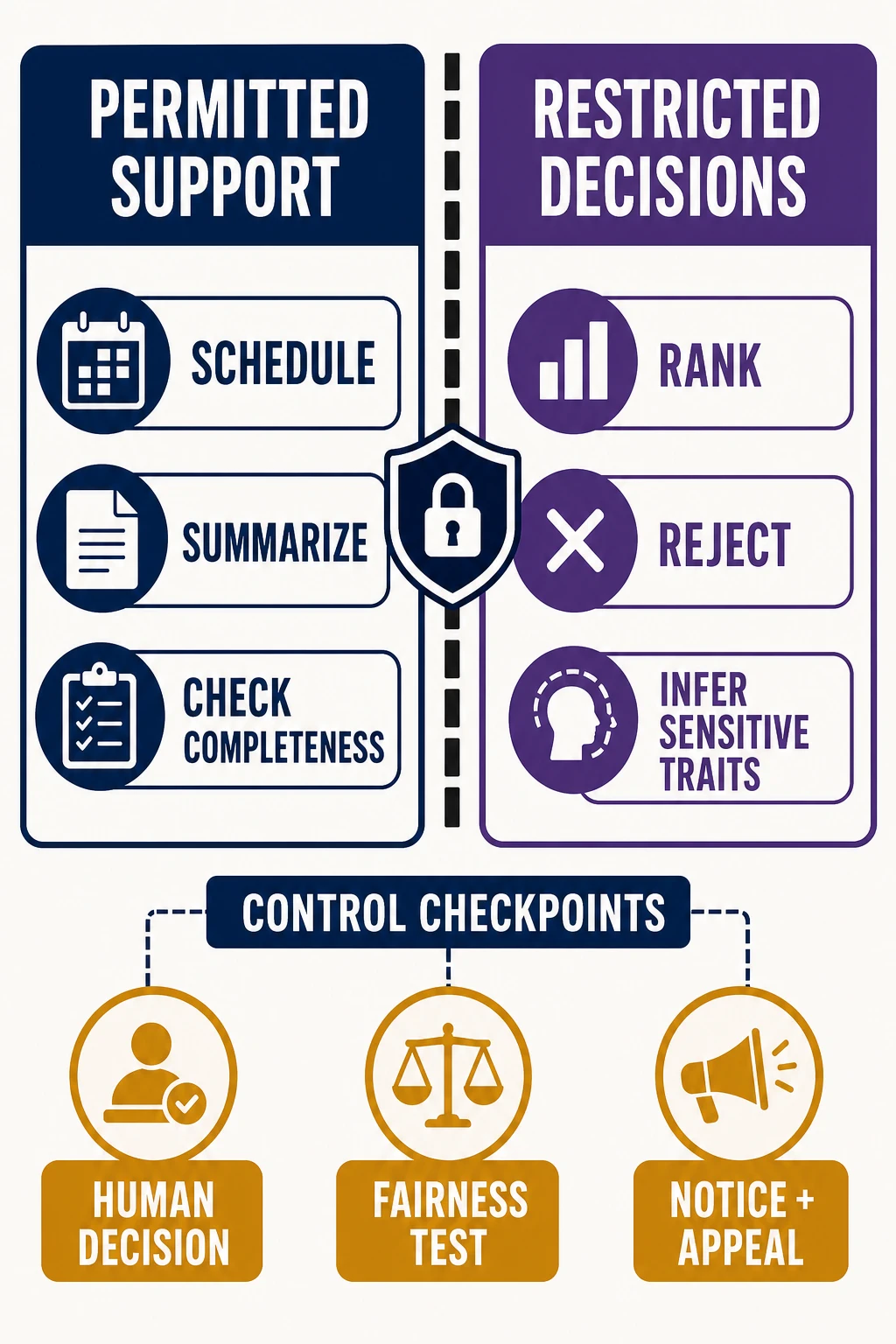
The pilot pauses while the team restates the use case: reduce clerical work through scheduling, source-linked summaries, and completeness checks; do not rank, reject, infer sensitive traits, handle accommodation information, or decide who receives consideration. A human decision at the end of a model-shaped queue is not meaningful human authority.
Start With the Queue the Assistant Must Beat
Before the pilot, recruiters work from a declared job rubric and the original application materials. Applications are assigned by a deterministic rule rather than predicted fit. Review is imperfect: formats vary, duplicate entry consumes time, missing fields cause follow-up, and evidence can be overlooked. Yet the baseline makes two useful properties visible. Every submitted application has a route to review, and the reviewer can distinguish the applicant’s evidence from an interpretation of it.
The candidate system must improve that complete process, not merely reduce seconds spent on the profiles a recruiter happens to open. The comparison includes time to a completed review, applications left unopened, corrections, accessibility failures, accommodation handling, complaints, and how often relevant evidence reaches the rubric. If summaries make early files faster to scan while quietly stranding the rest, average handling time has concealed a loss of opportunity.
The impact assessment therefore traces attention as carefully as a formal decision. It follows sourcing, application, screening, assessment, interview, selection, offer, and correction. At each step the team asks what the system displays, hides, orders, delays, or makes the default. Applicants, recruiters, hiring managers, interviewers, accommodation staff, vendors, and independent reviewers encounter different consequences from the same output.
The first boundary is intentionally modest. Scheduling may use declared availability and deterministic rules. A completeness check may identify an absent required field without judging the answer. A summary may organize evidence supplied for the application, provided each material statement points back to its source and uncertainty remains visible. The assistant cannot generate a fit score, recommendation, shortlist, rejection reason, compensation proposal, personality judgment, or inference about health, disability, emotion, protected characteristics, or willingness to accept poor conditions. Accommodation information travels through its established restricted process, not through the general summarization path.
Applicable employment, equality, disability, privacy, labor, procurement, and automated-decision rules depend on the jurisdiction and the actual influence of the tool. Qualified specialists must review the deployed workflow, notices, assessments, consultation duties, records, accessibility, and applicant rights before use and after material change. Calling the output a summary does not settle that analysis.
Preserve Evidence Without Manufacturing Preference
The failed design treated extraction, interpretation, and presentation as one convenient feature. The repaired system separates them.
An intake service binds each file and form response to the correct application. A parser records what it could read, which regions it could not interpret, and whether the document structure may have lost meaning. The summarizer may transform only readable, in-scope material. Each summary statement carries a source link; unsupported claims are blocked, uncertain extraction is labeled, and an incomplete parse prevents the summary from becoming the default view.
The application record stores the original material, extraction state, summary, corrections, and version history as distinct objects. It does not use a candidate’s name, photograph, inferred traits, social-media activity, or historical hiring outcome as evidence of suitability. Criteria come from the work and the declared rubric. Past hiring decisions are observed institutional choices, not trustworthy labels merely because they already exist in a database.
Presentation is part of the control boundary. The interface does not sort by a model output, place a persuasive badge beside selected profiles, create an unexplained “recommended” tab, or make a generated rationale easier to read than the source. Work allocation follows the declared deterministic queue. Within an application, the reviewer sees parse warnings and source-linked evidence before any polished conclusion. The original remains one action away, and a correction does not require overriding a model’s score because no such score exists.
Recruiters record evidence against the same job rubric independently of the generated summary. They may correct or discard the summary, return to the ordinary workflow, and flag a recurring extraction problem. Hiring managers own the job criteria and employment judgment; they cannot ask the assistant for a rationale it has no authority to produce. Human authority here means preserving a person’s practical ability to encounter the evidence and decide from it, not adding an approval click after the system has allocated attention.
Test the Path From Submission to Consideration
Evaluation begins with record integrity. Tests cover application identity, file boundaries, access control, retention, deletion, and separation of accommodation information. A wrong-person attachment or disclosure blocks release regardless of summary quality.
The next layer challenges parsing and summarization with representative application formats, languages in scope, assistive-technology output, long work histories, nontraditional evidence, scans, tables, multi-column layouts, malformed files, and deliberately incomplete material. Reviewers distinguish unsupported additions, material omissions, wrong attribution, chronology errors, broken source links, and detected parse failures. They record severity and context instead of compressing these failures into one similarity score. The incident in this case becomes a regression test: the missing column must cause an explicit incomplete-parse state, never a confident profile.
Then the team tests the interface and the human-system pair. In a shadow phase, the assistant cannot alter the live queue. Reviewers compare what people inspect and record with and without summaries. They look for position effects, premature stopping, automation bias, skipped source material, correction burden, consistency of rubric use, and applications left unopened. A later bounded pilot preserves the deterministic allocation rule and measures the full workflow, including time to completed review rather than time per opened profile.
Fairness analysis follows both error and opportunity. The team examines whether extraction failures, omissions, review completion, progression, and correction outcomes differ across relevant groups and intersections, using a lawful and privacy-preserving analysis plan. Sample size, missing group information, uncertainty, and multiple comparisons remain visible. Aggregate parity cannot establish that the criteria are job-related, the process is accessible, accommodation works, or applicants can challenge material errors. Those questions require qualitative review and direct testing as well as quantitative measures.
Adversarial cases include instruction-like text embedded in a résumé, attempts to elicit sensitive inferences, fabricated credentials, identity mismatch, unusual Unicode, vendor changes, and a manager asking the system to produce a covert rank order. Refusal is part of correct behavior. So is a plain failure state when the source cannot be read reliably.
Release gates follow consequence. An identity mismatch, unauthorized disclosure, hidden ranking path, sensitive inference, inaccessible required step, or material omission that can pass as a complete summary stops the pilot. Lesser defects have explicit limits and sampling requirements. No average time saving compensates for a control that systematically removes some applications from effective consideration.
Correction Must Restore Opportunity
When the applicant reports the missing experience, the team does more than repair the summary. It preserves the original file, parser result, summary version, queue position, display events, recruiter actions, model and vendor versions, and later correction under appropriate access and retention rules. HR determines whether the error changed the applicant’s opportunity and restores consideration through a process that does not penalize the applicant for reporting it. The applicant receives a human response rather than an explanation generated by the same system under review.
The investigation asks where evidence disappeared and how that omission shaped attention. Here, the parser lost a column, completeness monitoring checked form fields but not document regions, the summary carried no visible uncertainty, and the queue used the summary as an ordering signal. Improving résumé extraction addresses only the first failure. The design must also make partial evidence explicit and remove model-shaped ordering.
The correction channel is tested before launch. Applicants receive a plain-language account of the system’s actual role where required or appropriate, an accessible way to report material errors, an alternative route through the process, and a human contact. Staff can locate the affected record, suspend automation, correct data, determine whether other applications share the failure pattern, restore consideration, and communicate an outcome. A mailbox that cannot change the employment process is not contestability.
Monitoring continues the same argument. It covers parse failures, source-link defects, summary corrections, unopened applications, queue position, rubric completion, recruiter reliance, bypass, accommodation failures, complaints, correction time, progression patterns, group disparities, vendor changes, and attempts to expand the tool’s authority. A new fit badge, a changed default sort, or a manager’s informal use of summaries to shortlist candidates counts as a scope change even if the model itself is unchanged.
The Impact and Release Record
Before the pilot resumes, one decision record should let an independent reviewer reconstruct the system’s actual influence:
- the jobs, locations, applicant populations, languages, file types, and workflow stages inside the boundary;
- the administrative tasks permitted and every employment judgment, sensitive inference, and accommodation function kept outside authority;
- the baseline allocation rule and evidence that every application retains a route to completed review;
- input provenance, job relevance, excluded data, retention, access, vendor boundaries, and the treatment of unreadable or incomplete sources;
- severity-specific results for identity, extraction, omission, unsupported claims, source links, accessibility, attention, reliance, correction, and opportunity across relevant groups;
- applicant notice, alternative path, correction, restored-consideration procedure, pause conditions, incident search, and named owners;
- current specialist review of applicable obligations and the triggers for renewed review, including a new jurisdiction, job family, vendor, model, input, interface, or decision use.
HR owns the employment process and restoration of opportunity. Hiring managers own job criteria and documented decisions. Product and engineering own system behavior, lineage, fallback, and change control. Privacy and security own information boundaries. Accessibility and accommodation owners test the real path. Independent risk reviewers challenge relevance and fairness evidence. Qualified legal and labor specialists determine current obligations. A vendor’s audit or assurance can inform those duties; it cannot assume them.
The strong implementation saves clerical effort while preserving the route from submitted evidence to accountable consideration. The weak one leaves rejection to a person but lets a model decide whose file the person will see.
The clinical case before this one showed how an interface can hide the evidence a reviewer needs. Here, presentation determines whether review happens at all. The remediation agent that follows makes the same authority question more visible by attaching it to production actions; hiring systems show why attention itself can be consequential power.
See Fairness, Harm, and Impact Assessment, Regulatory and Policy Landscape, and Third Parties and Vendors.