AI Systems Handbook / Chapter 16
The AI Lifecycle: From Idea to Retirement
Run AI-enabled systems through explicit evidence gates, feedback loops, change controls, incident paths, and responsible retirement.
Preparing audio…
Audio edition
The AI Lifecycle: From Idea to Retirement
The Pilot That Outlived Its Decision
An insurer pilots an assistant that summarizes incoming claims correspondence and drafts a routing note. It cannot approve, deny, or price a claim. The pilot has an owner, a frozen release, a representative test set, and daily human review.
Six months later, the assistant serves four regions. The corpus has doubled. Reviewers inspect complaints but no longer sample ordinary work. The model provider has changed twice. A new document source sends low-resolution scans, and no one can say whether the original approval still applies.
Nothing crossed a dramatic failure line. The system simply outlived the evidence that gave it permission to operate.
An AI lifecycle is the continuing argument for why a particular system may act in a particular context. Each consequential decision names the evidence, authority, scope, expiry, and route back. Launch is one decision in that argument, not its conclusion.
Follow One Decision Through Time
Product delivery and governance cannot run as separate tracks. Evaluation, security, privacy, domain review, human oversight, and operations all change what may be built and exposed. Bringing them together late creates a ceremonial gate: reviewers can sign, but the system has become too expensive to change.
The lifecycle begins earlier and remains active longer.
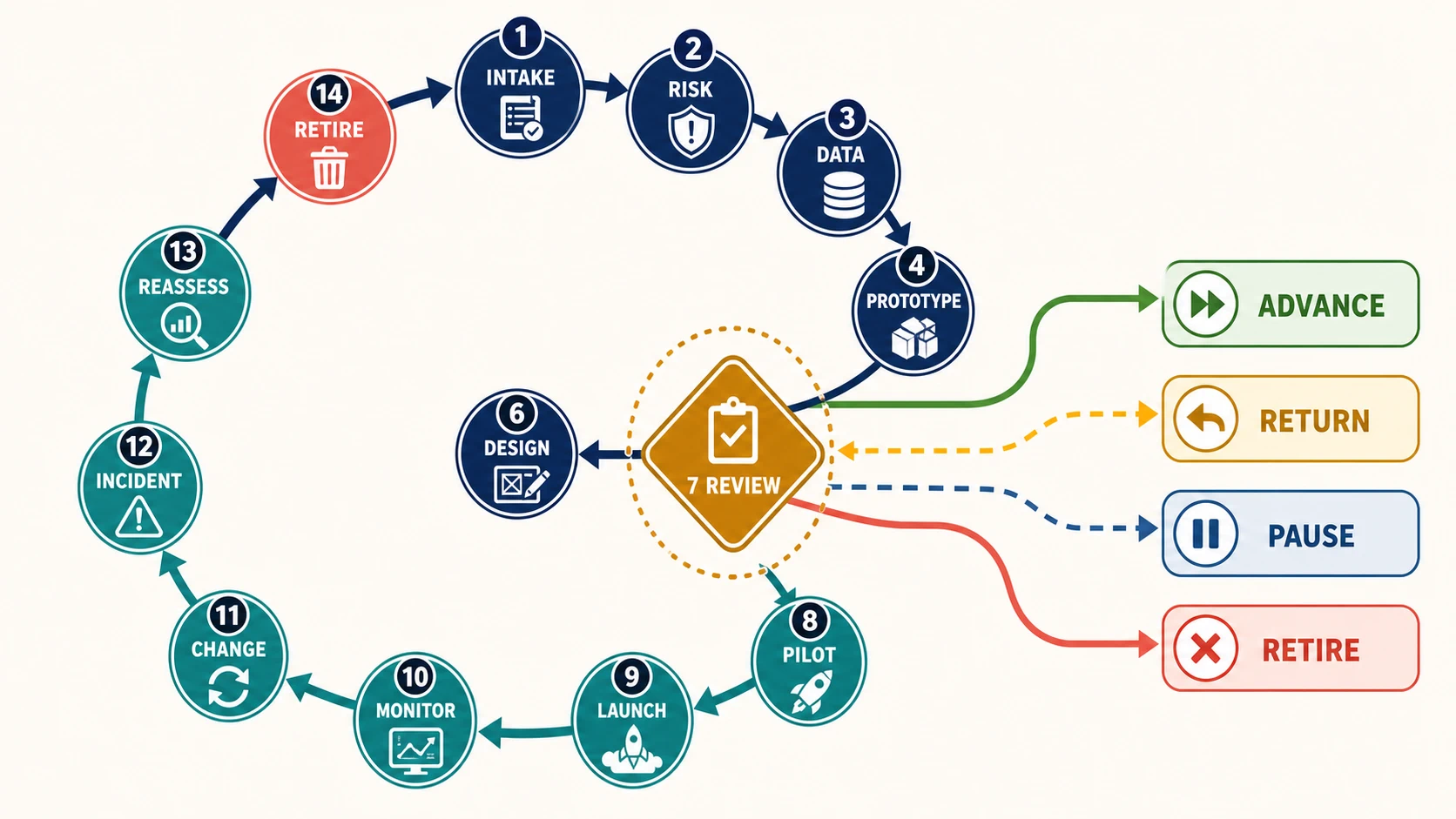
At each consequential boundary, ask four questions:
- What decision is actually being made?
- What evidence supports it for this system and context?
- Who may advance, constrain, return, pause, or end the work?
- Which date or event makes the decision invalid?
Those five outcomes matter. A team may advance because the evidence meets the next stage’s entry conditions, or advance with conditions while it gathers evidence under restricted scope. It may return a known deficiency for redesign, pause while uncertainty or harm is investigated, or retire or reject the system when value no longer justifies risk and burden. A gate that can only approve is a meeting, not a control.
Earn the First Bounded Release
The claims assistant enters the lifecycle at intake and use-case framing. The team names the user job, affected people, current queue, proposed AI role, non-AI baseline, expected value, error consequences, and stop conditions. The action boundary is explicit: the assistant drafts a routing note; a claims worker remains responsible for the route. That distinction lets the team reject a fluent demonstration that has not yet found a safe place in the workflow.
At risk triage, personal data and customer impact determine the route through the rest of development. Privacy, security, accessibility, and claims-domain reviewers must participate. Higher autonomy would require a different route; calling the same model from an automatic decision service would not be a minor product variant.
Data readiness tests whether the available evidence can support this use. The team verifies provenance, rights, retention, access, source coverage, label quality, and representative error cases. Documents without clear rights are excluded. Sparse handwritten examples become a recorded limitation rather than being hidden inside an aggregate score. A data card and rights record support a specific decision: this evidence may be used for these experiments, not for every future claims task.
The prototype then attacks the assumptions most likely to kill the project. Can the system extract the relevant passage? Can a reviewer locate the source of a summary claim? Can permissions prevent the prototype from seeing documents outside its test boundary? A prototype exists to retire uncertainty. It should use bounded data and permissions, log its versions and results, and never acquire production users by convenience.
During offline evaluation, the candidate competes with the existing queue and a simple rules baseline. Summary fidelity and route accuracy are measured separately. Reviewers inspect severe misroutes, document sources, languages, scan quality, and cases where the right behavior is abstention. Where sampling permits, uncertainty is reported rather than buried in a point estimate. Thresholds chosen before the final evaluation reduce the temptation to fit the release rule to a favorable result.
Evidence that a component performs well still does not prove that the system can fail safely. System and control design follows the complete action path: intake, extraction, evidence display, draft creation, human confirmation, downstream routing, correction, logging, and monitoring. Low-quality scans go to manual intake. Tool permission stops at draft creation. Each material failure has a preventive control, a way to detect escape, and a recovery owned by someone who can act.
At specialist review, the frozen boundary and its evidence reach the people whose judgment the risk route requires. Security inspects trust boundaries and abuse paths. Privacy inspects data movement and retention. Accessibility and domain reviewers test whether the workflow works for the people who must use or challenge it. Reviewers need enough time and authority to impose conditions or refuse release; collecting signatures after the architecture is fixed does not satisfy this stage.
The result is not a full launch. It is a six-week pilot covering two document sources during staffed hours. This scope comes from evidence: overnight reviewer capacity cannot meet the abstention service level. A shadow deployment could have measured behavior without changing outcomes; this human-confirmed pilot may influence work because authority and reversibility remain intact. Sampling includes ordinary traffic as well as high-consequence edges, so the team does not learn only from complaints.
Turn Approval Into an Expiring Claim
The launch approval binds the release identifier to its system card, evaluation report, risk and control record, monitoring plan, rollback target, owners, residual risk, and decision rationale. It records the two allowed sources, staffed hours, prohibited claims decisions, six-week expiry, and provider-version change as a mandatory reassessment trigger.
This is where lifecycle artifacts form an evidence chain rather than a paperwork heap. The use-case canvas establishes the proposed action path. The risk record determines the review route. Data and experiment records say what evidence was available and which assumptions survived. The evaluation report and system card support the bounded release. The immutable manifest identifies the exact approved configuration. Monitoring, incident, change, and retirement records later answer whether that approval remains valid and how it ended.
Link these records with stable system and release identifiers instead of copying the same account into each document. The system inventory should reveal the owner, risk route, operating status, current release, last and next review, and retirement trigger. A reviewer should be able to move from a production alert back to the release, evidence, and authority that put the affected behavior into service.
Approval has both scope and time. Its evidence may depend on a provider version, reviewer staffing, a corpus boundary, an affected population, or an external obligation. When any of those changes, the team does not ask whether the original approver still feels comfortable. It asks which claim has become stale and which stage must reopen.
Keep the Permission Valid in Production
After launch, production monitoring tests the assumptions that made approval possible. Service health and cost matter, but so do data quality, route quality, severe errors, security signals, user outcomes, reviewer capacity, overrides, appeals, and complaints. Every alert needs an owner, a response, and enough release identity to reconstruct what happened.
The new mail source exposes why several feedback streams are necessary. A rise in scan-quality rejection appears before complaint volume changes. Human overrides could reveal routing error, but they could also reflect workload pressure. Complaints reveal serious failures but miss silent harm. User ratings may measure preference rather than correctness. Model outputs can even shape later labels, causing the system to validate its own past behavior.
For each feedback source, record who creates it, what they can observe, how it is sampled, what incentives shape it, and which decision it can support. Preserve independent outcome measures where possible. Abundant production interaction is not permission to retrain automatically.
When the provider announces a model change, change management classifies consequence rather than counting altered files. A model, threshold, prompt, corpus source, tool permission, or policy can invalidate evidence while the application code remains untouched. The team freezes the candidate change, reruns the relevant evaluation, verifies the control path, and returns to approval. A documentation typo needs a record and review, not the same evidence burden. Materiality belongs to behavior and consequence.
The scan-quality alert creates a different loop. The team narrows scope by routing that mail source to manual intake while operations repairs the scanner integration. If harmed correspondence had already escaped, incident response would contain exposure first, preserve evidence, communicate through the agreed path, remediate, and add regression cases. Investigation must be able to recover the exact model, data, prompt, retrieval context, tool calls, controls, and human decisions. “The AI made a mistake” is not an incident reconstruction.
Even without a change or incident, periodic reassessment revisits value, context, affected groups, control performance, vendor dependencies, staffing, and relevant obligations. A technically stable system can become unsuitable because the operation around it changed. Reassessment therefore asks both whether the system still performs and whether it still deserves its role.
Make Retirement a Designed Stage
Two years later, the insurer replaces the correspondence workflow with a case-management system that performs deterministic extraction for the supported forms and sends ambiguous material directly to specialist queues. The assistant’s remaining value no longer pays for its review burden and residual risk. Retirement is the responsible decision.
The team stops traffic and disables the feature paths, but that is only the visible edge of retirement or replacement. It communicates the change to users, migrates dependent workflows, revokes service and tool permissions, applies retention and deletion rules to data and artifacts, preserves evidence required for audit or incident follow-up, closes vendor resources, and verifies that no batch job, regional configuration, or unofficial consumer still calls the old system.
A decommissioning record names what ended, what replaced it, which records remain and why, how access was removed, and who verified the result. The inventory changes from active to retired only after traffic, authority, exposure, and hidden dependencies have ended. Otherwise the organization has retired its attention while the system continues to operate.
Trace a Lifecycle That Failed
Return to the original six-month state: four regions, complaint-only review, two provider changes, a doubled corpus, and no answer about approval. Before reading further, identify the earliest stage whose decision is no longer defensible.
There may be several. Expansion escaped the pilot boundary. Provider and corpus changes bypassed change management. Complaint-only sampling weakened production evidence. The original approval expired without reassessment. The valuable move is not to assign one generic governance failure; it is to restore the chain of decisions in causal order.
For each break, write the smallest record that would make the next action decidable:
- the affected system and release;
- the stale or missing claim;
- the evidence needed now;
- the person with authority to constrain, return, pause, or retire it;
- the allowed scope while uncertainty remains;
- the date or event that forces another decision.
Then choose the next state. Do not default to unconditional launch or total abandonment. The responsible result may be a returned evaluation, a narrower region, a temporary manual route, a paused dependency, or retirement. A system is inside its lifecycle when new evidence can still change its permission to act—and when the organization can bring that permission to a definite end.
Source Notes
- NIST AI Risk Management Framework 1.0, a voluntary, use-case-agnostic framework for managing AI risk across design, development, deployment, use, and evaluation; verified 2026-07-19. NIST notes that version 1.0 is under revision, so the chapter relies on durable lifecycle principles rather than claiming a future revision’s contents.
- NIST AI RMF Core, guidance that Govern is cross-cutting and that Map, Measure, and Manage operate iteratively across the lifecycle; verified 2026-07-19.
- NIST SP 800-218A, secure development practices for producers of AI models and systems and acquirers of those systems; verified 2026-07-19.