Case Study 7: Public Sector Benefits Triage
Design public-benefits triage as transparent queue support with human authority, service-level safeguards, audit, and practical appeal.
The Application Nobody Denied
A public agency faces a growing benefits backlog. A proposed model predicts which applications are likely to be simple and sends them to a fast lane. In a pilot replay, one modeled household is placed in the complex queue because a payroll record conflicts with a recent loss-of-income declaration. The application is not denied. It simply waits.
On day four the household receives an automated request for evidence already attached to the application. On day eleven a caseworker discovers that the payroll feed is a month out of date. Rent is now overdue. By the time the case reaches an eligibility decision, the fast lane has improved the agency’s average processing time while making this household’s route slower, harder to understand, and more expensive to survive.
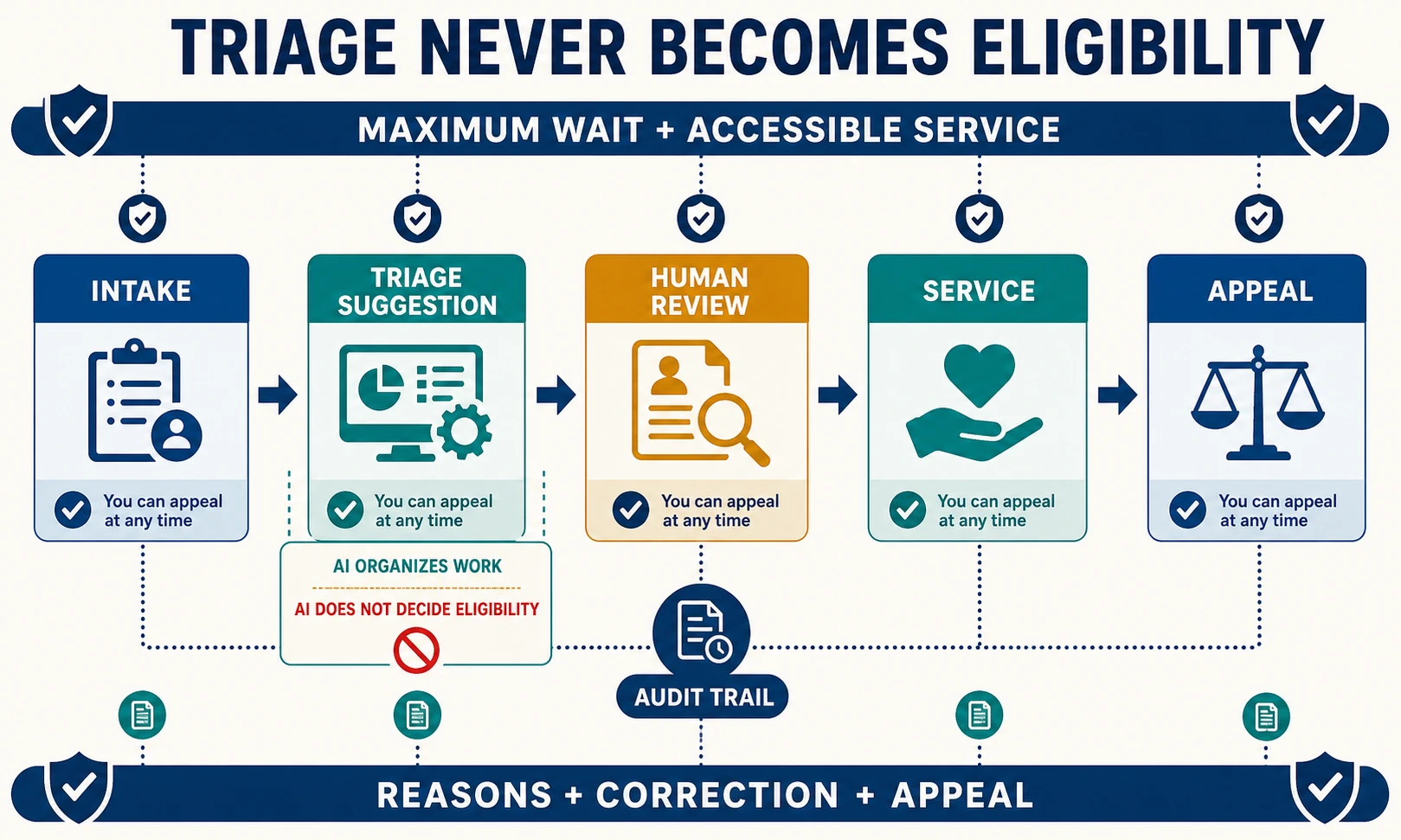
Queue position is not clerical when it changes access to food, housing, health care, or income support. The agency redesigns the system around that consequence. The model may help staff choose the next useful action, but maximum-wait protection, urgent-need rules, human judgment, correction, and appeal govern the route from intake to service. Delay, friction, and repeated proof requests are outcomes of the system, not noise around the eligibility decision.
Find the Delay Before Predicting It
The existing service has published eligibility rules, trained caseworkers, standard queues, urgent-needs escalation, translation and accessibility support, and quality sampling. It also has accumulated failure: confusing forms, duplicate verification, fragmented records, staff shortages, and handoffs that return an application to the back of a queue. A prediction system laid over those conditions could learn to sort administrative difficulty without removing any of it.
The baseline study therefore follows applications through time. It measures time to first meaningful action, total resolution time, repeated evidence requests, correction, abandonment, appeal, and caseworker effort. It distinguishes a genuinely difficult eligibility question from a record the agency failed to join, a form it failed to explain, or an accessibility need it failed to meet. The modeled household’s conflict is resolvable by checking the source date; a classifier should not turn stale data into a longer service path.
The impact assessment maps applicants, dependants, caseworkers, community advocates, appeals staff, program owners, data stewards, oversight bodies, and taxpayers. It considers financial insecurity, housing or food risk, dignity, privacy, unequal administrative burden, and trust in public institutions.
Qualified officials and counsel verify the current jurisdiction, program, authority, notice, recordkeeping, procurement, accessibility, equality, data-protection, and review requirements. The system record separates binding obligations from agency policy and design choices; this case study is an engineering pattern, not legal advice.
Give the Suggestion Less Authority Than the Service Rules
The model may suggest a work queue and flag information that may be missing or contradictory. It may not determine eligibility, infer fraud, vary the evidence legally required of similar cases, generate an adverse reason, or close a case. Urgent-needs rules remain deterministic, visible, and able to outrank the suggestion. Applicants can use non-digital channels without penalty.
Each suggestion is a versioned record rather than a score passed silently into a work queue. It identifies the permitted routing action, the data used, data freshness, a limited reason, uncertainty, applicable service rule, and when the suggestion expires. A deterministic policy layer then applies urgent-need escalation, maximum waits, accessibility commitments, conflict rules, and route capacity. If the source data is stale, the policy is unavailable, or the model cannot produce a permitted reason, the application follows a safe ordinary path.
Caseworkers encounter the original application before the suggested queue. They see the limited triage reason, data freshness, uncertainty, and relevant policy—not a mysterious risk score. They can correct a field, choose another route, request specialist help, or pause automation without a speed or agreement target turning disagreement into personal cost. Their change is the operative state; a downstream process cannot quietly restore the model’s route. Corrections and overrides become evidence for system review, but are not treated as worker error by default.
Maximum-wait protections age every application toward attention. A predicted-complex case cannot remain indefinitely behind easy work, and a fast lane cannot consume the staff needed to honor the ordinary lane’s service level. Queue controls track the oldest and most consequential waits, not only throughput. Randomized and risk-based samples include every route, low-confidence and overridden cases, language and accessibility needs, repeat requests, and people who disengage before a formal decision.
Test the Route Through Its Consequences
Historical cases are useful only after the team examines how earlier administrative choices produced their labels. “Time to close” is not a neutral target if abandonment or premature closure counts as efficiency. Reviewer agreement is likewise incomplete: caseworkers may reproduce a burden built into the old process.
The replay set includes the modeled stale-payroll case and variations that change one fact at a time. The record is current but arrives under an unfamiliar document type. The household uses a screen reader. Translation length changes extraction quality. An urgent-need declaration arrives after triage. A caseworker corrects the route while an overnight batch still holds the old suggestion. The ordinary queue reaches its maximum wait while fast-lane work continues to arrive. The system must preserve the correction, surface the escalation, and prevent queue age from becoming invisible.
Evaluation follows the whole service path: time to first meaningful action, total resolution time, repeat evidence requests, corrections that persist, abandonment, appeal and overturn, access to service, and caseworker workload. It compares the existing process, policy-only workflow repair, and the human team with model support. The model earns a place only if it improves on the strongest feasible non-AI alternative without shifting delay or proof burden onto people less able to absorb it.
Segment analysis covers contextually and lawfully appropriate groups, regions, languages, disability and accessibility needs, household structures, application channels, and intersections where the evidence supports responsible interpretation. The agency states why an attribute is needed, who may access it, and what happens when it is missing. Uncertainty and thin samples remain visible. Average speed cannot compensate for severe delay concentrated among one group.
Usability research includes applicants and advocates, especially people with limited connectivity, language barriers, disabilities, unstable documentation, or prior difficulty navigating the program. The qualitative question is not merely “Did you like the portal?” but “Could you understand what happened and obtain help or correction without extraordinary effort?”
Let Correction Change the Case
Notice describes where automated support is used and what it does not decide. When routing materially affects service, the agency can explain the main data and policy basis in useful language. Applicants can correct factual data, submit missing context, request accessible communication, and reach a person without diagnosing a model failure first.
In the replay, the applicant reports that the payroll record predates the job loss. That correction creates a case event with an owner and response time. It invalidates the old routing suggestion, returns the application to an appropriate queue without losing its accumulated age, and records whether the repeated evidence request caused a missed service target. A correction that changes a database but not the workflow is not a remedy.
Appeal must not depend on recognizing an AI error. A person challenges the service outcome or process; the agency investigates the system involvement. The appeal route states what can be challenged, how to obtain human help, when a response is due, and who can alter the case. Frontline staff can pause automated routing during incidents. Appeals staff can inspect the versioned input, suggestion, reason, policy decision, human action, correction, queue movements, notices, and timestamps without reconstructing events from scattered logs.
Pilot the Bad Day, Not the Average Day
The agency begins in shadow mode. Staff compare the proposed route with policy-only workflow repair and the existing process, including cases in which the right recommendation is no special route at all. A limited pilot follows only after legal, program, accessibility, privacy, security, procurement, labor, and affected-community review has produced implementable conditions for the actual jurisdiction and service.
The first capacity rehearsal doubles arrivals, removes two experienced caseworkers, introduces a document format the extractor has not seen, and lets the fast lane fill continuously. The service must preserve urgent escalation, maximum waits, human correction, and ordinary-path capacity. Quietly raising a threshold or asking staff to clear suggestions faster is a failed rehearsal, even if the daily average remains attractive.
Launch criteria include service quality and distributional floors, not just backlog reduction. Stop conditions include maximum-wait breaches, unexplained disparities, inaccessible notice or appeal, increased repeat requests, corrections that do not propagate, material drift, broken lineage, an inability to reproduce a route, or insufficient staff to deliver the promised human path.
Monitoring combines queue age and outcomes with complaints, community feedback, worker corrections, audit samples, abandoned applications, and vendor or model changes. Changes to source systems, eligibility policy, document formats, model or vendor, route capacity, or affected population reopen the assessment. A public-facing summary describes purpose, boundaries, evaluation, known limitations, oversight, and how to seek help without exposing security-sensitive details or personal data.
The Impact and Appeal Record
Before pilot approval, one compact record should let a program leader, community representative, auditor, appeals officer, or qualified reviewer understand both the system and the route through one case. It records:
- the public-service purpose, affected programs and populations, exact AI role, prohibited uses, non-AI alternatives, current legal and policy review, vendors, versions, and named decision owners;
- the pathway from input through suggestion, policy controls, queue movement, human action, notice, correction, service outcome, and appeal, including maximum waits and the safe ordinary route;
- data provenance and freshness, permitted features and reasons, label limitations, accessibility and language coverage, retention, access, and the attributes deliberately excluded;
- baseline, shadow, replay, capacity, segment, usability, and pilot evidence, with uncertainty, severe failures, affected-person findings, staff workload, and independent review;
- launch scope, service and distributional floors, stop triggers, pause and restoration authority, monitoring owners, public disclosure, expiry, and changes that reopen the decision; and
- for an individual case, only the protected evidence needed to reconstruct what happened and provide correction or remedy, with access and retention limits.
The modeled household’s record now shows the stale source, the expired suggestion, the repeated request, the applicant’s correction, the preserved queue age, the caseworker’s action, the missed service target, and the resulting review of other cases exposed to the same data failure. The appeal repairs the case and returns the defect to owners who can repair the service.
The strong implementation helps staff find the next useful action while making delay visible and correctable. The weak one improves average throughput by teaching the institution not to see the people waiting longest.
The remediation case before this one made authority visible in credentials and production writes. Here the same question appears in administrative time: who may make another person wait, under what rule, and with what route back? The education-tutor case that follows moves from access to learning and asks whether easier completion can conceal a worse outcome.
See Human Oversight, Fairness and Impact Assessment, and Regulatory and Policy Landscape.