AI Systems Handbook / Chapter 36
Change Management and Continuous Improvement
Classify AI system changes by materiality, rerun the right evidence, and release improvements without silently invalidating prior approval.
Preparing audio…
Audio edition
Change Management and Continuous Improvement
The Upgrade That Changed More Than the Model
A support assistant team replaces a provider model after offline tests show better answer quality and lower cost. The API contract is unchanged, so the release is treated as routine. Within days, the assistant cites fewer sources, abstains less often, and writes longer answers that overflow the review interface. Agents begin approving drafts without seeing the final paragraphs.
Nothing in the application diff explains the failure. The model change altered several behaviors, the interface turned those changes into workflow risk, and the lightweight release path never tested the combined system.
Treat every AI change as a claim that the system remains acceptable. The review depth should follow the change’s possible effect—not the size of its code diff or the vendor’s label for it.
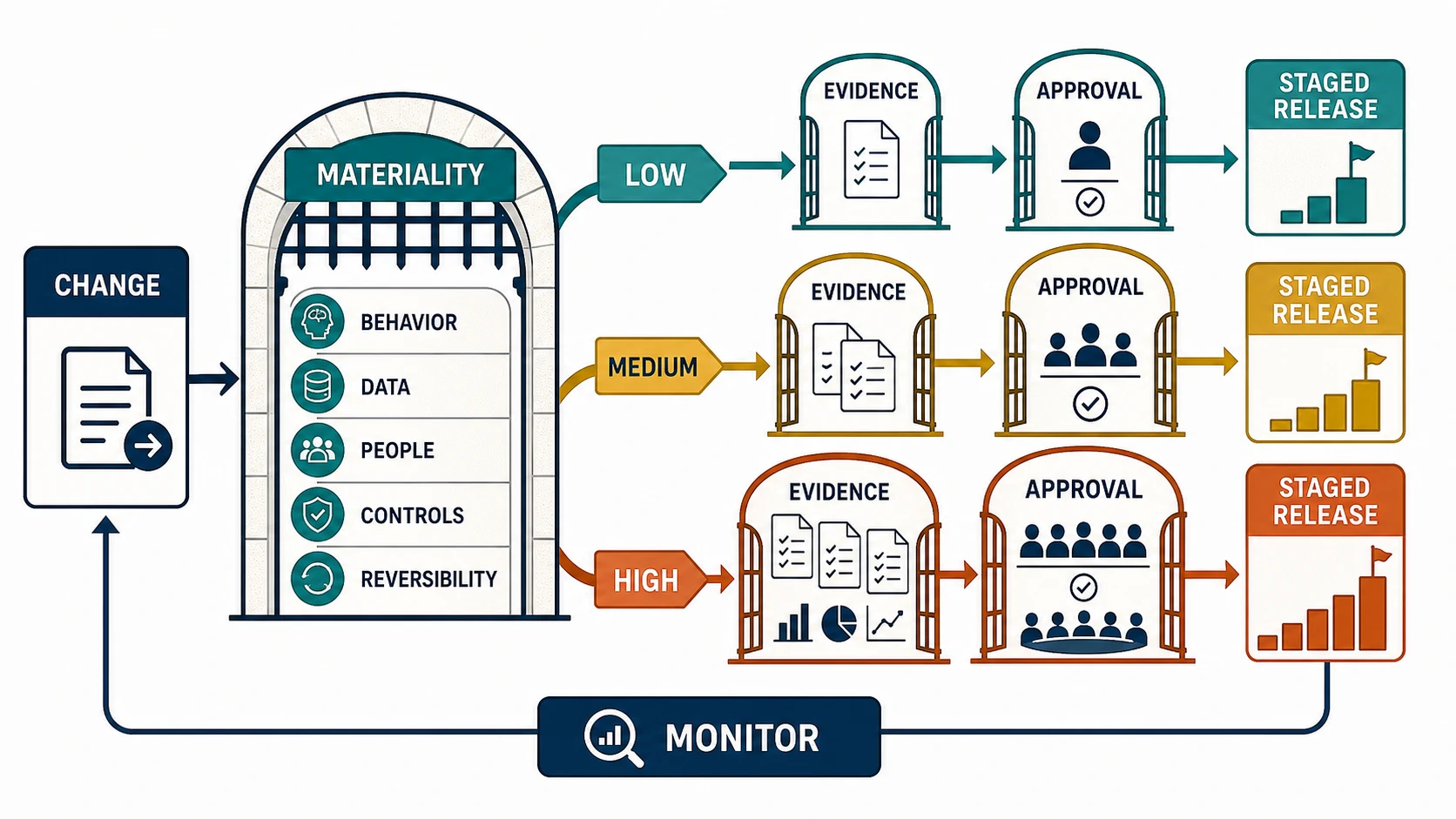
The Release Bundle Is the Change Boundary
The team initially records one edit: provider model A → provider model B. That is too narrow to reproduce the candidate or predict its effects. The model runs inside a release bundle: prompts and inference settings shape its answers; retrieval and permissions determine its evidence; policies and tools determine what it may do; the interface determines what a reviewer can see; monitoring and fallback determine what happens after release.
Data, users, and operating conditions belong at the boundary too. A new corpus source can alter retrieval without changing application code. A higher-volume user group can turn a tolerable review step into a queue. A mutable model alias, hosted embedding service, vendor-managed filter, external policy service, or changing law can alter the accepted system without a repository commit.
The change record therefore names the current and proposed bundle, including dependencies the team cannot pin. For an unpinnable dependency, it records how a change will be detected, what notice the supplier owes, and which safe mode follows an unexpected move. Versioning is not clerical completeness. It is what makes comparison, incident reconstruction, and coherent rollback possible.
Materiality Routes the Work
The model replacement can change answer accuracy, citation behavior, refusal, length, latency, cost, and reviewer workload. It is material even though its API shape is stable. The relevant question is not “How large is the diff?” but “What accepted claim could this change invalidate?”
Begin with intended use and affected people. Does the proposal add a decision, population, language, domain, or degree of autonomy? Could it change a consequential outcome, accessibility, fairness, disclosure, appeal, or a person’s ability to contest the result? Then follow the system: new data or rights, changed behavior, weaker or stronger controls, different exposure, and dependencies that inherit the effect. Finally ask how much the team knows and how cleanly it can recover. A new failure family with weak ground truth needs discovery; an irreversible migration or downstream decision needs more scrutiny than a tested rollback.
Organizations may name routes low, medium, and high, but the label is only shorthand for evidence and authority. Correcting explanatory copy while leaving behavior and controls untouched may take a lightweight route. Adding a curated source under existing permissions may require focused retrieval and authorization tests. A model replacement, consequential threshold change, new tool permission, removed approval, or new population normally widens the review.
A one-line threshold edit can be material. A large refactor can take a lighter route when strong equivalence evidence shows that behavior and controls are preserved. When the plausible effect is uncertain, run a discovery evaluation or route upward; uncertainty is part of materiality, not a reason to call the change small.
Let the Change Choose the Evidence
The support team pins both provider versions and replays the same model-upgrade candidate against its versioned evaluation set. These illustrative results expose the trade rather than hiding it in one score:
- task success rises from 84% to 87%;
- citation precision falls from 96% to 91%, below the 95% acceptance floor;
- p95 latency improves by 18%;
- refusals weaken for ambiguous account-access requests;
- longer answers increase review time and sometimes hide text below the interface fold.
The last result is why a model-only benchmark was never enough. Component tests can isolate retrieval, ranking, generation, authorization, and tool behavior, but the release gate also needs end-to-end work with the real interface and human workflow. The affected evidence slice includes citation support, ambiguous access requests, full-answer visibility, reviewer comprehension and workload, latency, cost, and the user groups who depend on accessibility modes. Known failures from incidents, complaints, red teams, and prior releases remain in the portfolio so that improvement does not reopen an old path.
Set comparison rules before looking at the candidate. Some measures permit a bounded trade-off. Some require non-regression. Authorization, severe-harm, or other hard control floors cannot be averaged away by gains elsewhere, and aggregate improvement cannot conceal a serious loss for one segment.
The evaluation set and rubric are themselves versioned. Holdout cases lose value when repeated tuning teaches the team their answers, while a suite frozen against last year’s users and conditions can certify an obsolete world. Preserve stable regression cases, protect suitable holdouts, and deliberately refresh the portfolio from production evidence.
Approval Follows the Residual Risk
The candidate does not pass. The team keeps the access policy fixed, adjusts prompt and retrieval behavior, adds an interface check that confirms reviewers can see the complete answer, and reruns the affected evidence. Only a bundle that meets citation, refusal, task, workload, latency, and cost conditions may enter a small canary.
That route is proportionate because the model replacement can alter several accepted behaviors. A lightweight change still needs an owner, a reproducible bundle, directly relevant regression tests, a named approver, and a recorded outcome. A higher-impact change may reopen the impact assessment and require independent, domain, security, privacy, accessibility, or human-factors review. Approval belongs to people authorized to accept the residual risk revealed by the evidence, not merely to whoever can merge the code.
Emergency work uses an expedited route. Record the triggering condition and authority, constrain exposure, preserve the previous bundle, run the minimum safety evidence available, and attach an expiry time. The emergency label cannot become permanent approval; retrospective evaluation either earns the new state or replaces it.
Production Completes the Test
Offline evidence cannot reproduce every production interaction. The support bundle enters a canary with explicit traffic, user, and time bounds. The change record names stop conditions for citation loss, refusals, hidden text, reviewer delay, and unexpected segment behavior. Telemetry verifies the deployed model, prompt, corpus, policy, interface, and monitoring versions rather than assuming the intended bundle arrived together.
If the canary stays within its conditions, exposure grows in steps. If it crosses a hard floor, the team rolls back the bundle rather than swapping only the model and creating an untested combination. If the result is merely ambiguous, exposure holds while the owner investigates. Rollback, fallback capacity, and the authority to stop are tested before users supply the evidence that they work.
The change closes only after production evidence answers the claim that opened it. Did answer quality improve? Did citation and refusal remain acceptable? Did cost fall without shifting hidden work to reviewers? Did affected groups experience the same benefit? A neutral or harmful result is rolled back or revised, even when the release itself was flawless.
Continuous Improvement Is the Same Loop
Monitoring, incident reviews, appeals, user reports, audits, red teams, drift, cost trends, and frontline staff all produce signals. A useful backlog ties each proposed improvement to a hypothesis about user value, harm, reliability, or control effectiveness. The operating loop is simple enough to remember:
signal → hypothesis → proposed change → materiality → evidence → approval → staged release → outcome
It also applies to the process. Which dependencies changed without detection? Which tests failed to predict production? Which approvals exposed a real weakness, and which arrived too late to help? Which release could not be reconstructed? Change management improves when those answers alter the next route, not when the organization merely closes more forms.
AI Change Request
- Purpose: problem or opportunity, affected users, and expected benefit.
- Release bundle: current and proposed versions for model, prompt, data, retrieval, policy, tools, code, interface, and monitoring.
- Materiality: dimensions considered, classification, uncertainty, and reviewer.
- Impact: behavior, people, data rights, security, privacy, accessibility, operations, cost, and dependencies.
- Evidence plan: datasets, segments, baselines, metrics, thresholds, adversarial cases, human review, and production checks.
- Control plan: approvals, staged exposure, rollback, kill switch, stop conditions, and heightened monitoring.
- Decision: approved, limited, revised, rejected, or expired; authority and residual risk.
- Outcome: production evidence, surprises, follow-up work, and closure date.
Transfer the Decision
Route each proposal through either lightweight review, focused re-evaluation, or full review: correct help text; add one curated corpus source; change a fraud threshold; accept an unannounced vendor model alias update; give an assistant a write-capable tool; expand a pilot into a new language and region. For each choice, name the accepted claim that could be invalidated, the evidence needed, the approving authority, and the recovery path.
Then design the regression portfolio for the support-assistant upgrade. Separate hard floors from negotiable trade-offs, include the reviewer interface and workload, and define the canary’s stop conditions before seeing another result.
Source Notes
- NIST AI Risk Management Framework Core, voluntary guidance organizing AI risk work through Govern, Map, Measure, and Manage, including ongoing monitoring, change management, and measurable continual improvement; verified 2026-07-20. NIST notes that AI RMF 1.0 is being revised, so teams should verify the current version when adopting it.
- NIST AI RMF Playbook, voluntary suggested actions and documentation practices aligned to the AI RMF Core; verified 2026-07-20. The Playbook is neither a universal checklist nor an ordered implementation sequence.
- See MLOps and LLMOps Foundations for release-bundle lineage and Incident Response for AI Systems for turning incidents into regression protection.